

Town on the Camino
Cerva
Portugal
- places to stay
- 2
- Camino
- 1
- Elevation
- 311 m
Cerva is the goal after the longest mountain stage of the Caminho Leon de Rosmithal: 29.9 kilometres from Parada de Aguiar over the Serra and 839 metres down into the valley. Below waits an old district town with a church, a pillory and old stone bridges in the valleys around it. An evening to arrive, before the Ponte de Cavez tomorrow.
How long to stay?
An evening is enough, especially for your knees. Cerva is a small place, and after the long descent you mainly want to sit down. You can see the church and the pillory in half an hour. If you need a rest day, the circular walk through the valley of the Póio gives you something lovely to do without a backpack.
Cerva in Ninja numbers
- 839 metres down over the last 20.3 kilometres from Gouvães da Serra; at kilometre 164.0 you were still at 999 metres, in Cerva you are at a little over 300.
- 29.9 kilometres is the length of the stage from Parada de Aguiar, the longest mountain stage of the route.
- 9.1 kilometres to the Ponte de Cavez over the Tâmega tomorrow.
- 2,280 people lived in the parish of Cerva in 2011.
- 78.0 kilometres still to go to Braga.
Arriving: the long descent from the Serra
From Parada de Aguiar the Caminho Leon de Rosmithal climbs onto the Serra once more; just past the mountain village of Gouvães da Serra you reach 999 metres. Then it goes downhill almost without a break, from the plateau down into the valleys. Cerva lies at a little over 300 metres, and when you arrive, you have the loneliest stage of the route behind you.
In brief: a district town without a district
Until 1853 Cerva was the seat of its own concelho, which also included Alvadia and Limões. Then the district was dissolved; today Cerva is a vila in the municipality of Ribeira de Pena. What remains is the pillory, the sign of its old jurisdiction, and the church of Saint Peter.
The municipality of Ribeira de Pena is one of the first to have waymarked its section of the Rosmithal route: in March 2026 arrows, shells and information boards were already in place here.
Around the church: what to see
Most of it is in the village; the bridges in the valley are an outing for a rest day.
- Igreja de São Pedro: The main church is dedicated to Saint Peter, the patron of the village. Cerva celebrates its festival on 29 June. We have not found opening hours.
- Pelourinho: The pillory has been protected as a property of public interest since 1933. It recalls that Cerva was once a district of its own with its own law.
- The bridge over the Póio: In the valley of the Póio near Alvite stands an old stone bridge, a national monument since 1939. Wikipedia calls it Roman, the municipality Romanesque. It lies on the Vale do Póio circular walk, which starts at the Casa da Torre in Cerva and, according to the municipality, is 11.3 kilometres long.
- Casa da Torre: The cultural centre in the village is the start and finish of the circular walk through the valley.
Honestly
- The stage to get here is hard. 29.9 kilometres with 920 metres of descent and almost no supplies on the way. Don't underestimate it, especially in fog on the Serra.
- There is no pilgrim hostel. You sleep in a room you have booked in advance.
- For a rest day, Cerva is small. Apart from the church, the pillory and the circular walk into the valley, we have found nothing documented.
Where pilgrims sleep
There is no pilgrim hostel in Cerva. In the village there are a hotel and a holiday house, which you will find further down this page. Book in good time, there is not much choice.
Ninja tips
- Plan for the descent. Over the last 20 kilometres you lose almost 840 metres; poles help your knees.
- Arrive on a Sunday if you want to shop. That is market day in Cerva; on the first and third Tuesday of every month there is also a larger feira.
- Walk into the Póio valley on your rest day. The circular walk from the Casa da Torre follows the river, through riverside woodland and past the old bridge.
Practical tips for pilgrims
- Shopping: weekly market on Sunday, feira on the first and third Tuesday of the month; we have not checked individual shops.
- Waymarking: The section in the municipality of Ribeira de Pena is waymarked (as of March 2026); by March/April 2027 the Camino is to be waymarked in all municipalities (as of November 2026).
- Festivals: São Pedro on 29 June.
Onward: down to the Tâmega
After Cerva the route climbs once more to 463 metres, then descends into the valley of the Tâmega. After 9.1 kilometres you cross the river on the 13th-century Ponte de Cavez, very probably the stone bridge that Rožmitál's riders already crossed. Then it continues via Arco de Baúlhe to Cabeceiras de Basto, 24.3 kilometres from Cerva.
Deep dive: A place that was once a district
A short read, in case you want to learn more about Cerva. About two minutes' reading.
The pillory on the square
In many Portuguese towns a stone column stands on the main square. It is called a pelourinho, and it was the sign that a place had its own rights, its own court, its own officials. Cerva has such a column, and that tells its story: until 1853 the village was the seat of its own district. Then Portugal reorganised its administration, many small districts disappeared, and Cerva became part of Ribeira de Pena. The pillory stayed. It has been protected since 1933.
Bridges in the valley
In the valleys around the village flow two small rivers, the Póio and the Lourêdo. Old stone bridges cross both. Whether they date from Roman times or from the Middle Ages, the sources do not agree. What is certain is that roads linking the mountains with the Minho have run here for a long time. You came along one of them today.
What Cerva gives you
After a day on the Serra, Cerva is above all one thing: down below. Until Braga the route never climbs above 600 metres again. The loneliest kilometres are behind you.
Where to stay in Cerva
Places to stay in Cerva.
 Open
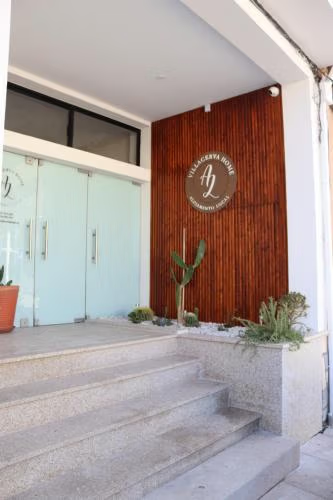
Villa Cerva Home
 Open
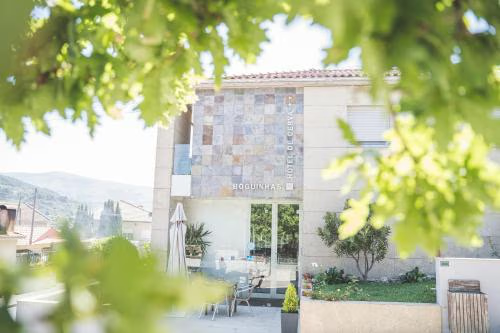
Hotel De Cerva
Town 9 of 16