


Estella carries the star in its name: King Sancho Ramírez founded the town on the Way of St James around 1090, and the Codex Calixtinus already praised its bread, its wine and the river Ega. Romanesque churches and a royal palace line the Camino. An afternoon is enough, and tomorrow wine flows from the fountain at Irache.
Right now in Estella (as of October 2026)
- Albergues closing for winter: The parish albergue San Miguel is open until 31 October, and the ANFAS foundation albergue has been closed since September. Hostel Ágora closes on 12 November, Alda on 12 December, Capuchinos Rocamador on 18 December.
- Municipal albergue: It stays open in winter but takes a break from mid-December to mid-January. According to the pilgrim portal Gronze, from 14 December 2026 to 18 January 2027.
- Pilgrim help desk: The pilgrim orientation service at Calle Curtidores 33 is only open from mid-April to mid-October and is now closed.
How long to stay?
An afternoon is enough. Estella is compact, and the best of it lies right on the Way: the portal of Santo Sepulcro, the royal palace and the stairway up to San Pedro de la Rúa. Cross the Ega and you can add the Plaza de los Fueros and San Miguel. We couldn't find reliable opening hours for the churches, so ask at the tourist office next to the palace. For a full rest day, Estella is on the small side.
Estella in Ninja numbers
- Around 112 kilometres lie behind you since Saint-Jean-Pied-de-Port, according to Camino Ninja. Still 664 to Santiago, so you've only just begun.
- 13,400 pilgrims stayed in the municipal albergue alone in 2024. By one estimate, around 80,000 walked through the town.
- 6 pilgrim hospitals stood in Estella in 1354. Today they are albergues, but the idea is the same.
- A good 10 kilometres without a bar, shop or albergue await you tomorrow between Villamayor de Monjardín and Los Arcos.
Arriving: along the Ega to the star
From Puente la Reina it's just under 22 kilometres, according to Camino Ninja. After Villatuerta the path leads you into town along the bank of the Ega. Just past the first albergue there are public toilets and a drinking fountain. Then you stand before the Iglesia del Santo Sepulcro: to the left of the steps up to the Gothic portal stands St James as a pilgrim, weathered but unmistakable. He welcomes you to Estella.
The municipal albergue is on Calle La Rúa, right on the Camino. Further on, the Camino passes between the royal palace and the stairway of San Pedro de la Rúa. The Plaza de los Fueros and the San Miguel quarter are on the other side of the river.
In brief: a town founded for pilgrims
Around 1090, King Sancho Ramírez of Navarre founded the town next to the older village of Lizarra, and with a charter of its own he brought Frankish merchants here. Before that, the Way of St James ran south of the place. Estella comes from the Latin stella, star. Lizarra is Basque and comes from lizar, the ash tree. The town grew with the pilgrims: in 1354 there were six hospitals. Alongside them lived one of the largest Jewish communities in Navarre, until it was persecuted in the fourteenth century and expelled in 1498.
In the nineteenth century, Estella was twice the seat of the Carlist pretender, in the wars over the Spanish crown. Because of its many churches and palaces, people still call it the "Toledo of the North".
The star above the town
Legend has it that on the night of 25 May 1085, shepherds from the neighbouring village of Abárzuza saw stars falling onto a hill. In a cave they found an image of the Virgin. Because it could not be carried down into the valley, a chapel was built up there. This is the Virgen del Puy, the town's patron saint, celebrated on 25 May. Some say the story was the merchants' idea, to attract even more pilgrims. If so, it worked.
Today's Basilica del Puy above the town dates from 1951, the statue of the Virgin inside from the fourteenth century. If you have the energy, climb up: you look out over the Ega valley. And you are on your way to Compostela, which many interpret as a "field of stars".
Along the Camino: What to see
Almost everything lies on the old pilgrim street or a few steps off it. You don't need a detour, just a closer look.
- Iglesia del Santo Sepulcro: The church is first mentioned in 1123 and was never finished. Its Gothic portal from the early fourteenth century was restored in 2025. In the tympanum you see the Last Supper, the three Marys at the tomb and the Crucifixion, with a row of apostles above. What matters to you is the figure to the left of the steps: the apostle James as a pilgrim. The church has been closed since 1881, so you only see the portal from outside.
- Palacio de los Reyes de Navarra: Built in the second half of the twelfth century, the palace is the only surviving secular Romanesque building in Navarre. Look at the capital on the left side of the façade. It shows Roland fighting the giant Ferragut, and it is signed by a Martinus of Logroño. You may already know Roland from Roncesvalles. Since 1991 the palace has housed the museum of the painter Gustavo de Maeztu. The tourist office is right next door.
- San Pedro de la Rúa: The town's oldest church stands on a rock above the Camino, with a long stairway leading up. Its Romanesque cloister is considered one of the finest in Navarre, even though only two of its four galleries remain. The others were destroyed in 1572 when the castle above was demolished. The capitals tell of the life of Christ and the saints. In one chapel a relic of the apostle Andrew is venerated, and a pilgrim legend surrounds it (more in the deep dive). We couldn't find opening hours or admission.
- San Miguel: On the other side of the river, the church stands on a rock the locals call La Mota. It was built around 1187 to 1196, and its Romanesque portal is badly weathered. From here it's not far to the Plaza de los Fueros.
Food and drink
As early as the twelfth century, the pilgrim guide in the Codex Calixtinus wrote that Estella was "fertile in good bread and excellent wine, in meat and fish". At the bakeries you'll find two specialities today: alpargatas de Estella, puff pastry with almond cream, and the Torta txantxigorri with pork crackling and lard. Add the dishes of Navarre such as lamb in chilindrón sauce and cheese from the Sierra de Urbasa. In the evening the bars of the old town serve pintxos.
Honestly
- You'll often see the churches only from outside. Santo Sepulcro has been closed since 1881, and we found no reliable opening hours for San Pedro and San Miguel. Ask at the tourist office as soon as you arrive, rather than standing at locked doors later.
- In late autumn, options shrink. From November some albergues are closed, and from mid-December the municipal one too (see box). If you walk in winter, check beforehand what is open.
- The municipal albergue is big and has few showers. Pilgrims in the app praise the kitchen, the courtyard and the price, but complain repeatedly about too few showers for so many beds. Arriving early helps.
Where pilgrims sleep
- Albergue de peregrinos de Estella: the municipal albergue at Calle La Rúa 50, right on the Camino. It belongs to the town and is run by the local association of Friends of the Camino. 78 places in five dormitories, €8 per night (as of October 2026). You can reserve up to 20 places by email, held until 15:00; the rest go to whoever arrives. Check-in from 12:00, in winter from 13:00, doors close at 22:00. You can also get a credencial here.
- Albergue Parroquial San Miguel: the parish albergue, about 300 metres from the Plaza de los Fueros. It works on a donativo basis, and pilgrims in the app report dinner and breakfast and friendly volunteers. Open from late March to 31 October.
- Albergue de la fundación ANFAS: This albergue belongs to a foundation for people with intellectual disabilities, who work here. €12 per night, open from late March to September, closed in August.
- Albergue Capuchinos Rocamador: at the edge of town on the Camino, about 900 metres from the Plaza de los Fueros. Dormitory €15, open until 18 December. According to the app freshly renovated and quiet; there is no dinner.
There are also private albergues and hostels with dormitories, mostly between €12 and €23 per night, which can be booked through booking platforms. If every bed is taken, there's an albergue in the sports hall in Ayegui, just under two kilometres further on.
Ninja tips
- A sip for tomorrow: Around four kilometres beyond Estella, at the monastery of Irache, wine has flowed from a fountain of the Bodegas Irache since 1991; the second tap gives water. The inscription at the tap says: if you want to reach Santiago with strength, take a sip and toast to happiness. It's a sip, not a wine tasting. Information on the hours is contradictory; in the morning you're on the safe side.
- Refill your water in Villamayor: After Villamayor de Monjardín there is only one single fountain before Los Arcos. Fill your bottles, and better take a longer break there.
- Reserve at the municipal albergue: Some of the beds can be secured in advance by email. If you arrive late, use it, because the rest go to whoever arrives first.
- Eat together: Several pilgrims in the app tell of shared dinners, with wine, at the municipal albergue. Ask when you check in whether there's one tonight.
- Thursday is market day: The Plaza de los Fueros is then full of stalls. A good moment to shop for tomorrow.
Practical tips for pilgrims
- Tourist office: Calle San Nicolás 1, next to the royal palace, phone +34 948 556 301. Here you'll find town maps and information on opening hours.
- Credencial and stamp: You can get a credencial at the municipal albergue.
- Shopping: The town has a pharmacy, cash machines, supermarkets and bakeries.
- Getting there and away: Buses connect Estella with Pamplona and Logroño.
Onward: via Irache to Los Arcos
You leave Estella along Calle San Nicolás, past the royal palace, and walk through a green space to Ayegui, just under two kilometres away according to Camino Ninja. A good four kilometres beyond Estella you pass the monastery of Irache and the wine fountain. Then the path divides: the traditional Camino Francés leads via Azqueta to Villamayor de Monjardín (a good 9 kilometres from Estella), while a variant goes via Luquin. To Los Arcos it's around 21.5 kilometres, according to Camino Ninja.
What awaits you tomorrow
A sip of wine at the monastery fountain, a short climb to Villamayor de Monjardín and then a long stretch without shade. At the end, Los Arcos awaits with the church of Santa María, whose north portal from 1591 is carved in stone like an altarpiece. Behind it lies a cloister in flamboyant late Gothic. You've earned it after ten kilometres without a bar.
Deep dive: A town built for the Way
A long read, in case you want to learn more about Estella. About twenty minutes' reading.
A saint at the town gate
As you come into town along the bank of the Ega, you pass a church that was never finished. The Iglesia del Santo Sepulcro has a large Gothic portal, but behind it almost everything that makes a church is missing. And to the left of the steps, weathered yet unmistakable, stands a man in pilgrim's clothes: the apostle James, dressed like someone on his way to Santiago. He is the first to greet you in Estella.
That's no coincidence. This church stood at the start of the old pilgrims' street, the Rúa de los Peregrinos, now called Calle Curtidores. At the other end of the street stood the church of San Nicolás, where the road to Castile left the town. A medieval pilgrim arriving here walked from one saint to the next, straight through a quarter that had been built for him.
Estella, you see, is not a town that simply grew. It was founded, with a plan and a purpose. And the purpose, in a way, was you.
The Way is moved
Around a thousand years ago, the Way of St James did not pass through this town. In 1077 it ran to the south, from Villatuerta up the slope of Montejurra and past the monastery of Zarapuz. Down by the Ega lay a village called Lizarra. It is mentioned as early as 958 in the records of the nearby monastery of Irache, and it had a castle and a church dedicated to Saint Peter.
Then a king stepped in. Sancho Ramírez, King of Navarre and Aragón, wanted to bring his lands to life, and he knew how: with outsiders who traded and with pilgrims who spent money. Between 1076 and 1084 he gave the people of the new settlement at the foot of the castle a charter of their own. It guaranteed property, free trade and a council of their own. The original is lost. Its model was the charter of Jaca. Estella is considered founded around 1090, and from then on the pilgrims' road ran right through it.
The people the charter attracted were called Franks. That meant merchants and craftsmen from beyond the Pyrenees. They settled first in the quarter of San Martín, around the church of San Pedro de la Rúa, which around 1090 replaced an older chapel of Saint Martin of Tours. Soon the town grew across the river. On the other side rose the quarter of San Miguel, then San Salvador del Arenal, later abandoned, and San Juan, laid out on a royal vineyard. San Juan and San Salvador received the same charter as San Pedro in 1187 and 1188.
Three quarters, three churches, three councils, and often three opinions. Only in 1266 did King Theobald the Second create a single council in which each quarter was to be represented.
Star or ash tree
The town has two names, and both are old. You first find the name Estella in 1072, when a certain Lope Arnalt is named as the king's official "in Stella". Five years later the settlement at the foot of the castle is already called Stella. That's Latin for star. An eight-pointed star is still on the town's coat of arms today.
Lizarra is the Basque name, and it comes from lizar, ash tree. Today the two names often stand side by side: Estella-Lizarra. So you are walking into a place named both after a tree and after a heavenly body. For a town on the road to the field of stars, as many interpret the name Compostela, that's not a bad start.
The night of the falling stars
Of course there is a legend too, and it is about stars. Around the year 1085, so the story goes, shepherds from the neighbouring village of Abárzuza saw stars falling onto a hill above the river one night in May. They climbed up and found, in a cave, an image of the Mother of God with the Child. It had been hidden there, people said, when the Moors conquered the peninsula. King Sancho Ramírez wanted the figure taken to the church of San Pedro, but it would not be moved. So he had a chapel built where it was found.
This is the Virgen del Puy, the Virgin of the Hill, patron of the town to this day. Her feast is on 25 May. The figure you see up there today is made of wood covered in silver, and it dates from the late thirteenth or early fourteenth century. The basilica around it is modern. The architect Víctor Eusa from Pamplona designed it, and it was completed in 1951. Its floor plan and its decoration follow the eight-pointed star of the coat of arms.
And then there is the suspicion that even guidebooks voice openly: some say the merchants of the young town invented the story to attract even more pilgrims. It can't be proven, and it can't be disproven either. All that's certain is that the legend and the founding fall within almost the same decade.
Bread, wine and good water
How well the plan worked you can read in the oldest pilgrims' guide in the world. In the twelfth century, a cleric from France, whom tradition calls Aymeric Picaud, described the road to Santiago. His text is now the fifth book of the Codex Calixtinus. He divides the route through Navarre into daily stages, and one of them runs from Pamplona to Estella. The next, he writes, goes from Estella to Nájera, and he adds dryly: on horseback, of course.
About Estella itself he writes that it is "fértil en buen pan y excelente vino", fertile in good bread and excellent wine, in meat and fish, and supplied with all good things. He praises the river too. Through Estella flows the Ega, with sweet, healthy and extraordinary water.
The praise had a background. Shortly before, the same author warns against the river at Lorca, which you crossed today on your way here. He calls it deadly and tells how two locals sat on the bank sharpening their knives. They assured him the water was fine to drink. Two horses drank and died on the spot, and the two men skinned them right away. After an experience like that, a river with good water was worth a mention. If you came into town along the Ega, you walked beside exactly that water.
Merchants, money changers and six hospitals
Estella lived off the Way, and the Way brought above all two groups of traders: Franks and Jews. In the thirteenth century the town was known for its money-changing table, where coins from every corner of the world were exchanged. No wonder, on a road where people from many countries travelled with foreign money.
For the pilgrims themselves there were beds. In 1354 Estella had six hospitals. One of the most important was San Lázaro. In 1524 the small houses were merged into one large General Hospital. That was the usual development at the time: fewer small hostels, more administration.
The town grew important. In the assemblies of the estates of Navarre, Estella sat right after Pamplona and before Tudela, and people liked to argue about that order. In 1274 King Henry the First died here after a fall from the castle wall, according to the town's history. His daughter Joan inherited the throne and married Philip the Fourth of France. With that, the crown of Navarre passed to the French royal house of the Capetians. A fall in Estella shifted a piece of European history.
Even in the sixteenth century Estella was a place of books and learning. In 1546 the printer Miguel de Eguía set up a press here, which moved to Pamplona in 1568. And a Franciscan who bore the town's name, Diego de Estella, lived from 1524 to 1578 and became known as a spiritual writer.
The church on the rock
The town's most important church does not stand on the flat but on a rock above the Way. San Pedro de la Rúa was the parish church of the Franks, recorded as a parish since 1174 but probably older. In 1256 it became Estella's main church. Below, the Camino runs past; above, the church sits enthroned, and in between there is a long flight of steps. Climb up, and you see from above the path you have just walked.
The main portal dates from the middle of the thirteenth century. Its edge is lobed in arcs, like a flower. Art historians see a close kinship with the portals of San Román in Cirauqui and the church of Santiago in Puente la Reina, both places you have just walked through. The sculptors, it seems, travelled the same road as the pilgrims. On the door jambs you find figures you would not expect on a church: a siren, a centaur, harpies and griffins, some with crude allusions.
Inside, the oldest thing is the twelfth-century baptismal font, the only liturgical object that survives from the original building. The apse was built in the last quarter of the twelfth century, the naves in the thirteenth, the vaults only in the sixteenth and seventeenth. In a seventeenth-century altarpiece hangs a Romanesque crucified Christ from the thirteenth century. In the sanctuary stands a Mother of God from the late thirteenth century, the Virgen de Belén. She used to stand in the church of Santo Sepulcro at the entrance to town and came here when that church closed in 1881.
Here, in this church, in 1523, the Emperor Charles the Fifth, as King of Spain Charles the First, swore to respect the town's ancient rights. He was on his way to Fuenterrabía. In 1592 Philip the Second came through Estella, ill, and took the oath only the following day.
A cloister with two wings
The finest thing about San Pedro is its cloister, and it is a torso. It was built around 1170 on a square plan. Today only two wings remain, the western and the northern. The other two were lost in 1572, when the castle above the church was demolished on the orders of the viceroy Vespasiano Gonzaga. The rubble came crashing down and smashed half the cloister.
What remains is considered sculpture of the first rank, carved by several masters. The capitals tell of the life of Christ, from the Annunciation to the Resurrection, and of the lives of the saints, among them the apostle Andrew. In between you see harpies, winged sirens and sphinxes. And in one place the columns are twisted into each other, as if someone had wrung out the stone.
Near this castle, which was called Zalatambor, once lay Estella's Jewish quarter. More on that shortly.
The bishop nobody knew
Andrew is in the cloister for a reason. The town has two patron saints, the Virgen del Puy and the apostle Andrew, and Andrew came as a pilgrim. At least that's how the legend tells it, dated to the year 1270.
A bishop from Patras in Greece, the city where, according to tradition, Andrew had died, set out for Santiago. In his luggage he carried a relic, a piece of the apostle's shoulder blade. In Estella he died. Nobody knew who he was, so he was buried like an ordinary pilgrim in the cloister of San Pedro. Then, night after night, the sacristan saw lights above the grave. They opened it, found the relic and learned whom they had buried.
Since 1706 Andrew has had his own Baroque chapel in San Pedro, with a Rococo altarpiece from the late eighteenth century. At the town festival in August, Masses are still celebrated for the Virgin and for Andrew. You don't have to believe the legend to like it. It tells of a pilgrim who never arrived, and of a town that did not forget him all the same.
Roland against the giant
Opposite the steps of San Pedro, at the corner of Calle San Nicolás, the old pilgrims' entrance, stands a building that has no equal in Navarre: the Palacio de los Reyes de Navarra, the only surviving secular Romanesque building in the region. It dates from the second half of the twelfth century. Below, a gallery of four arches opens to the street; above are four large windows, each divided by slender little columns. The brick third storey was only added in the eighteenth century.
Look at the capital at street level on the lower left. On the stone are the names "Pheragut" and "Rollan", and with them "Martinus me fecit" and "de Logroño": Martinus of Logroño made me.
The capital tells a story from the legends around Charlemagne, a story that also appears in the Codex Calixtinus. At Nájera, a few days' walk west of here, the knight Roland meets the giant Ferragut. During a pause in the fight, the two talk about faith, about the Trinity, the Resurrection and the virginity of Mary. By a trick Roland learns where the giant is vulnerable: at the navel. When the fight resumes, Ferragut throws him to the ground, but Roland stabs him in the navel and escapes. At the end of the capital lies the giant's severed head. According to the museum, the carving does not follow the text of the Codex exactly in its details. On the right side of the palace, other capitals show pride, the punishments of hell and lust, sermons in stone, if you like.
If you were in Roncesvalles, you already know Roland. That is where he is said to have fallen. Here in Estella you can still see him win.
A palace that perhaps wasn't one
The name sounds clear enough: Palace of the Kings of Navarre. According to the usual account, the kings lived here from the late twelfth to the middle of the fifteenth century whenever they were in Estella. But it's not that certain. Tomás Biurrun held that the house was no royal palace at all, but the meeting place of the Franks of San Martín. Professor Lacarra, on the other hand, linked it to the great palace mentioned in the account books of the thirteenth century. The museum that now occupies it leaves the question open.
A royal palace or a merchants' town hall: that's more than a footnote. In the one case it would be a house of power, in the other a house of the citizens who made this town great in the first place. Perhaps the second even suits Estella better.
From the eighteenth century the building was lived in. In 1729 Philip the Fifth created the title of Duke of Granada de Ega, and for a time the building was named after these dukes. On 17 December 1868 it was sold for 4,500 escudos to the administration of the district prison. Many openings were bricked up, and until 1954 it held prisoners. Then the Government of Navarre bought the house and gave it back its old face. Since 14 June 1991 it has shown the works of the painter Gustavo de Maeztu, born in Vitoria in 1887, died 1947, one of the important figures of Basque painting in his time. A palace that perhaps wasn't one became a prison, and the prison became a museum.
The portal you mustn't miss
Back to the beginning, to Santo Sepulcro, the Church of the Holy Sepulchre. It is first mentioned in 1123, as the seat of a confraternity of the Holy Sepulchre. Later more confraternities joined: one of Saint Julian of Le Mans, one of the Virgin of Bethlehem and one of the Virgin of the Pillar. It was built in fits and starts from the twelfth to the sixteenth century. Three naves were planned. Only the Romanesque side apse to the north was finished, mainly because the money ran out.
The showpiece is the portal from the early fourteenth century. Twelve arches step inwards, and from the keystones six angels look out. One blows a trumpet; the others hold the instruments of the Passion. You read the tympanum from bottom to top like a book. At the bottom, the Last Supper, carved from a single block of stone. Above it, the three women at the empty tomb, Christ's descent into the underworld, and the scene in which Mary Magdalene meets the risen Christ and he tells her: Do not hold on to me. At the very top, the Crucifixion, with Mary and John, with the soldier holding the lance and the one offering the reed with vinegar. To left and right, in two groups, the apostles stand in their niches.
And at the bottom of the steps, the two large figures. On the left, James as a pilgrim. On the right, a bishop with mitre and crozier, whose identity is still uncertain: perhaps Julian of Le Mans, perhaps Saturnin of Toulouse, perhaps Martin of Tours.
In 1821 part of the church was turned into a parish church. In 1881 it was over: the quarter had emptied, and the church was closed. Its treasures went to San Pedro. In 2025 the portal was restored. The interior stays shut, but what you come for is outside anyway.
Across the river: San Miguel
On the other side of the Ega, San Miguel stands on a rock the locals call La Mota. There has been a parish of the Archangel Michael here since 1145. The oldest surviving parts date from around 1187 to 1196. The east end steps out in five small rounded apses; the three Gothic naves were added in the first half of the sixteenth century. Experts consider the north portal the most significant part of the church, artistically and in what it depicts. Even weathered, it's worth a look.
Behind the apse stands a small chapel of Saint George. The figure of the rider there was restored by amateurs in 2018, and the result was fiercely disputed. That, too, is part of the story of old churches: not every rescue is one.
The night in March 1328
Estella was not only a town of pilgrims and merchants, but also a town of Jews. They are recorded from the late eleventh century, almost from the founding. Their quarter lay in San Pedro de la Rúa, near the castle of Zalatambor. In the thirteenth century the community reached its peak, with about 110 families, roughly a tenth of the inhabitants. It is considered the third largest in the kingdom after Tudela and Pamplona.
On the night of 5 to 6 March 1328 the Jewish quarter was attacked. The mob had been stirred up by a Franciscan named Pedro de Ollogoyen. The inhabitants were killed or driven out. Among the victims was the family of a man who later became known as a rabbi and poet: Menahem ben Aarón ibn Zerah. Afterwards five of the attackers were hanged and heavy fines were imposed on those involved, 10,000 pounds in all. In 1366 the community still numbered 89 families. In 1498 the Jews had to leave Navarre; most had already been baptised by then. Their synagogue became the church of Santa María Jus del Castillo.
It's a side of history that easily disappears on a page for pilgrims. But the same town that took in strangers killed its own neighbours that night. When you walk past San Pedro, you also walk past this quarter.
A monastery with a fountain
Tomorrow morning, after about four kilometres, you pass the monastery of Irache, and it is older than Estella. It is first mentioned in 958. From 1056 to 1098 Veremundo was abbot here, who is venerated today as a saint. The legend says he secretly carried food to the pilgrims under his habit. When he was confronted, the bread turned into flowers or firewood.
As early as 1052 to 1054, King García Sánchez the Third had a hospital for pilgrims built at this monastery, the first in the kingdom. It remained important until 1090, the very year to which Estella's founding is dated. It's fair to assume that the young town took over part of the monastery's task.
The abbey church was built in the twelfth and thirteenth centuries, with a Romanesque apse. The Renaissance cloister was created in the sixteenth century by the master builder Martín de Oyarzábal. From 1569 to 1824 there was a university here, the first in Navarre. In the wars of the nineteenth century the monastery became a military hospital, for Napoleon's army and for the Carlists. Later the Piarist fathers lived and taught here, until 1984. In between lies a dark chapter: from 1937 to 1939 Franco's forces used the building as a camp for Republican prisoners. Since 1986 Irache has belonged to the Government of Navarre. A plan to turn it into a state-run hotel has failed.
And then there's the fountain. Since 1991, on the square in front of the monastery, one tap has poured wine from the Bodegas Irache, the other water. Above it, in essence, it says: pilgrim, if you want to reach Santiago with strength, take a sip of this great wine and toast to happiness. You may call it advertising, and it is advertising. But it stands in a long tradition. Almost a thousand years ago, pilgrims already found a bed at this spot.
The holy city of the Carlists
In the nineteenth century Estella became the capital of a lost cause. In Spain two lines of the royal house fought over the crown, and the followers of the pretender Don Carlos, the Carlists, had their stronghold in Navarre. In 1833, in Estella, General Tomás de Zumalacárregui was appointed commander of the Navarrese troops. In 1835 the pretender himself entered the town, and it received the honorary title "Cradle of the Restoration".
Then came the split within the camp. In February 1839 the Carlist general Rafael Maroto had several leaders of his own side who opposed him shot behind the sanctuary of the Puy. A few months later he made peace with the other side. Of all places, the hill of the stars became the site of an execution.
In the Third Carlist War, from 1872, the next pretender, Charles the Seventh as his followers called him, set up his court in Estella. The town was now called the "Holy City of Carlism". At the monastery of Irache his wife, Margarita of Bourbon-Parma, ran a military hospital. In February 1876 government troops won at Montejurra, the mountain the Way of St James once crossed, and the next day they took Estella. On 4 March 1876 King Alfonso the Twelfth came to the town.
The twentieth century did not pass without a trace either. In 1931 an assembly in Estella approved a draft for a joint statute of autonomy for the Basque Country and Navarre. In 1936, after the military coup, the mayor Fortunato Aguirre was arrested and on 29 September shot. Estella was often where Spain wrestled with itself.
Estella the beautiful
Perhaps you have read that the Codex Calixtinus already called the town "Estella la bella", Estella the beautiful. It sounds good, but the text doesn't say so. The pilgrims' guide praises bread, wine, meat, fish and the river, in other words what a tired traveller needs. It says nothing about beauty. According to the pilgrim portal alberguescaminosantiago, the town bore the nickname Estella la bella in the fifteenth century; who coined it is not recorded.
Later a second nickname followed: the Toledo of the North, because of its many Romanesque churches, palaces, monasteries and bridges. The historian Julio Caro Baroja called Estella the capital of Navarrese Romanesque. Those are big words for a town of fewer than fifteen thousand people. But when you look down from the Puy in the evening, you understand why they were chosen.
That the Codex mainly praises the food is, by the way, no bad news. It means that the pilgrims of the twelfth century found here above all one thing: what they needed.
Pilgrims today
The Way created Estella, and it keeps the town alive to this day. In the municipal hostel alone, around 13,400 pilgrims stayed the night in 2024, and by one estimate some 80,000 passed through the town in total. The hostel belongs to the town and is run by the local association of the Friends of the Camino, people who have walked themselves. There is also a parish hostel that works on a donation basis, and a hostel where people with intellectual disabilities work alongside the staff.
The six hospitals of 1354 are gone. But the idea behind them, that a town takes in strangers because it lives from them and because that's how it should be, has survived.
What Estella gives you
You've only been on the road a few days. More than six hundred kilometres still lie ahead of you. Estella shows you how seriously this Way was taken a thousand years ago. A king moved it to found a town. The town kept six hospitals, a stonemason signed his work with his name, and with a foreign bishop nobody knew came its patron saint.
Perhaps you'll take one image with you from here: the weathered James at the town gate, who has stood there for some seven hundred years, in pilgrim's clothes, greeting everyone who comes. He doesn't know who you are, and he doesn't ask. He simply stands where the Way enters the town. Tomorrow morning you'll pass a fountain that pours wine. Whether you take a sip or only water is up to you. Either way, you may raise a glass: to the road behind you, and to the one still to come.
Where to stay in Estella
The places pilgrims rate highest in Estella come first.
- Top #1

- Top #2
 OpenReservations acceptedAlbergue La Hostería de CurtidoresEstella
5.07 reviews
17€KitchenCooktopsMicrowaveAnd more - Top #3
 OpenReservations acceptedAlbergue de peregrinos de EstellaEstella9€KitchenCooktopsMicrowaveAnd more
- Top #4
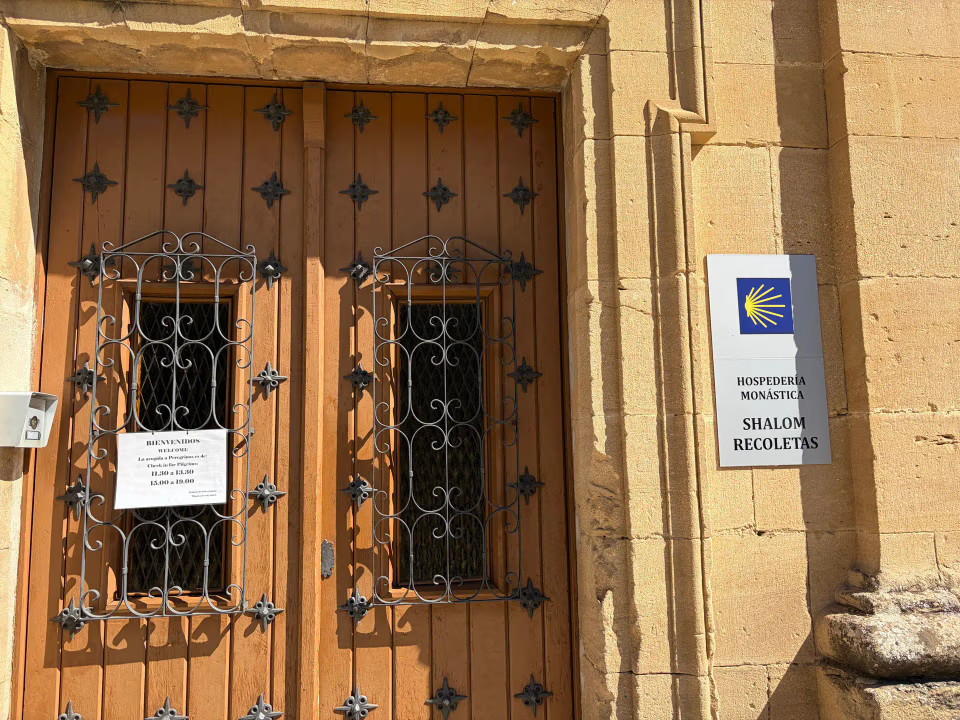 OpenHospedería Monástica Shalom Recoletas or Religiosas RecoletasEstella25€KitchenCotton Sheets & Pillowcases
- Top #5
 OpenReservations acceptedAlbergue Capuchinos RocamadorEstella13€KitchenMicrowaveWi-FiAnd more
Services in Estella
What you can find in town before the next stage.
- ATM
- Café
- Shop
- Tobacco
- Medical clinic
- Pharmacy
- Fountain
- Post office
- Train station
- Bus station
- Restaurant
Source: © OpenStreetMap contributors · updated November 2025
Caminos through Estella
Open a Camino to follow it on the map from Estella.