


In Puente la Reina the ways become one: just before the town the Camino Aragonés from the Somport flows into the Camino Francés, and at the edge of town an eleventh-century bridge, built by a queen for pilgrims, takes you across the Arga. Santiago is still 686 kilometres away. An afternoon is enough.
How long to stay?
An afternoon is enough. Puente la Reina is one street with a bridge at the end, and that's exactly how you should experience it: check into your albergue, walk the Calle Mayor down to the bridge without your pack, look into whichever churches are open, and in the evening go back to the water once more. The town doesn't offer enough for a rest day. If you need one, you're better off in Pamplona or Estella.
Puente la Reina in Ninja numbers
- 686 kilometres to Santiago from here, according to Camino Ninja. From now on it's the same path for everyone.
- About 2.5 kilometres lie between Óbanos, where the two ways merge, and Puente la Reina, according to Camino Ninja.
- 165 kilometres is the length of the Camino Aragonés from the Somport to here, according to Camino Ninja.
- A good 500 pilgrims were counted at the Somport in the last reliable survey, in 2015. In Saint-Jean and Roncesvalles, 38,500 started in the same year. The first way of the old pilgrims' guide is today the emptiest.
Arriving: where two ways become one
From Pamplona you come over the Alto del Perdón, through Uterga and Muruzábal to Óbanos. Here the Camino Aragonés, coming from the Somport via Jaca and Sangüesa, ends and flows into the Camino Francés. At the edge of Óbanos a sculpture marks the spot. Then you cross a road and walk through the Arga valley to Puente la Reina.
Before the town entrance stands the Monumento al Peregrino, a pilgrim figure from 1965 bearing the sentence: „Y desde aquí, todos los caminos a Santiago se hacen uno solo.“ And from here on, all the ways to Santiago become a single one. The sentence goes back to the pilgrims' guide in the twelfth-century Codex Calixtinus. Then you pass under an arch connecting the church del Crucifijo with the convent, and you're in the Calle Mayor. It leads you through the whole town to the bridge.
A town that grew from a bridge
In the eleventh century a queen of Navarre had a bridge built here over the Arga so that pilgrims could cross the river safely. Which queen it was is not certain: tradition names Muniadona, wife of Sancho the Great, or Estefanía, wife of García de Nájera. The town took her name: Puente la Reina, the Queen's Bridge. In Basque it's called Gares.
King Alfonso the Battler brought Frankish settlers to the river, and in 1122 they received their town charter. They laid out the town as a rectangle, with the Calle Mayor in the middle. The street follows the Camino to the bridge. So Puente la Reina really is built around the Way, and you can feel it to this day. The bridge has been a protected monument since 1931.
On the Calle Mayor: what to see
Everything important lies on your route, from the town entrance to the bridge. We didn't find opening hours for the churches.
- Iglesia del Crucifijo: The first church at the town entrance. In the twelfth century the Templars founded a hospice for pilgrims here and built this church, originally called Santa María de los Huertos. A Gothic nave was added in the fourteenth century. After the end of the Templars, everything passed to the Knights Hospitaller. The church holds the crucifix it is named after today. The Camino passes under the arch connecting church and convent.
- Iglesia de Santiago: The church of St James on the Calle Mayor dates from the twelfth century and was later remodelled. Look out for the portal with its many-lobed arches, and the tower. Inside stands the Santiago Beltza, the black St James, a wooden figure of the apostle. It's called that because it was blackened with soot when it was found.
- San Pedro and the Virgen del Txori: In the church of San Pedro stands a figure of the Virgin that used to stand in a tower in the middle of the bridge, until the tower was torn down around 1843. Legend has it that a little bird, „txori“ in Basque, kept flying up from the river and washing her face with water. Ever since, she has been called the Virgen del Txori.
- The Puente Románico: The Romanesque bridge is the reason the town exists. In the evening, walk across and back once more without your pack. You'll cross it anyway the next morning, but by then your mind will already be on the stage.
Food and drink
We didn't find a reliable source for a speciality of Puente la Reina. Camino Ninja pilgrims praise the many restaurants near the albergues. Some albergues offer dinner themselves, Jakue for example as a buffet and Santiago Apóstol with a pilgrim menu.
Honestly
- The albergue on the hill is far. Santiago Apóstol lies beyond the town centre, up a steep hill. Many Camino Ninja pilgrims like the albergue but find the walk there hard after a long stage. And for an evening in town you have to go back down.
- Cheap means cramped. At the Padres Reparadores, many pilgrims sleep in small rooms, say Camino Ninja pilgrims. In return there's a garden that almost everyone praises.
- Thin walls at Jakue. The albergue at the town entrance is well kept but noisy, even in the private rooms.
- The descent from the Perdón takes it out of you. On the way here, after the Alto del Perdón, comes a descent over loose gravel that surprises many.
Where pilgrims sleep
- Albergue de los Padres Reparadores: the big albergue at the town entrance on Calle del Crucifijo, right on the route, with garden and kitchen. From €9 (as of October 2026), the cheapest in town.
- Albergue Santiago Apóstol: at the edge of town on the hill, with lots of space, a large laundry area, a bar and a view. Dorm beds about €10 to €15 (as of October 2026).
- Albergue Jakue: at the town entrance on the Camino, albergue and hotel in one, with a dinner buffet.
There are also smaller private albergues such as Albergue Puente with a terrace, Amalur and Estrella Guía, with dorm beds from about €11 to €25 (as of October 2026).
Ninja tips
- Take in Eunate: In Muruzábal a marked path branches off to the octagonal church of Santa María de Eunate. The detour costs about three kilometres, and you come back via Óbanos. Admission €2, €1.50 for pilgrims. You get the stamp in the house next to the church.
- A photo at the monument: The pilgrim figure before the town entrance is where the sentence „todos los caminos … se hacen uno solo“ stands. If you came over the Aragonés, this is your finish-line photo.
- Laundry at Santiago Apóstol: If you sleep on the hill, use the large laundry area. Several Camino Ninja pilgrims point it out.
- Cross the bridge twice: once in the evening without luggage, once in the morning as you set off. It's worth it both times.
- Quickly to Pamplona: If you have to stop here, the bus takes about 25 minutes to Pamplona. There you'll find trains, long-distance buses and a small airport.
Practical tips for pilgrims
- Shopping: Puente la Reina has all the services you need as a pilgrim. Buy supplies for the next day, as the villages on the way to Estella are small.
- Stamps: at the albergues and, when they're open, in the churches.
- Óbanos: The village before Puente la Reina has a pharmacy, ATM, shop and tourist office. In July of even-numbered years, the villagers perform the „Misterio de Obanos“ there, a legend about a pilgrim.
Onward: over the bridge to the west
You leave town over the Romanesque bridge. Then the route goes via Mañeru (4.9 kilometres) and Cirauqui (7.6 kilometres) to Lorca (13.1 kilometres) and Villatuerta (17.9 kilometres). After 21.7 kilometres you reach Estella. All distances according to Camino Ninja.
What awaits you tomorrow
The pilgrims' guide in the Codex Calixtinus had nothing but praise for Estella: „fértil en buen pan y excelente vino, así como en carne y pescado“, fertile in good bread and excellent wine, in meat and fish. And of the river it wrote that the water of the Ega was sweet, healthy and extraordinary. On the old pilgrim street of Estella stands the church of Santo Sepulcro, and beside its steps a St James greets you who is himself shown as a pilgrim.
Deep dive: The Queen's Bridge
A short read, in case you want to learn more about Puente la Reina. About three minutes' reading.
A sentence from the twelfth century
In the twelfth century a cleric from France wrote a pilgrims' guide that is known today as the fifth book of the Codex Calixtinus. It lists four ways leading from France to Santiago. Three of them unite before the Pyrenees, the fourth comes over the Somport. And then it says that they join into a single one in Puente la Reina, in Spanish land. Since 1965 this thought has stood on the monument before the town entrance.
A queen without a certain name
The town owes its name to a bridge, and the bridge to a queen. In the eleventh century she had it built over the Arga so that pilgrims didn't have to wade through the river. Who she was is not known for certain. Tradition names Muniadona, wife of Sancho the Great, or Estefanía, wife of his son García. It's a fine twist that the founder of the most famous structure has no certain name. Her work, however, still stands.
A town for strangers
King Alfonso the Battler brought settlers from France to the bridge, next to the older village of Garesch. In 1122 they received the town charter of Estella. They laid out the town as a rectangle, and the Way ran right through the middle. In the twelfth century the Templars came and founded a hospice for pilgrims. When their order was dissolved in 1312, the property passed to the Knights Hospitaller. The history was not only peaceful. In 1328 there were pogroms against the Jews in Puente la Reina, as there were in Estella that same year.
A bird and a Madonna
There used to be a tower on the bridge, and in a niche stood a figure of the Virgin, the Virgen del Puy. People told that a little bird came up from the river and washed her face with water from the river. That's why she was called the Virgen del Txori, the Virgin of the Bird. Around 1843 the tower was torn down. The figure was moved to the church of San Pedro, where it stands today.
The empty way and the full one
Whoever comes over the Camino Aragonés has a few very quiet days behind them. In 2015 a good 500 pilgrims were counted at the Somport, and 38,500 in Saint-Jean and Roncesvalles in the same year. In Puente la Reina the two meet: the silence of the Somport and the company of the Francés. For some it's a shock, for others a relief.
What Puente la Reina gives you
Tomorrow you'll cross the bridge that a queen built for people like you, and no one knows exactly which queen. From here on, everyone walks the same way. Perhaps that's the lesson of this place: where you come from matters less from now on than the direction you're walking in.
Where to stay in Puente la Reina
The places pilgrims rate highest in Puente la Reina come first.
- Top #1
 OpenReservations acceptedAlbergue PuentePuente la Reina
4.39 reviews
17€KitchenCooktopsMicrowaveAnd more - Top #2

- Top #3
 OpenReservations acceptedAlbergue Estrella GuíaPuente la Reina22€MicrowaveBreakfastWi-FiAnd more
- Top #4

- Top #5
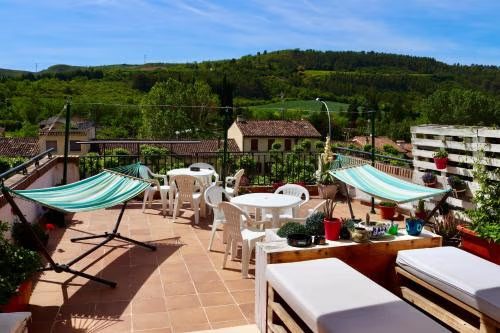 OpenReservations acceptedAlbergue Puente para peregrinosPuente la Reina18€KitchenWi-FiPrivacy CurtainsAnd more
Services in Puente la Reina
What you can find in town before the next stage.
- ATM
- Café
- Shop
- Tobacco
- Medical clinic
- Pharmacy
- Fountain
- Post office
- Restaurant
Source: © OpenStreetMap contributors · updated November 2025
Caminos through Puente la Reina
Open a Camino to follow it on the map from Puente la Reina.