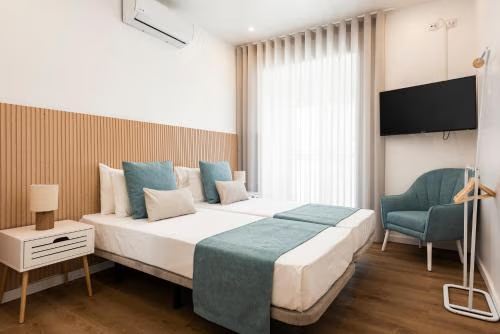
Town on the Camino
Faro
Portugal
- places to stay
- 131
- Camino
- 1
- Elevation
- 3 m
Faro is the beginning at the very bottom: the Camino de Faro starts at the cathedral of the Algarve's capital, and just under 980 kilometres lie ahead of you to Santiago. There is no pilgrim hostel and no credencial here. Pause briefly before you set off, as the bone chapel of the Carmo asks you to.
How long to stay?
An afternoon is enough. For most people Faro is the place where they get off the plane or the train and set off the next morning. You need the night anyway. An afternoon is enough for the cathedral, where your Camino begins, and the bone chapel of the Carmelite church. If you have a whole day, the Ria Formosa lagoon lies just outside the city. But more important here than any sightseeing is preparation: credencial, track, water, accommodation for the first days.
Faro in Ninja numbers
- Just under 980 kilometres from the cathedral in Faro to Santiago: a good 436 to Porto de Muge on the Tagus, then another 541.5 on the Camino Portugués Central.
- 23 kilometres is the length of your first stage to Loulé, with around 440 metres of climbing.
- 1,245 skulls are counted in the bone chapel of the Carmo, the remains of more than a thousand monks.
- 1249 is the year Faro was conquered for Portugal as the last town of the Algarve. Probably there too: the Grand Master of the Order of Santiago.
Arriving: a start without a run-up
Nobody walks into Faro; you land here. A city bus runs from the Algarve's airport into the centre (check the line on site). From Lisbon and Porto you arrive on the long-distance trains of the Portuguese railway, CP. There is no Camino leading into Faro. Everything begins here.
Your starting point is the Sé, Faro's cathedral. From here the Camino de Faro heads north, via Montenegro and Santa Bárbara de Nexe into the limestone hills of the Barrocal. In the Ninja database it is called Caminho Português Central do Sul, the name given to it by the volunteers who waymarked it from 2016.
In brief: Santa Maria at the edge
Already in antiquity there was a port here called Ossonoba. Under the Moors the town was called Santa Maria, in the eleventh century Santa Maria Ibn Harun, and that is probably where the name Faro comes from. In 1249 King Afonso III conquered the town. With that, the Algarve was Portuguese.
In 1487 Samuel Gacon printed the Pentateuch in Hebrew in Faro, the first book printed in Portugal. In the sixteenth century Faro became a city and a bishop's see. At the end of that century English privateers under the Earl of Essex sacked the town. The earthquake of 1755 devastated the Algarve, but the sandbanks of the Ria Formosa saved Faro from the tsunami. A year later it became capital of the Algarve. Today a good 46,000 people live in the city.
Stop here: two places to pause
Before you walk 980 kilometres, it is worth standing still for a moment. Faro has two places for that, and both have to do with death without being gloomy.
The first is the bone chapel behind the Carmelite church. Above its entrance is a sentence you can take with you for the coming weeks: "Pára aqui a considerar que a este estado hás-de chegar." Stop here and consider that you will come to this state. That sounds harsh. But for someone just setting out, it is an honest question: what are you setting out for, if time is limited?
The second is smaller and stands at your starting point. Outside the cathedral there is an altar made of bones, an ossuary. Anyone taking their first step here passes the same reminder, only more quietly. Then you turn round and set off.
At the starting point: what to see
For pilgrims, Faro is not a place with a long list of sights. We have not found reliable opening hours or admission prices for either place; ask on site.
- Sé de Faro: The cathedral is your starting point. Its history begins in the mid-thirteenth century: after the conquest of 1249, according to tradition, the mosque became a church. At the end of the thirteenth century it was consecrated to the Virgin Mary. In the sixteenth century it became a cathedral when the Algarve's bishop's see moved from Silves to Faro, and at the end of the century the English under the Earl of Essex devastated the building. What you see today mixes Gothic, Baroque and the plain Portuguese style. Inside there is an eighteenth-century organ by Johann Heinrich Hulenkampf, outside the bone altar. This is where your Camino begins. Ask for a first stamp; there is no list of stamp places on this route.
- Capela dos Ossos at the Carmo: Behind the Carmelite church of Nossa Senhora do Carmo, from the eighteenth century, lies the bone chapel, consecrated in 1816. It holds the remains of more than a thousand Carmelite monks, 1,245 skulls. Above the door is the reminder quoted above. For a pilgrim it is the right place to be silent for a quarter of an hour before setting off.
- Ria Formosa: Faro lies on a lagoon that has been a natural park since 1978, around 170 square kilometres in size, with islands and sandbanks. Around 30,000 birds pass through every year; in spring and autumn it is a resting place for migratory birds. The sandbanks protected Faro from the tsunami in 1755. If you have a free day, take a look at the lagoon before you head inland.
Food and drink
Faro lies by the sea and the lagoon, and that shapes the cooking: fish and seafood. More important for pilgrims: buy food for the first stage in Faro. What awaits you in the villages is never certain on this route. All along the Camino de Faro there are stretches where cafés close at midday or are missing altogether.
Honestly
- No pilgrim hostel, no credencial. We have not found a pilgrim hostel in Faro, and the route's organisers do not issue credenciales here. Order your pilgrim passport online in advance, or you start without one.
- The arrows are not reliable. According to reports from 2026, the yellow arrows are missing in places. Don't start here without an offline track.
- The first day is no warm-up. To Loulé it is 23 kilometres and a good 400 metres of climbing up into the Barrocal, and on the second and third days it goes on into the Serra do Caldeirão. A good 40 per cent of the whole route's climbing lies in the first 90 kilometres.
- You will be alone. A pilgrim who walked from Santiago do Cacém to the Tagus in 2021 wrote: "never saw one walker until Santarém". Enjoy the silence or find company beforehand.
- Summer is too hot. From June to September the route through the Alentejo is not recommended. Walk between October and May.
Where pilgrims sleep
We have not found a pilgrim hostel in Faro. You sleep in a hostel or guesthouse in the centre. It is best to book ahead and choose a place within walking distance of the cathedral, so you are right at the starting point in the morning. On the rest of the route, too, real pilgrim hostels are the exception. Plan the first nights while you are still in Faro.
Ninja tips
- Walk from the airport into town: From the airport you can walk into the old town in about an hour. The second half follows the first stage, just in reverse, and it is a genuinely lovely stretch. That way you get to know your Camino on the day you arrive.
- Order your credencial in advance: The Associação Espaço Jacobeus (AEJ) sends the pilgrim passport online for €3.20 plus postage (as of September 2026). Along the route it is issued by parishes and the cathedrals of Évora, Beja, Santarém and Portalegre, none of them in Faro.
- Collect stamps wherever you can: There is no list of stamp places. Ask in churches, at the parish councils (Juntas de Freguesia) and in tourist offices.
- Load the track offline: Load the stages in the Camino Ninja app before you set off. Where the yellow arrows are missing, it is your guide.
- Call the Junta: On later stages there are places where only the parish council can arrange a roof. Call two days ahead. Best to note the phone numbers while still in Faro.
- The choice in the Algarve: Around 28 kilometres to the east, the Via Nascente starts in Tavira, a second route north. The two share not a single metre of trail. Decide before you start.
- A sentence for the road: Take a photo of the inscription above the bone chapel. Perhaps you will think of it on a long, empty day in the Alentejo.
Practical tips for pilgrims
- Getting there: Faro airport with a city bus to the centre, CP long-distance trains from Lisbon and Porto.
- Best time to go: October to May, ideally spring. In December Faro can be sunny and mild; one pilgrim once reported 19 degrees.
- Shopping: Stock up in Faro on food and water for the first day.
- Walking a shorter route: Many only walk as far as Alcácer do Sal and take transport from there to Lisbon to continue on the Camino Portugués Central. That is legitimate, but it is a different route.
Onward: into the Barrocal
From the cathedral you head north out of the city. After 3 kilometres you reach Montenegro, after just under 14 kilometres Santa Bárbara de Nexe, then it climbs through the limestone hills of the Barrocal to Loulé (23 km). On the second day comes Salir with its castle from the Almohad period, then the Serra do Caldeirão with the highest point of the whole route, 406 metres. At Porto de Muge on the Tagus, after a good 436 kilometres, your route joins the Camino Portugués Central from Lisbon.
What awaits you tomorrow
Loulé is your first stage destination. There stands the church of São Clemente, Gothic from the thirteenth century, and its bell tower was once a minaret. From Faro, which lies practically at sea level, you climb around 440 metres into a landscape of limestone hills. A good first day to find out how your rucksack sits.
Deep dive: The beginning at the end of the land
A long read, in case you want to learn more about Faro. About twenty-five minutes' reading.
In front of the Sé, at the beginning of everything
When you stand in front of the cathedral in Faro, you are standing at a curious point. Behind you lies the lagoon of the Ria Formosa, and beyond it come sandbanks and the Atlantic. In Portugal you cannot go much further south. Ahead of you lie almost a thousand kilometres to a grave in Galicia. Most pilgrims begin their walk somewhere in the middle of a story, in a town that has watched pilgrims come and go for centuries. You begin yours in a place where nothing of the kind ever existed.
Faro is not an old pilgrim town. We have found no source that tells of medieval pilgrims to Santiago setting out from here, no pilgrim hospital, no confraternity of Saint James. The path you are about to take is young, barely ten years old. And yet this town is connected to Santiago in a strange way: through a bishop who, in late antiquity, brought to trial a man who probably came from Galicia; through an order of knights that bore the apostle's name and conquered the town; and through a cathedral whose bishop was robbed by foreigners. His books are still in Oxford today.
These stories belong to you before you set off. They tell of an edge that again and again became a beginning.
Ossonoba, a town with a bishop
Long before there was Faro, there was Ossonoba. The first settlements go back to the time when Phoenician seafarers settled the coasts of the Mediterranean and the Atlantic. Ossonoba became the most important centre in the south of what is now Portugal, a port through which grain, fish and ores were traded. In Roman times the town belonged to the province of Lusitania. After the Romans came the Byzantines and the Visigoths. Towers in the town wall still bear witness to the Byzantines today.
Ossonoba was Christian early, and early it had a bishop. A bishop named Vincentius is recorded for the year 306. After him come names from three centuries: a Petrus in 589, a Saturninus in 653, an Exarnus in 666, a Belitus in 683, and finally an Agrippius at the end of the seventh century. Then the line breaks off. With the arrival of the Muslims the diocese came to an end, and it would take almost nine hundred years before a bishop resided in this town again.
But one man from this line wrote himself into church history, and not for the better. And he leads you, by a detour, to Galicia.
Ithacius and the man from Galicia
In the fourth century Ithacius was bishop of Ossonoba. At the same time an educated man from a distinguished family was gathering followers, probably born in Gallaecia, the land that today covers Galicia and the north of Portugal. His name was Priscillian, and he preached a strict, ascetic Christianity. His following grew, and he became bishop of Ávila. Other bishops considered him a heretic. A synod in Zaragoza condemned his leaders in the year 380.
Ithacius became his bitterest opponent. When the decisions of the Church achieved nothing, he turned to the secular authorities and obtained an imperial edict. In the end there was a trial in Trier, at the court of the emperor Maximus, and Ithacius was the chief accuser. The charge was no longer heresy but sorcery, a crime that carried the death penalty. In the year 385 Priscillian and several of his companions were executed by the sword. Historians see this as the first case in which Christians had another Christian killed for heresy.
Even his contemporaries were appalled. Martin of Tours, the famous bishop, had protested against a secular court ruling on a matter of faith. Ambrose of Milan and the Pope also condemned what had been done. Bishops in Gaul broke off communion with Ithacius, and a synod of Spanish bishops deposed him. The man from Ossonoba had won and lost everything.
And this is where it becomes interesting for you. Priscillian's body was brought back from Trier to Hispania, and in Gallaecia he was venerated as a martyr. The English church historian Henry Chadwick therefore considered it possible that the grave in Santiago de Compostela holds not James after all, but Priscillian. This can no more be proven than its opposite. It is a conjecture, nothing more. But it is a strange thought: you set out from the town of the bishop who brought Priscillian to his death, and you walk to a grave in which some suspect the dead man of those days.
Santa Maria, at the edge of the West
In the year 713 the Moors came, and for a long time Ossonoba remained the most important centre in the southwest of the peninsula. In the ninth century a man named Yahia Ben Bakr rose up, later his son Bakr Ben Yahia, and for a short time a small principality of its own arose here, with a defensive wall. In the tenth century the name Santa Maria appears. It was older than the Moors: already under the Visigoths the Christian town was called Santa Maria de Ossonoba, and even under Muslim rule it kept the name of the mother of Jesus. In the eleventh century the town was then called Santa Maria Ibn Harun, after the family of the Banu Harun, who ruled a small kingdom of their own here, the taifa of Santa Maria in the Gharb, the west of al-Andalus.
After the Christian conquest Ibn Harun became Santa Maria de Faaron, then Farom, Farão and finally Faro. At least that is how the municipality of Faro itself explains it, and how the local newspaper Postal reported it in the summer of 2026.
You can still see something of this time. When you walk through the Arco da Vila into the old town, there is a horseshoe arch on the right that is attributed to the eleventh century. It was one of the gates of the Islamic town, was uncovered again during building work in 1992, and is the only horseshoe arch in the Algarve still standing in its original place. The people of Santa Maria Ibn Harun walked through this gate.
It was not a peaceful time. In 1147 a band from the Second Crusade plundered the Moorish town. In 1217 a Frisian fleet on its way to the Fifth Crusade came and plundered and burned Faro once again. For the people at the edge of the Gharb, the men with the cross were first of all robbers from the sea.
March 1249: a town surrenders
The actual conquest came without a great battle. In the middle of the thirteenth century the Portuguese pushed their frontier south step by step, through the valley of the Guadiana and into the eastern Algarve. Mértola had fallen, Tavira, Ayamonte, Cacela, and in 1248 even the great city of Seville, to the Castilians. The lord of the region around Faro, Ibn Mahfuz, ruler of the taifa of Niebla, was isolated. Faro could no longer expect help from anywhere.
In March 1249 a Portuguese army stood before the town, under King Afonso the Third. This is documented by a deed of donation that the king issued in Faro in March 1249. In February he had still been in Ourém. The force was probably small, but disciplined. Most of the men were younger sons and illegitimate children of the nobility, and some of them were richly rewarded. From them came families that still shaped Portugal in the fourteenth century. Faro surrendered. Muslim sources say the town was handed over. Shortly afterwards Albufeira, Porches and some smaller places fell. With that, the Portuguese conquest of the Algarve was complete.
Castile saw things differently and claimed the Algarve for itself. Only in the Treaty of Alcañices in 1297, with the Pope as mediator, was Portuguese possession finally recognised. The town, however, flourished. The safe harbour and the salt trade brought prosperity, and with the decline of Silves, Faro took over the administration of the Algarve.
The Master from Barcelos
At the conquest of Faro, according to the sources on the siege, one man was present whom you will meet again and again on this walk without ever reading his name on a sign: Paio Peres Correia, Master of the Order of Santiago. Alongside the knights of the apostle fought the knights of the Order of Avis.
Paio Peres Correia was born around 1205 in Monte de Fralães near Barcelos, in the north of Portugal, on the route that pilgrims walk today from Porto to Santiago. Early on he went to Uclés in Castile, the headquarters of the order. Later he led the Portuguese knights from Alcácer do Sal. In late autumn 1242 the brothers in Mérida, on the Vía de la Plata, elected him Grand Master of the whole order, for life.
What follows reads like a map of the south. In the west he took part in the conquests of Mértola, Ayamonte, Cacela and Tavira. In the east followed Chinchilla and Montemolín, Cartagena, Lorca and Mula, and in 1248 the conquest of Seville in the service of Ferdinand the Third of Castile. Paio Peres Correia served two kingdoms, Portugal and Castile, under the sign of the same apostle. He died in 1275. In 1511 the Catholic Monarchs had his remains brought to the monastery of Tentudía in Extremadura, which he himself had founded in 1240 as a small chapel.
The Order of Santiago had come to Portugal as early as 1172. In 1217 it conquered Alcácer do Sal and made the castle its headquarters until 1235. Santiago do Cacém, which bears the apostle in its name, was its first outpost in the south from 1186. So when you walk north from Faro, you are walking backwards through the history of these knights: from their last victory on the coast to their early castles in the Alentejo. The apostle's sword cleared this path long before anyone came with a backpack and a scallop shell. You can admire that or find it unsettling. It is worth knowing both.
A book printed on 30 June 1487
Under the Moors and under the Christian kings, Jews lived in Faro. Already in Moorish times Jewish scholars made copies of the Hebrew Bible here, and in the fourteenth century the community grew in importance. Their quarter lay in the Vila Adentro, the town within the walls, where the cathedral also stands.
On 30 June 1487 a man named Samuel Gacon completed in Faro the printing of the Five Books of Moses in Hebrew. It is the first dated book printed in Portugal and the first Hebrew book of the country. The history of Portuguese printing begins with it. Gacon printed it on parchment, in two columns, with vowel signs, 110 leaves. A single copy survives.
Nine years later this world was over. In 1496 King Manuel the First decreed that all Jews who would not be baptised had to leave the country. On the site of the Jewish quarter the convent of Nossa Senhora da Assunção was built. The same king endowed Faro with a hospital, the church of the Misericórdia, a customs house and a slaughterhouse on the shore. In this town, care and expulsion lie that close together.
How Faro became a bishop's town
After the Christian reconquest of the south, the Algarve had a bishop again, but not in Faro: in Silves, the old Moorish capital in the west. The diocese had been established at the end of the twelfth century, when the Christians held Silves for a short time, but then remained without a bishop until 1253. Over the centuries Silves lost importance, and Faro gained it.
In 1540 King John the Third raised Faro to the rank of city. When the bishop's seat came is given differently in the sources, and the explanation is simple: the transfer was decided as early as 1539 and 1540, but only carried out on 30 March 1577, under Bishop Jerónimo Osório. Since then the church of Santa Maria in Faro has been the cathedral of the Algarve. After almost nine hundred years a bishop had returned to the town where Vincentius and Ithacius had once sat.
Barely twenty years later the English came.
The Sé: a church from seven centuries
Before we come to them, take a look at the church you are standing in front of. Tradition says an early Christian basilica already stood here, though there is no archaeological proof. Likewise it is said that the Moors had a mosque on this spot, which became a church after the conquest of 1249. What is certain is that two years after the conquest, in 1251, construction of the main church began, and that towards the end of the thirteenth century an archbishop of Braga consecrated it to the Virgin Mary. Under the Moors the town was called Santa Maria, and Santa Maria is the name of its church to this day.
Not much remains of the first building. Fires and earthquakes damaged it several times, the English set it on fire in 1596, and the earthquakes of 1722 and 1755 forced major rebuilding. What has survived you see as soon as you enter: the tower and the Gothic main portal from the thirteenth century. The tower rests on a porch with three great arches. For more than seven hundred years people have walked through these arches, and now you walk through them.
Inside, there is no Gothic space waiting for you, but a church with three naves, separated by plain columns of the Tuscan order. The architecture is simple. The richness lies in the side chapels. What you see today is a mixture of Gothic, Renaissance, Baroque and that plain Portuguese style called Estilo Chão, the plain style. The cathedral is a National Monument of Portugal.
What you see in the cathedral
Walk slowly, clockwise, and you walk through the centuries. Two chapels still date from the thirteenth or fourteenth century and belonged to the original church of Santa Maria. In one stands a Gothic figure of the Virgin from the fifteenth century under an original Gothic vault. In the other, the chapel of Saint Dominic, lies the tomb of a nobleman named Ruy Valente, also from the fifteenth century.
The main chapel was rebuilt between 1630 and 1640. Its altarpiece is entirely gilded and carries figures from the sixteenth century: Mary, Peter and Paul, and above them a painting of the Coronation of the Virgin. The choir stalls were completed in 1704. In the chapel of the Rosary, rebuilt in 1690, tile pictures tell of the Flight into Egypt and of the twelve-year-old Jesus in the Temple. Figures of Black boys recall a confraternity that already existed here in 1554. In the chapel of the Souls, from 1722, two angels carry a skull and bones. The chapel of Saint Blaise, built around 1750, is adorned with wood and gold from Brazil, and the chapel of Nossa Senhora dos Prazeres, completed in 1752, is considered a masterpiece of Portuguese Baroque in the Algarve.
Before you leave, turn around and look up, to the left above the main entrance. There hangs a Baroque organ from the eighteenth century, built by Johann Heinrich Hulenkampf and painted with Chinese motifs. It is well preserved and is played on special occasions. Classical concerts also take place at such times. On the first floor is the cathedral museum with liturgical vessels, vestments and statues, and 68 steps take you up the tower. From the top you look out over Faro and on to the Ria Formosa.
Outside in the courtyard there is something else you should not miss: a small altar of skulls and bones, an ossuary, at the far right end of the courtyard. Next to it is the chapel of Saint Michael with wooden figures from the first half of the eighteenth century. The bones in the courtyard are a foretaste of what awaits you in the Carmelite church.
There is one thing you should honestly know: we have found no altar of Saint James, no pilgrim figure and no confraternity of Saint James for Faro's cathedral. The church where your walk begins is dedicated to Mary, not to the apostle. Perhaps that fits. The town was already called Santa Maria when nobody here was thinking of Santiago.
July 1596: Essex arrives
In the summer of 1596 Portugal was not independent. Since 1580 the Spanish king had also ruled in Lisbon, and England was at war with Spain. On 1 July 1596 an English and Dutch fleet attacked Cádiz. The commanders were Robert Devereux, Earl of Essex, and Lord Howard of Effingham. Walter Raleigh was there too. They stayed in Cádiz for sixteen days. On the way home they decided to take on provisions on the coast of the Algarve.
In the late afternoon of 23 July 1596 the troops landed west of Faro, probably at Farrobilhas. The next morning they attacked the town. There was hardly any resistance. The bishop was not in the town; he had led the men fit to fight to Lagos. The other inhabitants had fled with everything they could carry. There was little to plunder. Bands of the attackers moved inland as far as São Brás de Alportel, where locals drove them back on 25 July. Others met militias near Loulé and Tavira and turned back. On 27 July the English withdrew, and behind them the town was burning. Walls, churches, houses and the cathedral were damaged. The news reached Lisbon the next day.
The bishop was Fernão Martins Mascarenhas. He came from Montemor-o-Novo in the Alentejo, had studied in Évora and Coimbra, had been rector of the University of Coimbra, and had only been bishop of the Algarve since 1595. He owned a library, and his volumes bore his coat of arms, stamped in gold on the binding. The English took them with them.
Eight years later, in the dedication of a book, Mascarenhas wrote about the raid, which he had not witnessed himself: „as mulheres lamentam-se, as crianças choram“, the women lament, the children weep. As bishop he helped during a plague in the Algarve and distributed his grain during a famine in Portimão. In 1616 he became Inquisitor General of Portugal, and he rebuilt his library, partly with books that the Inquisition had confiscated and that he diverted to himself. That, too, is part of him.
The bishop's books: a disputed question
What became of the books? In the year 1600 the Earl of Essex gave a pile of books to a man who was just then refounding the old university library in Oxford: Thomas Bodley. The gift comprised 176 titles in 215 volumes. At least 65 titles in 91 volumes bear the arms of Mascarenhas and certainly come from Faro, and some others probably do too. The Bodleian Library, one of the most famous libraries in the world, thus counts among its earliest holdings the loot from a raid on the Algarve. An English seaman who had been there, William Monson, wrote decades later quite unselfconsciously: „which Library was brought into England by us“.
Ever since, there has been a question that will not go away: do the books belong back in Faro? In December 2013 an association in Faro, named Faro 1540 after the year the town became a city, resolved to demand their return. In England individuals lobbied members of parliament and the librarian. The library replied that restitutions were rare, and that the books belonged to a European heritage that should be well cared for and accessible to all. The historian Peter Booker of the British Historical Society of Portugal considers the demand hopeless and contradicts its basic assumption: „The erroneous premise is to suppose that the books were stolen from the city of Faro“. The books were the bishop's private property. If anyone had a claim, it would be his heirs, not the town and not the diocese.
And then there is a stubborn story that you will read in many texts about Faro, including the English Wikipedia: among the stolen books, it says, was Samuel Gacon's Hebrew Pentateuch, Portugal's first book, and it is now in Oxford. A closer look shows that this is not quite right. An essay in the journal Sephardic Horizons traces the path of the only surviving copy. Soon after it was printed it probably belonged to an owner in northern Italy, then in the sixteenth century to a Rabbi Nissim in Mantua, later to the collector Giuseppe Almanzi in Padua, and in 1868 it came to the British Museum. Today it is in the British Library in London, not in Oxford. And Essex's gift to Bodley contains no Hebrew books at all. So Portugal's first book had left Faro long before the English came. How it got to Italy, nobody knows.
We tell you this at such length because it is a good example of something you will meet constantly on the Camino: stories that are too beautiful not to pass on, and yet are not quite true. Sometimes the true version is the better one.
Gold from Brazil: the Igreja do Carmo
A few streets north of the old town stands a church that tells of quite another time. The Igreja do Carmo, properly the church of the Third Order of Our Lady of Mount Carmel, was founded in 1713 at the instigation of Bishop António Pereira da Silva, to plans by Frei Manuel da Conceição. From 1747 it was enlarged under the master builder Diogo Tavares. The work lasted until 1755, the year of the great earthquake. The church survived it.
It was the time of King John the Fifth, and it was built with gold from Brazil. Inside, a single nave awaits you with four side chapels, tiles, carved wooden ceilings and gilded woodwork by Gaspar Martins, Manuel Martins and Miguel Nobre. The two towers are younger: one was finished at the beginning of the nineteenth century, the other only in 1878, with a carillon of nine bells.
You can stand in this church and marvel. You can also think about where the gold came from and who dug it out of the earth. Both are true. The path you are setting out on will show you many more churches like this.
The chapel of bones
Behind the church lies a room of about four by six metres. Its walls, columns, arches and the small altar are lined with bones: thigh bones, shin bones, ribs, and 1,245 skulls. Skeletons are painted on the vault, there are tombstones in the floor, and behind glass, in a niche of the altar, hangs a crucified Christ.
The chapel was built in 1816. The town's cemeteries were full, and the order had the remains exhumed from its old cemetery next to the church. They are, so it is said, the bones of more than a thousand Carmelites. From them a room was made that says something, and what it says is written above the door: „Pára aqui a considerar que a este estado hás-de chegar.“ Stop here and consider that you will come to this state.
There are several bone chapels in Portugal; the best known is in Évora. They belong to an old Christian practice, the memento mori, the remembrance of one's own death. One was meant to remember that life is finite, and to pray for the dead. For people in the nineteenth century this was more self-evident than it is for us. For you, just setting out, it can be a simple question, with no piety needed: if time is limited, what do you want to use it for? A pilgrimage is one of the few occasions in life when you are allowed to carry that question around with you for weeks.
1755: the sandbanks and a new gate
On 1 November 1755, All Saints' Day, the earth shook off the coast of Portugal. Lisbon was destroyed, and in the Algarve too the earthquake caused severe damage. In Faro the tremors struck churches and convents, the Franciscan convent and the convent of Santa Clara, the bishop's palace, walls, towers and houses. The cathedral, already damaged by an earthquake in 1722, had to be rebuilt once more.
Then came the tidal wave. It devastated the places along the coast. Faro, however, was largely spared. The sandbanks and islands of the Ria Formosa caught the wave. Lagos, on the other hand, capital of the Algarve since 1577, was destroyed. In 1756 Faro became the seat of administration for the whole region.
So Faro owes its rank not only to kings and bishops, but also to a strip of sand. That is a modest lesson, and it suits a pilgrim's path.
After the earthquake Faro rebuilt, and one bishop left his mark on the town in the process: Francisco Gomes do Avelar. He brought the architect Francisco Xavier Fabri from Genoa to the Algarve, and Fabri built him the gate through which you enter the old town today, the Arco da Vila. It was inaugurated in 1812. Two columns, a round arch, above it a bell tower with a clock, and in a niche a marble figure from Italy: Saint Thomas Aquinas, patron saint of the town since at least 1620.
In Faro they tell two stories about him. The first: the saint kept the plague away from the town. The second is lovelier. When the workers tried to lift the heavy statue into place, it would not budge. Only when the bishop whispered something in its ear did it become light. What he whispered, the legend does not say. The square in front of the gate bears the bishop's name today, Praça de Dom Francisco Gomes.
When you walk through the Arco da Vila, you walk through three ages at once: through the bishop's Baroque gate, past the horseshoe arch of the Moors, into the town where Ossonoba once lay.
The lagoon before the town
What protected Faro from the tidal wave is today one of the great natural treasures of Portugal. The Ria Formosa is a lagoon behind a chain of sand islands, Armona, Barreta, Culatra, Tavira and others, with six openings to the sea. Five of them the sea made itself, one was made by people, for the port of Faro, completed in 1952. On 2 May 1978 the lagoon was placed under protection, since 1980 it has been an internationally protected wetland, and in 2010 the Portuguese voted it, with 656,356 votes, one of the seven natural wonders of their country.
Around 30,000 birds pass through here every year. The lagoon is a corridor for migratory birds, and you can see flamingos, terns and avocets. In the shallow basins shellfish are farmed and harvested. The birds that rest here in spring and autumn are, in their own way, pilgrims too: they come from far away, stay briefly and move on. If you have a free day, watch them before you set off north yourself.
A young path
That leaves the question of why a Way of Saint James begins here at all. The answer is surprisingly recent. In 2016 volunteers began painting yellow arrows north from Faro, supported by the Associação Espaço Jacobeus, a Catholic pilgrim association based in Braga. Behind the work was a master's thesis at the University of the Algarve: the student Susana Sousa explored the route with a group of volunteers, supervised by Luís Filipe Oliveira, who at the time spoke in Tavira about the role of the Order of Santiago in the conquest of the south. Since 5 March 2017 the stages from Faro to Almodôvar have been recognised on the ground and marked with yellow arrows, across the Serra do Caldeirão to beyond the border of the Alentejo. Among those who supported it were the municipality of Loulé, the village of Ameixial and the Franciscan lay order of Faro. Susana Sousa said something at the time that tells you a lot about this path: accommodation costing more than 15 euros was expensive for pilgrims.
From Ameixial the path today follows the Caminho Português de Santiago Central through the Alentejo and the Ribatejo, which the region's tourism authority runs together with sixteen municipalities. In 2021 it became the first state-certified Way of Saint James in Portugal. It leads you to places whose names you will hear differently after this text: past the battlefield of Ourique, where Afonso Henriques defeated the Moors on 25 July 1139, the feast of Saint James, and afterwards became the first king of Portugal. To Santiago do Cacém, the knights' first outpost. To Alcácer do Sal, their old headquarters, where in the Igreja de Santiago fourteen tile panels tell the life of the apostle. And on to Samora Correia in the plain of the Tagus, whose commandery was founded by Paio Peres Correia, the man who was there at the conquest of Faro.
So the path is new, but the trail it follows is old. It draws a line through the land that the knights of the apostle conquered in the name of Santiago, and it turns that line into something else: a path that you walk alone, slowly and unarmed. Whoever walks it today is mostly alone. A pilgrim wrote in 2021 about the stretch to the Tagus that he did not see a single other walker until Santarém.
What Faro gives you
Faro gives you no grand farewell. There is no pilgrim hostel here, no stamp with a tradition, no Saint James above the portal. The cathedral where you set off belongs to Mary, and the town has lived most of its centuries without thinking of Santiago.
But it gives you something else to take along. It shows you how stories shift over the centuries: how Ossonoba became Santa Maria and Ibn Harun became Faro, how a bishop who accused a heretic became a footnote in the question of the grave in Santiago, how the loot from a raid became the foundation of a famous library, and a lost book became a legend that is not true. It shows you that a strip of sand can save a town. And it gives you a sentence, above a door made of bones, that you will not forget.
Stop here and consider that you will come to this state. You can read this sentence as a threat. You can also read it as an invitation not to waste the time you have. You have almost a thousand kilometres ahead of you. You will be alone a great deal, walk through cork oak forests and grain steppes, pass castles of the knights of the apostle, and arrive in the evening in places where nobody is waiting for you. Perhaps the sentence from Faro will come back to you on one of those days. Then you will know where you began.
Where to stay in Faro
Places to stay in Faro.
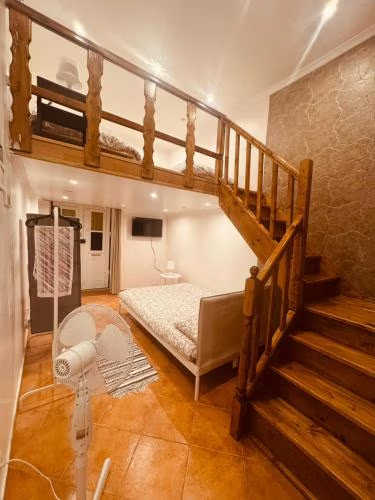 OpenReservations accepted
Faro Coast Guest House
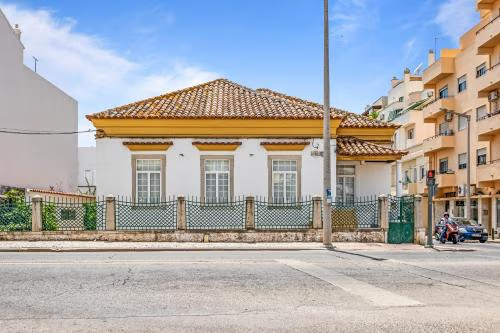 OpenReservations accepted
Plaza Inn Hostel & Rooms
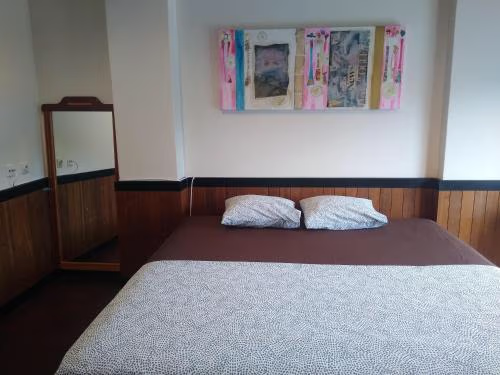 OpenReservations accepted
Melaya Private Rooms