

Town on the Camino
Flüeli-Ranft
Switzerland
- places to stay
- 7
- Camino
- 1
- Elevation
- 725 m
Flüeli-Ranft is the place of silence on the Via Jacobi: below the village lies the gorge to which Niklaus von Flüe left his family in 1467 to live for nineteen years in a cell as Brother Klaus. You can visit his hermitage, his house and two chapels. An afternoon is enough, but take all of it.
How long to stay?
An afternoon is enough, but take all of it. Flüeli-Ranft is a hamlet on a rocky ridge above the gorge of the Melchaa, not a small town. What fills the afternoon is the path down into the Ranft, to the cell and the chapels, and back up to the birth house and the dwelling house. If you stay the night, you can go down once more in the evening or early in the morning, when it is quiet. Brother Klaus's grave is not here but 3.5 kilometres further along the Way in Sachseln.
Flüeli-Ranft in Ninja numbers
- 26.4 kilometres from Beckenried to here, with 940 metres of ascent. If you slept in Stans, it was 16.7.
- 284.3 kilometres still lie ahead of you to Geneva, where the Via Jacobi ends.
- 19 years Brother Klaus lived in the Ranft, from October 1467 until his death on 21 March 1487.
- 11,000 people celebrated mass with Pope John Paul II on the meadow next to his house on 14 June 1984.
- 1947 is when Niklaus von Flüe was canonised. Since then he has been the patron saint of Switzerland.
Arriving: over the hills of Obwalden to the rocky ridge
From Stans you climb via Ennetmoos into the hills of Obwalden; the day's highest point is at 832 metres. Shortly before the end, in St. Niklausen, the guest house of Bethanien Convent stands on a rise right by the Way. Then you reach Flüeli at 725 metres: a hamlet with a chapel on the rock, Brother Klaus's dwelling house and the path that leads down into the gorge.
In brief: a farmer becomes a hermit
Niklaus von Flüe was born here in 1417. He was a farmer, soldier, councillor and judge, married to Dorothee Wyss and father of ten children. Around 1442 to 1455 he built his dwelling house in the Flüeli. In October 1467, with his wife's consent, he left the family and moved into the Ranft, ten minutes' walk from his farm. He lived there until 1487, according to the accounts of his contemporaries without eating. As early as 1470 Pope Paul II granted a first indulgence for the shrine in the Ranft, and it became a station on the Way of St. James. In 1481 his advice at the Stanser Verkommnis saved the Swiss Confederation.
Down into the silence: what to see
The sites are close together, but the Ranft lies deep below the village. A steep path leads down; allow enough time, because the way back up takes longer.
- Ranft with hermitage and upper chapel: This is where Brother Klaus lived. Friends built him a chapel and a simple cell next to it. It has one window to the chapel and one to the outside, no chair, no bed. For pilgrims this is the heart of the place: you stand in the room where someone lived out of silence for nineteen years. Go slowly, and if you can, at a time when few people are there.
- Lower Ranft chapel: Built in 1501, a few years after his death, down by the Melchaa. It is considered one of the finest late Gothic buildings in Switzerland. Down here it is quiet.
- Brother Klaus's dwelling house: Built around 1442 to 1455 for Niklaus von Flüe, as tree-ring dating confirms. He lived here with his family until 1467, and his descendants lived in it until the early 19th century. A two-storey log house with an open smoke kitchen, renovated in 1944 to 1945. Next to the house John Paul II celebrated mass in 1984.
- Birth house: The house in which Brother Klaus was probably born in 1417 was rebuilt in its present form around 1522. In the room said to be the birth chamber stands a statue from the middle of the 16th century. Since its restoration in 1999 to 2000 it has been open to visitors.
- Flüeli chapel: The chapel on the rock above the village was built from 1614 to 1618 and consecrated in 1618 to St. Charles Borromeo.
Food and drink
Flüeli is small. There are inns and hotels in the village; we did not find a supermarket. Shop in Stans before you climb up; tomorrow in Sachseln by the lake you will find everything again.
Honestly
- The Ranft is no secret. It is the shrine of Switzerland's only saint and a place of pilgrimage; you will rarely be alone there. You are most likely to find the silence early in the morning or in the evening.
- The way back is steep. Going down is easy, coming up takes much longer. Leave your rucksack at your lodging.
- The grave is elsewhere. If you are making a pilgrimage to Brother Klaus, you will find his grave in the parish church of Sachseln, 3.5 kilometres further along the Way.
- The stage here is long. From Beckenried it is 26.4 kilometres with 940 metres of ascent. Split it in Stans if you really want the afternoon in the Ranft.
Where pilgrims sleep
There is no pilgrim hostel in the Spanish sense, but there are two houses that suit the place. The Gästehaus Kloster Bethanien stands in St. Niklausen on a rise right by the Way, shortly before the Ranft. In the village itself, zentrumRANFT, a seminar centre and house of silence, offers rooms. There are also hotels. Book the day before.
Ninja tips
- Go down twice: Once in the afternoon to see everything, and once in the evening or early morning just to sit.
- Sleep at Bethanien or in the Flüeli: If you stay the night, you can go down once more in the evening. If you walk on, you experience the Ranft only in passing.
- Sachseln belongs to it: Plan an hour in Sachseln tomorrow morning. Without the grave, Brother Klaus's story is only half told.
- Poles for the way back: The path up out of the Ranft is steep. Poles make it easier.
Practical tips for pilgrims
- Stopping: Sachseln on the lake, 3.5 kilometres further on, has a railway station.
- Money: Francs; cards are accepted at almost all the inns.
Onward: via Sachseln to the Brünig
From the Flüeli you descend 3.5 kilometres and 292 metres to Sachseln on Lake Sarnen, to Brother Klaus's grave. Then you walk along the lake via Giswil to Lungern (18.5 kilometres) and up to the Brünig (22.5 kilometres). The day's highest point, at 1,082 metres, is on the path beyond the pass. To Brienzwiler with its pilgrim hostel it is 26.9 kilometres, with 981 metres of ascent and 1,028 metres of descent.
What awaits you tomorrow
Sachseln and the grave of the hermit you visited today in his gorge. Then a long day along Lake Sarnen and Lake Lungern, up to the Brünig, where you leave Central Switzerland and descend into the Bernese Oberland.
Deep dive: One window to the chapel, one to the world
A short read, in case you want to learn more about Flüeli-Ranft. About three minutes' reading.
A man who had everything
Niklaus von Flüe had everything a man could have. He was a farmer with his own farm, a councillor and judge in his land, he had fought in wars, he was married to Dorothee Wyss, and they had ten children. The house he built in the Flüeli around the middle of the fifteenth century still stands. You can go inside.
A walk of ten minutes
In October 1467 he left. Not far, just down into the gorge below his farm, ten minutes on foot. His wife agreed. Friends built him a chapel and a cell there. The cell has two windows. One looks into the chapel, one to the outside. There is no chair, and no bed either. He lived like this for nineteen years, and from all that his contemporaries report, he ate nothing during that time. He said the mass nourished him.
Why they came
That is exactly what made him famous. People came to see it, to talk to him, to ask him for advice. As early as 1470 the Pope granted an indulgence for the place, and so the Ranft became a station for pilgrims on their way to Santiago. In 1481, when the Confederates in Stans were on the verge of falling out, a priest carried his advice there, and the alliance held. Advice from a cell with two windows.
The silence after
He died on 21 March 1487. In 1501 a second chapel was built down by the stream; it still stands today. In 1649 he was beatified, in 1947 canonised. He is the patron saint of Switzerland, revered as a peacemaker. In 1984 a pope celebrated mass beside his house, and eleven thousand people stood on the meadow.
What the Ranft gives you
You have been on the road for days, and perhaps you too have left something behind in order to walk. Brother Klaus went only ten minutes away. He did not need three thousand kilometres to get away; he needed a gorge and a cell with two windows. One to the chapel, one to the world. Perhaps that is also the question this place asks you: where does your one window look, and where the other?
Where to stay in Flüeli-Ranft
Places to stay in Flüeli-Ranft.
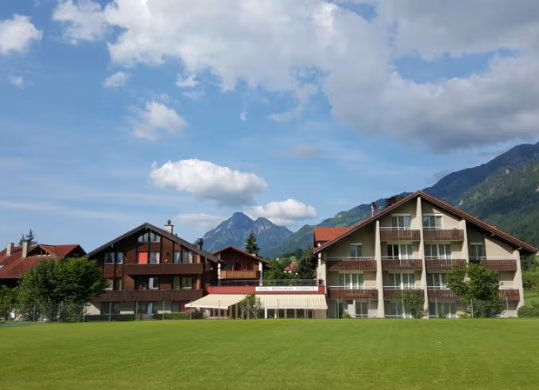 Open
Hotel FlüeMatte
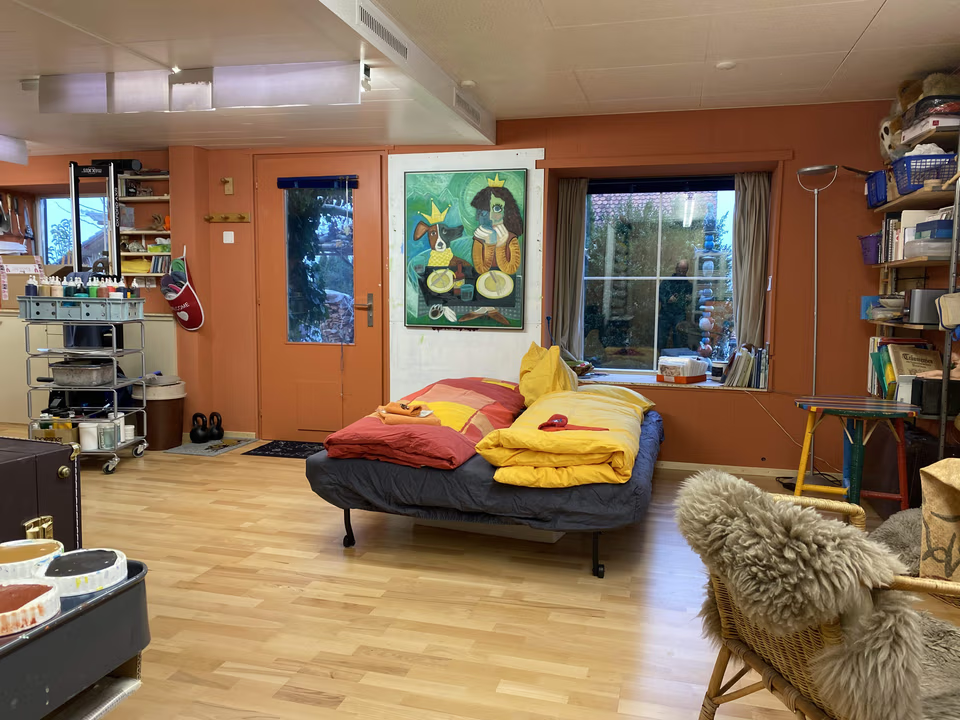 Open
Kunstwerkstatt Flüeli-Ranft
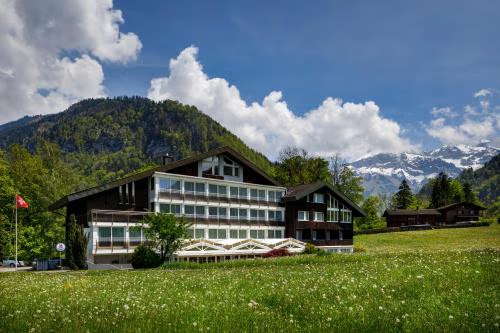 OpenReservations accepted
Hotel Klausenhof Flüeli


Town 12 of 28