

Town on the Camino
Sachseln
Switzerland
- places to stay
- 18
- Camino
- 1
- Elevation
- 488 m
Brother Klaus is buried in Sachseln on Lake Sarnen, and for centuries people have made pilgrimages to his grave in the baroque parish church. His habit hangs here, a museum shows the oldest portrait of him, and Dorothee, the woman who let him go, is remembered here too. An afternoon is enough; for the grave alone, an hour.
How long to stay?
An afternoon is enough; passing through, an hour. If you slept in Flüeli-Ranft, you come down in the morning, visit the church and the grave and walk on along the lake towards the Brünig. If you stay the night here, you have time for the museum opposite the church and an evening by Lake Sarnen. The town does not fill a second day.
Sachseln in Ninja numbers
- 3.5 kilometres from the Ranft down to Sachseln, with 292 metres of descent. Cell and grave are only a short descent apart.
- 1679 is when Brother Klaus's remains were moved into today's church. Since 1934 they have rested in a silver shrine, now inside the altar.
- 1492 is when the altar wing in the museum was painted: the oldest portrait of Brother Klaus, five years after his death.
- 280.8 kilometres from here to Geneva, the end of the Via Jacobi.
- 23.4 kilometres to Brienzwiler on the other side of the Brünig.
Arriving: from the Ranft to the lake
From the Flüeli the path leads 3.5 kilometres down to Lake Sarnen. Sachseln lies at 484 metres on the shore, and the parish church with its free-standing tower stands in the middle of the village. Opposite is the museum, and to the left of the church the pilgrimage office.
In brief: a church for a grave
Brother Klaus died in the Ranft in 1487 and was buried in Sachseln, in the nave of the church of the time, under a sandstone slab bearing his likeness. In 1518 he was moved to a raised stone tomb. After his beatification in 1649 the community built a new, larger church in early baroque style from 1672 to 1684; it was consecrated on 7 October 1684. The tower is older, it dates from the 13th century and later received its onion dome. The church is a building of national importance and was last comprehensively renovated from 1974 to 1976.
At the hermit's grave: what to see
Church and museum face each other; you can manage both with your rucksack on.
- Parish and pilgrimage church: Brother Klaus has been buried here since 1679. Since 1934 his remains have lain in a silver shrine, which was built into the altar where mass is celebrated during the renovation of 1974 to 1976. In the right side aisle his hermit's habit, kept here since 1610, hangs in a glass case. Between the left side altars hangs a copy of his meditation picture. For pilgrims this is the end point of the Brother Klaus story that began up in the Ranft.
- Grave chapel: The chapel by the tower holds the stone tomb of 1518 with the grave slab under which Brother Klaus originally lay, and a Gothic choir cross from the 14th century that probably came from the earlier church.
- Remembering Dorothee: A bronze relief from 1984 shows Dorothee and Brother Klaus together, and since 1991 a statue of Dorothee has stood by the tower. She was the woman who stayed, with ten children and a farm. Here she is not forgotten.
- Brother Klaus Museum: Opposite the church, since 1976 in a town house from 1784. The museum tells the lives of Niklaus von Flüe and Dorothee Wyss; its most important piece is the altar wing of 1492, the oldest portrait of the saint. Open from Palm Sunday to All Saints, Tuesday to Saturday 10:00 to 12:00 and 13:30 to 17:00, Sunday 11:00 to 17:00, closed on Mondays; admission CHF 10 (approx. €11), Wednesdays CHF 4 (as of the 2023 season, according to the museum portal; check beforehand).
Food and drink
Sachseln has inns and restaurants in the village and by the lake. It is worth shopping here for the long way to the Brünig.
Honestly
- Hardly any pilgrim beds. There is no pilgrim hostel; besides hotels and holiday flats you will find a few private rooms.
- The museum is closed in winter. Outside the season from Palm Sunday to All Saints you will not see the altar wing.
- The day still goes a long way after this. If you come from the Ranft and want to reach Brienzwiler, you still have 23.4 kilometres and the Brünig ahead of you after Sachseln. Do not sit too long.
Where pilgrims sleep
There is no pilgrim, parish or monastery hostel in Sachseln. You will find hotels, holiday flats and a few private rooms that take pilgrims; alternatively, sleep in the Flüeli or in St. Niklausen. Call the day before.
Ninja tips
- Talk to the chaplain: The Brother Klaus chaplain offers conversations and confession, phone +41 41 660 12 65.
- Pilgrimage office for questions: To the left of the church, Pilatusstrasse 12, phone +41 41 660 44 18. Here you get information and guided tours.
- First the Ranft, then Sachseln: Walking in this direction, you come to the cell first and then to the grave. This order tells the story the right way round.
- Museum on Wednesdays: On museum day, admission costs 4 instead of 10 francs.
Practical tips for pilgrims
- Train: Sachseln has a station; from here you can reach Lucerne or Interlaken over the Brünig.
- Money: Francs; cards are accepted almost everywhere.
Onward: along Lake Sarnen to the Brünig
From Sachseln you walk along the shore of Lake Sarnen to Giswil (6.0 kilometres) and up to Lungern (15.0 kilometres, 367 metres of ascent). Then you climb to the Brünig Pass (19.0 kilometres) and descend on the other side to Brienzwiler, 23.4 kilometres in total with 930 metres of ascent and 735 metres of descent.
Deep dive: The grave and the woman who stayed
A short read, in case you want to learn more about Sachseln. About three minutes' reading.
A burial in the village
When Niklaus von Flüe died in the Ranft in March 1487, he was buried in Sachseln, in his parish church. He was laid to rest in the nave, under a slab of sandstone bearing his likeness. In 1518 he received a raised stone tomb on the same spot. It stands today in the grave chapel by the tower.
A church built for him
In 1649 Brother Klaus was beatified. Afterwards Sachseln built a new church in early baroque style from 1672 to 1684. In 1679 his remains were moved. Since 1934 they have lain in a shrine of silver, and since the last major renovation this shrine has been part of the altar at which mass can be celebrated every day. Whoever kneels here kneels at his grave.
The woman who stayed
Brother Klaus did not leave in 1467 without asking his wife. He left because she agreed. Dorothee Wyss stayed behind on the farm with ten children, ten minutes from his cell. In Sachseln she has not been forgotten. A relief from 1984 shows the two of them together, and since 1991 a statue of Dorothee alone has stood by the tower. The museum opposite also tells both their lives.
What Sachseln gives you
You have walked from the cell to the grave in a single morning. Perhaps you are also thinking of those who stayed at home while you walk. Every departure has someone who stays behind. In Sachseln they have set her a memorial.
Where to stay in Sachseln
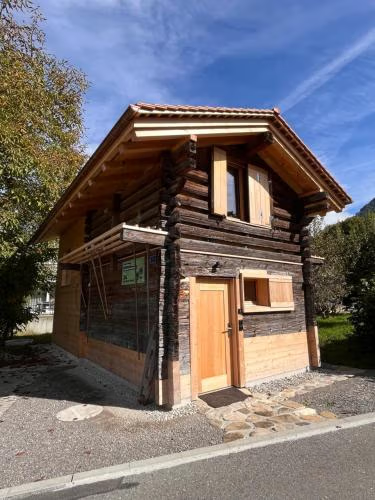
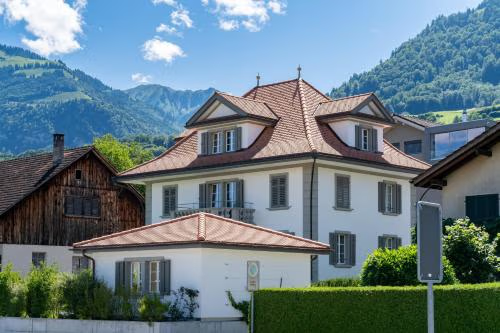
Places to stay in Sachseln.
 Open
Nida Geisser und Lukas Joller
- Open
Silvia Harvey
- OpenReservations accepted
Sonja Emma und Fridolin Schnider




Town 13 of 28