

Stage town on the Camino
León
León, Castilla y León, Spain
- places to stay
- 42
- Caminos
- 3
- Elevation
- 834 m
León is the city of light on the Camino Francés: in the Gothic cathedral the day pours through 737 stained-glass windows, and in San Isidoro kings lie beneath Romanesque frescoes. After the Meseta, a rest day here is time well spent. At San Marcos the Camino San Salvador sets off, about 121 kilometres to Oviedo.
Right now in León (as of October 2026)
- Carbajalas closing: The Benedictine nuns' albergue is open from 1 March to 31 October. In winter, ask in advance whether they are taking pilgrims.
- Cathedral in winter: The winter timetable has applied since 1 October: Monday to Saturday 9:30–13:30 and 16:00–19:00, Sundays and holidays 9:30–11:30 and 13:00–15:00. Admission €8, free on Tuesdays 17:30–19:00.
- Stained glass under repair: A restoration of the stained glass and the west portal is starting and is expected to take four to eight years. Individual windows, including rose window VIII, are being taken out and restored in the workshop.
How long to stay?
Worth a rest day, just not on a Monday. The cathedral alone fills a morning if you give the windows the time they deserve. The San Isidoro museum with the royal pantheon takes another hour, and it is closed on Mondays. Then there are San Marcos, Gaudí's Casa Botines and, in the evening, the Barrio Húmedo. After a week on the Meseta, a day without your pack does you good anyway, and beyond León the land starts to climb again. If you start in León, allow at least an afternoon for your credencial and the cathedral.
León in Ninja numbers
- More than 55,000 pilgrims passed through León in 2025, according to the city's pilgrim association. 39,233 of them slept in albergues.
- 737 stained-glass windows fill the cathedral, more than 1,765 square metres in all.
- 2,677 South Koreans walked through León in 2025. That puts them fourth, after Spaniards, Italians and French, ahead of Americans and Germans.
- Around 140 bars are squeezed into a couple of streets in the Barrio Húmedo.
- 314 kilometres separate León from Santiago, according to Camino Ninja.
Arriving: from the Portillo through Puente Castro
Coming from Mansilla de las Mulas, you walk just under 19 kilometres on the Camino Francés. At the Alto del Portillo on the N-601 main road you see León below you for the first time. Then you go down to Puente Castro, once a Roman settlement and a suburb of traders, and over the bridge across the Torío into the city.
Beyond the Barrio de Santa Ana the route follows Calle Barahona, Puerta Moneda, Herreros and the Rúa to the Plaza de San Marcelo. On the way you pass the Plaza de Santa María del Camino, which locals call the Plaza del Grano, home of the Carbajalas albergue. Calle Ancha brings you to the cathedral.
In brief: camp, kingdom, parliament
León began as a military camp. In 74 AD the Roman Legio VII Gemina settled here for good, and "Castra Legionis", the camp of the legion, gave the city its name.
In 910 the kings of Asturias moved their court from Oviedo to León, and the city became the capital of a kingdom of its own. Around 987 Almanzor sacked it, and Alfonso V rebuilt it. In 1188 Alfonso IX summoned nobles, clergy and representatives of the towns here. In 2013 UNESCO recognised these Cortes as the cradle of parliamentary government. Today León has about 123,000 inhabitants.
The city of light
After days on the Meseta you have mostly seen sky, plenty of light and little shade. In León that light comes indoors. The cathedral was built between 1205 and 1301 on the model of Reims, and its roughly 1,800 square metres of glass are its glory. Most of the panes date from the thirteenth to the fifteenth century. Locals call their cathedral "Pulchra Leonina", the beautiful one of León.
Light comes at a price. Glass is fragile, and the cathedral already had a complete restoration from 1859 to 1901. Now another major cure is beginning: the church and the regional government have agreed on eleven million euros for the windows and the west portal. Take your time, sit down in a pew and just look up.
Light and stone: what to see
Everything is in the old town or right on the Camino, and the walk follows the route: cathedral, San Isidoro, the walls and San Marcos come one after the other.
- Catedral de Santa María: The Gothic cathedral was built almost entirely between 1205 and 1301, and its plan is a scaled-down copy of Reims. For pilgrims it is the second of the three great cathedrals on the Camino, between Burgos and Santiago. The Virgen Blanca, the White Virgin, stands at the west portal. During the nineteenth-century restoration the baths of the Roman legion were found beneath the building, larger than the church above them. Admission €8, free on Tuesdays from 17:30 to 19:00 (as of October 2026). Because windows are being removed, there may be gaps. Services sometimes interrupt visiting hours.
- Real Colegiata de San Isidoro: The collegiate church stands right on the way out of town. Its Panteón de los Reyes, the burial vault of the kings of León, is called the "Sistine Chapel of the Romanesque" because the frescoes are still where they were painted. The museum holds the Chalice of Doña Urraca from the eleventh century, along with reliquary caskets in ivory and Limoges enamel. Museum with pantheon €6, with a guided tour €8, the whole collegiate church €10. In winter Tuesday to Saturday 10:00–14:00 and 16:00–19:00, Sundays 10:00–14:00, closed on Mondays. On Wednesdays from 16:00 to 18:00 there are only free guided tours (as of October 2026).
- San Marcos: In the twelfth century a hospital for pilgrims was founded here, later the seat of the Order of Santiago in the Kingdom of León. The present building with its long Plateresque façade on the Bernesga was begun in the sixteenth century and finished in the eighteenth. The poet Francisco de Quevedo was imprisoned here from 1639 to 1643, and during the Civil War it was a prison camp. Today it is a Parador. What matters to you is the square in front: a stone pilgrim rests at the foot of the stone cross, and this is where the Camino Francés and the way to Oviedo part.
- Casa Botines: Antoni Gaudí built this house for textile merchants at the same time as he was designing the Bishop's Palace in Astorga. Today it is the Museo Gaudí. 2026 marks the hundredth anniversary of his death. When you reach Astorga the day after tomorrow, you will see the second Gaudí building on the Camino. We could not find opening hours and prices for 2026.
- The Roman walls: León's city walls are among the oldest in Spain. As it leaves the old town, the Camino runs alongside them on Calle Ramón y Cajal. Other stretches stand on Avenida de los Cubos and at the Arco de la Cárcel.
Food and drink
León is a tapas city, and the Barrio Húmedo to the right of Calle Ancha is its heart. Around the Plaza de San Martín there are some 140 bars. In many of them every drink comes with a small free tapa, so an evening of three glasses turns into dinner. Some bars specialise in morcilla, blood sausage, and the wine often comes in a thick tumbler. Nobody knows for sure where the name "the damp quarter" comes from. One explanation: so much loose wine once flowed here that the streets were wet.
Honestly
- The cheap convent albergue closes at the end of October. In winter you are mostly left with private hostels, usually €15 to €25 for a dormitory bed. Budget accordingly.
- Many hostels are not pilgrim albergues. You often share the dorm with tourists, and pilgrims report noise in the rooms and from the street. In León, earplugs belong in your pocket.
- The windows are a work in progress. When individual windows are out, you will not see the full splendour. This may go on for years.
- In and out along the road. You arrive via the Portillo on the N-601, and the way out to the west runs through suburbs and, as far as Villadangos, close to the N-120.
Where pilgrims sleep
- Albergue de las Benedictinas Carbajalas: León's classic pilgrim albergue, in the Benedictine nuns' convent on the Plaza del Grano, set up in the early 1990s together with the city's pilgrim association. 85 places, women and men sleep separately. You pay by donation and cannot book. Check-in 12:00 to 22:00, after which you cannot go out again. There is no proper kitchen, only a microwave and a kettle. In the evening there is Mass, Vespers and the pilgrim blessing. Open from March to October.
- Albergue-Residencia San Francisco de Asís: the Capuchin friars' house, dormitory beds from €12. Pilgrims like the six-bed rooms with their own bathroom and the hospitalero, and the kitchen is in the basement.
There are also plenty of private hostels in the old town, usually €15 to €25 for a dorm bed. León has had no municipal albergue since 2012.
Ninja tips
- Be back with the nuns before 19:00: If you sleep at the Carbajalas and want to experience Mass, Vespers and the blessing, be back in good time before 19:00. For many it is the quietest evening after the Meseta.
- Tuesday evening at the cathedral: From October to April admission is free on Tuesdays from 17:30 to 19:00.
- San Isidoro on Wednesday afternoon: On Wednesdays between 16:00 and 18:00 the museum offers free one-hour guided tours, first come, first served.
- Tapas instead of a pilgrim menu: Three drinks with free tapas in the Barrio Húmedo often replace dinner.
- Tomorrow: left or straight on: Beyond La Virgen del Camino the route forks. Decide tonight whether to stay by the N-120 or take the quieter variant via Villar de Mazarife, and think about both days to Astorga.
Practical tips for pilgrims
- Sunday: On winter Sundays the cathedral is only open until 15:00, with a break from 11:30 to 13:00. The San Isidoro museum closes at 14:00 on Sundays.
- Shopping: León is the last big city before the mountains. Whatever you are missing, shoes, plasters, rain gear, is best bought here.
- Getting here and away: León is a classic starting point for the Camino Francés and can be reached by train and bus via Madrid.
Onward: San Marcos, and then two ways
The Camino leaves the old town past San Isidoro, along the Roman walls and across the Plaza de San Marcos. There the routes divide.
On the Camino Francés you cross the Bernesga and a footbridge over the railway to Trobajo del Camino and La Virgen del Camino, 7 kilometres according to Camino Ninja. There the route forks. Straight on, the historic route runs beside the N-120 to Villadangos del Páramo (20.5 kilometres) and on to San Martín del Camino (25 kilometres). To the left, the quieter variant follows farm tracks to Villar de Mazarife, about 21 kilometres, with less shade and more distance on the second day. The two meet again before the bridge of Hospital de Órbigo. Astorga is just under 50 kilometres away according to Camino Ninja.
The Camino San Salvador turns north just after San Marcos, follows the Bernesga and climbs over the Cantabrian Mountains to Oviedo, 121 kilometres according to Camino Ninja. The first larger stage town is La Robla, after a little over 27 kilometres.
What awaits you tomorrow
Your first day out of León is a day of decisions. In La Virgen del Camino stands a basilica built from 1957 to 1961, with the apostles on its façade and bronze doors attributed to the sculptor Subirachs. A modern church on the old way, unexpected after all that Gothic. Most pilgrims end this day in San Martín del Camino.
And the day after, the medieval bridge of Hospital de Órbigo is waiting, where the two routes come together again.
Deep dive: A legion, a kingdom and a house of light
A long read, in case you want to learn more about León. About twenty-five minutes' reading.
Beneath the glass
Stand in the nave of the cathedral and wait until your eyes adjust. After the days on the Meseta, where the light comes from every side and stays nowhere, this is a different light. It falls through glass, it has colours, and it moves across the floor while you stand there. The walls seem almost to be missing. Where other churches have stone, this one has colour.
León is the city where you feel this most clearly. But the cathedral is only the latest chapter of a long story. Beneath its floor lie the baths of a Roman legion. A few hundred steps away, the kings of a realm that no longer exists rest under frescoes that have been on their ceiling for more than eight hundred years. By the river stands a palace that was once a pilgrim hospital, then a prison, then a camp, and is now a hotel. And in the middle of the old town stands a house by Gaudí that several of the city's engineers considered a danger.
This text tells the story of this city as far as it can be documented. Where the sources are silent or disagree, it says so.
The legion between two rivers
In the beginning León was not a town but a camp. Around the year 29 before Christ, during Rome's wars against the Cantabrians and Asturians in the north, the Sixth Legion pitched its camp between the rivers Bernesga and Torío. About a hundred years later another force arrived, one that shapes the city to this day. On 10 June 68 the future emperor Galba had raised a new legion, the Seventh. Vespasian filled its ranks with the remnants of another unit, and that is where its epithet Gemina came from, meaning roughly the double one. In the year 74 it moved into the old camp on the Bernesga and stayed.
It stayed for a remarkably long time. For centuries the Legio Septima Gemina was the only legion permanently stationed on the Iberian Peninsula. Its task was to keep the mountain peoples of the north in check. Some historians suspect it also guarded the gold mines of Las Médulas, but that is a theory. Detachments of the legion fought in Dacia, on Hadrian's Wall and against Palmyra. Its trail only fades in the early fifth century.
The legion's camp gave the city its name. The Latin word legio, in the accusative legionem, became León by way of forms such as Leyone and Leyón. The name originally has nothing to do with the lion that stands on the coat of arms today. The lion only came into the coat of arms later.
You can see more of the legion than you might think. When you leave the old town tomorrow morning, you walk along the old wall. Beneath the cathedral, in the nineteenth century, the legion's baths were found, larger than the church above them. A brick bearing the name of the emperor Antoninus Pius suggests they were built in the second century, and they were still in use in the fourth. In 1996 archaeologists uncovered a gate of the old camp at the Puerta Obispo. So in León you quite literally pray above a Roman bath, next to a Roman gate.
A capital on ruins
After the Romans came the Suebi and the Visigoths, and in 712 the Muslims conquered the city. Alfonso the First of Asturias took it back in 754, but it lay on the frontier, and for almost a hundred years hardly anyone lived in it. Only Ordoño the First resettled it around the middle of the ninth century. He set up his palace, of all places, in the old Roman baths.
In 910 León became a capital. Ordoño the Second moved the court here from Oviedo, and the Kingdom of Asturias became the Kingdom of León. After defeating a Muslim army at San Esteban de Gormaz in 916, he gave his palace to the Church. Within the walls of the baths where the king had lived, the first cathedral was built. Ordoño the Second died in Zamora in 924. His tomb now stands behind the high altar of the cathedral, and the recumbent figure dates from the thirteenth century.
The capital was never safe. At the end of the tenth century Almanzor, the military leader of the Caliphate of Córdoba, came and laid it waste. He had the small church that stood over the relics of the martyr Pelagius razed. Yet as early as 999 Alfonso the Fifth was crowned in the restored cathedral. He rebuilt the city.
A saint from Seville
This royal city needed a saint. Ferdinand the First, King of León and Castile, and his wife Sancha rebuilt the church of Pelagius and made it their family's burial place. What was missing was a great relic.
The opportunity came from the south. The Caliphate of Córdoba had broken apart, and the small Muslim kingdoms that took its place had to pay tribute to the Christian kings. Abbad the Second, known as al-Mutadid, the ruler of Seville, gave Ferdinand, along with money, something worth more to the king: the bones of Saint Isidore. Isidore had been Archbishop of Seville in the seventh century, the most famous scholar of Visigothic Spain, a man whose books were read throughout the Middle Ages. A Christian poet later put a farewell into al-Mutadid's mouth. He is said to have spread a brocade cloth over the coffin and said: "Now you are leaving here, revered Isidore."
In 1063 the relics arrived in León, and the church got a new name: San Isidoro. A community of canons following the Rule of Saint Augustine has guarded them ever since. To this day León celebrates the saint's arrival in December. A brotherhood, the Cofradía del Milagroso Pendón de San Isidoro, marked the nine hundred and sixty-second anniversary in December 2025.
For pilgrims, this made San Isidoro an essential stop. The pilgrims' guide in the Codex Calixtinus, written around the middle of the twelfth century, says so explicitly. In essence it says that in León the venerable body of Saint Isidore is to be visited, bishop, confessor and doctor, who enlightened the Spaniards with his teaching. So when you walk through San Isidoro today, you are following an instruction almost nine hundred years old.
As you leave, look up at the façade. A saint rides there with his sword drawn. At first glance you think of Santiago Matamoros, the Moor-slayer, as you may already have seen him in other churches. But here it is Isidore himself, in the same pose. In León even the scholar from Seville was turned into a warrior.
The crypt of the kings
The heart of San Isidoro lies in the museum, and you can only reach it through the museum: the Panteón de los Reyes, the burial place of the kings. Ferdinand and Sancha wanted it as a family crypt, and their daughter Urraca had it built after 1065 together with the portico and the gallery above. According to the usual figures, eleven kings, twelve queens, ten infantes and other members of the court lie here, among them Urraca the First, who was called the Reckless.
But what draws people here is not the tombs, it is the ceiling. In the twelfth century a master whose name nobody knows, and whom art history simply calls the Master of San Isidoro, painted the vaults. He painted in fresco, onto the fresh plaster, and that is why the colours are still there, gold, ochre, a greyish green. The room is called the Sistine Chapel of the Romanesque.
Take your time with the scenes. In the centre Christ is enthroned as ruler of the world, holding in his left hand an open book with the Latin sentence: I am the light of the world. Around him are the signs of the four evangelists, the angel, the ox, the eagle and the lion. Then the stories: the Annunciation, the Massacre of the Innocents in Bethlehem, the Last Supper, the Revelation of John.
The most beautiful scene is the simplest. An angel brings shepherds the news of the birth of Christ. One of the shepherds is drinking wine from a leather skin, another is blowing a horn, dogs and goats leap about. It is a picture from the lives of the people who lived around León back then.
Even closer to their daily life is the calendar on one of the arches. Every month has its work. In April they sow, in September they harvest grapes, in November they slaughter the pig. Above it stands Christ as Lord of Time. If you pass through León in autumn, you can compare the pictures of the months with what you have seen out in the fields.
In July 2022 a restoration of the paintings began, during which the museum stayed open. Since then the guided tours have explained how the frescoes were painted.
Two doors and a misunderstanding
San Isidoro has two Romanesque portals on its south side. The main door is called the Puerta del Cordero, the Door of the Lamb. Its tympanum, made before 1100, shows the sacrifice of Abraham. Next to it, on the south transept, is the second door, the Puerta del Perdón, the Door of Forgiveness. The city of León attributes its reliefs to a master builder named Esteban, who is said to have gone on to work at the cathedral of Santiago. In the tympanum you see the Descent from the Cross, the three Marys at the empty tomb and the Ascension.
A story has grown up around this door that you may already have heard. Sick pilgrims who could no longer make it to Santiago are said to have received the same indulgence here as at the Apostle's tomb. We tried to verify this and did not find it. Neither the city of León nor the art guides we read tell this story. As far as we can see, it belongs to another place. In Villafranca del Bierzo, several stages further west, the church of Santiago also has a Puerta del Perdón. There it is said that anyone who was ill or too weak for the last mountains could receive forgiveness at this door, as if they had reached Santiago. Even there, the stories of papal privileges rest mainly on tradition.
So we do not know for certain why the door in León is called the Puerta del Perdón. Doors of this name exist at several great churches in Spain. What can be said is this: a sculptor said to have worked on this door went on to the Apostle's tomb. In that sense a trail leads from here to Santiago too.
The infanta's chalice
In the museum of San Isidoro there is a small vessel that has been argued over in recent years more than any other piece in León. It is the Chalice of Doña Urraca. It consists of two very old onyx bowls, one as the cup, the other as the foot. In the eleventh century the infanta Urraca, daughter of Ferdinand the First, had them mounted in gold and set with her own jewels, with sapphires, pearls and emeralds. On the foot, in Latin letters: In the name of the Lord, Urraca, daughter of Ferdinand.
In 2014 a book appeared in Madrid with the title Los reyes del Grial, the kings of the Grail. In it, Margarita Torres and José Miguel Ortega del Río put forward a bold thesis: the upper onyx cup was the cup of the Last Supper. They relied on medieval Arabic texts from Cairo. According to these, the Caliph of Egypt sent the cup around 1055 to the ruler of Denia, in thanks for grain during a famine, and he passed it on as a gift to Ferdinand the First. As further evidence the authors cited a small chip on the cup, noticed in 2010 when the chalice was taken apart for a replica.
The experts were sceptical, and they stayed that way. In 2015 the French historian Patrick Henriet accused the authors of mixing science and fiction. In the same year the Spanish historian Alejandro García Sanjuán criticised the unclear origin of the documents and their translation, and called the book a strategically designed commercial work. In 2017 the Granada researcher Luis Molina argued that the Cairo text is in fact a eulogy of a caliph of Córdoba, written almost a hundred years before the cup is supposed to have reached Denia.
What remains when you stand in front of the display case? A work of great beauty that a king's daughter had made from her own jewellery almost a thousand years ago. Whether it is more than that is not for you to decide. Most historians say no. The story of the Grail has many places, and León is only the most recent to lay claim to it.
Spring 1188
In the cloister of San Isidoro, in the spring of 1188, something happened that makes the city prouder today than any chalice. Alfonso the Ninth had just come to the throne. His kingdom was at war with Portugal and Castile, the reconquest of the south had stalled, and the crown needed money. New levies were driving up prices. In this situation the king summoned his court, nobles and bishops, as was customary. What was new was that he also summoned elected representatives of the main cities, with a vote.
What was decided there has come down to us in the so-called Decreta. The king promised not to start a war or make peace without hearing those whose counsel he owed. The inviolability of the home was recognised, disputes were to be settled in court and not by force, and citizens and their property were protected against abuses, including abuses by the nobility, the clergy and the king himself. In León some call this the Magna Carta Leonesa, twenty-seven years before the English one.
In 2013 UNESCO added the Decreta to its Memory of the World register as the oldest documentary record of European parliamentarism. Since then León has called itself the cradle of parliamentarism.
This is not entirely undisputed, and it is worth taking an honest look. Iceland already had its assembly, the Althing, around 930, though without written laws until the thirteenth century. Many experts stress that the Decreta introduced little that was new and above all strengthened the pact between the king and the powerful. Some of what is now attributed to the year 1188 grew over the whole reign of Alfonso the Ninth. And the cities were asked for sober reasons: the king needed their money. But perhaps that is exactly the core of every parliament. Those who pay want a say. In León this was written down for the first time, as far as we know.
A cathedral modelled on Reims
The cathedral you stood in is the third on this site. Above Ordoño's palace a Romanesque church was built in the eleventh century, consecrated on 10 November 1073. But in the thirteenth century León wanted something different. Around 1205, under Alfonso the Ninth, work began on a new church in the style that came from France. Construction soon stalled because the foundations caused problems.
In 1255 work began in earnest. Bishop Martín Fernández drove the building forward, supported by King Alfonso the Tenth, known as the Wise. The master builder was a Master Enrique, probably a Frenchman, who had previously worked in Burgos. So if you saw the cathedral of Burgos a week ago, you may already have seen work by the same man. Enrique died in 1277, and a Spaniard named Juan Pérez took over. When Martín Fernández died in 1289, services were already being held in the choir, and in 1302 Bishop Gonzalo Osorio opened the whole church to the faithful. The towers came later, the north tower in the fourteenth century, the south tower in the fifteenth.
The model was Reims. The ground plan of León is almost a reduced copy of the French coronation cathedral. But León took the idea of the Gothic very far: little wall, much glass. Hence the name the cathedral already bore in the fifteenth century. A Latin saying of the time listed the great churches of Spain: Sancta Ovetensis, pulchra Leonina, dives Toledana, fortis Salmantina. The holy one of Oviedo, the beautiful one of León, the rich one of Toledo, the strong one of Salamanca. Pulchra Leonina, the beautiful one, is what she is called to this day. The city's pilgrim association bears the name too.
Eighteen hundred square metres of light
Exactly how much glass there is depends on whom you ask. In the nineteenth century the architect Demetrio de los Ríos measured around one thousand seven hundred and sixty-four square metres. Other figures speak of eighteen hundred. According to the latest figures there are seven hundred and thirty-seven individual stained-glass windows. Most date from the thirteenth to the fifteenth century, some from the Renaissance, others from the restoration in the nineteenth century.
The windows follow a plan, and once you know it you can read the cathedral. Below, at eye level, they show plants and everyday work. In the middle, in the triforium, the coats of arms of nobles, churchmen and cities. Above, in the high clerestory, the great biblical stories. On the cooler north side stands the Old Testament, on the warmer south side, where the sun is, the New. The builders turned light itself into theology.
Three great rose windows close off the arms of the church. The west rose above the main portal dates from the late thirteenth century and shows the Virgin with the Child, surrounded by twelve angels. The north rose shows Christ with twelve musicians. The south rose is entirely from the nineteenth century. In the choir you find the Tree of Jesse, the family tree of Christ. And there are windows that are not pious at all. In the upper band of windows on the north side hangs a hunting scene, La cacería, which may have come from a royal palace.
So much light has its price, and León has paid it several times. In 1631, after a collapse, Juan de Naveda placed a dome over the crossing that put too much strain on the walls. In the nineteenth century the cathedral was close to collapse. In 1859 Matías Laviña took over and began dismantling parts of it. After his death in 1868 Juan de Madrazo devised a timber framework that held up the whole building while it was rebuilt. Madrazo was dismissed in 1879 and died a few months later. From 1880 Demetrio de los Ríos built the neo-Gothic west front, and Juan Bautista Lázaro completed the work and in 1895 began restoring the glass. Only in 1901 did the cathedral reopen.
The worry about the glass has never ended. Since 2009 exterior grilles and a second layer of glazing have protected the windows, under the lovely project name León Cathedral, the dream of light. When this text was written, in autumn 2026, the next major cure was beginning. Church and region had agreed on eleven million euros for the windows and the west portal, the first phase for the windows of the transept. Individual windows, among them rose window number eight, were to be removed and restored in a workshop. It is expected to take four to eight years. If a window is missing when you visit, now you know why.
What else you find in the cathedral
Before you go in, stop in front of the west front. On the central pillar of the main portal stands the Virgen Blanca, the White Virgin. What you see is a copy by the sculptor Andrés Seoane. The original has stood inside in a chapel since 1954. Above her Christ sits at the Last Judgement, and the Archangel Michael weighs the souls. Among the blessed, so it is explained, you can recognise King Alfonso the Tenth, holding musical instruments.
Among the figures of the west front there is also a Saint James, recognisable by the scallop shell on his hat. His pedestal is worn, rubbed smooth by the hands of the pilgrims who have touched it for centuries. It is a small detail and perhaps the most beautiful pilgrim sign in the cathedral. Put your hand there too, if you like.
On the south side a portal tells the life of Saint Froilán, a bishop of León whom the city still venerates as its patron. Pilgrims went through it to visit his remains. They lie in a shrine made by Enrique de Arfe between 1519 and 1522.
Inside, the choir stalls are worth a look. They were carved from walnut between 1461 and 1481, and among the saints and prophets hide mocking scenes about the clergy. The stone screen closing off the choir, the trascoro, was made by Juan de Badajoz the Younger in Renaissance style, and its reliefs were completed by 1590. Behind the high altar lies Ordoño the Second, the king who had given his palace to the Church.
And then there is the thing above the door. Above the left west portal hangs a piece of leather that people took for the skin of an evil mole, el topo maligno. In the 1990s it was examined more closely. It is the shell of a leatherback turtle, a sea turtle.
If you look up as you leave, you may see storks on the pinnacles of the choir. They nest there, and some stay for the winter.
Pilgrims in León
How did pilgrims reach León in the past? The pilgrims' guide in the Codex Calixtinus describes the stages. The eighth runs from Sahagún to León, the ninth from León to Rabanal. After Mansilla, it says, comes León, city and seat of the royal court, full of all kinds of goods. The author also knows the rivers: the Porma, crossed by a huge bridge between Mansilla and León, the Torío, which flows through León at the foot of the castle of the Jews, and the Bernesga on the other side of the city.
You already know this castle of the Jews, even if you did not notice. It is Puente Castro, the suburb you walked through into the city today. In the Middle Ages it was called Castrum Iudeorum, and it was home to León's oldest and most important Jewish quarter. In 1196 Castilian and Aragonese troops destroyed it. The Jewish inhabitants moved into the city, to the Santa Ana quarter, which you walked through right afterwards. A memorial stone remembers them today.
Pilgrims entered the old town through the Puerta Moneda. Not far beyond it stands the church of Santa María del Camino, also called del Mercado, on the Plaza del Grano. Its oldest part is Romanesque. In the early eighteenth century the apse was torn down to build a space for an image of the Virgin from the fifteenth century, the Virgen del Camino, Our Lady of the Way. On the same square today is the hostel of the Benedictine nuns, the Carbajalas. If you sleep there and go to the pilgrim blessing in the evening, you are continuing a very old custom, almost on the same spot.
San Marcelo on the Plaza de San Marcelo had a hospital too. After its destruction by Almanzor the church was rebuilt in 1096, and a hospital was founded with it. The bones of Saint Marcellus, a Roman centurion and martyr, came here from Tangier in 1493.
And pilgrims kept coming, for centuries. In 2025 the pilgrim association Pulchra Leonina counted more than fifty-five thousand people from one hundred and four countries passing through León. 39,233 of them slept in hostels. Spaniards were the largest group, followed by Italians and French, and in fourth place, ahead of Americans and Germans, South Koreans. Six pilgrims were over ninety years old. The oldest, an Italian woman of ninety-five, stayed overnight in León in May.
San Marcos: a hospital for the poor of Christ
When you leave the old town to the west, you reach the Bernesga and stand before a building that looks more like a palace than a hostel. Yet that is exactly how it began.
In July 1152 the infanta Sancha Raimúndez, sister of King Alfonso the Seventh, donated land outside the city walls, by the bridge over the Bernesga. She gave it to an archdeacon named Arias on one condition: he was to build a church and a hospital for the pobres de Cristo, the poor of Christ. The house served as a church and hospital for pilgrims on the way to Santiago.
Soon a powerful new master arrived. Around 1170 a military order had been founded in the Kingdom of León bearing the name of the Apostle, the Order of Santiago. Its knights were to defend the frontier against the Muslims and protect the pilgrims. In 1176 San Marcos passed to the order and became its most important house in the Kingdom of León. In 1184 the first Grand Master of the order, Pedro Fernández de Castro, was buried in its church.
The building you see today is much younger. By the early sixteenth century the old hospital had fallen into ruin. Ferdinand the Catholic, himself a member of the order, funded a new building in 1514. Juan de Orozco built the church, Martín de Villarreal the façade, Juan de Badajoz the Younger the cloister and the sacristy. In 1541 the church was consecrated. Then the order moved away, came back in 1602, and the long building was only finished in the eighteenth century.
Read the façade, it is a picture book. Along the base runs a row of medallions with heads from history and legend, Hercules, Hector, Hannibal, Julius Caesar, Judith, Lucretia, Charlemagne, El Cid, Isabella the Catholic, Ferdinand, Charles the Fifth, Philip the Second. Above the main portal Santiago rides in the Battle of Clavijo, the legendary battle in which, according to tradition, the Apostle appeared on a white horse. On the tower that closes the façade on the river side you see the cross of the order and the lion of León. The church front next to it is covered with symbols of the Order of Santiago. And in front of the house, on the square, a stone pilgrim rests at the foot of a stone cross, in front of a house that was once built for people like him.
A poet in chains
San Marcos was not only a hospital and the house of an order. It was also a prison, and its most famous prisoner was one of Spain's greatest poets. Francisco de Quevedo, satirist, moralist, knight of the Order of Santiago, was arrested in 1639 on the orders of the Conde-Duque de Olivares, the most powerful man at the court of Philip the Fourth, and brought to León. He stayed here for almost four years, until 1643.
In his letters he describes his imprisonment. His wounds had become infected, there had been no surgeon, and he had had to cauterise them himself. He lived on alms. He called himself "un vivo enterrado", a man buried alive. And he wrote. In this cell he produced a life of Saint Paul, a book on the constancy and patience of Job, and a work on the providence of God. In 1643 he was released, and two years later he died.
The twentieth century gave San Marcos a darker history. After the religious community was dissolved in 1836, the building served as a school, a veterinary school, barracks, a prison and a stud farm for stallions. From 25 July 1936, a few days after the start of the Civil War, it became a camp for Republican prisoners. Until 1940, at times up to six thousand seven hundred men were held there. How many died there is disputed, and the figures vary widely. A survivor, Gabriel Montserrate Muñoz, later recounted that the sick were loaded onto the cart for the dead, and some were still alive. In 2007 the Museo de León placed a memorial stone to the victims in one of its rooms, and in 2021 an association for the recovery of historical memory campaigned for another on the square.
Later San Marcos became a state-run hotel, a Parador. Whoever sleeps there today sleeps in a building that was built for pilgrims and in which people suffered. Both belong to this place.
Gaudí and the merchants' house
In the middle of the old town, not far from the cathedral, stands a house that looks like a small castle with pointed turrets. It is the Casa Botines, one of the few buildings that Antoni Gaudí built outside Catalonia.
It was commissioned by two textile merchants, Simón Fernández and Mariano Andrés, whose firm went back to a Catalan named Juan Homs y Botinàs. Hence the name. Gaudí had been recommended to them by his great patron, the industrialist Eusebi Güell from Barcelona. Gaudí accepted partly because he was working nearby at the time. In Astorga he was building the bishop's palace. When you arrive there in two days, you will see the second Gaudí building on the Camino. The plans arrived in December 1891, construction began on 4 January 1892, and after only ten months, in November 1892, the house was finished.
The people of León did not trust the building. Gaudí set the house on foundations of the kind used in Catalonia, and several of the city's engineers declared that on this ground it would not hold. Gaudí answered in his own way. He asked the critics to submit their objections in writing and signed, so that he could display them in the entrance hall once the house was finished. The house still stands.
Above the entrance Saint George fights the dragon. In 1953 there were plans to replace the figure with a Virgin, the Virgen del Camino. In the process workers found a lead tube behind the statue. Inside were Gaudí's signed plans, the purchase contract for the plot, the record of completion and newspapers from León. Gaudí had left a time capsule. Saint George stayed. Today it is a replica, carved by Andrés Seoane in 1956.
In 1929 the savings bank of León bought the house, and it later belonged to Caja España. Since 23 April 2017 it has been a museum. When this text was written, in 2026, it was the hundredth anniversary of Gaudí's death, and in June León honoured him with a Mass in the cathedral.
Decline and return
León was a capital as long as there was a kingdom of its own. In 1230 Ferdinand the Third, already King of Castile, also inherited León, and the two crowns remained united. León lost its court. In the fourteenth century came hunger and crisis, and in 1349 and 1350 the plague. The city remained important, but it became provincial.
In July 1808 Napoleon's troops took León, and only in June 1812 were they gone again. In 1833 León became capital of the new province, in 1863 the railway arrived, and with it the city grew beyond its old walls. In 1979 León got a university.
The Camino, too, was quiet for a long time. San Marcos became barracks and a prison. Only towards the end of the twentieth century did pilgrims return in large numbers. In the early nineties the Benedictine nuns of Santa María de Carbajal, together with the pilgrim association Pulchra Leonina, opened rooms in their convent. The municipal hostel closed in 2012 during the economic crisis, the nuns stayed. Today pilgrims sleep in convents and hostels, and in the evening they wander through the Barrio Húmedo, where every glass comes with a small tapa.
On the square in front of San Marcos two ways part today. One goes west, via Astorga and over the mountains to Santiago. The other leads north, over the Cantabrian Mountains to the cathedral of San Salvador in Oviedo, the old capital from which the kings came to León in 910. Whoever takes this way walks their move in reverse.
What León gives you
This city has many layers, and they all lie on top of one another. A camp, then a palace in the baths, then a church in the palace, then a cathedral over everything. A hospital for the poor of Christ that became a palace, a prison, a camp, a hotel. A saint who came from Seville, and a chalice people argue about. None of it has completely disappeared. It just lies beneath what came after.
Perhaps it is similar with you right now. Beneath the pilgrim walking through León today lies the person who set out a few weeks ago, and beneath that, the one who first had the idea. The Meseta has not taken the layers away, it has only laid them bare.
In the end León always comes back to the same thing, to the light. The builders of the thirteenth century made the walls as thin as they dared, so that as much of it as possible could come in. You do not have to believe anything to understand that. Sit down in a pew, ideally in the late afternoon, when the sun is on the south side and the New Testament glows. Watch where the light falls. Tomorrow you walk on, and the land begins to rise again.
Where to stay in León
The places pilgrims rate highest in León come first.
- Top #1
 OpenReservations not accepted
Albergue Pilgrims Benedictinas Santa Maria de Carbajal
KitchenMicrowaveWater BoilerAnd more - Top #2
 OpenReservations accepted
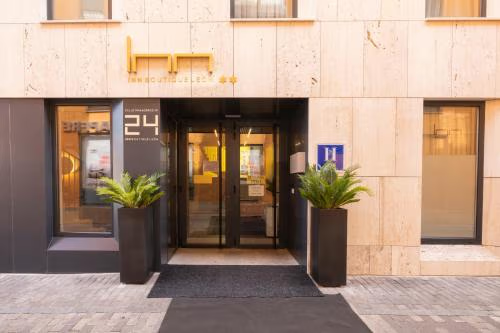
Inn Boutique León
- Top #3
 OpenReservations accepted
Quartier León Jabalquinto


Services in León
What you can find in town before the next stage.
- ATM
- Café
- Shop
- Tobacco
- Medical clinic
- Pharmacy
- Fountain
- Post office
- Train station
- Bus station
- Airport
- Restaurant
Source: © OpenStreetMap contributors · updated January 2025