


Stage town on the Camino
Astorga
León, Castilla y León, Spain
- places to stay
- 17
- Caminos
- 2
- Elevation
- 872 m
Astorga is a crossroads: after about 701 kilometres from Seville, the Vía de la Plata ends here and joins the Camino Francés. The Roman town on its hill has Gaudí's Bishop's Palace, a cathedral and a pilgrim tradition going back to 1121. An afternoon is enough, and tomorrow the mountains begin.
Right now in Astorga (as of October 2026)
- Gaudí year: 2026 marks the hundredth anniversary of Gaudí's death. Since May 2026 his Bishop's Palace has new gardens and new night lighting.
- Albergues in winter: The large Siervas de María albergue is open all year. Seasonal albergues along the route close one by one from mid-October.
How long to stay?
An afternoon is enough. The old town sits compactly on a hill, with the cathedral and the Bishop's Palace right next to each other. For both of them, a walk along the Roman walls and a plate of cocido, you do not need a whole day. But stay the night and do not walk on: beyond Astorga the route climbs towards Monte Irago, and this is where you stock up before the villages get smaller. If you come from the Vía de la Plata and have walked alone for weeks, you can take a rest day here to arrive properly on the busy Francés.
Astorga in Ninja numbers
- About 701 kilometres lie between Seville and here on the Vía de la Plata, according to Camino Ninja. In Astorga it ends.
- About 265 kilometres remain from here to Santiago, according to Camino Ninja.
- Since 1121 Astorga has taken in pilgrims. That year the Hospital San Feliz was founded, and the big pilgrim albergue stands on its site today.
- 41 chocolate factories existed in Astorga in 1916. Four are still working.
- 27 towers stood on the Roman town wall in the third century, along a little over two kilometres around the hill.
Arriving: two routes, one hill
On the Camino Francés you come from Hospital de Órbigo, a little over 17 kilometres according to Camino Ninja, via Santibáñez de Valdeiglesias and San Justo de la Vega. On the heights before San Justo stands the Crucero de Santo Toribio, a stone cross from which you see Astorga for the first time. Below, you cross the railway on a footbridge with zigzag ramps, then climb up into the old town. The Siervas de María albergue lies right on the route on the Plaza San Francisco, in the old town near the town hall.
On the Vía de la Plata you arrive from the south, from La Bañeza, just under 25 kilometres according to Camino Ninja. In Astorga this route ends and becomes the Camino Francés. If you came along the Plata wanting a shortcut to Galicia, you already turned off onto the Camino Sanabrés at Granja de Moreruela. That route does not join here.
In brief: gold, bishops, hospitals
Astorga began as a Roman camp of the Legio X Gemina towards the end of the first century BC. It grew into the town of Asturica Augusta, made rich by gold from the mountains, from Las Médulas among other places. Pliny called it a magnificent city. Parts of the Roman sewers still run beneath the streets today.
Around 249 a bishop called Basílides is mentioned, which makes Astorga one of the oldest dioceses in Spain. On the Camino the town became one of the great hospital towns: in 1121 the Hospital San Feliz was founded, and the town now wants to locate and signpost around twenty historic hospitals. Astorga and Burgos are considered the two towns on the Camino with the most hospitals. About 10,300 people live in Astorga today.
The crossroads: what to see
It is not only two Caminos that meet here. Roman roads met here, a Catalan architect met a Catalan bishop here, and here the high plateau meets the mountains. Everything lies close together on the hill of the old town. Unfortunately we could not reliably find opening hours and prices for autumn 2026 for any of the sights, so ask at your albergue.
- Palacio Episcopal de Gaudí: After a fire destroyed the old Bishop's Palace, Bishop Juan Bautista Grau asked his friend Antoni Gaudí for a new one. Gaudí's design was approved in 1889, and the foundation stone was laid in 1890. When the bishop died in 1893, Gaudí fell out with the cathedral chapter and left, and Ricardo García Guereta completed the building. Today the palace is the Museo de los Caminos, a museum dedicated to the Camino. For a pilgrim, that is the reason to go: a Gaudí building that is all about your own journey. Since May 2026 the palace has new lighting in the evening.
- Catedral de Santa María: Right next to the palace. A first cathedral was consecrated in 1069, the present building was begun in 1471 and only completed in the eighteenth century. That is why it is late Gothic inside and Baroque outside, with the right tower dating from 1704 and the left one only from 1965. Inside stands the high altar by Gaspar Becerra from 1558, a masterpiece of Spanish Renaissance sculpture.
- Roman Astorga: Two bath complexes, a temple of Augustus and a house with a mosaic of a bear and birds survive from Asturica Augusta. The Roman museum is housed in the cryptoporticus of the old forum, the Ergástula. If you have walked five weeks on the Vía de la Plata, here you stand at the end of the road the Romans built.
- Chocolate: From the middle of the nineteenth century to the first third of the twentieth, Astorga was a chocolate town, with 41 manufacturers in 1916. The chocolate museum tells the story. Four manufacturers are still working, and chocolate is good food for the mountains.
Food and drink
The best-known dish of the region is cocido maragato, a stew from the Maragatería, the land of the Maragatos around Astorga. It is eaten back to front: first the meat, then the chickpeas and vegetables, and the soup last. Afterwards there are mantecadas, small butter cakes, and chocolate. Mantecadas and cecina, air-dried beef, have a protected designation of origin based in Astorga.
Honestly
- The big albergue is noisy and cramped. Siervas de María has 156 places in dormitories of up to 30 beds. Pilgrims praise the kitchen and terrace but find the bathrooms dated and too few for so many people. If you want quiet, sleep at the Franciscans'.
- The last stretch drags. After the railway bridge you still have to climb up into the old town, at the end of a long day from Hospital de Órbigo or even from Villar de Mazarife.
- For Plata pilgrims it suddenly gets crowded. In 2024 about 9,000 pilgrims reached Santiago on the Vía de la Plata, while in 2025 more than 242,000 came along the Francés. If you come from the south, from here on you share paths, bars and dorms with far more people.
Where pilgrims sleep
- Albergue de peregrinos Siervas de María: the pilgrim albergue of Astorga's Camino association, with volunteer hospitaleros, in a former convent on the site of the old Hospital San Feliz. 156 places, €7 to €8, open all year, no reservations. There is a kitchen, and the washing machine and dryer cost €3 each. You can also get a credencial here.
- Franciscano Santa María de los Ángeles: the Franciscans' albergue near the cathedral and the Gaudí palace, 60 places, about €10. Most rooms have two beds, no bunks, and their own bathroom, and the kitchen is large.
- Albergue San Javier: a private albergue in an old house near the cathedral, 110 places, from €12. Pilgrims like the fireplace, the books and the foot bath, but criticise the big dormitory and the creaking beds.
There are also smaller private albergues, with dorm beds from about €15.
Ninja tips
- Evenings with the Franciscans: At 18:00 the pilgrims meet to share their experiences, and at 19:00 the friars celebrate Mass with a pilgrim blessing, individually if you wish. Many call it a highlight of their Camino.
- Mention your knees: At Siervas de María you do not always choose your own bed. If your knees, hips or feet hurt, say so when you arrive, so that you get a lower bunk.
- Supplies for Monte Irago: Astorga is the last town before the mountains. Shop here, for the following day too.
- Bring a stone: The day after tomorrow you reach the Cruz de Ferro, where pilgrims have left a stone brought from home for generations. If you do not have one yet, tonight is the time to think about what it should carry.
- See the palace at night: Since May 2026 the Gaudí palace has new evening lighting. A short walk after dinner is worth it.
Practical tips for pilgrims
- Credencial: If you start in Astorga, you can get your credencial at Siervas de María.
- Laundry: At Siervas de María the washing machine and dryer cost €3 each. The Franciscans have a large laundry room.
- Getting here and away: Astorga has train and bus connections to León and on to Madrid. If you finish the Vía de la Plata here, that is your way home.
Onward: up to Monte Irago
The Camino Francés leaves Astorga to the west through the Maragatería, heading for Monte Irago. Via Valdeviejas and Murias de Rechivaldo, after a little over 6 kilometres you reach the turn-off to Castrillo de los Polvazares, which lies 1.4 kilometres off the route. The way continues via Santa Catalina de Somoza and El Ganso to Rabanal del Camino, just under 20 kilometres according to Camino Ninja. Foncebadón is a little over 25 kilometres away, Ponferrada about 52.
What awaits you tomorrow
Tomorrow you walk into the Maragatería, and in the evening Rabanal del Camino awaits at the foot of Monte Irago, where most pilgrims from Astorga spend the night. Benedictine monks live in Rabanal and pray Vespers with the pilgrims in the evening.
If you have more energy, walk on to Foncebadón, and the morning after you will have only a short stretch left to the Cruz de Ferro.
Deep dive: Where the roads meet
A long read, in case you want to learn more about Astorga. About twenty-five minutes' reading.
A hill where two ways end
When you arrive in Astorga, the last stretch is uphill. The town sits on a hill above the plain, and if you come from the east, you have just crossed the railway tracks and then had to climb once more, at the end of a long day. At the top, the cathedral and Antoni Gaudí's bishop's palace stand so close together that they might have arranged to meet. And under your feet lie the remains of a Roman city.
Astorga is a place where ways come together. That was true before there were any pilgrims. Roman roads met here, gold from the mountains was gathered here, and the mule trains of the Maragatos passed through here on their way between Galicia and Madrid. Today the Camino Francés meets the Vía de la Plata here, the long way up from Seville. If you come from the east, the Meseta is behind you. If you come from the south, you have some seven hundred kilometres behind you, often almost alone. Tonight you sit in the same albergue.
This text tells how Astorga became this crossroads. It is about legionaries and gold seekers, about a bishop who went on pilgrimage to Jerusalem, about twenty hospitals, about a cathedral that took three centuries to build, about an architect who left in a quarrel, about carriers who were never robbed, and about chocolate.
A camp for the Tenth Legion
It begins with a war. Between 29 and 19 before Christ, the Emperor Augustus fought campaigns against the Astures and the Cantabri, the last peoples of the Iberian Peninsula who had not yet submitted to Rome. Towards the end of the first century before Christ, the Romans set up a camp on this hill for the Legio Decima Gemina, the Tenth Legion. Archaeologists have found two defensive ditches and the trenches where the posts of wooden buildings once stood. Spanish scholars usually date the founding to around 14 before Christ.
When the fighting was over, the soldiers moved on, and the camp became a civilian town. It took its emperor's name, Asturica Augusta, the town of the Astures that belongs to Augustus. As early as the year 27 after Christ, a pact of hospitality with the local people, the Zoelae, shows that Rome had settled in with the people around it.
Asturica became the chief town of a large judicial district, the Conventus Asturum. Pliny the Elder, who served as a senior official in Hispania and knew the region around the year 73, wrote about the Astures and their capital in his Natural History. He called Asturica an urbs magnifica, a magnificent city.
Gold from the mountains
What made the town magnificent was gold. In the mountains to the west, in the Maragatería, around the Teleno and above all at Las Médulas, the Romans had whole hillsides torn down to get at the metal. Asturica became the town where this gold was administered and collected. Inscriptions name procurators of the mines, imperial officials who watched over the workings.
More of this rich town survives than you notice at first glance. Under the Plaza Mayor lay the forum, a square of more than 31,000 square metres. Part of it is a long barrel-vaulted gallery, about fifty metres long, which people in Astorga call the Ergástula. The word means a prison for slaves, and an old interpretation says that slaves from the gold mines were locked up here. There is no evidence for that. Scholars today think it more likely that the gallery was the substructure of a shrine for the emperor. Today it holds the town's Roman museum.
There are two bath complexes, the large and the small, both found only in the 1980s. There are houses of wealthy families, among them one with a mosaic showing a bear and birds. And there is the sewer system. Its tunnels were discovered in 1863, and parts of it are still in use today.
In the late third century the whole hill was given a wall, a good two kilometres long, with twenty-seven semicircular towers about sixteen metres apart. The Middle Ages went on using it. Sections of it still stand, and when you walk around the old town in the evening, you walk past stones that Romans laid. The end came with the end of the mines: under the Emperor Diocletian no more gold was mined, and the town lost its importance.
The road from the south
Where there is gold, you need roads. A Roman road register, the Itinerarium Antonini, describes several routes that started or ended at Asturica. One of them came from the south, from Augusta Emerita, today's Mérida, the capital of the province of Lusitania. It ran north via Cáceres and Salamanca, and its destination was Asturica. The milestones on this section carry high numbers, up to more than three hundred Roman miles. Beyond Astorga, not a single milestone of this road has been found. This is where it ended.
Today we call this road the Vía de la Plata. The name has nothing to do with silver. In Arabic-speaking Spain it was called al-Balat, the paved road, and over time balat probably turned into plata. As the Christian kingdoms advanced south, the Roman road became a pilgrim way to Santiago.
Another route from Astorga led west, and Spanish scholars see in it the later pilgrim way. When you set out for the mountains tomorrow, you are walking in a direction the Romans already knew.
Whether the Vía de la Plata really ends in Astorga is, incidentally, a matter of dispute. The tourist Ruta de la Plata marketed today runs from Seville all the way to the coast at Gijón, passing through León and bypassing Astorga. The mayor of Astorga has criticised this again and again, and an association in the town has been protesting against this artificial extension since 2006. For pilgrims, things are simpler: the Way of St James on the Vía de la Plata ends here, and from here you continue on the Camino Francés. Anyone from the south who wanted a shortcut to Galicia already turned off onto the Camino Sanabrés at Granja de Moreruela.
Bishops since the third century
Astorga is one of the oldest episcopal cities in Spain. Around the year 249 a bishop named Basílides is mentioned. At that time the see was still joined with León; after the Edict of Milan in the year 313 it lay in Astorga alone. Bishops from Astorga travelled to the early councils, to Zaragoza in the year 380 and to Toledo.
The best known of them is Toribio. He became bishop around the middle of the fifth century, and before that he had been a pilgrim himself, only in the other direction. He sold his possessions and went to Jerusalem. There he is said to have won the trust of the Patriarch Juvenal and become sacristan of the Church of the Holy Sepulchre. On the way back he met Pope Leo the Great in Rome. He later corresponded with him, because in his diocese the teaching of Priscillian, which the Church had condemned as heresy, was reviving. Toribio died in Astorga in 476.
What he brought back from Jerusalem is a matter of tradition. According to it, a piece of the Cross of Christ came to Astorga with Toribio, the Lignum Crucis. In the eighth century, as the Muslims pushed north, his bones and the relic are said to have been taken to safety in a monastery in the Liébana valley in Cantabria. The piece of the Cross is venerated there to this day, and the monastery is called Santo Toribio de Liébana. It is not even certain whether the bishop from Astorga and the saint whom Liébana venerates as its founder were one and the same man. Scholars argue about it. In Astorga's cathedral, though, Toribio stands tall above the altar behind the choir, and on your way into town you passed a stone cross that bears his name.
The centuries that followed were hard. In the year 456 the Visigothic king Theodoric the Second sacked the town, and in 569 his successor Leovigild did so again. In the year 714 the Muslim commander Táriq came through on his march north and destroyed it. Only around 850 did King Ordoño the First of Asturias have Astorga resettled and rebuilt by a count named Gatón. For a few years Astorga was even a royal seat: García the First ruled from here until he died in 914. Then the capital moved to León. And towards the end of the tenth century the warlord Almanzor besieged and plundered the town several times, in the years 988, 994 and 996.
The pilgrims come
In the tenth and eleventh centuries the tomb in Santiago began to draw people from all over Europe, and their way led through Astorga. The town's bishops looked after this way. Bishop Osmundo, who ruled towards the end of the eleventh century and introduced the Roman liturgy in his diocese, is said to have had a bridge built over the Sil around 1082 so that pilgrims could cross the river safely. Because it was reinforced with iron, it is said to have given its name to a whole town: Ponferrada, the iron bridge. In a few days you will walk across it.
Around 1140 the most famous pilgrim guide of the Middle Ages was written, the fifth book of the Codex Calixtinus. It divides the way into daily stages, and the ninth runs from León to Rabanal. So for its author Astorga was not a stage town but a place you passed through on a long day. In his list of places along the way, though, he names it specifically: after Órbigo comes the city of Astorga, then Rabanal, which is called the captive.
Three centuries later a German monk wrote a pilgrim guide in verse. Hermann Künig von Vach belonged to the Servite order, the Servants of Mary, and his little book was printed in Leipzig in 1495. For precisely this section he had some idiosyncratic advice: anyone following him should not turn off towards Astorga after León, but take the other direction, and then he would not have to cross the mountains. And he wrote, in essence: my advice is to avoid Rabanal. Most pilgrims ignored him, and you probably did too.
Twenty hospitals
Anyone passing through Astorga in the Middle Ages found many doors open. The historian María José Pérez Álvarez of the University of León writes that up to twenty hospitals were operating in Astorga in the Middle Ages, most of them run by religious communities and above all by confraternities. Only Burgos had a comparable density. Another account even speaks of twenty-four houses for pilgrims and the poor. The exact number depends on what you count, because many of these hospitals were small, a few beds in a house kept by a confraternity.
The town's pilgrim association gives 1121 as the year the Hospital San Feliz was founded, and so in 2021 Astorga celebrated nine hundred years of hospitality to pilgrims. The town band played for the anniversary, and the association's president, Juan Carlos Pérez, spoke of Astorga's long tradition of hospitality. It was moving, he said, that today's pilgrims walk on the same ground as those of centuries ago. The town's large pilgrim albergue now stands on the site of the old San Feliz.
At the beginning of the sixteenth century, fourteen hospitals were still working. Their names sound like a litany: San Roque, Santa Bárbara, Los Prestes, San Andrés, Santo Tomás, San Esteban, San Lázaro, Santo Tomé, San Juan Bautista, Santa Marta, San Feliz, San Nicolás, Los Mártires and Corpus Christi. But many small houses with little money were hard to keep going. In 1521 several confraternities, among them those of San Feliz, Santa Marta and San Nicolás, decided to manage their income together. Towards the end of the century they divided up the work: San Nicolás, San Feliz and Corpus Christi took in travellers, Los Mártires and Santa Marta cared for the sick. In 1626 the small houses were sold and a large one bought instead, and so the Royal Hospital of the Cinco Llagas, the Five Wounds of Christ, came into being.
Around 1700 four hospitals were left, and by the middle of the eighteenth century only two: Cinco Llagas and San Juan Bautista. Pérez Álvarez points out something that is easy to overlook. By then most of the people travelling along the Camino were no longer pilgrims but travellers of every kind, and the hospitals only took in those who had no money.
The older of the two, San Juan Bautista, stands right next to the cathedral. It was founded by the cathedral chapter, and documents from the time of King Ferdinand the Second of León show that it was a pilgrim hospital by the twelfth century at the latest. People say that Francis of Assisi lay here on his pilgrimage to Santiago to recover from an illness, and that a Franciscan friary was founded in the town afterwards. That is a legend. What is documented is that the hospital burned down in 1756 and was rebuilt with money from Bishop Francisco Javier Sánchez Cabezón. The neoclassical doorway from that time still stands. In 1885 the Sisters of Charity took it over, and to this day it is a house for people who need care, a home for the elderly with room for 140 residents. For nine hundred years, then, this house has never stopped taking people in. The Hospital of the Cinco Llagas, for its part, was entrusted in 1892 to a nursing order, the Siervas de María, whose name the large pilgrim albergue bears today.
The walled-in women of Santa Marta
Right by the cathedral stands the church of Santa Marta, dedicated to the town's patron saint, and between it and the chapel of San Esteban is one of the strangest places on the whole Camino. It is the cell of the Emparedadas, the walled-in women. It survives from a medieval church that stood here before the present one.
Women lived in this cell, shut in. Through a barred window onto the street they received their food; through a second window they could see into the chancel of Santa Marta and so take part in the services. Why the individual women lived here, whether by their own choice or not, the sources we found do not say.
Above the window onto the street there is a Latin inscription. Translated, it says: Remember my judgement, for so shall yours be also. Mine yesterday, yours today. For centuries pilgrims walked past this window and read this sentence or had it read to them. It was addressed to them, to everyone passing by outside, free, on the move, with a goal in front of them.
A cathedral three centuries in the making
The cathedral of Santa María does not stand on empty ground. Before it there was a pre-Romanesque church, then a Romanesque one, consecrated on 20 December 1069 under King Alfonso the Sixth and Bishop Pedro Núñez. In 1120 Queen Urraca gave land next to the church for the buildings it needed. By the thirteenth century the cathedral already bore the epithet Apostólica, the Apostolic.
On Monday, 16 August 1471, the foundation stone was laid for a new, Gothic building. Work began with the apse. The first master builders are thought to have been Juan de Colonia and his son Simón, the family from Cologne who also left their mark on Burgos cathedral. In the sixteenth century the works were directed by Rodrigo Gil de Hontañón, one of the great master builders of the Spanish Renaissance. He lived in Astorga himself and led the building until 1559, and the south portal of 1551 is his, with God the Father in the tympanum, holding the world in his hand and blessing it.
The last three bays to the west were added only in the seventeenth century. The main facade was designed in the late seventeenth and early eighteenth centuries by Francisco and Manuel de la Lastra, and Pablo Antonio Ruiz worked on it from 1708 to 1710. Then came the Lisbon earthquake. In the year 1755 it shook Astorga too, and the cathedral was badly damaged. Half a century later Napoleonic troops damaged the cloister and the stained glass. The two towers are over sixty metres high, and if you look closely, their stones are different colours, from greenish to pink. There is a reason for that: the left tower was only completed in 1965. The cathedral has been a national monument since 1931.
You can see the three centuries of building in it. Inside it is a Gothic church with tall vaults whose ribs grow straight out of the piers without capitals. Outside it shows a Baroque face. One peculiarity you only notice with a compass: the cathedral faces northeast, not due east, because it follows the plan of its predecessor.
What you see in the cathedral
Stop for a moment in front of the main portal. The facade tells scenes from the life of Jesus: the driving of the traders from the Temple, the woman taken in adultery, the Descent from the Cross, two healings. One of them is the healing of the blind man of Bethsaida. The sculptor portrayed this blind man as a pilgrim. Anyone standing in front of this portal in the eighteenth century with staff and scrip saw himself in the facade.
Above, in the tympanum, stands Saint James. Here he is not the Moor-slayer riding high on horseback with a sword, as you see him in many Spanish churches. He receives the pilgrims who arrive and sends them on their way. Above him is the Lamb of God, guarded by four angels.
Inside, the high altar draws the eye. In the 1550s the cathedral chapter held a competition. Two respected workshops applied, and so did Gaspar Becerra, an artist from Baeza who had trained in Italy. He won, the contract was signed in 1558, and in 1584 the altarpiece was finished. It was painted by Gaspar de Hoyos and Gaspar de Palencia. Over three storeys the altarpiece tells the life of Christ and of Mary, with the Assumption and the Coronation of Mary in the centre and a large Crucifixion group at the very top. Art historians see it as the high point of what is called Romanism in Spain, the art that brought Michelangelo's power and physicality to Spain.
In the choir there are 97 stalls of unpainted walnut, carved in the second quarter of the sixteenth century by Juan and Nicolás de Colonia and other masters. Above you see apostles and saints, below prophets. But under the tip-up seats the carvers gave free rein to their humour. There, dogs play cards and smoke pipes as they do. One of the stalls belongs to Santo Toribio.
In a side chapel sits the Virgen de la Majestad, a Mother of God carved from pear wood in the twelfth century and covered in silver. She holds an apple and points to the Child on her lap. When she was restored in 1988, small packets were found in a relic compartment in her back. One was labelled as containing splinters of the True Cross, another as the milk of Mary. Perhaps someone remembered the piece of the Cross that, according to tradition, Toribio had once brought from Jerusalem.
The organ has 2,830 pipes. Next to the cathedral is its museum, and behind it the Hospital San Juan Bautista. The cathedral, the hospital and the bishop's palace are among the sites that UNESCO included in its World Heritage listing as parts of the Way of St James in 2015.
A palace for a friend
On 23 December 1886 the old bishop's palace of Astorga burned down. It had long been dilapidated. The bishop was Joan Baptista Grau i Vallespinós, and he came from Reus in Catalonia, just like a young architect he knew. The two had met in Tarragona, where Grau was vicar general and consecrated a church whose altar this architect had designed. His name was Antoni Gaudí. Astorga had no diocesan architect of its own, so Grau asked his friend.
Gaudí had no time just then. In Barcelona he was building the Palau Güell, and he had just taken over the Sagrada Família. So he asked the bishop for photographs, drawings and descriptions of the site and drew the plans in Barcelona. Because a bishop's palace was a public building, the Royal Academy in Madrid had to approve it, and after some changes the design was approved in February 1889. The foundation stone was laid on a 24 June, the feast of John the Baptist and the bishop's name day. Whether that was in 1889 or 1890, the sources do not agree. Now Gaudí came himself, several times, and he brought Catalan craftsmen he trusted. The palace was to be, as Gaudí is quoted as saying, a castle on the outside and a church on the inside. He built it of granite from the Bierzo, with four corner towers and a moat around it.
In 1893 Bishop Grau died. Gaudí still designed the catafalque for his funeral. Then the dispute with the cathedral chapter came to a head, and on 4 November 1893 Gaudí resigned. The upper floor and the roof were still missing. On leaving he is said to have said: they will be unable to finish it, nor to leave it unfinished. Years later, so the story goes, the Infanta Isabel de Borbón asked him why he had left Astorga. Gaudí is said to have answered: Señora, I did not leave, I was thrown out.
The prophecy came true. An architect from León tried his hand at the building and soon gave up; one from Santiago made little progress between 1899 and 1904. In 1905 Bishop Julián de Diego Alcolea tried to bring Gaudí back, in vain. Only Ricardo García Guereta completed the palace, between 1907 and 1915, following Gaudí's plan but in a tamer language. An inscription gives 12 October 1913 as the day of completion.
No bishop ever lived in this palace. In 1913 Bishop de Diego was transferred to Salamanca, and the building stood empty. In the Civil War it was an artillery barracks and the seat of the Falange. In 1956 a bishop began fitting it out as a residence after all, but he died in 1960, and his successor Marcelo González Martín turned it into a museum. Since 1962 the palace has been the Museo de los Caminos, the Museum of the Ways. In the garden stand three zinc angels that Gaudí had designed for the roof. They were cast in 1913 but never went up. One carries a processional cross, one a crozier, one a mitre.
Inside you will find religious art from the diocese, and much of it has to do with the way you are walking right now. In one room Saint James is gathered in three forms, as pilgrim, at prayer and as warrior. The palace is one of only three buildings Gaudí built outside Catalonia. A second stands in León, the Casa Botines, which you passed in León. Between 2014 and 2017 the palace was restored for 1.8 million euros, and in May 2026, in the hundredth year since Gaudí's death, it got new gardens and new lighting at night.
The carriers who were never robbed
When you walk out of Astorga tomorrow, you enter the Maragatería, the land of the Maragatos. For centuries the Maragatos were famous as arrieros, carriers who moved goods across Spain in long mule trains. Their routes linked the Galician coast with the Castilian plateau and with Madrid.
As early as 20 February 1367, King Henry the Second exempted the carriers of Astorga from the portazgo, a toll paid on goods when entering a town, and the privilege soon applied throughout the kingdom. Notarial records from Galicia show carriers from Quintanilla de Somoza and Castrillo de los Polvazares who undertook in 1633, 1636 and 1657 to bring pickled oysters as far as Medina de Rioseco and La Bañeza. They carried mostly fish from Galicia, but also tax money. The Crown even entrusted them with gold from the Americas, which they brought from the ports to the court.
Their reputation was their capital. Travellers described them as taciturn, serious and phlegmatic, among them the Augustinian friar Enrique Flórez and the Englishman George Borrow, who travelled through Spain selling Bibles in the 1830s. The Maragatos were considered completely honest and reliable, and for that they charged at least twice as much as other carriers. Remarkably, there is not a single documented robbery of a Maragato mule train, while other carriers were robbed all the time. Some contemporaries therefore suspected deals with the bandits. An oral tradition tells of a carrier from Castrillo who had royal gold stolen from him in a Galician port. He made good the loss and lost his entire fortune doing so.
Not everyone got rich. Only about a fifth of the people of the Maragatería lived from carrying, and the money was concentrated in a few families. Most toiled on the poor soil. You can still see the large carriers' houses tomorrow if you make the short detour to Castrillo de los Polvazares.
The end came with the railway. On 19 February 1866 the first train from León reached Astorga, and towards the end of the nineteenth century nobody needed mule trains any more. Many Maragatos moved to Galicia and to Madrid and carried on with what they knew: the fish trade. Some went further still. In the eighteenth century Maragatos were among the first settlers in Patagonia, and in Uruguay and southern Brazil their name is known to this day.
In Astorga two figures made of lead remind you of them, Juan Zancuda and la Colasa. They stand on the town hall on the Plaza Mayor, built by the master builder Manuel de la Lastra in the late seventeenth century, and strike the hours. And in every restaurant in town, cocido maragato, the carriers' stew, is on the menu.
Where do the Maragatos come from?
Hardly any question is debated in Astorga so eagerly or for so long. For centuries the Maragatos lived as a community of their own, with their own dress and their own customs, and for a long time they faced discrimination and suspicion. Who were they?
The oldest answer on record is the least friendly. In the eighteenth century people said the name came from mauri capti, captive Moors, that is, Muslims who had stayed on here after the Christian conquest. The Benedictine monk Martín Sarmiento collected this and other explanations in 1768 and rejected them. He considered the Maragatos descendants of the pre-Roman Astures. In the nineteenth century the Dutch Arabist Reinhart Dozy again suggested descent from Berbers who had stayed around Astorga under Ferdinand the First and become Christians. Eduardo Saavedra, on the other hand, saw traces of the Celts in their wedding customs.
Today's research is more sober. The historian Laureano Rubio of the University of León explains the name from the carrying trade itself: the men brought fish from the sea to the gatos, and gatos, cats, is still the nickname for the people of Madrid. Del mar a los gatos, from the sea to the cats, became maragato. Another trail leads to a fourteenth-century gravestone found in A Coruña in the middle of the nineteenth century. It shows a bag and a whip, a carrier's tools, and the Latin word mercator, merchant. And the dress that was supposed to look so foreign is, in today's view, a fashion worn in many parts of Europe in the eighteenth century.
There is no certain answer. Perhaps that is the most honest lesson of this dispute: that people who live differently are quickly credited with a mysterious origin, and that the riddle sometimes dissolves when you simply look at how they earned their bread.
Chocolate
You can see it in the shop windows: this town has a long history with chocolate. Cocoa came to Spain from Mexico with Hernán Cortés in the 1520s. Astorga was one of the first towns in Europe where chocolate was drunk and made.
Why here of all places, far from any port? Once again the Maragatos play the lead role. Their mule trains dominated trade between the Galician ports and Madrid, and with them cocoa beans and other goods from the Americas came to Astorga. The town also tells a story of a Marqués de Astorga who is said to have got to know chocolate in Mexico and to have given his daughter cocoa beans as a dowry. In 2025 the mayor, José Luis Nieto, called this the first written reference to chocolate in the town. Monasteries made their own chocolate too. And then there is the climate: the dry cold of the plateau let the chocolate cool quickly and naturally.
In the nineteenth century the craft became an industry, and around 1914 to 1916 Astorga counted between 41 and 49 chocolate factories, depending on the source. That made the small town one of the great chocolate centres of Spain, alongside Madrid, Barcelona and Valencia. Some makers supplied the royal household. Later most of them disappeared. How many are still working today, the sources state differently, between four and eight. On 13 December 1994 the Chocolate Museum opened, according to the town the first of its kind in Spain, in a small villa that a chocolate manufacturer built for himself in the twentieth century. There you can see old machines, posters and wrappers.
Besides chocolate, Astorga has two more specialities with a protected designation of origin: mantecadas, small butter cakes, and cecina, air-dried beef. Both keep well in a rucksack.
Besieged and torn down
Astorga was not always a town of hospitality. It was also a fortress. On 16 July 1465 King Henry the Fourth made the nobleman Álvar Pérez de Osorio Marqués de Astorga, and the town, until then royal and free, became the property of a lord.
It lived through its hardest time in the War of Independence against Napoleon. On 2 May 1808, the same day Madrid rose up, peasants and day labourers in Astorga rose against the French. On the last day of 1808 French troops marched in, and after that the town changed hands several times. In March 1810 General Junot arrived with a whole army corps. The defenders under General José María Santocildes held the old walls for weeks. Only on 15 April did the French heavy siege guns arrive, and by 20 April the wall had been breached. A first assault on the evening of 21 April was beaten back. The next morning Santocildes surrendered, his ammunition almost spent. Some 2,500 Spaniards were taken prisoner. In 1812 Spanish and British troops took the town back, and on 17 August the French capitulated.
The Roman wall had suffered badly in this fighting. Afterwards its northern and southern sections were almost completely demolished, along with many towers on the west side. The old town gates no longer exist; only their names live on in street names, Puerta del Rey, Puerta del Sol. For its role in this war Astorga received the titles very noble and loyal.
After that, things went up and down. From 1866 the railway brought new connections and helped the chocolate industry, but it ended the age of the Maragatos. From 1896 a railway even ran south along the old Vía de la Plata, as far as Plasencia. It closed in 1983. The population peaked in 1981 and has been slowly falling since. On 1 January 2025, 10,305 people lived in Astorga.
Astorga today
But the pilgrims came back. The albergue on the site of the old San Feliz is run today by the town's pilgrim association, with volunteer hospitaleros who take in people from all over the world every evening, all year round. At the 2021 anniversary the mayor said the association had taken on the historic role of the hospitals and modernised it. The town wants to locate the roughly twenty historic hospitals and mark them with signs, so that you can see where they stood.
On the Vía de la Plata some 9,000 pilgrims reached Santiago in 2024; on the Camino Francés there were more than 242,000 in 2025. For some, Astorga is the place where it suddenly gets crowded; for others, it is a place where new faces appear, with other stories.
When this text was written, in the autumn of 2026, Gaudí had been dead for a hundred years, and the town was celebrating him. The palace has new gardens and is lit up at night, and in May 2026 the diocese remembered Bishop Grau with a sculpture, the man who brought his friend from Reus to Astorga.
What Astorga gives you
Astorga is a town of layers. Under the paving lie Roman sewers, above them medieval walls, beside them a cathedral that grew for three centuries, and a palace whose architect left it in a quarrel. Much here did not turn out as planned, and yet it stands.
The town reminds you that ways are older than the people who walk them. The Romans brought gold over this hill, the Maragatos fish and cocoa, and the pilgrims brought what they carried with them, their questions, their exhaustion, their hopes. In twenty hospitals they were given a bed for it.
If tonight you meet someone who came from the other direction, from Seville perhaps, after weeks almost alone, ask them what it was like. From tomorrow you walk the same way, up into the mountains to the iron cross where pilgrims lay down a stone. And perhaps before that you will pass the window at Santa Marta, above which it says: mine yesterday, yours today. You can read that sentence as a threat. You can also take it as an invitation not to waste today.
Where to stay in Astorga
The places pilgrims rate highest in Astorga come first.
- Top #1
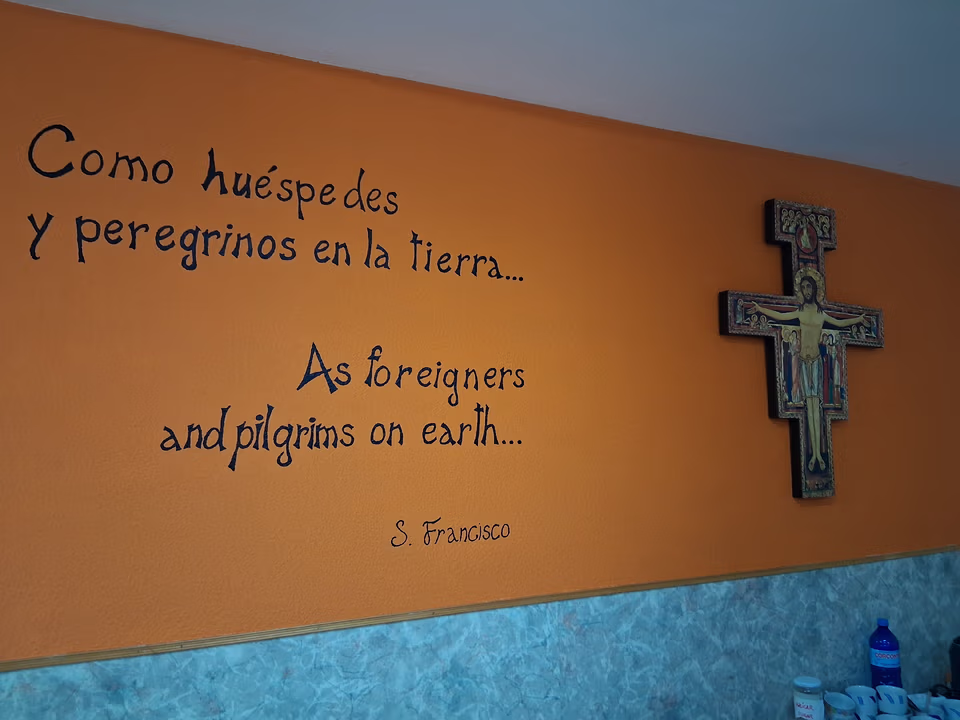 OpenReservations acceptedFranciscano Santa María de los ÁngelesAstorga
4.935 reviews
12€KitchenMicrowavePrivate LockersAnd more - Top #2
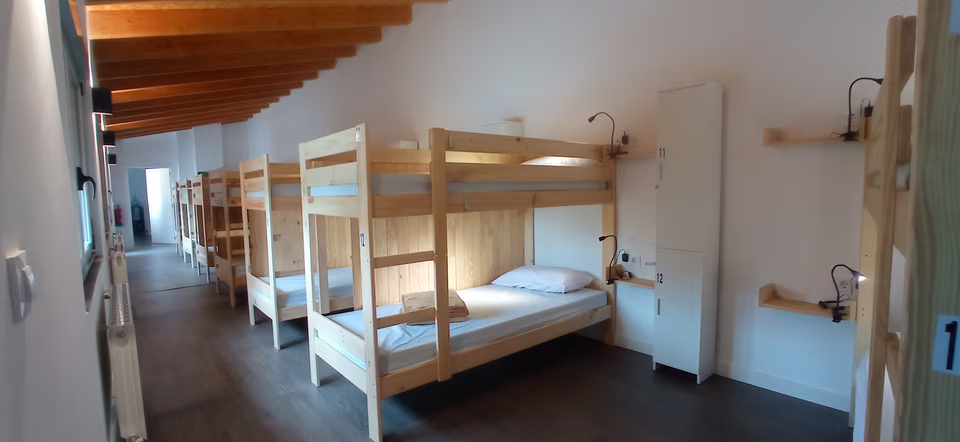 OpenReservations acceptedAlbergue MyWayAstorga15€Wi-FiCommunity DinnerWashing MachineAnd more
- Top #3
 OpenReservations acceptedAlbergue San JavierAstorga12€KitchenCooktopsPlates & UtensilsAnd more
- Top #4
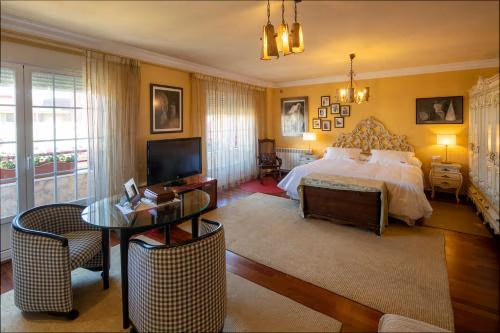 OpenReservations acceptedHotel El Descanso de WendyAstorga64€Wi-FiTVIndividual Power PlugsAnd more
- Top #5

Services in Astorga
What you can find in town before the next stage.
- ATM
- Café
- Shop
- Medical clinic
- Pharmacy
- Fountain
- Post office
- Train station
- Bus station
- Restaurant
Source: © OpenStreetMap contributors · updated January 2025
Caminos through Astorga
Open a Camino to follow it on the map from Astorga.