

Town on the Camino
Lourenzá
Lugo, Spain
- places to stay
- 4
- Caminos
- 2
- Elevation
- 55 m
Lourenzá lies in a valley below the high plateau, 166.3 kilometres before Santiago, and lives around a 10th-century monastery. Its Baroque façade is the work of the architect who went on to design the Obradoiro façade in Santiago. For many a stage town after 27.2 kilometres from Ribadeo, for others just a stop before Mondoñedo.
How long to stay?
An afternoon is enough. Lourenzá is a small town, and almost everything that defines it stands on one square: the monastery of San Salvador with its church. If you come from Ribadeo, you have a long day behind you and look at the façade in the evening. If you arrive earlier, you walk the 8.7 kilometres on to Mondoñedo, which has more to offer.
Lourenzá in Ninja numbers
- 27.2 kilometres lie behind you if you come from Ribadeo, with 872 metres of ascent and almost as much descent.
- 166.3 kilometres are left from here to Santiago on the Camino del Norte.
- 55 metres is the town's altitude. By Abadín, a good day's stage further on, you climb to over 500 metres.
- 8.7 kilometres take you to Mondoñedo, if you want to extend the stage.
Arriving: down into the valley
After Ribadeo the Camino leaves the coast for good. The path climbs via Vilela and San Vicente de Covelas into the hills, reaches the day's highest point of 363 metres at Vilamartín Grande and then drops via San Xusto into the valley. Lourenzá lies below, surrounded by meadows, and the monastery is impossible to miss from afar.
In brief: the monastery of the Conde Santo
In the 10th century Count Osorio Gutiérrez founded a monastery here. After his wife's death he withdrew there himself as a monk, and people called him the Conde Santo, the holy count. The town grew up around the monastery. Over the centuries pilgrims were always taken in here.
The church only got the face you see today in the 1730s. The master builder Fernando de Casas Novoa designed the Baroque façade, and shortly afterwards he drew the new façade of Santiago Cathedral, the Obradoiro. If you look closely, Lourenzá gives you a foretaste of your goal.
Façade and cloister: what to see
Everything is on the monastery square.
- Monastery of San Salvador: The complex includes the abbey, the church, several chapels and two cloisters; it is a protected heritage site. Casas Novoa's Baroque façade is worth a look in the evening light, and for pilgrims it is a greeting to Santiago. According to Gronze the church opens at 11:00; guided tours can be booked on 982 121 104.
- Museo de Arte Sacro: The museum in the monastery shows, among other things, a marble sarcophagus that Gronze dates to the 6th century. We found no opening hours; ask at the monastery.
Honestly
- Many walk straight through. With only 8.7 kilometres to Mondoñedo, Lourenzá is often just a lunch stop.
- The stage from Ribadeo is tough. 27.2 kilometres with a good 870 metres of climbing in constant ups and downs; you will feel it in the evening.
- The public albergue is off the route. According to Gronze it stands about 100 metres from the Camino.
Where pilgrims sleep
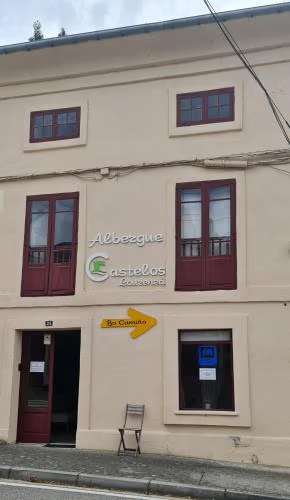
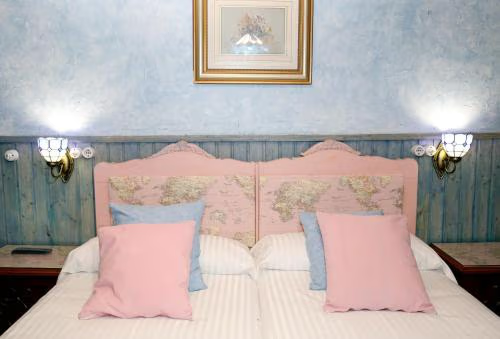
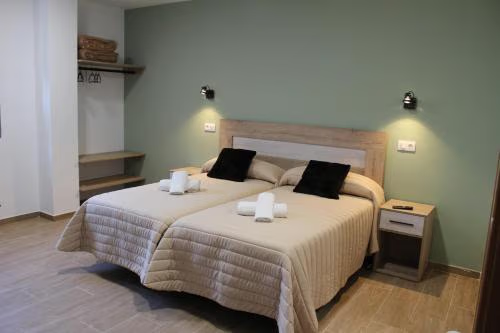
Lourenzá has a public pilgrim albergue, open all year according to Gronze, for €10 (as of October 2026). There are also private albergues: O Pedregal in the centre with a dormitory for €18, Savior, open from March to November, and Castelos right on the route. For Castelos the information on the season is contradictory; call ahead in autumn and winter.
Ninja tips
- Look at the façade before you reach Santiago. It is the work of the same master builder as the Obradoiro.
- Ask about the guided tour. You only see the cloisters and museum on a tour or when the museum is open.
- Extending is easy. Mondoñedo is 8.7 kilometres away with 357 metres of ascent, a good two hours.
Onward: to Mondoñedo
Beyond Lourenzá the path climbs via Grove to 244 metres and then drops into the valley of Mondoñedo, 8.7 kilometres on. The bishops' town is the next big goal and for many the stage town after Ribadeo.
Deep dive: A count becomes a monk
A short read, in case you want to learn more about Lourenzá. About two minutes' reading.
The holy count
In the tenth century Galicia was a land of powerful counts, and one of them was called Osorio Gutiérrez. He founded a monastery in this valley. When his wife died, he gave up his power and lived as a monk himself behind the walls he had had built. The people of the area soon called him the Conde Santo, the holy count. The square in front of the monastery still bears his name.
A façade as a rehearsal
Almost eight hundred years later the monastery church was given a new face. In the seventeen-thirties the master builder Fernando de Casas Novoa designed a Baroque façade. Shortly afterwards he drew the façade that made him famous: the Obradoiro of Santiago Cathedral. Standing in front of the church in Lourenzá, you see how a master builder practised before he dressed the goal of all pilgrims in new clothes.
What Lourenzá gives you
Here you are still a good week from Santiago. Lourenzá shows you two things: a man who laid down his power in order to arrive, and a façade that already points to the end of your journey. You can take both with you when you set off tomorrow morning.
Where to stay in Lourenzá
Places to stay in Lourenzá.
 OpenReservations accepted
Albergue Castelos
 OpenReservations accepted
Albergue Pensión Savior
 OpenReservations accepted
Pensión Albergue O Pedregal
Services in Lourenzá
What you can find in town before the next stage.
- Café
- Shop
- Pharmacy
- Fountain
- Post office
- Restaurant
Source: © OpenStreetMap contributors · updated February 2026
Town 39 of 49