

Town on the Camino
Ribadeo
Lugo, Spain
- places to stay
- 20
- Caminos
- 3
- Elevation
- 38 m
Ribadeo is your first town in Galicia: you cross the Ría del Eo from Asturias on the Puente de los Santos, and 193.5 kilometres to Santiago still lie ahead. An old harbour with a modernist tower, a fortress and a convent, plus albergues for every budget.
How long to stay?
An afternoon is enough, but take a whole one. The stage from Tapia is short, you are here by midday. That gives you time for the old town with the Torre de los Moreno, the convent of Santa Clara, the fortress of San Damián and the view across the ría from the chapel on the Atalaia hill. If you have more time, take a trip to the Playa de las Catedrales, which is not on the Camino. Tomorrow the route heads inland, and your first day in Galicia is a demanding one.
Ribadeo in Ninja numbers
- 193.5 kilometres are still left from here to Santiago on the Camino del Norte. More than 700 already lie behind you.
- 13.9 kilometres is the length of the stage from Tapia de Casariego, with only 228 metres of ascent.
- 872 metres of ascent await you tomorrow on the 27.2 kilometres to Lourenzá.
- Since 1999 the Xunta's pilgrim albergue has stood above the ría.
- 1915 is when the Torre de los Moreno was finished, built by two brothers who had made their fortune in Argentina.
Arriving: over the bridge into Galicia
From Tapia you walk along the coast to Figueras on the shore of the Ría del Eo. The ría is the border between Asturias and Galicia, and you cross it on the Puente de los Santos, the motorway bridge, on one of its two footways. Below you lies the ría, ahead of you Ribadeo. The Xunta's pilgrim albergue stands right at the edge of town, almost beneath the viaduct, looking out over the water. From there you walk up into the old town.
In brief: a harbour between two lands
Ribadeo received its town charter and a weekly market, which still exists, from King Ferdinand III. For a long time the town lived from its harbour, which traded as far as the Baltic. In the 17th century the fortress of San Damián was built to protect the ría; in the early 18th century the English destroyed it, and in 1809 it lay in ruins once more. In the mid-19th century the harbour lost out to larger rivals. Then, as everywhere on this coast, the Indianos came back, emigrants who had grown rich in the Americas, and they built. Since 2004 the historic centre has been protected.
The old town above the ría: what to see
The old town sits on a hill above the harbour, everything is within walking distance.
- Torre de los Moreno: The tower on the Plaza de España is the town's landmark. The brothers Pedro and Juan Moreno Ulloa, emigrants to Argentina, had it built by the Argentinian architect Julián García Núñez, a pupil of Gaudí. It stands on the highest point of town, where the fortress used to be, and was built of concrete and wrought iron, new in Galicia at the time. It has been a protected cultural asset since 1997.
- Convento de Santa Clara: The convent goes back to a community of women from the 13th century; the church and cloister date from the 18th century. A quiet place after crossing the border.
- Iglesia de Santa María del Campo: The parish church has a Gothic portal from the 14th century and a neo-Gothic tower. The former convent church has been the parish church since 1835.
- Capela da Atalaia: The chapel on the hill above the ría is one of the oldest churches in town. A panoramic lift takes you up, and from the top you look back at the bridge and Asturias.
- Fuerte de San Damián: The fortress by the water once guarded the entrance to the ría. Today it is an exhibition space run by the town.
Honestly
- The Xunta albergue is small. It has only just over ten beds and takes no bookings. In summer it fills up fast.
- The Catedrales are an excursion. The famous beach is not on the Camino, you need a bus or taxi, and from 1 July to 30 September and in Holy Week you have to register in advance. You only see the rock arches at low tide.
- Tomorrow gets tough. Beyond Ribadeo the route leaves the coast and climbs to over 360 metres. Underestimate it and your first day in Galicia will hurt.
Where pilgrims sleep
The Xunta de Galicia's Albergue de peregrinos de Ribadeo stands at the edge of town above the ría, on the Estrada do Faro. It is open all year, from 13:00 to 22:00, costs €10 including disposable bedding and takes no bookings (as of August 2026). There is no kitchen, only a fridge and microwave. Ribadeo also has several private albergues, such as the Albergue A Ponte as well as El Olivo, Viruxe, Río Eo and Namor, with dormitory beds between €12 and €30 (as of October 2026). On top of that there are guesthouses and hotels.
Ninja tips
- Register for the Catedrales before you set off. If you want to visit the beach in summer, don't wait until Ribadeo to find out that all the slots are gone.
- Take the lift to the Atalaia. From the top you see the bridge you came over and Asturias on the other side.
- Shop today. Tomorrow you face 27.2 kilometres with the steepest climb in days.
Practical tips for pilgrims
- Xunta albergue: Phone +34 648 931 930; credencial required.
- Market: Ribadeo has had a weekly market since the Middle Ages, and there is also the market hall for fresh food.
- Lighthouse: The lighthouse on the Isla Pancha dates from the mid-19th century; you reach the little island over a bridge.
Onward: up into the interior
Beyond Ribadeo the Camino del Norte turns away from the coast. Via Vilela and San Vicente de Covelas you climb to 363 metres, shortly before Vilamartín Pequeno, and then descend via San Xusto to Lourenzá: 27.2 kilometres with 872 metres of ascent and 855 metres of descent. After that the route continues to Mondoñedo and across the Terra Chá until it meets the Camino Francés in Arzúa.
Deep dive: A tower from Argentina
A short read, in case you want to learn more about Ribadeo. About three minutes' reading.
The bridge as a border
For days you have been walking along the coast of Asturias. Then you stand in Figueras on the shore of a wide stretch of water, and on the other side lies Galicia. Here the Ría del Eo is the border. You walk across on the bridge, high above the water, on the narrow path beside the traffic. The bridge was built in 1987 and rebuilt in 2008 for the motorway. When you reach the other side, you are in the land of the Apostle.
A harbour that sailed into the world
Ribadeo was for a long time a harbour that sailed far. Its merchants traded as far as the Baltic. When trade declined in the nineteenth century, many young people went to the Americas. Two of them were the brothers Pedro and Juan Moreno Ulloa. They grew rich in Argentina and had a tower built in their home town such as Galicia had never seen: of concrete and wrought iron, by an Argentinian architect who had learned from Gaudí. It stands exactly where the fortress once stood, on the highest point of the town.
What Ribadeo gives you
The Torre de los Moreno was never a showpiece for its builders alone. It was an apartment building, and downstairs there was a casino, the library, a bank. The brothers brought something back from abroad and placed it at the centre of their town. You come here today from far away, over a bridge, and tomorrow you walk on into the country. Perhaps you take something with you, and perhaps you leave something here.
Where to stay in Ribadeo
Places to stay in Ribadeo.
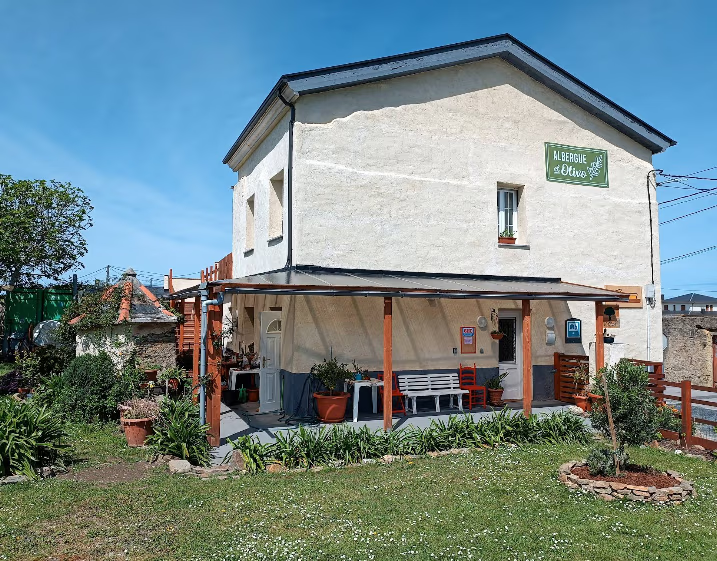 OpenReservations accepted
Albergue El Olivo
 OpenReservations not accepted
Albergue de peregrinos de Ribadeo
- OpenReservations accepted
Albergue Viruxe


Services in Ribadeo
What you can find in town before the next stage.
- ATM
- Café
- Shop
- Tobacco
- Pharmacy
- Fountain
- Post office
- Train station
- Airport
- Restaurant
Source: © OpenStreetMap contributors · updated February 2026
Town 38 of 49