

Town on the Camino
Matosinhos
Distrito do Porto, Região do Norte, Portugal
- places to stay
- 12
- Camino
- 1
- Elevation
- 6 m
Matosinhos is where your Camino reaches the sea: eleven kilometres after Porto, a port town with fish restaurants and an image of Christ that, legend says, washed ashore here. There is no pilgrim albergue, but there are hostels. From here you follow the Senda Litoral north along wooden boardwalks.
Right now in Matosinhos (as of October 2026)
- Lifting bridge to Leça: The Ponte móvel over the Leça was closed for works from 15 June 2026 and reopened on 14 August. On 7 October 2026 it was closed again because of a fault. We could not find out whether it has reopened since. During closures, a free bus run by the port authority takes pedestrians and cyclists across the river.
How long to stay?
An afternoon is enough. If you start in Porto, you arrive early after eleven kilometres and have the rest of the day for the beach, the fishermen's memorial and a fish dinner. The pilgrimage church of the Senhor de Matosinhos is not on the coast but in town, and it is worth the walk if you have time. For a whole rest day there is too little to hold a pilgrim here.
Matosinhos in Ninja numbers
- 11 kilometres from Porto to here, according to Camino Ninja. A short day, and that is exactly what makes it the ideal first day for many.
- 272 kilometres to Santiago still lie ahead of you, according to Camino Ninja, if you follow the Senda Litoral.
- 152 fishermen died on 1 December 1947 when four trawlers sank off the coast. Their memorial stands by the beach.
- 54 canneries operated here between 1940 and 1960. Today there are three.
- 2 national monuments by Álvaro Siza, the architect from Matosinhos, have stood in Leça da Palmeira since 2011, just across the bridge.
Arriving: along the coast to the fishing port
From Porto you walk down the Douro to its mouth at Foz do Douro and then north along the coast. You pass the Castelo do Queijo, a fort from the mid-seventeenth century, and then the long beach of Matosinhos opens up. Tall buildings on your right, the sea on your left. The lifting bridge over the Leça takes you to Leça da Palmeira, where the Senda Litoral continues north.
If you want to skip the stretch through Porto, take metro line A to Mercado station or bus 500 to the coast. The arrows start at the metro station.
In brief: Bouças, fish and canneries
For a long time the place was called Bouças, after a tenth-century monastery. The municipality moved its seat to Matosinhos in 1853 and took its name in 1909. At the end of the nineteenth century the port of Leixões was built as a sheltered harbour for Porto. It brought the fishermen and the canneries, whose heyday came between 1940 and 1960. Matosinhos has been a city since 1984. Today it is a dense, lively suburb of Porto with a character of its own: harbour, fish restaurants and beach.
What the sea brings
The story of Matosinhos begins, if you believe the legend, with a piece of wood in the water. Nicodemus, who took Jesus down from the cross, is said to have carved a figure of Christ and thrown it into the sea in Judea. The waves carried it to the beach of Matosinhos, but without one arm. Years later a woman was gathering driftwood for her fire, and one piece kept jumping out of the flames. Her mute daughter cried out that it was the arm of the Lord. It fitted. Since the sixteenth century the image has had its own church, and Matosinhos has been a place of pilgrimage.
But the sea has also taken. On 1 December 1947 four fishing boats sank and 152 men drowned. On the seafront promenade the sculpture „Tragédia do Mar“ remembers them. For a pilgrim who has only just set out, it is a good place to stop for a moment.
On the beach and in town: what to see
Most of it is right on the way. Only the pilgrimage church needs a detour into town.
- Tragédia do Mar: The sculpture by José João Brito was unveiled on the seafront promenade in 2005, based on a painting by Augusto Gomes. It remembers the 152 fishermen who stayed at sea in 1947. At the start of a long coastal route it reminds you that this sea, which you will walk beside for days, is more than a backdrop.
- Igreja do Senhor Bom Jesus de Matosinhos: The church of the Christ from the sea was founded in the sixteenth century and remodelled in Baroque style from 1743 by Nicolau Nasoni, the architect who also built Porto's Torre dos Clérigos. Inside you will find gilded altars from the eighteenth century and the figure at the heart of the legend. According to a travel portal it opens on weekdays from 9:00 and on Sundays only until 12:30 (Rua Silva Cunha 107).
- Piscina das Marés and Casa de Chá da Boa Nova: As you continue along the coast of Leça da Palmeira beyond the bridge, you come into the area of two early buildings by Álvaro Siza, the Pritzker Prize winner from Matosinhos: the seawater pool Piscina das Marés, opened in 1966, and the tea house Casa de Chá da Boa Nova, designed and built between 1958 and 1963. Both have been national monuments since 2011. The pool was recently restored, with Siza himself overseeing the work. We did not find opening hours for the pool.
Food and drink
Matosinhos is known for its fish. Leixões is considered Portugal's most important fishing port, and on Rua Heróis de França the town's traditional fish restaurants stand close together. For a first evening on the Camino it is a good address.
Honestly
- It is short for a stage. Eleven kilometres is not much. If you are already fit, walk on to Labruge or Vila Chã, where there are pilgrim albergues.
- No pilgrim albergue. Matosinhos only has hostels and guesthouses. A dorm bed costs more than in a public albergue.
- Not a fishing village. Matosinhos is a dense suburb of Porto with a large industrial and fishing port. If you are looking for idyll, you will find it further north along the coast.
- The bridge is unreliable in 2026. Allow for waiting for the shuttle bus (see box).
Where pilgrims sleep
Matosinhos itself has no public albergue and no pilgrim albergue. Several private hostels are close to the route and in the town centre, and a dorm bed costs from around €25 (as of October 2026). In summer and September book early, as the hostels do not only take pilgrims.
- A Casa Vermelha – Pilgrims & Bikes Hostel: a private hostel for pilgrims and cyclists across the river in Leça da Palmeira, a good kilometre further on according to Camino Ninja, with dorm beds from €15 (as of October 2026).
Ninja tips
- The perfect first day: If you arrive in Porto and don't want to walk 25 kilometres straight away, Matosinhos is your goal. Eleven flat kilometres by the water to warm up.
- Metro instead of suburbs: If you don't want to walk the stretch through Porto, take the metro to Mercado. The arrows start there.
- In a storm, go behind the houses: If the wind on the boardwalks gets too strong, walk on the streets behind the first row of houses, parallel to the coast. You will still hear the sea.
- Wood is kind to your knees: Pilgrims praise the boardwalks along the coast because they are softer than paving and asphalt.
- Senda or Coastal Way: The Senda Litoral stays by the sea. The Portuguese Coastal Way runs a little further inland on some sections. The two meet again in the towns, so you can choose day by day.
Practical tips for pilgrims
- Getting here: Metro line A to Mercado or bus 500 from Porto along the river.
- Bridge: If it is not working, the free bus runs between Matosinhos and Leça da Palmeira, every 10 to 15 minutes during the day (as of October 2026).
- Bad-weather emergency: In a storm you can take the metro to Vila do Conde or Póvoa de Varzim.
Onward: north on the boardwalks
From Matosinhos you follow the Senda Litoral across the bridge to Leça da Palmeira and then north along the coast. According to Camino Ninja it is just under 12 kilometres to Praia de Angeiras, a good 13 to Labruge and just under 16 to Vila Chã. To Vila do Conde it is just under 23 kilometres. In Camino Ninja the Portuguese Coastal Way does not pass through Matosinhos but runs from Porto via Maia and only reaches the coast at Praia de Angeiras.
What awaits you tomorrow
A whole day on the Atlantic, flat and to a good extent on boardwalks. At the end you cross the Ave and stand in Vila do Conde, a town where ships were built for the voyages of discovery and where, in 1502, a king stopped on his pilgrimage to Santiago. If you prefer a shorter day, stay in Labruge or Vila Chã.
Deep dive: What the sea carries ashore
A long read, in case you want to learn more about Matosinhos. About fifteen minutes' reading.
Where your Way finds the sea
If you are coming from Porto, you have spent the whole morning walking beside water, first along the Douro, then at its mouth, then up the coast to the north. In Matosinhos that becomes something else. The beach lies broad and open, behind you stand the tall buildings of a town that long ago grew into Porto, and ahead of you begins the path that will lead you along the Atlantic for days. Matosinhos is not a village, not an idyll and not a classic pilgrim town with an albergue and a pilgrim mass. It is a port town with a large industrial and fishing harbour and plenty of fish restaurants.
And yet it is a place worth stopping. Hardly any town on the Portuguese coast speaks so clearly about what the sea gives people and what it takes from them. According to tradition, the sea brought Matosinhos its Christ, around whom a pilgrimage has grown over the centuries. It brought the town fish, work and canneries. And in a single night in December 1947 it took more than a hundred and fifty men. Further inland there is also a monastery where knights took in pilgrims on their way to Santiago and where a king married in secret. This text tells these stories, as far as they can be documented.
Bouças, the town before the town
For a long time this place was not called Matosinhos at all. The old name was Bouças, after a monastery that already stood here in the tenth century. In 1833 a municipality of Bouças was created. In 1853 it moved its seat to the village of Matosinhos, and in 1909 it took on that name as well. Matosinhos has been a city since 1984, and at the 2021 census the municipality had a little over a hundred and seventy-two thousand inhabitants.
The old name lives on in the legend we are about to come to. Because before the famous image of Christ was called Senhor de Matosinhos, people called it the Lord of Bouças.
The wood that leapt out of the fire
The story told in Matosinhos begins far away, in Jerusalem. Nicodemus, who appears in the Gospels as a secret follower of Jesus and helped bury him after the crucifixion, is said to have carved a wooden figure of the crucified Christ afterwards. Because he had seen Jesus in his last hours, its face was considered a faithful likeness. Nicodemus is said to have hidden the instruments of the Passion inside its hollow body. In times of persecution, the legend explains, people preferred to throw holy things into the sea rather than let them be burned. So Nicodemus gave the figure to the Mediterranean off the coast of Judea.
The waves, so it is said, carried it halfway round Europe to the beach of Matosinhos. On the way it had lost an arm. The people of Bouças built it a house of God, called it Nosso Senhor de Bouças and venerated it for fifty years because of its many miracles, without its arm.
Then a woman was gathering driftwood on the beach. She added one piece to the others, carried it home and threw it on the fire. The wood leapt out. She threw it back in, and it leapt out again. Her daughter, who was mute, gestured excitedly, and then spoke for the first time: it was the arm of the Lord of Bouças. The wood was brought to the figure, and the arm fitted so exactly that it seemed never to have been separated.
One tradition even gives a year for the arrival on the beach, the year 124. That belongs to the legend, not to history. What is documented is that in the sixteenth century the figure was taken to a church built especially for it in Matosinhos. From then on it was called Senhor de Matosinhos, the Lord of Matosinhos. On the beach, a stone monument from 1758 recalls him, the Padrão do Bom Jesus.
How old is the Christ really?
The legend makes the figure one of the oldest images in Christendom, made by an eyewitness. Historians naturally see it differently, but they still take the figure very seriously. The historian Joel Cleto has studied the images of Christ attributed to Nicodemus. Such images exist on many coasts of the Mediterranean and the Atlantic, and of several of them it is said that sailors or travellers found them in the sea. Cleto links their spread to the growth of coastal settlements on the Iberian Peninsula from the twelfth century onwards and to maritime trade. According to him, the idea of Nicodemus as a woodcarver of images of Christ is an old one in the West, older than his later connection with the legends of the Holy Grail.
About the Lord of Matosinhos himself, Cleto writes a remarkable sentence: it is probably the oldest life-size sculpture of a crucified Christ in Portugal. That is no miracle story, but in its own way it is astonishing enough.
So two truths stand side by side here. One says the image came across the sea from Jerusalem. The other says it is a very old work, made at a time when many such images were venerated on the coasts of Europe and people told each other the sea had brought them. You do not have to choose. But you understand why this story is so alive in a town whose people look at the sea every day and live from it.
The church of the Lord of Matosinhos
The church where the figure stands today is not on the beach but in town. It is called Igreja do Senhor Bom Jesus de Matosinhos, and it was founded in the sixteenth century. What you see today is above all the work of the eighteenth century. From 1743 the Italian Nicolau Nasoni renewed it from the ground up, the same architect who built the Torre dos Clérigos in Porto.
From outside you see a large Baroque façade with pilasters and a strongly curved entablature. It has three portals, the central one the largest, and in two niches beside it stand the apostles Peter and Paul. The central section is raised and ends in a broken pediment with a Latin cross. Flame-shaped finials, volutes and pinnacles give the two bell towers their lively silhouette.
Inside, the church is older than the façade suggests. Three naves are separated by five round arches from the sixteenth century resting on Ionic columns, and above them lies a wooden coffered ceiling from the seventeenth century. The first high altar was made between 1576 and 1579 from Ançã limestone, created by João de Ruão and Tomé Velho. Only a painted figure of Saint Peter survives from it. In 1650 it was followed by an altar of gilded wood by Ambrósio Pereira, and that too had to give way to today's altar in the eighteenth century.
Today's high altar was designed by Luís Pereira da Costa from Porto. It covers the vault, the triumphal arch and the side walls of the apse and stands, in style, at the transition from the so-called national style to the style of the time of King John the Fifth. The gilded altarpieces of the mid-eighteenth century were carved by Domingos Martins Moreira and gilded by José da Mota Manso, who also made the pulpits. The altarpieces in the transept, for the Chapel of the Blessed Sacrament and for the Senhor dos Passos, were made between 1746 and 1750. In a wall niche lies the tomb of a bishop, Frei João de São José e Queirós, who was Bishop of Grão-Pará in Brazil.
At the centre, though, stands the figure around which everything turns: the Christ that the sea is said to have brought. The church is a place of pilgrimage to this day, and the well-known festivities of the Senhor de Matosinhos are celebrated here.
If you find it open, sit inside for a moment. From the coast it is a detour into town, but it is the place where Matosinhos keeps its oldest story.
Leça do Balio: knights who protected pilgrims
Inland, on the river Leça, not on your coastal route but on the Central Way that runs north from Porto via Maia, stands the most important medieval building in the municipality: the monastery of Leça do Balio. There was Christian life there as early as the tenth century. It is said that the monastery stands on the remains of a temple to Jupiter. That is a tradition, not a finding.
Its great age began in the twelfth century. Countess Teresa, the mother of Portugal's first king, is said to have handed it to the Hospitallers, the knightly Order of the Hospital of Saint John of Jerusalem, later known as the Order of Malta. Historians consider it unlikely that the order was here as early as 1112, as a later copy claims. What is certain is a document from 1140: in it Afonso Henriques, the first king of Portugal, confirmed the order's possessions in Leça and freed it from dues. Leça became the first seat of the Hospitallers in Portugal. The Balio, the order's administrator, resided here, and the place is named after him to this day.
The Hospitallers were knights, but their origin lay in care, for the poor, the sick and pilgrims. The monastery lay on the Portuguese Way to Santiago, and a study of the order in Portugal describes how Leça devoted itself even more to helping pilgrims after the order's seat was moved south to Crato in the fourteenth century. One tradition tells that nobles from the south who died here on their way to Santiago were buried in the monastery by the knights.
The church you see today is Gothic and dates essentially from the fourteenth century. The monastery complex was renewed between 1306 and 1336, and these works are associated with the prior Frei Estêvão Vasques Pimentel. The church is a fortified church, and its architecture has something military about it. The fortifications were meant to protect the monks, and the pilgrims who stopped here on their way to Compostela. In 1834 the religious orders left the monastery, but the church of Santa Maria de Leça do Balio is still a parish church today. In 1910 the monastery was among the first buildings that Portugal declared a national monument.
A wedding a country talked about
On 15 May 1372, King Ferdinand the First of Portugal married Leonor Teles in Leça do Balio. It was a wedding that should not have happened. Ferdinand was promised to an Infanta of Aragon, and Leonor had already been married. Her first marriage was annulled, and the king married her in the Hospitallers' monastery, in secret, as the story goes. One travel site calls it the first love match of the Portuguese monarchy, another a controversial and romantic wedding.
A sculpture by the sculptor Irene Vilar commemorates this wedding in Leça. And every year in September, Matosinhos re-enacts it. Since 2006 the town has held a medieval festival around the monastery called Os Hospitalários no Caminho de Santiago, the Hospitallers on the Way of Saint James. There are jousts, markets and taverns, and there is a hospital for pilgrims, where arriving pilgrims have their feet washed in a ceremony. On the last day the king's wedding to Leonor Teles is re-enacted. It is theatre, but it shows how strongly Matosinhos sees itself today as a stop on the Way of Saint James.
A monastery open again
For a long time the monastery was above all a monument. In 2016 it was bought by the Lionesa business group of the Pinto family. They commissioned Álvaro Siza, the town's most famous architect, to turn the monastery into a cultural centre. Siza had poor-quality later additions demolished, preserved the granite, restored doors, windows and floors where possible and rebuilt them where necessary. An old silo became a round fountain in which visitors can dip their feet. Next to it, in 2024, his Open Sculpture was built, a white structure with elements reminiscent of a cathedral.
Today the foundation of Livraria Lello, the famous bookshop in Porto, has its headquarters there. The architect António Choupina, who worked with Siza on the project, said the aim had been to open the experience to all. If you have time and take the bus, it is a special detour: a place where knights took in pilgrims, reinterpreted by an architect born a few kilometres away.
Harbour, sardines, canneries
The Matosinhos you walk through today is a child of the late nineteenth century. That is when the port of Leixões was built, because Porto needed a sheltered harbour on the open sea. With the harbour came the fishermen, and with the fishermen came the canneries. Their heyday was between 1940 and 1960, when there were fifty-four of them in the town, and their tins went for export. From 1970 the decline set in, and by 1989 one factory after another had closed. Today three are still working: Portugal Norte, Pinhais and Ramirez.
The fish has stayed. Leixões is considered the most important fishing port in Portugal, and on Rua Heróis de França the traditional fish restaurants stand close together. Since 2005 a huge net sculpture by the American artist Janet Echelman has floated above the roundabout on the coast. Its real name is She Changes, but people here call it the Anemone. If you like, you can see in it a fishing net moving in the wind.
The night of the first of December 1947
The first of December 1947 began overcast and gloomy, but it was not raining, and there was hardly any wind. In the morning a boat full of sardines came into Leixões, and the skippers sent their crews out again. In the afternoon the boats put out and headed south, towards the fishing grounds off Figueira da Foz.
A few hours later the weather turned. The wind veered to the northwest, grew colder and came in gusts like a cyclone. The night was dark, without a moon, and the waves grew as high as mountains. Most boats turned back. Four got into trouble between Aguda and Senhor da Pedra near Vila Nova de Gaia, very close to the coast, and sank. Men were swept overboard. The families stood on the southern breakwater of Leixões and on the beach of Matosinhos and waited.
A hundred and fifty-two fishermen did not come back. That is the figure given by the sources in Matosinhos, although an American magazine reported a hundred and sixty-five dead two weeks later. They left seventy-one widows and a hundred and fifty-two orphans. The mourning reached as far as Póvoa de Varzim and Vila do Conde, which you will pass through in the coming days, and to the south as far as Espinho and Murtosa. The same magazine told of a family that had lost four men, with twenty-one children. And of a boy who had been orphaned along with five siblings. When a social worker asked him what he wanted to be, he said: "A fisherman, like father, of course."
After a well-known painting by the painter Augusto Gomes, the sculptor José João Brito created the sculpture Tragédia do Mar, Tragedy of the Sea, which has stood on the promenade since 2005. Your route passes right by it. Stop beside it for a moment.
An architect from here
Álvaro Siza was born in Matosinhos in 1933. In 1992 he received the Pritzker Prize, the most important award in architecture. Two of his early works stand just across the bridge on the coast of Leça da Palmeira, close to your route.
The first is the Casa de Chá da Boa Nova, a tea house on the coast, designed and built between 1958 and 1963, not far from the Boa Nova lighthouse of 1927. The second is the Piscina das Marés, a swimming pool filled with seawater. It opened in 1966. Both buildings have been national monuments since 2011, and the pool was recently renovated for around 1.3 million euros, with Siza himself overseeing the work.
For a pilgrim this is a lovely coincidence. At the start of his career Siza built on exactly this coast, and in old age he reopened a monastery in Leça do Balio where pilgrims were once taken in. If you walk the first kilometres beyond the bridge slowly, you see how a man worked with the sea in the place he came from, rather than against it.
What Matosinhos gives you
Matosinhos is where your Way becomes a coastal Way. From here on you have the sea on your left, day after day, all the way to Galicia. It will bring you wind and space.
As you leave, this town tells you two stories about this sea. In one it brings something: a piece of wood that makes a girl speak and a whole town go on pilgrimage. In the other it takes: a hundred and fifty-two men in one night. Both stories belong together, and the people here have lived with both.
You do not have to believe any of it to take something from it. Perhaps just this: the sea you are now walking beside is not a backdrop. Go down to the beach once more in the evening, look west to where the sun sets, and leave Porto behind you. Tomorrow the Way north begins.
Where to stay in Matosinhos
The places pilgrims rate highest in Matosinhos come first.
- Top #1
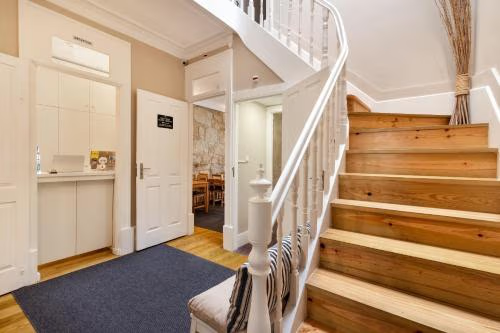 OpenReservations accepted
Fishtail Sea House
- Top #2
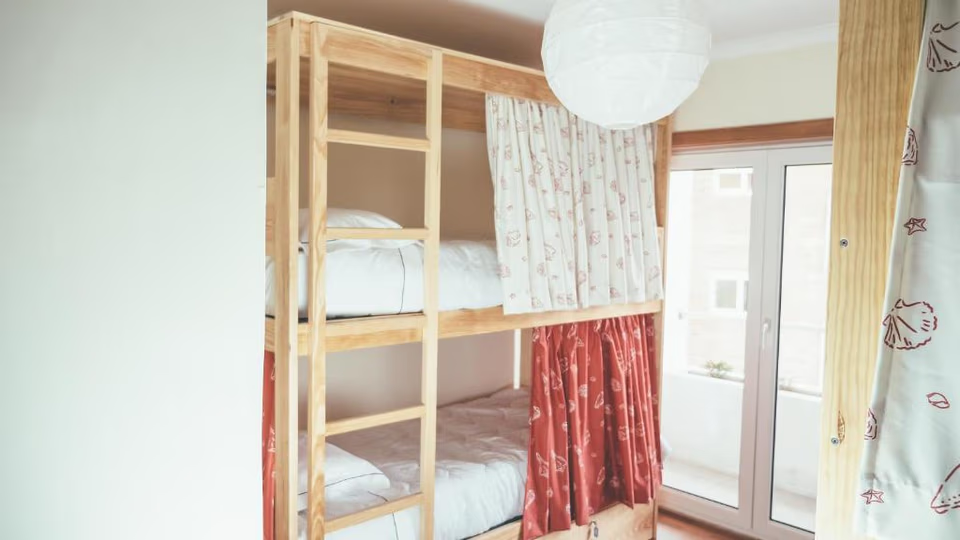 OpenReservations accepted
Oportocean Hostel
- Top #3
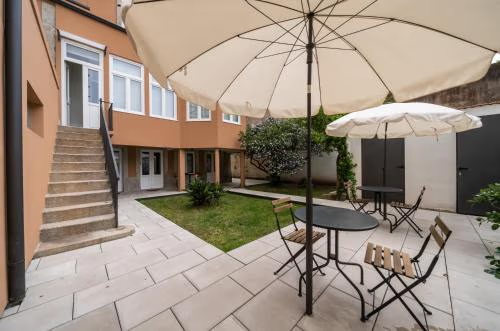 OpenReservations accepted
CASA RIETSCH


Services in Matosinhos
What you can find in town before the next stage.
- ATM
- Café
- Shop
- Tobacco
- Medical clinic
- Pharmacy
- Fountain
- Post office
- Train station
- Restaurant
Source: © OpenStreetMap contributors · updated April 2026