

Portuguese Coastal Way
256.7 kilometres, 12 stages, start at Porto Cathedral: the Portuguese Coastal Way (Caminho Português da Costa) shares its first 6.3 km out of the city with the Central Portuguese Way, then passes Porto Airport through the hinterland to Vila do Conde and only sees the sea in Póvoa de Varzim — from there beaches, dunes and river mouths accompany the route via Esposende and Viana do Castelo to Caminha. There it leaves the coast, follows the Minho via Vila Nova de Cerveira to Valença and crosses the Ponte Internacional to Tui, where it joins the Central. To be honest: the ferry to A Guarda, Baiona and the Ría de Vigo belong to the Senda Litoral, not to this route.
- 01At a Glance
- 02Overview
- 03Other Names
- 04Who It's Ideal For—and Who It's Not So Ideal For
- 05Route & Landscape
- 06Stages, Terrain & Difficulty
- 07Kings, Monks and an Inscription from 862: Evidence of the Coastal Route
- 08Along the Minho Instead of Across the Water: Cerveira, Valença, Tui
- 09The Coastal Way and Its Siblings: What “Coast” Really Means Here
- 10Highlights Along the Way
- 11Cities, not beaches: where to linger on the Coastal Route
- 12Art along the way: between monasteries, fountains and viaducts
- 13Legends along the way
- 14Festivals along the way
- 15Wind, boardwalks and roads
- 16How Pilgrims Find Their Way onto This Path
- 17The Variante Espiritual
- 18Continuing the Pilgrimage to the End of the World: Fisterra and Muxía
- 19Preparation & Practical Information
- 20What the journey will cost you
- 21Getting There
At a Glance
- Start / finish: Porto (Sé Cathedral) / Santiago de Compostela (cathedral)
- Length: 256.7 km
- Duration: 12 stages (Camino Ninja division), 11–13 days
- Elevation: ↗ 4,843 m / ↘ 4,651 m — in small portions, no pass
- Highest point: 256 m — Santiago de Compostela itself; in Portugal 142 m on the coastal ridge beyond Carreço (km 91.5)
- Stages: 12 — Porto, Vila do Conde, Esposende, Viana do Castelo, Caminha, Vila Nova de Cerveira, Tui, O Porriño, Redondela, Pontevedra, Caldas de Reis, Padrón, Santiago
- Landscape: Porto's hinterland, coastal towns and beaches between Póvoa de Varzim and Caminha, the Minho riverbank to Valença, Galician eucalyptus and granite tracks
- Border crossing: on foot over the Ponte Internacional Valença–Tui (1886) — no ferry on this route
- Waymarks: yellow arrow and shell; blue azulejo tiles in Portugal, from Tui the Galician stone markers with kilometre count
- Traces of St James: St James dedication at Castelo do Neiva in 862; Valença fortress and Tui Cathedral (consecrated 1225) as border sanctuaries
- Hostels: albergues in every stage town; from Tui the dense Galician network
- Connections: Central Portuguese Way from Tui; Senda Litoral as the shore path running parallel to Caminha; Variante Espiritual from Pontevedra
- Character: easy to moderate — plenty of paving and tarmac in Portugal, soft forest and field tracks in Galicia
Overview
The Portuguese Coastal Way (Caminho Português da Costa) is the route that links Portugal's coastal towns — and takes its time before it shows you the sea. From Porto Cathedral it walks the first 6.3 kilometres out of the city together with the Central Portuguese Way, then turns off and heads through the hinterland past Porto Airport (km 12.6) to Vila do Conde. Only in Póvoa de Varzim, after almost 32 kilometres, is the Atlantic beside you — and it stays there via Esposende, Viana do Castelo and Caminha, where the route turns again: along the Minho, via Vila Nova de Cerveira to the fortress of Valença and over the Ponte Internacional to Tui. That is where the Coastal Way proper ends; the remaining 118 kilometres to Santiago it walks on the Central.
Together with the Central and the Senda Litoral it forms the trio of Portuguese Caminos from Porto — added together the most walked Camino in the world, ahead of the Camino Francés. To be honest, the naming is the biggest stumbling block: if you want sand under your feet, the Senda Litoral is your route; if you want the towns, monasteries, fortresses and a border crossing on foot over an iron bridge from 1886, this is yours.
Other Names
In Portuguese the route is the Caminho Português da Costa, in Spanish the Camino Portugués de la Costa or Camino Portugués por la Costa, in English the Portuguese Coastal Way or Coastal Route of the Camino Português. Not to be confused with the Senda Litoral, the actual shore path: it leaves Porto Cathedral in a different direction — along the Douro to the sea —, hugs the water all the way to Caminha and takes the ferry to A Guarda there, reaching Redondela via Baiona and Vigo. The Coastal Way, by contrast, stays in Portugal as far as Valença and only meets the Senda again in Redondela. In many sources and even on waymarks the two names overlap — don't let that confuse you.
Who It's Ideal For—and Who It's Not So Ideal For
The Coastal Way is ideal for you if you want to see the sea without having sand under your feet all day: village streets, seafront promenades, pine forest and riverbanks alternate, the stages run between 15.7 and 28.4 kilometres, and with Vila do Conde, Viana do Castelo, Valença, Tui and Pontevedra it strings together more towns worth seeing than any other route from Porto. It also suits a first Camino: well marked, hostels in every stage town, two countries in twelve days.
To be honest, though, it is not for you if “coastal way” makes you expect an uninterrupted sea view — for the first 32 kilometres you see no water, and from Caminha you follow a river, not the ocean. That is what the Senda Litoral is for. Nor will you find solitude here: the route is busy in summer, and from Tui you share it with the pilgrims of the Central.
Route & Landscape
From the start at Porto Cathedral the route first leaves the city together with the Central; after about 6.3 kilometres the two part ways and the Coastal Way heads through the hinterland north of the city, past Porto Airport (km 12.6) — the surf beaches of Matosinhos are left to the Senda Litoral. In Vila do Conde, after 28.4 kilometres, the Poor Clares' convent with its aqueduct is a first highlight; the route does not reach the sea here yet, it carries on through residential streets. You first see the Atlantic in Póvoa de Varzim, a lively seaside resort — and from then on it stays with you.
From Esposende the landscape opens up: pine forests, sand dunes, the wide mouth of the Cávado, then the climb onto the coastal ridge beyond Carreço, at 142 metres the highest point in Portugal. The highlight of the Portuguese half is Viana do Castelo with the Santa Luzia basilica above the town. Beyond Caminha the route switches from ocean to river: along the bank of the Minho it goes via Vila Nova de Cerveira to Valença, whose star fortress guards the border high above the river. Over the Ponte Internacional you are in Tui, in Galicia and in Spain — and from here the Central leads to Santiago with granite paths, eucalyptus forest and that unmistakable Galician light.
Stages, Terrain & Difficulty
The Coastal Way is mostly flat in its Portuguese half, with a single climb of note beyond Carreço; the Spanish part gets hillier beyond Tui and between O Porriño and Redondela, but stays easy walking. Surfaces alternate between paving in the towns, tarmac in the suburbs, seafront promenades, pine-forest paths and, in Galicia, soft forest and field tracks. The kilometres come from the Camino Ninja map and add up exactly to the route's 256.7 km.
- Porto → Vila do Conde (28.4 km) — out of the city with the Central, then through the hinterland past the airport; convent and aqueduct of Vila do Conde
- Vila do Conde → Esposende (23.5 km) — the sea for the first time in Póvoa de Varzim; Aguçadoura, Apúlia, Fão
- Esposende → Viana do Castelo (26.3 km) — Cávado estuary, pine forest, Castelo do Neiva with the St James dedication of 862, basilica on the horizon
- Viana do Castelo → Caminha (26.5 km) — over the coastal ridge beyond Carreço (142 m), Vila Praia de Âncora, last view of the ocean
- Caminha → Vila Nova de Cerveira (16.0 km) — along the Minho, Spain on the far bank; castle of 1321
- Vila Nova de Cerveira → Tui (17.6 km) — star fortress of Valença, Ponte Internacional (1886), Tui Cathedral
- Tui → O Porriño (16.0 km) — through the border forest, at the end through the industrial estate
- O Porriño → Redondela (15.7 km) — Mos, Capilla de Santiaguiño; in Redondela the Senda Litoral joins
- Redondela → Pontevedra (20.7 km) — Ría de Vigo, Ponte Sampaio, car-free old town
- Pontevedra → Caldas de Reis (21.5 km) — or take the Variante Espiritual from here; spa town with hot springs
- Caldas de Reis → Padrón (18.9 km) — to the little town of the apostle's boat and the pimientos
- Padrón → Santiago de Compostela (25.6 km) — O Milladoiro, the last hills to the Plaza del Obradoiro
Kings, Monks and an Inscription from 862: Evidence of the Coastal Route
The Coastal Way is no tourist invention — its traces reach back astonishingly far. In the church of Castelo do Neiva, right on the route between Esposende and Viana do Castelo, the Bishop of Coimbra dedicated a temple to St James as early as 862 — one of the oldest Santiago dedications outside Spain, recorded in an inscription you can still see in the church today. At that time the tomb in Compostela had been known for barely two generations.
Prominent pilgrims are documented too: King Manuel I of Portugal used the coastal route in 1501 on his way back from Compostela, the Italian priest Giovanni Battista Confalonieri described it in 1594, and even Cosimo III de' Medici travelled along it in 1669. Modern recognition nevertheless came late: only in 2010 did the Xunta de Galicia declare the Coastal Way an official Camino — it had been waymarked since 1993, and Portugal certified its section in 2022.
To be honest, the sources for today's course between Caminha and Valença are thinner than for the coast: the Cistercians of Oia with their “ruta monacal” and the caravel Pinta at Baiona belong to the Galician coastal variant — and therefore to the Senda Litoral. If you want those stories, take the ferry at Caminha; if you want to cross the border on foot, stay on this route.
Along the Minho Instead of Across the Water: Cerveira, Valença, Tui
Beyond Caminha the Coastal Way turns away from the ocean and takes the river as its guide: for sixteen kilometres you follow the Minho, with Spain on the far bank the whole time. Vila Nova de Cerveira — King Dinis had the castle built in 1321 — is today the “Vila das Artes” with a biennial and a stag sculpture above the town. Then Valença rises from the riverbank: a star-shaped bastion fortress of the 17th and 18th centuries, with a whole old town inside its walls, hostels, towel shops and the first shell pointing towards the bridge.
The border crossing here is not a boat but a bridge: the iron Ponte Internacional of 1886 carries rail and road across the Minho, and pilgrims walk over on the footway — a few minutes, two countries, one time zone. On the other side Tui awaits with its cathedral of Santa María, consecrated in 1225 and built like a castle, with battlements and a wall walk above the river. From Tui you are on the Central Portuguese Way; the stone markers now count down the kilometres to Santiago, and you only notice the changeover because the number suddenly adds up.
The Coastal Way and Its Siblings: What “Coast” Really Means Here
Three Caminos link Porto with Santiago: the Central Portuguese Way inland, the Coastal Way through the coastal towns and the Senda Litoral by the water. Central and Coastal Way leave the cathedral together and part after 6.3 kilometres; the Senda Litoral heads straight from the cathedral down the Douro to the sea. In Vila do Conde it joins the Coastal Way, between Póvoa de Varzim and Caminha the two often run only a street apart — and in Caminha they separate again: the Senda takes the ferry to A Guarda and goes via Oia, Baiona and Vigo, the Coastal Way heads up the river to Valença and Tui. In Redondela all three are together again.
In practice many pilgrims mix: the Senda Litoral for the beach sections, the Coastal Way when the towns beckon or the sand gets too deep. The Camino Ninja App supports exactly that — you can combine the three routes freely and get a coherent stage plan. A special charm of the Coastal Way: it runs right past Porto Airport, at kilometre 12.6 — you can literally start walking from the gate. And if you would rather get straight to the water: to the Senda Litoral it is 6.5 km from the arrivals hall following the arrows to the Atlantic coast, about two hours on foot.
Highlights Along the Way
- Sé Cathedral, Porto — the shared start of all three Portuguese routes, first stamp in the pilgrim passport
- Santa Clara Convent, Vila do Conde — with the aqueduct of 1714: four kilometres, 999 arches
- Póvoa de Varzim — where you see the sea for the first time
- Castelo do Neiva — St James church with the dedication inscription of 862
- Basílica de Santa Luzia, Viana do Castelo — enthroned on the hill above town, Lima estuary and Atlantic
- Caminha — cobbled old town at the mouth of the Minho; here Coastal Way and Senda Litoral part
- Vila Nova de Cerveira — castle of 1321, “Vila das Artes” on the river
- Fortaleza de Valença — star-shaped border fortress with an old town behind its walls
- Ponte Internacional Valença–Tui — iron bridge of 1886: the border on foot
- Tui Cathedral — consecrated 1225, cathedral and castle in one
- Redondela — where all three Portuguese Caminos meet
- Pontevedra — one of Galicia's most beautiful old towns, almost car-free
Cities, not beaches: where to linger on the Coastal Route
The Coastal Route shows you the sea late and the cities early. For the first kilometres you see no water, but you do pass monasteries, shipyards, fortresses and a border you cross on foot. Whoever just waits for the beach walks right past the best days.
- Vila do Conde (half a day): The first stage ends in a town that grew big on shipbuilding in the 16th century. On the Ave lies a replica of a nau from that era, with the shipbuilding museum right beside it. If you prefer to watch craftsmanship, head for the bobbin lace museum. Finally, take a look at the aqueduct built at the start of the 18th century, which carried water on 999 arches to the Santa Clara monastery.
- Viana do Castelo (a full day): You arrive over the iron bridge across the Lima, often credited to Eiffel. In the harbour lies the Gil Eannes, launched here in 1955 and a hospital ship for the Portuguese cod fishermen off Newfoundland and Greenland. Today she is a museum ship. A funicular climbs Santa Luzia hill, and at the top you get the basilica and the view over the Lima estuary.
- Valença (half a day): The stage to Tui is short enough to stay put here. The fortress got its present star shape in the 17th and early 18th centuries. Up on the walls you stand in Portugal and look at Spain, at the cathedral of Tui on the far bank of the Minho. From there you'll wonder next morning who was actually guarding whom.
- Tui (one evening or half a day): With its battlements, the cathedral looks like a fortress. Its west portal bears the year 1225 and is considered the earliest Gothic work on the Iberian Peninsula. The cloister is the only Gothic one among Galicia's cathedrals. The Dominican Pedro González Telmo, patron saint of sailors, died in Tui in 1246, and the chapel of San Telmo stands over the house where he died.
- Caldas de Reis (half a day): The town is a gift for your feet. The springs rise from the ground at over 40 degrees, and next to the Fuente de las Burgas pilgrims soak their feet in the warm water. On the Umia lies an old garden with trees from five continents. Just right for a long afternoon before the last stages to Santiago.
- Santiago (at least two nights): On the Obradoiro, sit down in the middle once and turn slowly on the spot. Ahead of you the cathedral, to the left the Hostal dos Reis Católicos, which the Catholic Monarchs founded as a pilgrim hospital, behind you the Pazo de Raxoi with the town hall, to the right the Colexio de San Xerome of the university. Church, care, city and learning on one square. On the second day you have time to look inside each of these buildings.
Art along the way: between monasteries, fountains and viaducts
The Portuguese Coastal Way is not a cathedral route, but it has treasures of its own. These stops are worth a break:
- Vila do Conde, Santa Clara: The Poor Clare convent was founded in 1318. In the Gothic church the founders lie in tombs from around 1526, Manueline funerary art in pale Ançã stone. An aqueduct with 999 arches once ran from the convent for about four kilometres; storms destroyed part of it.
- Vila do Conde, Igreja Matriz: At the end of 1502 King Manuel I stopped here on his pilgrimage to Santiago. Afterwards João de Castilho built the nave and main portal in the Manueline style from 1511 to 1513.
- Póvoa de Varzim, Igreja Matriz: a Baroque church, consecrated in 1757, with nine gilded altars and a Rococo high altar.
- Viana do Castelo, Praça da República: The fountain was made by the stonemason João Lopes the Elder around 1555. Beside it stand the arcades of the Casa da Misericórdia from 1589 and the Misericórdia church with azulejos by Policarpo de Oliveira Bernardes. A few steps further, the old pilgrim hospital from the 15th century is now an information centre for the Portuguese Coastal Way, with a stamp and water.
- Viana do Castelo, Santa Luzia: The basilica on the hill was built from 1904 to 1959 on the model of Sacré-Cœur in Paris. A funicular has run up to it since 1923.
- Caminha, Igreja Matriz: begun in 1488, with a richly inlaid wooden ceiling from 1565 and the Chapel of the Seafarers. On the square in front, the fountain of 1551 shows fabulous creatures and a crowned man.
- Vila Nova de Cerveira, the art town: The Bienal de Cerveira has been held here since 1978. Above the town, an iron stag by José Rodrigues from 1985 keeps watch on the Monte do Crasto.
- Redondela, the viaducts: Two iron railway bridges span the town, built in 1876 and 1884, both protected as cultural heritage. Trains still run over one of them.
- Caldas de Reis, Fuente de las Burgas: Hot thermal water flows from the neoclassical fountain of 1881 with two lion heads. Right next to it stands the only church in Galicia dedicated to Thomas Becket.
Legends along the way
By the sea the saints come from the water, and the animals fight for their land.
- The Crucified One of Matosinhos: Nicodemus is said to have carved the crucifix, and the sea washed it up on the beach at Matosinhos, missing an arm. For fifty years no new one fit. Then someone was about to throw a piece of driftwood on the fire, and a mute daughter cried out: That is the arm. Art historians date the figure to the 12th to 14th century. Matosinhos lies on the Senda Litoral, a detour from the Portuguese Coastal Way.
- James in Castelo do Neiva: The apostle is said to have come ashore here; two scallop shells in the municipal coat of arms recall it. What is documented is something else: a dedication stone of the church from the year 862.
- The ferryman of souls: In A Ver-o-Mar near Póvoa, the fishermen venerate Saint Andrew as the ferryman of souls. His footprint is said to be visible on a rock. Whoever does not visit it in life, so they say, must do so after death.
- The captain of Santa Luzia: A cavalry captain with diseased eyes prayed in the old chapel of Saint Lucy on the hill above Viana and is said to have regained his sight.
- The stag king of Cerveira: A stag found space, pasture and water on the mountain and stayed. When a young nobleman disputed his land, the weakened stag fought alone and won. He guards his realm, so the tale goes, to this day.
- The Coca of Redondela: According to legend, a dragon lived in the sea around the island of San Simón and carried off young women. To this day the Coca flees on Corpus Christi from the procession of the Virgin through the flower-decked streets.
Festivals along the way
Between May and August the coast celebrates. In these weeks beds become scarce.
- Matosinhos, Festas do Senhor de Matosinhos (mid-May to early June): one of the great festivals of the north, with procession and fireworks.
- Redondela, Festa da Coca (around Corpus Christi): The Coca races through the streets while the men dance the sword dance. A Festival of Tourist Interest in Galicia.
- Vila do Conde, São João (June, peak on 24 June): The parishes display their masts, lantern parades wind through the town in the evening, and afterwards the night moves to the beach.
- Vila do Conde, Feira Nacional de Artesanato (late July to early August): the great crafts fair, with a day for the lacemakers of the famous Rendas de Bilros.
- Viana do Castelo, Romaria da Senhora d'Agonia (mid-August): carpets of flowers in the lanes, a procession out to sea and the Mordomas in traditional dress and gold jewellery. If you come in August, book early.
- Póvoa de Varzim, Nossa Senhora da Assunção (15 August): a fishermen's procession and fireworks from the boats in the harbour.
Wind, boardwalks and roads
On the Portuguese Coastal Way the Atlantic is your companion, and it can turn rough. Between Póvoa and Esposende you walk for a long time on wooden boardwalks through the dunes. After heavy winter storms, most recently in February 2026 near Ofir, sections were destroyed; ask locally whether everything is passable.
At the Neiva the path crosses the river on granite slabs without a handrail. After heavy rain it can be torrential; then ask at the albergue how best to get across. You also cross the N-13 several times, and near Darque you walk on its pavement as far as the Eiffel bridge to Viana. Emergency number in Portugal and Spain: 112.
How Pilgrims Find Their Way onto This Path
The start is Porto Cathedral — thanks to the airport, Portugal's most convenient Camino entry. You share the first 6.3 kilometres with the Central Portuguese Way, then the Coastal Way branches off — not towards the Atlantic, but through the hinterland past the airport. In Vila do Conde the Senda Litoral joins you, having taken its own way along the water from the cathedral; the Coastal Way itself still runs through residential streets there and only sees the sea in Póvoa de Varzim. Practical links: the Ave Trail and the Aqueduct Trail connect coast and inland near Vila do Conde, and from Vila Nova de Cerveira the Senhora do Norte offers a quiet alternative crossing towards Vigo.
The Variante Espiritual
From Pontevedra a special option presents itself: the Variante Espiritual, an alternative route that follows the legendary sea journey of the apostle James. Instead of heading straight north, it first goes west via Combarro and the monastery of Armenteira to Vilanova de Arousa — and from there a boat takes you up the Ría de Arousa and the Río Ulla to Padrón, where the route rejoins the Central. Don't be misled by the numbers: its 79.9 kilometres compare with 40.4 direct Central kilometres between Pontevedra and Padrón — but about 31 of them you cover by boat. On foot you walk only around 49 kilometres, barely 10 km more than on the direct route, and need at most one extra day. It is chosen not for the kilometres anyway, but for the link to the myth: this is held to be the route by which the apostle's body was once brought to Galicia by ship.
Continuing the Pilgrimage to the End of the World: Fisterra and Muxía
In Santiago the Coastal Way officially ends — but for many the epilogue is still missing. The Camiño a Fisterra continues for around 91 km and 3–4 days to Cape Fisterra, the “end of the world” of antiquity: kilometre stone 0.0 at the lighthouse, sunset over the Atlantic, plus the Fisterrana as a certificate of its own. From Fisterra to Muxía is just a day's walk: the Camiño a Fisterra-Muxía links the cape in just under 29 wild coastal kilometres with the Marian sanctuary of Virxe da Barca — famous for its rocking stones right in the surf. The way back (or the opposite direction) you walk on the Camiño a Muxía (around 88 km) — or you simply take the bus from Muxía back to Santiago. Either way round: the Atlantic is the finer finale.
Preparation & Practical Information
The best time is April to October — in spring Portugal is wonderfully green, in autumn mild and quieter. July and August are the hottest months, but pleasant on the coast thanks to the Atlantic wind; in the Minho valley between Caminha and Valença it can be noticeably warmer than by the sea on still days. In winter the route is technically walkable, but some hostels close. Accommodation is available all along the route in pilgrim hostels (albergues) as well as private guesthouses and hotels; in high season booking ahead is advisable, especially in Viana do Castelo, Valença and Tui, where Coastal Way and Central meet.
As on all Portuguese and Spanish Caminos you need a pilgrim passport (credencial) to stay in the hostels and to receive the Compostela at the end; best order it online in advance. Planning your stages — and combining the Coastal Way with the Senda Litoral or the Central if you like — is easiest directly in the Camino Ninja App, where you put your stages together and plan suitable accommodation at the same time.
What the journey will cost you
The Coastal Way is cheaper in its Portuguese part than on the Spanish section. Pilgrim hostels (albergues) cost between 10 and 18 euros a night in Portugal (as of July 2026), in Spain usually 12–20 euros; the Xunta hostels in Galicia have a flat rate of 10 euros. A Menú del Peregrino costs around 11–15 euros in Spain, slightly less in Portugal. The daily budget with a night in an albergue, breakfast and dinner is around 35–55 euros; if you switch to private accommodation now and then, reckon with 60–90 euros a day.
Getting There
The natural starting point is Porto — and the Coastal Way runs right past Porto Airport (OPO) at kilometre 12.6. From there you can literally start walking: onto the Coastal Way at the door, or following the arrows 6.5 km (about two hours) across to the Senda Litoral on the Atlantic coast. If you want the classic start at the cathedral, the metro takes you to the city centre in about 30 minutes. So you don't have to go into town first — you can start right after landing.
For the return from Santiago the Empresa Freire bus from the Praza de Galicia to Santiago Airport (SCQ) is recommended — journey time about 30 minutes, fare about 3 euros (as of July 2026). Trains and further bus connections from Santiago de Compostela station.
- Plane: Porto (OPO) direct from many European cities; long-haul via Lisbon (LIS)
- Train: Porto Campanhã (IC/AP from Lisbon, Braga, Guimarães); return from Santiago
- Bus: FlixBus and national coaches to Porto
- Return SCQ: Empresa Freire bus from Praza de Galicia → airport, ~30 min, ~3 EUR
Partners
Partner for Portuguese Coastal Way
Camino Ninja is cooperating with official partners. For this camino the partner is:

Route guide for the Portuguese Coastal Way
Stage-by-stage guide with the best places to stay.
Printable PDF · free with a Camino Ninja account
Popular towns on the Portuguese Coastal Way
Picked by our team, in walking order.
- PortoEvery year more than 50,000 pilgrims start the Camino Portugués in Porto, and those coming from Lisbon take their first long break here. The old town on the slopes above the Douro is steep, beautiful and busy. From the cathedral you walk to Santiago along the coast or inland, 244 to 283 kilometres away.Read the town guide
- Moreira da MaiaFor many pilgrims, Moreira da Maia is where the Camino begins before they have even seen Porto: the airport lies on the edge of town, and the Coastal Way runs along its fence. In the middle of town stands the monastery of São Salvador, whose roots go back to the 9th century. An afternoon is enough.Read the town guide
- Vila ChãVila Chã is a small fishing village between Porto and Vila do Conde where women once captained the boats out to sea. For pilgrims it is the quiet stop of the first day on the coast: a public albergue for €10 in the old kindergarten, a fishing museum next door, sunset on the beach. One evening is enough.Read the town guide
- MindeloMindelo lies between fields and dunes, 23.1 kilometres beyond Porto: a quiet village with a Baroque church, plus Portugal's oldest nature reserve, set up in 1957 for migratory birds. There is also a name from the history books, only the place does not quite match. An afternoon is enough.Read the town guide
- Vila do CondeVila do Conde is the town of shipbuilders and of a king who came as a pilgrim: in 1502 Manuel I stopped here on his way to Santiago, and his visit led to the main church. On the Ave lie a replica of a ship of the discoveries and a convent with an aqueduct of 999 arches. The public albergue is closed.Read the town guide
- Povoa de VarzimPóvoa de Varzim is a fishing town that became a seaside resort. For generations its fishermen signed with their own marks, the Siglas Poveiras, which you can still find set into the ground in front of the town hall. The parish albergue is right in the centre. An afternoon is enough; tomorrow you walk along the dunes to Esposende.Read the town guide

Get your pilgrim credential and shell
Everything you need for the Portuguese Coastal Way, shipped to your door.
Visit Camino Shop
Other Caminos
Ansbacher Jakobsweg
Ansbacher Jakobsweg
From Weihenzell via Ansbach, Feuchtwangen, Dinkelsbühl, Ellwangen and the Ostalb to Ulm and Oberdischingen: 9 stages, monasteries, imperial cities and the watershed between the Kocher and the Brenz.
ReadAppenzeller Weg
Appenzeller Weg
52.6 km from Rankweil across the Rhine to St. Peterzell: St. James Chapel (1464), 163 Years of the Wedding Trail, connection to the Via Jacobi. Stages, costs, how to get there.
Read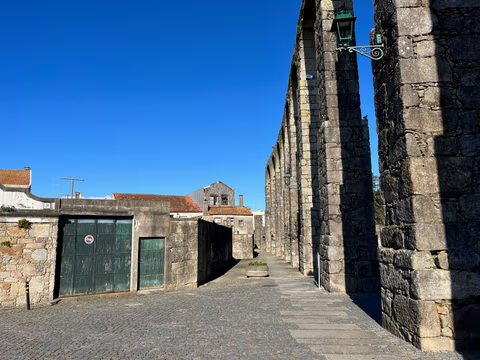
Aqueduct Trail – A path running along the Vila do Conde Aqueduct
From the Coastal Trail to the Camino Central: 12.9 km along the aqueduct from Vila do Conde to São Pedro de Rates. Route, stage, hostels, costs—explained honestly.
Read
