

Town on the Camino
Murça
Portugal
- places to stay
- 4
- Camino
- 1
- Elevation
- 485 m
Murça is the small town of the Porca: in the middle of town stands a granite wild boar from pre-Roman times, the town's landmark, which also lends its name to local wines. Add a Manueline pillory, the Misericórdia chapel of 1692 and a stamp at the Turismo. An afternoon is enough for all of it.
Right now in Murça (as of November 2026)
- Stamp: At the Posto de Turismo you can get a stamp for your credencial.
- Waymarking: The signposting of the Caminho Leon de Rosmithal is due to be installed in the territory of Murça, as in all municipalities along the route, by March/April 2027; until then you need the GPS track.
How long to stay?
An afternoon is enough. Murça is small and quickly explored: the Porca, the pillory, the Misericórdia and the parish church lie close together in the town centre. You arrive after 20.0 kilometres from Abreiro and still have time for a walk and a glass of local wine. You don't need a rest day, but on this section Murça is one of the few small towns with shops and services.
Murça in Ninja numbers
- 117.2 kilometres of the Caminho Leon de Rosmithal lie behind you since the start on the Douro, and 144.0 remain to Braga.
- 1224 is the year King Sancho II gave Murça its first charter.
- 1692 is the date of the Misericórdia chapel with its stone portal.
- 737 metres of climbing await you tomorrow, over 23.0 kilometres up to Alfarela de Jales.
Arriving: from the Tua up to Murça
From Abreiro the route climbs out of the Tua valley again, 20.0 kilometres with 517 metres of ascent and 334 metres of descent. On the way you leave the municipality of Mirandela. Murça lies at 485 metres. In October 2026 a stage of the municipalities' pilgrimage ended here on the Praça 5 de Outubro, where the priest blessed the rucksacks.
In brief: a wild boar and many charters
No one knows exactly how old Murça is. The Porca points to a settlement long before the Romans; in writing the place first appears in the Inquirições of Afonso II. On 8 May 1224 Sancho II gave it its first charter, Afonso III confirmed and extended it in 1268, Dinis renewed it in 1304 and Manuel I in 1512. The pillory, the sign of local jurisdiction, also dates from this time.
Through the town centre: what to see
Everything is a few minutes' walk apart; a short walk is enough.
- Porca de Murça: The stone figure of a sow, probably a votive image from pre-Roman times, stands on the Largo 31 de Janeiro. What it was for is unclear; legends surround it, and it is the town's landmark. For pilgrims it is a greeting from a time long before anyone walked to Santiago.
- The pillory: It is considered one of the best preserved in Portugal, from the early 16th century, with eight steps, a twisted shaft and five spiral finials. It recalls the charter of 1512.
- Capela da Misericórdia: The chapel of 1692 has a richly carved stone portal with four columns and a niche with a figure. We have not found its opening hours.
- Igreja de Santa Maria: The Baroque parish church with its attached bell tower has a stucco barrel vault inside, pulpits and altarpieces in various styles.
Honestly
- No pilgrim bed. There is no pilgrim hostel in Murça; you sleep in a residencial or a guesthouse. Sort out the night in advance.
- No arrows yet. As of November 2026 the route is not yet signposted in the territory of Murça, so you walk by the track; the arrows are due by March/April 2027.
- Tomorrow will be long and steep. The stage to Alfarela de Jales has 740 metres of ascent, and Alfarela has no documented bed either.
Where pilgrims sleep
There is no pilgrim hostel in Murça. In town there are two residenciais and a guesthouse, plus a country estate nearby; you will find them further down this page. Ask at the tourist office where pilgrims stay, and book ahead.
Ninja tips
- Get your stamp at the Turismo. On this section it is one of the few documented stamp points.
- Buy what you need for tomorrow here. On the way to Alfarela de Jales there are only villages such as Pópulo and Carva.
- Try a wine with the Porca. Some wines from the area carry the wild boar in their name.
Onward: to Alfarela de Jales
Beyond Murça the route climbs onto the plateau. Via Pópulo and Carva you climb for 23.0 kilometres to Alfarela de Jales at 831 metres, with 737 metres of ascent and 392 metres of descent. From here the route becomes rougher and lonelier.
Deep dive: The pig older than Portugal
A short read, in case you want to learn more about Murça. About two minutes' reading.
An animal of stone
In the middle of Murça stands a pig made of granite. More precisely, a sow, as the name says: Porca de Murça. No one knows who carved it or why. Most consider it a votive image from the time before the Romans, perhaps a sacred animal meant to protect herds and fields. Similar stone figures exist in north-eastern Portugal and western Spain, but the one in Murça has become the emblem of an entire town.
Charters from four kings
When Portugal came into being, the Porca was already old. Murça received its first charter from Sancho the Second in 1224. Afonso the Third confirmed it, Dinis renewed it, and Manuel the First granted a new one in 1512. The pillory with its twisted finials stands for this right to judge one's own affairs. Later came the chapel of the Misericórdia, the brotherhood that looked after the sick, the poor and travellers.
What Murça gives you
In the summer of 1466 the Bohemian embassy of Jaroslav Lev of Rožmitál travelled west through this region, on its way to Braga and Santiago. Their chronicle does not mention Murça. And yet Murça is the place where the new route already welcomes pilgrims: with a stamp at the Turismo and a blessing on the square. When this text was written, in autumn 2026, the arrows were still missing. The Porca waits patiently; it has waited longer than that.
Where to stay in Murça
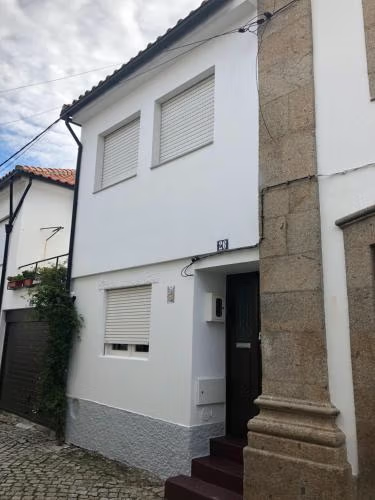
Places to stay in Murça.
 Open
Casa da Joana!
 Open
Restaurante & Residencial Terra Quente
Restaurant- Open
Residencial Vitorino
BreakfastRestaurantDinner Available
Town 6 of 16