

Stage town on the Camino
Muxía
A Coruña, Galicia, Spain
- places to stay
- 23
- Caminos
- 3
- Elevation
- 11 m
Muxía is the quieter end of the Way, a fishing town on a headland on the Costa da Morte. At its tip stand the sanctuary of the Virxe da Barca, the rocks from the legend of the stone boat and A Ferida, the monument to the volunteers after the 2002 oil spill. Fisterra is 27.8 kilometres away.
Right now in Muxía (as of October 2026)
- Albergues in winter: Two private albergues close at the end of November. The public albergue and several private ones are open all year, and in winter Muxía has more open beds than Fisterra.
- Bus back to Santiago: Monbus runs only a few times a day, and the buses often sell out quickly. Buy your ticket early. We haven't found an official winter timetable yet.
How long to stay?
An afternoon is enough, but many like to stay longer. Pilgrimage church, stones, the monument A Ferida and the viewpoint hill Monte Corpiño all lie close together at the tip of the headland. You can manage that in one afternoon, with sunset. But Muxía is quieter than Fisterra, and some pilgrims stay two or three nights just to sit by the sea. In rain, on the other hand, there is little to do.
Muxía in Ninja numbers
- 27.8 kilometres is the distance from Fisterra to Muxía, along the coast.
- Around 86 kilometres is the distance from Santiago directly to Muxía.
- 11 metres high and 400 tonnes heavy is A Ferida, the monument to the helpers after the oil spill of 2002.
- 2014 is the year the famous rocking stone Pedra de Abalar broke in a winter storm. Since then it no longer rocks.
Arriving: along the coast to the headland
If you come from Santiago, shortly before Muxía the path takes you past the Romanesque monastery of San Xiao de Moraime from the twelfth century and then along the coast to the harbour. The public albergue lies just before the centre. From the tourist office the path climbs once more, up to the pilgrimage church at the tip of the headland. If you come from Fisterra, you finally climb over the Facho de Lourido and from the beach of Lourido you see Muxía lying before you.
In brief: the Virgin in the stone boat
The legend says that the apostle James, discouraged by his mission in Galicia, was visited here by the Virgin Mary in a boat made of stone, to give him strength. Her boat turned into rocks that still lie next to the church today. Even before that, the place was a pagan cult site, and it became Christian in the twelfth century. The present pilgrimage church was built from 1717 to 1719 in the Baroque style. At Christmas 2013 lightning struck and set the church on fire, shortly after a restoration. The roof and the Baroque altar burned. In 2015 the first phase of the reconstruction was signed off. Every year on the second weekend of September, Muxía celebrates the great pilgrimage to the Virxe da Barca.
At the tip of the headland: what to see
- Santuario da Virxe da Barca: The pilgrimage church stands directly on the rocks by the sea, and this is where the Way to Muxía ends. We haven't found opening times.
- The holy stones: Next to the church lie the rocks said to have been the Virgin's stone boat. The Pedra de Abalar is said, according to legend, to have rocked only for people without sin. Since it broke in January 2014, it no longer does. Under the Pedra dos Cadrís pilgrims pass nine times, because according to tradition this helps against kidney and back pain. After weeks with a backpack, that may not be a bad idea.
- A Ferida: The huge granite sculpture by Alberto Bañuelos, "The Wound", has stood next to the church since 2003. It commemorates the oil spill after the sinking of the tanker Prestige in November 2002 and thanks the volunteers who cleaned the coast. It is split by a deep crack.
- Monte Corpiño: The small rocky hill behind the church has a cross at the top and an all-round view of the town, the church and the coast. The ascent goes over the rocks. A good spot for the sunset.
- Igrexa de Santa María: The parish church below the Corpiño is Romanesque. In 1203 Pope Innocent the Third handed it to the monastery of Carracedo, and the Gothic Rosary chapel dates from the end of the fourteenth century.
Food and drink
Muxía is a fishing village. Here you find the last drying racks for conger eel on the Costa da Morte. The Congrio has been air-dried here since the eighteenth century, and on Good Friday the town celebrates its own festival for it. In addition there are hake, percebes, crabs and squid. Some pilgrims find the food here better than in Fisterra. In the bars on the beach Praia das Lanchas you get tapas with your drink.
Honestly
- The rocking stone no longer rocks. Since 2014 the Pedra de Abalar is broken. So don't expect a miracle, but a stone with a story.
- The reconstruction was controversial. At the sign-off in 2015, locals protested, and the priest refused to sign the handover.
- The Muxiana is not for everyone. In October 2025 a couple was refused the certificate because of too few stamps.
- The bus is scarce. Only a few trips a day, and they are often full.
- The albergue kitchen lacks crockery. Pilgrims report a kitchen without pots and plates.
Where pilgrims sleep
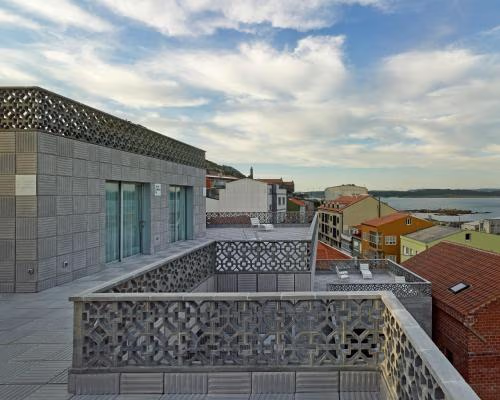
- Albergue de Peregrinos de Muxía: the public Xunta albergue on Rúa Enfesto, just before the centre. €10 per night, open all year, no reservations. It has a roof terrace with a view of the sunset. You also get the Muxiana here.
- Global Pilgrim House: At the very top of Rúa Enfesto, opposite the public albergue, a pilgrim house has been opening its doors since March 2026. It is expressly not an albergue but a home, with two rooms for a donation, a terrace and time for conversation. Register beforehand via WhatsApp.
Besides, there are several private albergues, usually €13 to €20 in a dormitory.
Ninja tips
- Nine times under the stone: Try the Pedra dos Cadrís. It can't hurt.
- Better to walk to Muxía: Many pilgrims advise going to Fisterra first and then to Muxía. That way your Way ends at the quieter place.
- Don't swim at Lourido: At the beach of Lourido the waves break hard, and there are strong rip currents.
- Collect enough stamps: For the Muxiana you need a credencial stamped at the important points of the Way.
- Sunset from above: Climb Monte Corpiño or sit on the rocks in front of the church. You can also see it from the roof terrace of the public albergue.
- Buy your bus ticket early: Online you can book at most 30 days in advance. The buses from Muxía sell out quickly.
Practical tips for pilgrims
- Muxiana: The certificate is free. It is issued at the tourist office and in the public albergue, and according to one pilgrim report now also at the town hall during office hours. Ask at the albergue.
- Onwards to Fisterra: The same credencial then also counts for the Fisterrana.
- Bus to Fisterra: There is no direct bus, you change in Cee.
Onwards: to Fisterra or back
On the Way between Muxía and Fisterra it is 27.8 kilometres along the coast to Fisterra. The Way is marked in both directions, with an "F" for Fisterra on the stones and arrows. Right after leaving Muxía there is a short climb, after that the path is mostly easy. For the first 14 kilometres to Lires there are no supplies, so take water. In Lires you can stay overnight if you want to split the stage. Most people go back to Santiago by bus.
What awaits you tomorrow
If you continue to Fisterra, at the end of the day the lighthouse at the cape awaits you, with the kilometre marker 0.000 and the sunset over the Atlantic. The name of the place comes from "finis terrae", the end of the earth.
Deep dive: The stone ship and the wound
A long read, in case you want to learn more about Muxía. About fifteen minutes' reading.
At the end of the headland
Muxía lies on a narrow peninsula that points into the Atlantic like a finger. Right at the front, at the tip, your Way ends. There stands a church with two towers, barely twenty metres from the water. In front of it lie large granite rocks with the surf breaking against them. And beside it a huge, split block of stone rises into the sky.
These three things tell the story of Muxía. The rocks tell of a legend that is older than the church. The church tells of counts, sailors and a Christmas night when lightning struck. And the split stone tells of a ship that sank off this coast in November 2002, and of thousands of people who came afterwards to help.
If you came from Santiago, this is your destination. If you came from Fisterra, you already have the end of the world behind you and have arrived at a place that is quieter. Many pilgrims say that is exactly what makes it special.
Monks from Moraime
The story of Muxía does not begin at the tip of the headland but a few kilometres inland, at a place you passed on the way from Santiago: San Xiao de Moraime. In the early twelfth century a Benedictine monastery stood here, the most powerful in the whole area around Fisterra.
Its beginnings were not peaceful. In 1105, shortly after its foundation, Norman pirates attacked the monastery and destroyed it. Later Saxons attacked as well. It was rebuilt with the help of a boy who grew up here in the area: Alfonso Raimúndez, raised by the powerful Count Pedro Froilaz de Traba. In 1119, aged just fourteen, he made a donation to the monastery that allowed it to be rebuilt. Later this boy became king, as Alfonso the Seventh of León and Castile, and called himself Emperor of Spain. You may know the Traba family, who protected the monastery, from Fisterra: a daughter of the same house endowed the church of Santa María das Areas by the cape in 1199.
The church of Moraime that still stands today is Romanesque, a basilica with three naves and three apses. Behind a later porch hides a Romanesque portal of great quality that has been compared with the Pórtico da Gloria in Santiago. A second portal on the south side shows the Last Supper. It was walled up for a long time. In 1970 wall paintings depicting the deadly sins were discovered inside. And nearby, remains of a burial ground were found, possibly from Roman or Visigothic times.
For pilgrims, Moraime was more than a church. The monastery ran one of the most important pilgrim hospitals on the way to the sea. And it was its monks who made the place at the tip of the headland Christian. Muxía, the sources say, owes its foundation as a town to this monastery, just like the sanctuary you are walking to now.
A weary apostle and a boat of stone
What the monks found at the tip of the headland was not an empty place. The great rocks by the sea had long been a sacred site, a place where people venerated stones. As early as the year 575, Bishop Martín de Dumio wrote a treatise on the correction of the country folk, in which he railed against such cults: against people who made offerings to stones, springs and trees. In Muxía the Church did not destroy such a place but gave it a new story.
The story told in Muxía goes like this. The apostle James had preached in Galicia, and hardly anyone wanted to listen. In Duio, a city on the bay of Fisterra, people mocked him so badly that he asked for the city to sink into the sea. Tired and discouraged, he came to this coast. There he saw a boat approaching over the sea. In it sat the Virgin Mary. She comforted him and told him that his task in Hispania was fulfilled and that he should return to Jerusalem. There, as anyone who knows the Way of Saint James knows, martyrdom awaited him. Mary left an image of herself on a small altar by the rocks. But her boat turned to stone.
The legend dates from the Middle Ages, and the monks of Moraime did a lot to spread it. Its heyday came later, when pilgrims from all over Europe told of it. In it, an ancient stone cult becomes Christian. And almost in passing it is an astonishingly human story. It is not about a triumphant saint but about one who no longer knew how to go on and found new courage.
The stones of the Barca
The rocks that are said to have been the boat still lie beside the church today. Which stone is which part of the boat, not even the sources agree. Some say the Pedra de Abalar is the hull and the Pedra dos Cadrís the sail, others say exactly the opposite. All agree on the Pedra do Temón, the rudder. Then there is the Pedra dos Namorados, the lovers' stone.
The most famous is the Pedra de Abalar, a block of rock about nine metres long. Abalar means to rock. Whoever stood on it and made it sway, it was said, was free of sin. With patience you could move it with your feet. Under the Pedra dos Cadrís, the stone of the kidneys, people pass nine times, because that is said to help against rheumatism and back pain. After weeks with a rucksack on your back, as a pilgrim you can understand that well.
How important these stones are to the people here became clear in the summer of 2013. In August researchers asked the residents of Muxía which heritage of their town mattered most to them. Most named the sanctuary and the pilgrimage, followed directly by the Pedra de Abalar and the other stones of the Barca. Many said this was a heritage they hoped would never be lost. A few months later, exactly that was put to the test.
Pilgrims who moved the stone
Since the fifteenth century there have been accounts by pilgrims who came all the way here from Santiago. And almost all of them tell of the stones.
The first is said to have been the Augsburg patrician Sebastian Ilsung, who reached the Barca in 1446. He tried to move the stone, and he succeeded. He wrote that anyone who had killed someone or was excommunicated and had not fully atoned for his sin could not move it. Twenty years later, in 1466, the Bohemian nobleman Leo of Rožmitál came with his retinue. His companion Václav Šašek marvelled: we saw on the coast a ship with its oars, ropes and other tackle, all made of stone.
In 1484 came Nikolaus von Popplau, a nobleman from Breslau. He described a wrecked ship of pure stone, with a mast and a hanging sail, and added: I and others were able to move this stone with one hand. In 1539 the Italian Bartolomeo Fontana wrote that only those in the grace of God could move the great stone.
On 5 October 1580 Erich Lassota von Steblau came not on foot but by ship. He described a large chapel or church at the entrance to the harbour, called de la Barca. The Austrian prelate Christoph Gunzinger noted soberly in 1654 that on the rocks there were many thousands of small snails forming figures such as crosses or the letters IHS. That this was a miracle, he added, was however no article of faith. And the Italian Carmelite Giacomo Antonio Naia celebrated Mass in the chapel in 1718 while the new church was being built. He marvelled that he could move the Barca with one hand.
The pilgrims, by the way, purified themselves before they came to the stones. On the old path to the sanctuary, the Camiño da Pel, there was a spring where they washed.
The counts' church
The first written mention of the sanctuary dates from 1544, and even that speaks of an older chapel. The church you see today was built between 1716 and 1719. It was begun by the Count of Frigilana y Aguilar and his wife Alfonsa de Castro. It was continued by their daughter Teresa Rivadeneira, who was married to the Count of Maceda. The Counts of Maceda lie buried in the church, by the high altar.
The building is Baroque but austere, with a floor plan in the shape of a Latin cross and plain walls. The interior was all the more splendid. The high altar was made in 1717 by the sculptor Miguel de Romay from Santiago. In its centre stood the Virgin of the Barca, surrounded by the twelve apostles. A few years later Romay also built the altar for the Christ with the golden beard in Fisterra. So the two sanctuaries at the end of the Way bear the signature of the same artist. A side altar of Saint Michael was decorated with scallop shells, gourds and pilgrim staffs, the signs of the pilgrims.
The figure of Mary herself is small, Gothic and painted. Some believe it comes from northern Europe, others from France. The two towers of the façade are younger than they look. They were only completed in 1958, paid for by Romualdo Bentín, a man from Muxía who had emigrated to America. And the sailors say the roof of the church used to be painted white, as a sign for the ships out at sea.
The pilgrimage in September
Once a year Muxía gets crowded. On the weekend after 8 September the town celebrates the Romaría da Barca, one of the most popular pilgrimages in Galicia. Since 1989 it has been recognised as a festival of national tourist interest.
On Saturday the path to the sanctuary already becomes one single procession. Many people come on foot from their villages, just like you. People eat in the open air, bagpipes and tambourines play, and the night is spent celebrating in the town. On Sunday there is an open-air Mass at the sanctuary, a procession down into the town and the blessing of the water, accompanied by a big firework display.
In the past the pilgrimage was rougher. At the beginning of the twentieth century the pilgrims were given bundles of straw to rest on and a cup of chocolate. Those who came from far away rented a room from the people in the town. And some penitents covered the old Camiño da Pel on their knees, a path that led over stone walls. The pilgrimage has moved poets too. Rosalía de Castro, Galicia's great poet, and Federico García Lorca wrote about it.
So if you are here in September, you experience Muxía quite differently from a quiet evening in October. More and more pilgrims plan their arrival for exactly these days.
The oil
On 13 November 2002 the oil tanker Prestige got into distress off Cape Fisterra. For six days it was towed back and forth off the coast, and on 19 November it broke apart and sank. It had 77,000 tonnes of heavy fuel oil on board. The oil drifted onto hundreds of kilometres of coast, and Muxía lay right at the centre of the disaster. To this day the town calls itself ground zero of the Prestige.
What came afterwards changed Muxía. Thousands of volunteers from all over Spain came to clean the beaches and rocks. The town has set up a monument to them that you cannot miss: A Ferida, the wound. The sculptor Alberto Bañuelos made it from granite from O Porriño, more than eleven metres high and weighing 400 tonnes. It counts as the largest sculpture in Spain. An insurance company, Aegon, donated it to the town, and it was inaugurated on 12 September 2003, less than ten months after the disaster. It stands beside the church, split by a deep crack, like a wound that has not fully healed.
For pilgrims too the disaster had a consequence you can hold in your hand. The Muxiana, the certificate for everyone who arrives here on foot, was created in 2002, the year of the Prestige. Its creation is linked to the many volunteers and visitors who came to Muxía at that time. When you collect your Muxiana today, you are holding a small legacy of that time in your hand.
Christmas 2013
In the night before 25 December 2013, lightning struck the sanctuary. The fire destroyed the roof and almost the entire interior. Miguel de Romay's Baroque high altar burned. The outer walls held, and the small Gothic figure of Mary also survived the fire. The bitter part: the Instituto del Patrimonio Cultural de España, the state heritage authority, had restored the church shortly before.
Thirteen days later, on 6 January 2014, the Pedra de Abalar broke in a winter storm. The stone that for centuries was supposed to recognise the sinless has lain in two pieces ever since. A fragment now serves as a bench in the forecourt of the church.
For the people of Muxía these were two blows in two weeks, aimed precisely at what they had named their most important heritage a few months earlier.
Who does a church belong to?
The rebuilding went quickly. On 26 March 2015, fifteen months after the fire, the first construction phase was handed over. It had cost around 736,000 euros. A new roof was on, the sacristy rebuilt, the floor repaired, side altars, angels and the gallery restored. On 31 May 2015 Mass was celebrated in the church for the first time again. Hundreds of neighbours came. One of them worked out that 524 days had passed since the last service.
But many were not satisfied. At the handover residents protested. They complained about the wood and the materials, the damp that blackened the walls, an ochre frame on the door and new furniture they compared to Ikea. A former director of the heritage authority called the work kitsch. The parish priest sided with the neighbours and refused to sign the handover. The mayor said it was good to listen to the neighbours, otherwise the very same mistakes would be made again. The sanctuary, he said, belonged to the Church, but it was also part of every single house in the town. One of the architects countered that people judged the work with the heart and not with the head. The technicians explained that much of it was provisional until the walls had dried, and that could take a couple of years.
Who was right? Probably both. A monument is a building you repair according to rules. But a sanctuary is also a place that belongs to the people who have been going there for generations. Whether and how the burned high altar has since been replaced, we have not been able to find out reliably. See for yourself when you stand inside, and ask the people in the town. They will be glad to tell you what they think of it.
Congrio in the wind
Muxía is not only a place of legends. Above all it is a fishing town. And it has something that no longer exists anywhere else on the Costa da Morte: the last drying racks for conger eel, the congrio. The fish is hung up there and dried in the air, an old method that is called anguiacho here. Documents from the eighteenth century already mention it.
Since 1996 Muxía has held its own festival at the harbour in honour of the congrio every year on Good Friday. More than a dozen people then cook around 1,500 portions, in empanada, in stew, braised or from the griddle.
Below Monte Corpiño there is, by the way, a second, older church, the parish church of Santa María. In 1203 Pope Innocent the Third transferred it to the Cistercian monastery of Carracedo. Its Gothic Rosary chapel dates from the end of the fourteenth century. Anyone who knows Muxía only as the place of the Barca easily overlooks that a village with its own church stood here eight hundred years ago.
What Muxía gives you
Muxía is a place that does not push anything on you. No lighthouse that everything revolves around, and less bustle than at the cape of Fisterra. Just a church, a few rocks, a split stone and the sea.
But these few things carry a lot. A legend of an apostle who wanted to give up, and a woman who gave him courage. Pilgrims from Augsburg, Bohemia and Breslau who stood here more than five hundred years ago and tried to move a stone. A village that received help in a black winter and set up a monument to the helpers. And a church that burned down and was rebuilt, not without dispute, but with the sympathy of a whole town.
Sit on the rocks in front of the church in the evening. Perhaps near the Pedra de Abalar, which no longer rocks. You do not have to believe in a stone ship to understand the story that is told here. Anyone who has been on the road for a long time knows the moment when they did not want to go on. And perhaps also the moment when someone or something gave them back their courage. Here, where the land ends, you can simply stay seated and listen to the sea.
Where to stay in Muxía
The places pilgrims rate highest in Muxía come first.
- Top #1
 OpenReservations accepted
Albergue-Hostel Muxía Mare
- Top #2
 OpenReservations accepted
Albergue Bela Muxía
- Top #3
 OpenReservations not accepted
Albergue de Peregrinos de Muxía




Services in Muxía
What you can find in town before the next stage.
- ATM
- Café
- Shop
- Tobacco
- Pharmacy
- Fountain
- Post office
- Train station
- Bus station
- Restaurant
Source: © OpenStreetMap contributors · updated November 2025
Town 3 of 3
Continue along the Camiño a Fisterra-Muxía
Muxía is the last popular town on the Camiño a Fisterra-Muxía.