

Town on the Camino
Oelsnitz
Germany
- places to stay
- 6
- Camino
- 1
- Elevation
- 396 m
Oelsnitz im Vogtland is the town beneath the towers of St James: the town church of St. Jakobi rises 73.5 metres and holds the largest organ in the Vogtland. After the fire of 1859 the town was rebuilt on a grid, and Schloss Voigtsberg adds to it. An afternoon is enough, because tomorrow 35.6 kilometres to Hof await.
How long to stay?
An afternoon is enough, and you should take it. Oelsnitz is the last town of the Saxon Way of St James before the Bavarian border, and it has a church of St James that you can't miss. For St. Jakobi, a walk across the market square and the climb up to Schloss Voigtsberg you need two to three hours. No more, because the last stage to Hof, at 35.6 kilometres, is longer than the two stages before it. An early night is part of the programme here.
Oelsnitz in Ninja numbers
- 272.3 kilometres since Bautzen. Only one more stage to Hof.
- 73.5 metres is the height of the towers of St. Jakobi, among the tallest in the Vogtland. The town hall of 1861 to 1864 reaches 42 metres and has to look up to James.
- 79.2 kilometres lie between the two Oelsnitz on the Saxon Way of St James. You passed Oelsnitz in the Erzgebirge at km 193.1; this one is the other.
- Around 500 buildings were destroyed by the town fire of 1859, and 70 percent of citizens were left homeless. That's why the streets are so straight today.
- 65 stops has the organ of St. Jakobi from 1930, the largest in the Vogtland.
Arriving: James is already waiting
From Treuen it's 27.1 kilometres via Bergen, Tirpersdorf and Hartmannsgrün. The Saxon Way of St James leads right through Oelsnitz, a town of a good 10,000 inhabitants (as of 2019) on the Weiße Elster. Here you don't end up in a church of St James by chance; it's the town's main church. Risk of confusion: Oelsnitz in the Erzgebirge is also on this way, almost 80 kilometres further back. When you book accommodation, look for "Vogtland" in the name.
In brief: the alders, the tin, the carpet
Slavic settlers settled in the 8th century where the Gerbersbach flows into the Weiße Elster, and gave the place a name meaning "place of the alders". By the early 13th century a church already stood on the hill above the settlement, and in 1357 town rights are documented. In the early 16th century tin mining brought a first boom, and in the Thirty Years' War imperial troops occupied the town in 1632, when more than 500 people died.
Then came the fires. In the 18th and 19th centuries they repeatedly ravaged the densely built town, worst of all in 1859. Oelsnitz was afterwards laid out anew on a grid. Around 1880 Karl Wilhelm Koch and Fritz te Kock founded the carpet factory from which the "Halbmond" brand grew. Since then Oelsnitz has been called "Teppichstadt" (carpet town), and carpets under that name are still made here today.
St. Jakobi: towers that burned twice
The church of the apostle you are heading for has endured a good deal in Oelsnitz. The first stone church was built in 1240, burned down in 1519 and was rebuilt in late Gothic style. Later fires destroyed large parts, but the vaulting survived them. After 1859 Constantin Lipsius gave it its present form with the two towers in 1866/67. The font by Ernst Rietschel from 1833 survived the fire of 1859. Two plaques at the church commemorate the composer Johannes Rosenmüller, who came from Oelsnitz, and the town's first peaceful demonstration in October 1989. For you as a pilgrim this is perhaps the loveliest punchline of the Vogtland: after 272 kilometres on the Way of St James you stand beneath the tallest towers for miles around, and they belong to James.
Beneath James's towers: what to see
The town centre was built on a grid after the fire, so you find your way around quickly. - St. Jakobi: Inside, a star vault on twelve pillars carries the space, the furnishings date from 1888, and the altar is neo-Gothic. On the south wall hangs a crucifix of 1515 that was in the Katharinenkirche until 1978. The Romantic organ was built by the Dresden workshop Jemlich in 1930 to plans by the Leipzig professor Karl Hoyer, with 65 stops and over 4,100 pipes. We didn't find opening hours. Tower climbs are occasionally offered; ask at the tourist information. - Schloss Voigtsberg: The castle of the Vögte (bailiffs) was built in the 13th century, and its keep is now a viewing tower. From 1855 the complex was part of the Zwickau penal institution, from 1874 a women's prison, until 1924. Today it houses the carpet museum, a small mineral cabinet and, since 2013, the exhibition "Illusorium" on book illustration. We didn't find reliable opening hours; ask beforehand on telephone 037421 729484. - Market square and town hall: The town hall was built from 1861 to 1864, as the town recovered from the fire. Its tower measures 42 metres. On the market square stands the Sperkenbrunnen. - Zöphelsches Haus: The half-timbered house of 1755 stood outside the town wall and therefore survived all the fires. Today the town library and the culture and tourist information are housed here. Tomorrow morning the last stage begins here.
Honestly
- We found no pilgrim hostel. In Oelsnitz you sleep in holiday flats, rooms and apartments, many of them on the market square.
- Opening hours are hard to get. For St. Jakobi and the museums in Schloss Voigtsberg we found no reliable times. If you want to see something in particular, call beforehand.
- The last stage is the longest. 35.6 kilometres to Hof, through small villages and the former border zone. If you don't want that in one day, split it at Triebel.
- Two Oelsnitz, one way. When booking and buying tickets, make sure it's Oelsnitz/Vogtl., not Oelsnitz/Erzgeb.
Where pilgrims sleep
We found no pilgrim hostel, parish accommodation or donativo place in Oelsnitz. You sleep in holiday flats, rooms and apartments, most of them on the market square, so right on the way. The accommodation list further down shows you what Camino Ninja knows.
Ninja tips
- Look at the font. Rietschel's font of 1833 is one of the few pieces in St. Jakobi that survived the fire of 1859.
- Split the last stage. Triebel lies after 11.1 kilometres, with a restored fortified church and a country inn that also has rooms. That leaves 24.5 kilometres to Hof the next day.
- Take in the keep. The tower of Schloss Voigtsberg is a viewing tower; from the top you see the town and St. Jakobi. Check opening beforehand.
- Start at the Zöphelsches Haus. The stage description to Hof starts here, and at the tourist information you get advice for the last day in Saxony.
Onward: across the old border to Franconia
From the Zöphelsches Haus the way goes along the Untere Kirchstraße to the footbridge over the Weiße Elster, past the Marienstift and along the Alte Triebeler Straße through meadows and woods to Triebel. Beyond it the Saxon Way of St James leads through the former inner-German border zone to the point where Bavaria, Saxony and Bohemia meet. Then it goes via Kugelreuth, Nentschau, Trogenau, Kirchgattendorf and Gattendorf to Hof, 35.6 kilometres in all.
What awaits you tomorrow
Hof, the goal of the Saxon Way of St James. There the way ends at the Lorenzkirche, the oldest church in town, and you can sleep in a former Poor Clares' convent that is now a pilgrim hostel. A worthy ending, and at the same time a beginning: in Hof the Upper Franconian Way of St James to Nuremberg begins.
Deep dive: A church for James
A short read, in case you want to learn more about Oelsnitz im Vogtland. About 2 minutes' reading.
Beneath two towers
When you stand in front of the town church in Oelsnitz, you have to tilt your head right back. The two towers of St. Jakobi are 73.5 metres high, among the tallest in the Vogtland. For someone who has been on the Way of St James since Bautzen, there is something comforting in that. For weeks you have been walking on a way that bears his name, and here, in a small town on the Weiße Elster, they built him the mightiest church for miles around.
A church on the hill
The history of the town begins with the alders. Slavic settlers settled in the eighth century at the mouth of the Gerbersbach into the Weiße Elster, and the name they gave the place means place of the alders. By the early thirteenth century a church already stood on a small hill above the settlement. The first stone church was built in 1240. Not far from it the Vögte built Voigtsberg castle in the thirteenth century.
Fire, again and again
Oelsnitz is a town of fires. In 1519 the church burned down and was rebuilt in late Gothic style. In 1632 imperial troops took the town, and more than five hundred people died. In the eighteenth and nineteenth centuries fires raged again and again in the tightly built lanes. The worst came in 1859. Around five hundred buildings burned down, and seven in ten citizens lost the roof over their heads. Of the church the vaulting remained, and the font that the sculptor Ernst Rietschel had made in 1833.
Built anew
Afterwards Oelsnitz rebuilt itself, this time with straight streets. The town hall was completed by 1864, and the church received its present form with the two towers in 1866 and 1867 to plans by Constantin Lipsius. In 1930 the great organ was added. Around the same time, from 1880, the carpet industry grew, and Oelsnitz became the carpet town. The castle on the hill had long since served as a prison, last for women, until 1924.
What Oelsnitz gives you
On the church hangs a plaque commemorating the town's first peaceful demonstration in October 1989. So at a church that has burned so often there is also a memorial to people who stood up for something without violence. Perhaps that is the message of these towers: what burns down can be built again. Tomorrow you walk across the old border to Hof.
Where to stay in Oelsnitz
Places to stay in Oelsnitz.
 OpenReservations accepted
Apartment in Stadtzentrum Oelsnitz
 OpenReservations accepted
Zwillinge Ferienwohnung am Markt
KitchenCooktopsMicrowaveAnd more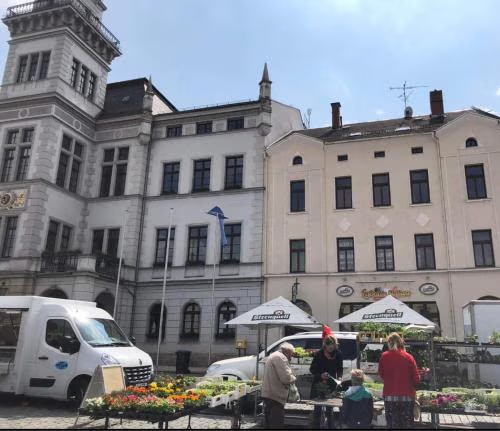 OpenReservations accepted
Kleinzimmer am Markt
MicrowaveWater BoilerWi-FiAnd more


Town 14 of 15