

Town on the Camino
Hof
Germany
- places to stay
- 14
- Caminos
- 3
- Elevation
- 480 m
Hof is the place of handover: the Saxon Way of St James ends here after 307.9 kilometres at the Lorenzkirche, and the Upper Franconian Way of St James to Nuremberg begins. You sleep in a former Poor Clares' convent and eat sausages from the Wärschtlamo in the town where the trains from Prague arrived in 1989.
How long to stay?
An afternoon is enough, but treat yourself to the evening. After 35.6 kilometres from Oelsnitz you arrive tired, and Hof doesn't ask much of you: the Lorenzkirche, the Hospitalkirche, the town hall tower and a few sausages in the old town fit into one afternoon. If the Saxon Way of St James ends here for you, stay a night anyway. Arriving takes time, and the pilgrim hostel in the old Poor Clares' convent is a good place for it. If you're walking on, you start the next morning on the Upper Franconian Way of St James.
Hof in Ninja numbers
- 307.9 kilometres since Bautzen. The Saxon Way of St James is done, and Saxony lies behind you.
- Three Ways of St James meet in Hof, according to Camino Ninja: the Saxon Way of St James, the Via Imperii and the Upper Franconian Way of St James, which starts here towards Bayreuth and Nuremberg.
- 13,600 people arrived at Hof main station from Prague in 14 special trains in autumn 1989, the first on 1 October at 6.14am.
- 90 painted panels were done by Heinrich Andreas Lohe in 1688/89 on the coffered ceiling of the Hospitalkirche.
- From €8 is what you pay for a bed in the pilgrim hostel in the Klarissenkloster, according to Camino Ninja data (as of November 2026).
Arriving: across the old border to the Saale
It's 35.6 kilometres from Oelsnitz im Vogtland. Beyond Triebel the Saxon Way of St James takes you through the former inner-German border zone to the point where Bavaria, Saxony and Bohemia meet, then through the villages of the Regnitzland via Trogenau, Kirchgattendorf and Gattendorf to Hof. Your goal is the Lorenzkirche with the Lorenzpark. Hof lies on the Saale, has a good 47,000 inhabitants (as of April 2024) and two cores: the historic old town and the neoclassical new town.
In brief: mother church, convent, new town
In 1214 the large parish of Hof with the Lorenzkirche is first mentioned, and around 1230 the new town is founded. In the 13th century the hospital at the Unteres Tor and a Poor Clares' convent are added. In the Second Margrave War of 1553 the Lorenzkirche and the Hospitalkirche are laid waste. On 4 September 1823 almost the whole new town burns down and is rebuilt in the Biedermeier style. Hence the calm, neoclassical face of the town centre.
In the 20th century Hof suddenly finds itself on the edge, on the inner-German border, through whose former zone you have walked today. In autumn 1989 the town becomes the arrival point for the refugee trains from Prague. Since 1967, film fans have come every October for the Hofer Filmtage.
The handover: Saxony passes you on to Franconia
For pilgrims Hof isn't a destination in the grand sense but a baton. The Saxon Way of St James ends here and hands you on to the Upper Franconian Way of St James, which leads from Hof via Bayreuth to Nuremberg, to the old pilgrim gathering point of St. Jakob. The Via Imperii also runs through Hof. By the Marienkirche there is a monument to the Way of St James. So whoever arrives here has not only a way behind them but also a choice: home, or onward. Both are right.
Old town on the river: what to see
Hof has two cores, the historic old town and the neoclassical new town. You can reach everything important on foot. - Lorenzkirche: The oldest church in Hof, the mother church and original parish of Hochfranken, mentioned as early as 1214. It was plundered and burned down in 1553 and given a neoclassical makeover in 1822. It holds the Hertnid altar, a panel altar commissioned by Hertnid von Stein. For you it's the end point of the Saxon Way of St James. We didn't find any opening hours. - Hospitalkirche: The hospital and church were built in the 13th century at the Unteres Tor. After the destruction in the Second Margrave War the church was rebuilt in 1557. In 1688/89 Heinrich Andreas Lohe painted all 90 panels of the coffered ceiling with biblical scenes, and the late Gothic Marian altar by Michael Heuffner dates from 1511. Open Tuesday to Friday from 9 to 12; otherwise ring the bell at the parish office next door (as of November 2026). Address: Unteres Tor 11a. - Former Poor Clares' convent (Klarissenkloster): Probably founded in 1287, dissolved after the Reformation. The east and south wings survive, now home to the Diakonisches Werk, a café and the pilgrim hostel. In the east wing there is a roof truss from the period after the Hussite attack of 1444/45, the largest hanging-beam structure in Upper Franconia. Viewing on request. - Rathaus (town hall): Inaugurated on 23 December 1566. The tower is 32 metres high and open to climb, and from the top you look out over the town. - Michaeliskirche and Marienkirche: The Michaeliskirche goes back to a chapel built around 1230 and is now the main Protestant church. The neo-Gothic Marienkirche in the pedestrian zone has the Way of St James monument outside the door and, inside, a memorial to the Berlin cathedral provost Bernhard Lichtenberg, who died in Hof in 1943 on the transport to Dachau concentration camp.
Food and drink
Hof eats sausage, and eats it on the street. Since 1871 the Wärschtlamänner have been selling sausages from the brass kettle: "Wienerla", "Gnagger", "Bauern" and "Weisa", in a bread roll ("Laabla"), with or without "Sempft" (mustard). Alongside them there is the Hofer Rindfleischwurst, cold-smoked over beechwood and on the EU register of regional specialities since 2009, and the Hofer Schnitz, a vegetable stew. Beer has been brewed in Hof since the 14th century, and "Hofer Bier" has been a protected geographical indication since 1998. We don't name restaurants; the tourist information will happily advise you.
Honestly
- The last stage is hard. 35.6 kilometres from Oelsnitz is the longest stage on the way through the Vogtland. If you can, split it at Triebel.
- We have little verified information on the hostel. We couldn't find out reliably how many beds there are or how you register. Check beforehand on the accommodation page at Camino Ninja or with the Diakonie Hochfranken.
- The Lorenzkirche isn't always open. We found no opening hours. Be prepared to stand in front of a closed door at the end point, and catch the moment in the Lorenzpark instead.
- Long-distance trains no longer stop in Hof. To get home you take regional trains, for example towards Nuremberg, Bamberg, Dresden, Zwickau or Munich. Plan for changes.
Where pilgrims sleep
- Pilgerherberge im Klarissenkloster (Diakonie Hochfranken, Klostertor 2): the town's pilgrim hostel, housed in the former Poor Clares' convent and run by the Diakonie Hochfranken, which calls the house "Pilgerherberge und Ort der Stille" (pilgrim hostel and place of stillness). From €8 according to Camino Ninja data (as of November 2026). A bed in a convent at the end of a long way: you couldn't finish a Way any better.
- There are also hotels, guesthouses and apartments in every price range. The accommodation list further down shows you what Camino Ninja knows.
Ninja tips
- Go to the Hospitalkirche in the morning. It's open Tuesday to Friday from 9 to 12; otherwise you ring the bell at the parish office next door. The 90 painted ceiling panels are the nicest surprise in town.
- Climb the town hall tower. 32 metres, open to climb, the best view over the town that was your goal.
- Find the Way of St James monument. It stands by the Marienkirche in the pedestrian zone. A finishing photo there is more honest than one in front of the town sign.
- Ask about the roof truss. If you sleep in the Klarissenkloster: the medieval roof truss in the east wing can be viewed on request.
- Eat at the Wärschtlamo. The sausages from the brass kettle have been a Hof institution since 1871. Order a "Wienerla" in a "Laabla" with "Sempft".
- Check the calendar. On Schlappentag, the Monday a week after Whit Monday, Hof holds a shooting festival that has existed since 1432. In October the Hofer Filmtage take place.
Practical tips for pilgrims
- Stamp: According to the route description of the Saxon Way of St James, you get the stamp at the tourist information.
- Tourist information: Ludwigstraße 24, telephone 09281 815-7777. In winter (November to March) Monday to Friday 10 to 4, Saturday 10 to 1; in summer (April to October) Monday to Friday 10 to 6, Saturday 10 to 1 (as of November 2026).
- Sunday: The tourist information is closed on Sundays. If you arrive on a Sunday, get your stamp on Monday or ask at the hostel.
Onward: two ways lead out of Hof
The Saxon Way of St James ends here. If you want to go on, you have two options: the Upper Franconian Way of St James leads from Hof via Bayreuth to Nuremberg and the Jakobskirche, which was already a gathering point for pilgrims in the Middle Ages. The Via Imperii also runs through Hof. The Franconian Ways of St James are marked with the blue sign with a stylised yellow shell.
Deep dive: A town where you arrive
A short read, in case you want to learn more about Hof. About 4 minutes' reading.
At the end point
When you stand in front of the Lorenzkirche in Hof, you have a good three hundred kilometres behind you since Bautzen. Bautzen, Dresden, Freiberg, Chemnitz, Zwickau, the Vogtland, and last the former borderland between Saxony and Bavaria. The Saxon Way of St James ends here, at the oldest church in town. It is as old as Hof's written history itself: in 1214, on the feast of St Catherine, the large parish of Hof with this church is mentioned for the first time. It's called the mother church, the original parish of Hochfranken. A good place to finish a way, because everything in Hof began here.
A town on a river, two cores
Hof grew from two settlement cores, the old town around the Lorenzkirche and a new town that arose around 1230. In the thirteenth century two institutions were added whose traces you can still see today. At the Unteres Tor a hospital with a church was founded. And a convent of the Poor Clares came into being, probably founded in 1287, that is, of sisters who lived by the rule of St Clare of Assisi. In 1348 an endowment by Gertrud von Uttenhofen renewed the convent, and from 1350 the sisters built their own church.
Fire and war
The town has been through a lot. After the Hussite attack of 1444 and 1445 a roof truss was built over the east wing of the convent, and it still stands today. In 1477 the convent burned, when Margareta von Brandenburg was abbess. In the Second Margrave War of 1553 the Lorenzkirche was plundered and burned down, and the Hospitalkirche was destroyed too and only rebuilt in 1557. With the Reformation, convent life ended. The last abbess, Amalie von Hirschberg, died in 1564, after which the convent passed to the margrave. The convent church fell into ruin, and its tower was taken down in 1743. Today nothing of it can be seen. On 4 September 1823, finally, almost the whole new town burned down. It was rebuilt in the Biedermeier style, and that's how the town centre still looks today.
A sky of ninety pictures
One of the loveliest rooms in town was created at a time when hardly anyone was thinking of pilgrims. In 1688 and 1689 Heinrich Andreas Lohe painted the coffered ceiling of the Hospitalkirche, all ninety panels, with scenes from the Bible. Beneath this ceiling stands a Marian altar that Michael Heuffner had carved in 1511 for the Michaeliskirche and that was no longer needed there after the Reformation. So it moved to the hospital. Whoever sits under this ceiling today sits in a room that for centuries was there for people who needed help.
Arrival at the station
In the twentieth century Hof became a border town. You walked through the former border zone on the last stage. Two moments from that time are present in Hof. In 1943 the Berlin cathedral provost Bernhard Lichtenberg died here on the transport to Dachau concentration camp. He had prayed publicly for the persecuted Jews. A memorial in the Marienkirche commemorates him. And in autumn 1989 Hof became a place of arrival. On 1 October, at fourteen minutes past six in the morning, the first special train from Prague rolled into the main station. Soon there were fourteen trains and thirteen thousand six hundred people who had come to the West from the Prague embassy.
Passed on
For pilgrims Hof has been a junction for some years now. On St James's Day, 25 July 2009, the Upper Franconian Way of St James was opened in Marktschorgast, leading from Hof via Bayreuth to the Jakobskirche in Nuremberg, a historic gathering point for pilgrims. Ten years later the Evangelischer Pressedienst counted thirty-six Jakobskirchen in Upper Franconia, thirteen of them on pilgrim routes. And the network grew in the other direction too: from Hof it was extended through Saxony, Thuringia and Saxony-Anhalt as far as Görlitz and Berlin. In Hof the lines meet, and here they are passed on.
Sausage, beer and an old festival
If you walk through the town centre in the evening, you meet a town that looks after its habits. Since 1871 the Wärschtlamänner have stood in the street with their brass kettles selling sausages in bread rolls. Beer has been brewed in Hof since the fourteenth century. And every year, on the Monday a week after Whit Monday, the town celebrates Schlappentag, a festival that has existed since 1432 and has been part of Bavaria's intangible cultural heritage since 2019. For a pilgrim who has been on the road for weeks, it's a friendly reminder that arriving also means sitting down at a table again.
What Hof gives you
When this text was written, in autumn 2026, there was a pilgrim hostel in the old Klarissenkloster, run by the Diakonie, which calls the house a place of stillness. That is perhaps the nicest thing about Hof: that a town in which so many people have arrived keeps a quiet room ready for pilgrims. You can stop here or walk on, to Bayreuth and Nuremberg, on the Upper Franconian Way of St James. Hof sets you no conditions. It takes you in, as it has taken in people for centuries, and passes you on.
Where to stay in Hof
Places to stay in Hof.
 Open
Diakonie Hochfranken — Pilgerherberge Klarissenkloster
- OpenReservations accepted
Hotel Posthorn
36€ 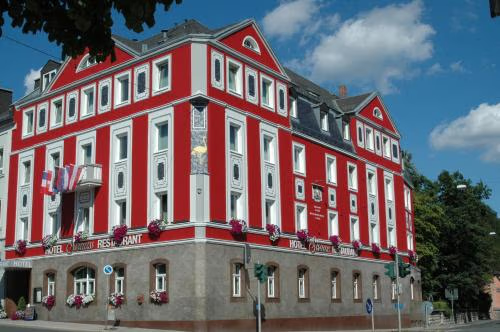 OpenReservations accepted
Hotel Strauss
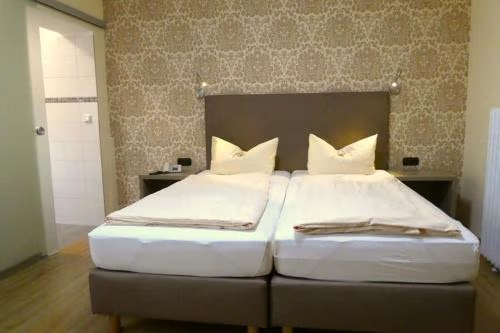
Town 15 of 15
Continue along the Sächsischer Jakobsweg
Hof is the last popular town on the Sächsischer Jakobsweg.