

Stage town on the Camino
Olveiroa
A Coruña, Galicia, Spain
- places to stay
- 6
- Caminos
- 2
- Elevation
- 274 m
Olveiroa is the village before the decision: five kilometers on, in Hospital, the path splits towards Fisterra and Muxía, both a good 32 kilometers away. You arrive after the longest stage of the route, 34 kilometers from Negreira, in a village with old hórreos and a parish of Saint James. One evening is enough.
How long to stay?
One evening is enough. Olveiroa is a small village with a good hundred inhabitants, a few albergues and a couple of bars. You arrive tired from the long stage, look at the hórreos, eat and sleep. The real work of the evening is a decision: Fisterra or Muxía first.
Olveiroa in Ninja numbers
- 34.0 kilometers from Negreira, with 854 meters of ascent, the longest day on the way to the sea. The highest point was 477 meters at kilometer 47.1, beyond Santa Mariña.
- 5.1 kilometers to Hospital, where the path splits.
- 32.3 kilometers to Fisterra turning left, 31.7 kilometers to Muxía turning right. Almost the same distance, very different.
- Around 15 kilometers without a bar or shop lie beyond Hospital on the way to Cee. You prepare for that this evening.
Arriving: across the river into the village
The last kilometers of the stage from Negreira lead down via Lago and Corzón to the Xallas, which you cross at Ponte Olveira. Then you are in Olveiroa, at 274 meters. Here the river is dammed into a long reservoir, the Embalse da Fervenza, built in 1996. The village was almost abandoned for a long time and has come back to life with the Camino.
In brief: a village of Saint James on the Xallas
Olveiroa belongs to the municipality of Dumbría, and its parish is dedicated to Saint James; on 25 July the village celebrates Santiago. For a long time Olveiroa was a remote farming village that kept losing its inhabitants. Only the pilgrims on the way to the sea woke it up again: where the path arrived, albergues and bars appeared. It is said that at the bridge of Olveiroa over the Xallas, Galician farmers fought against Napoleonic troops in the early 19th century. We found no historical detail on this.
At the fork: what to see
Olveiroa is small, and what there is to see lies in the village.
- The hórreos: The village's stone granaries are several hundred years old and have been restored. They are considered some of the largest and best-preserved in the province, and a wayside cross stands next to them. For you they are Galicia's calling card, which you will see everywhere from here to the sea, but rarely so beautifully gathered together.
- The Xallas and the reservoir: Along the river you come to the Embalse da Fervenza, a reservoir of 1,250 hectares. Tomorrow morning you walk a stretch along its shore.
- The fork in Hospital: Not a monument, but the most important place of the next days. At the roundabout in Hospital a waymarker points in two directions: left to Fisterra, right to Muxía.
Fisterra or Muxía?
Fisterra is the destination everyone knows: the cape, the lighthouse, the kilometer stone 0.000, the sunset over the Atlantic. The Camiño a Fisterra leads along the coast via Cee and Corcubión. Muxía is quieter: the sanctuary of the Virxe da Barca on the rocks by the sea, where, according to legend, Mary appeared to the apostle in a stone boat. The Camiño a Muxía goes through the hinterland via Dumbría.
You do not have to choose one. Between Fisterra and Muxía there is a waymarked connecting path, the Camiño a Fisterra-Muxía, and you can reach both places one after the other, in either direction. Ninja advice: If you go to Muxía first, you end at Cape Fisterra and have your "end of the world" there. If you go to Fisterra first, you end in Muxía, where less is going on. Both are right.
Eating and drinking
In the village there are bars with a pilgrim menu; we could not confirm a shop in Olveiroa. Tomorrow, after 3.7 kilometers, you come through O Logoso, where there is a shop and a bar, and in Hospital another bar. Stock up there for the day.
Honestly
- The stage here is too long for many. 34 kilometers with 854 meters of ascent after only one day out of Santiago. If you split it, you sleep in Vilaserío or Santa Mariña.
- No confirmed shop in the village. If you want to cook, bring the ingredients from Negreira.
- Beyond Hospital it gets empty. On the way to Cee, around 15 kilometers without supplies follow.
- The descent to Cee is stony. From the Cruceiro da Armada it goes steeply down over loose gravel, where many have already fallen.
Where pilgrims sleep
The public Albergue de peregrinos de Olveiroa run by the Xunta de Galicia has 46 beds, costs €10 and only takes pilgrims with a credencial, without reservation. It is open all year and lies at the entrance to the village; the kitchen has no dishes. In addition there are private albergues, which mostly cost €12 to 15 (as of October 2026): Albergue Hórreo, Albergue Santa Lucía and Albergue Casa Manola. There is no parish or donativo albergue.
Ninja tips
- Decide this evening, not at the roundabout. Hospital is no good place to brood; look at the two paths in the app beforehand.
- Shop in O Logoso or Hospital. After that, nothing comes for around 15 kilometers on the way to Cee.
- Stop at the Marco do Couto. On the way to Fisterra, the sculpture of the Vákner, a monster from the legends of this path, has stood there since 2022.
- Watch for your first glimpse of the sea. At the Cruceiro da Armada you see Cape Fisterra and the Atlantic for the first time. Then poles out for the steep descent.
Practical tips for pilgrims
- Credencial: In Fisterra you get the Fisterrana, in Muxía the Muxiana. Stamps from Olveiroa count toward them.
- Bus: Buses between Santiago and Muxía stop in Olveiroa.
- Festivals: Santiago on 25 July, San Martiño in mid-November.
Onward: to Hospital and the coast
Beyond the village the path leads past wind turbines and across the river to O Logoso (km 58.7) and Hospital (km 60.1). To Fisterra you turn left at the roundabout, over the Marco do Couto and the highlands to the Cruceiro da Armada and steeply down to Cee (km 74.4): 19.4 kilometers from Olveiroa, 344 meters up, 611 down, highest point 380 meters. From Cee it is another good 12.9 kilometers via Corcubión to Fisterra. To Muxía you turn the other way at the roundabout, via Dumbría (km 65.9) and Quintáns to Muxía (km 86.7), 31.7 kilometers from Olveiroa.
What awaits you tomorrow
The sea. Whichever path you take: tomorrow, after days in the hinterland, you see the Atlantic. On the way to Fisterra already at midday, at the Cruceiro da Armada above the Ría de Corcubión.
Deep dive: A village the path brought back
A short read, in case you want to learn more about Olveiroa. About three minutes' reading.
At the end of the longest day
When you arrive in Olveiroa, thirty-four kilometers lie behind you, and for most people that is the longest day of this path. Ahead of you lies a village with a good hundred inhabitants, stone granaries and a river dammed into a lake. Olveiroa is small. But it is the place where you have to decide.
Abandoned and found again
For a long time Olveiroa was a village that was emptying. The young left, houses fell into ruin, the old granaries stood without grain. What brought the village back was the path. As more and more pilgrims walked on from Santiago to the sea, they needed a place to sleep here, and Olveiroa lies exactly where you arrive after the long day. The Xunta built an albergue, private albergues and bars followed, the hórreos were restored. The village parish is dedicated to Saint James, and so a village of Saint James that had almost been forgotten became a place for pilgrims of Saint James again.
River and war
Down in the valley flows the Xallas, which since 1996 has been dammed into the Embalse da Fervenza. At the bridge of Olveiroa, farmers from the area are said to have fought French soldiers in the early nineteenth century, when Napoleon's troops held Galicia occupied. How it ended, the sources do not tell. The river flows calmly today, and pilgrims cross the bridge.
Two paths to the end
Five kilometers beyond the village, in Hospital, stands the waymarker that puts the choice before you. On the left the cape of Fisterra, which the Romans took for the end of the known world. On the right Muxía, where according to legend the Mother of God appeared to the apostle in a boat made of stone. A path of its own connects the two places, and many walk both.
What Olveiroa gives you
Olveiroa teaches you that a decision does not have to be final. As this text was written, in the autumn of 2026, pilgrims set out from here every day to the left and to the right, and many met again two days later at the other end. The village itself almost gave itself up once and came back. You are allowed to be tired this evening. Tomorrow you will see the sea.
Where to stay in Olveiroa
The places pilgrims rate highest in Olveiroa come first.
- Top #1
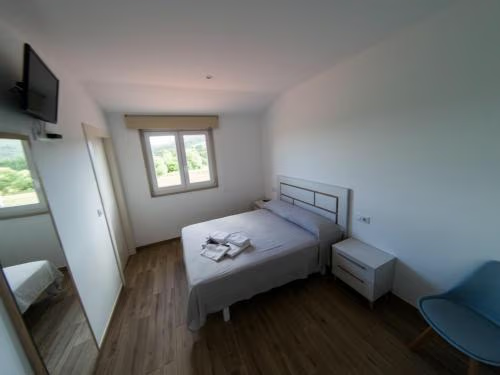 OpenReservations accepted
Albergue Casa Manola
- Top #2
 OpenReservations accepted
Pensión Casa Loncho
- Top #3OpenReservations not accepted
Albergue de peregrinos de Olveiroa

Services in Olveiroa
What you can find in town before the next stage.
- Café
- Shop
- Fountain
- Airport
- Restaurant
Source: © OpenStreetMap contributors · updated November 2025
Town 4 of 7