

Stage town on the Camino
Ponferrada
León, Castilla y León, Spain
- places to stay
- 21
- Caminos
- 2
- Elevation
- 534 m
Ponferrada owes its name to pilgrims: around 1082 a bishop had an iron-reinforced bridge built over the Sil for them. Later the Templars guarded the Way from their castle. Today the city is the stage end after the descent from the Cruz de Ferro and the starting point of the Camino de Invierno. An afternoon is enough, just not on a Monday.
Right now in Ponferrada (as of October 2026)
- New at the Basílica de la Encina: Since 30 July 2026 the Museo de Arte Sacro and the viewpoint in the tower have been open. We haven't found opening hours or prices yet.
- The castle in winter: From 1 November the Templar castle opens Tuesday to Sunday from 10:00 to 14:00 and from 16:00 to 18:00, closed on Mondays.
- Farewell to the benefactor: Joseph Leutenegger, the Swiss man who paid for a large part of the parish albergue, died near Zurich in September 2026, at almost ninety.
How long to stay?
An afternoon is enough, just not on a Monday. The old town is small, and everything you should see is there: castle, basilica, clock tower. After the long descent from the Cruz de Ferro you won't have energy for much more anyway. On Mondays the castle and museums are closed, and all you get is the view from outside. You only need a rest day here if your knees are protesting about the descent.
Ponferrada in Ninja numbers
- Around 213 kilometres separate Ponferrada from Santiago on the Camino Francés. On the Camino de Invierno it is around 271.
- 5,367 pilgrims started their Camino in Ponferrada in 2025 up to the end of October, a small increase on the previous year according to the Pilgrim's Office.
- Around 15,000 pilgrims slept at the San Nicolás de Flüe parish albergue in 2025, seven out of ten from abroad.
- More than 150,000 visits a year are counted at the Templar castle.
Arriving: across the Boeza into the city of the bridge
You come down off the Camino Francés. Behind you lies the toughest descent of the day, from Manjarín to Molinaseca, over slate slabs that turn slippery in the rain. From Molinaseca it is another 7.5 kilometres. The Way passes through Campo, which almost belongs to Ponferrada already and has an old church, Santa María de Vizbayo. Then it follows the river Boeza on asphalt. You cross it on the old stone bridge, the Puente Mascarón, and enter the city. If this stretch drags after a long day, you are not alone. If you have had enough, you can stop in Molinaseca.
In brief: a city named after a bridge
Around 1082 Bishop Osmundo of Astorga, with the help of King Alfonso VI, had a bridge built over the Sil so that pilgrims could cross the river safely. Because it was reinforced with iron, it was called Pons Ferrata, and that became Ponferrada. Around 1178 the Templars arrived and stayed until their order was dissolved in 1312. They extended the castle that bears their name today, although its most important buildings only went up in the fifteenth century under the first Count of Lemos. In the twentieth century iron, coal and power stations turned Ponferrada into an industrial city. Today around 63,000 people live here.
Protection for pilgrims: a bridge, a castle, an albergue
When you arrive in Ponferrada, you enter a city that has been built for pilgrims again and again. First the bridge that gave the place its name. Then the Templars, who according to the castle's leaflet came to protect the Camino and the iron bridge. In the fifteenth century the Catholic Monarchs supported the Hospital de la Reina for pilgrims.
And in 1999 came the albergue where you may be sleeping tonight. A Swiss couple, Joseph and Úrsula Leutenegger, paid for a large part of the building. It is named after Nicholas of Flüe, the patron saint of Switzerland. Since April 2000 pilgrims have slept here on a donation basis, looked after by volunteer hospitaleros. Nine centuries lie between the bridge and the albergue, but the idea has stayed the same: whoever is on the road should arrive here safely.
Between castle and basilica: what to see
Everything is in the small old town, just a few steps apart. Don't plan your visits for a Monday, when almost everything is closed.
- Castillo de los Templarios: At more than 8,000 square metres, the castle is one of the largest fortresses in north-western Spain. The Templars extended it to protect the very Way you are walking. It took on its present look, with the Torre del Homenaje and the Palacio Nuevo, in the fifteenth century under the Counts of Lemos. In the Palacio Nuevo the exhibition Templum Libri shows more than a hundred facsimiles and originals, among them the Book of Kells and Beatus manuscripts. After weeks on the Way, it is a quiet hour among old books. Full admission is €6, reduced €4. Pilgrims report paying €4. In October it opens from 10:00 to 14:00 and from 16:00 to 19:00, closed on Sunday afternoons and Mondays (as of October 2026).
- Basílica de la Encina: The church was built from 1572, its tower completed in 1614. Here stands the Virgen de la Encina, patron saint of the Bierzo. Legend has it that the Templars found her image in an oak while cutting timber for their castle. Since July 2026 the new Museo de Arte Sacro in the sacristy and crypt has shown more than 150 works of art, many of them for the first time. From the tower you look out over the city and the Bierzo, the valley you will walk through tomorrow.
- Torre del Reloj and Museo del Bierzo: The sixteenth-century clock tower was a gate in the old city wall and is its only surviving part. Right next to it, the Museo del Bierzo tells the story of the area, including finds from Las Médulas, the Roman gold mines that the Camino de Invierno passes. Admission is €2.70. In October it opens Tuesday to Saturday from 10:00 to 14:00 and from 16:00 to 19:00, Sunday mornings only, closed on Mondays (as of October 2026).
Food and drink
The speciality of the Bierzo is botillo, a smoked sausage made from a pig's stomach stuffed with ribs and other cuts. It comes with roasted Bierzo peppers. As for wine: red wines from the Mencía grape are at home here and cost little in the bars.
Honestly
- On a Monday, Ponferrada is only worth half as much. The castle and museums are closed. If you can, time your arrival for another day or stop in Molinaseca.
- Not every pilgrim is a fan. Some find the city skippable and the castle mostly a tourist magnet. If castles aren't your thing, you really won't miss much here.
- The big albergue is big. Well over a hundred beds, so the showers and washing area are busy in the afternoon. If you want quiet, book a private place.
- The last kilometres drag. After the steep descent from Manjarín there is still a stretch of asphalt along the Boeza, and the next morning you leave through Compostilla and Columbrianos.
Where pilgrims sleep
- Albergue de peregrinos San Nicolás de Flüe: the parish albergue of the Basílica de la Encina, run by volunteer hospitaleros. You give a donation (donativo), with at least €10 as a guideline. You can't book; beds go in order of arrival, and a credencial is required. It is open all year, with check-in from 13:00 to 15:00 depending on the season, and it closes around 22:30 in the evening. There is a kitchen, washing machines and a garden. The old town is a little over 400 metres away.
Private albergues charge around €15 for a dorm bed. Two of them are only open seasonally. Pilgrims praise a small albergue outside the old town, run by a couple who offer a shared dinner: Albergue Alea, open from April to November.
Ninja tips
- Pilgrim blessing in the evening: In the Capilla del Carmen opposite the parish albergue there is a blessing for pilgrims every evening.
- Show your credencial at the castle: Several pilgrims report paying only €4 instead of €6 with their credencial.
- Not just the walls: Take time inside the castle for the Templum Libri exhibition in the Palacio Nuevo. Between the Book of Kells and the Beatus manuscripts you find the calm that the battlements lack.
- The new tower: Since July 2026 you can climb the tower of the Basílica de la Encina and look out over the city and the Bierzo.
- No late arrivals: The parish albergue closes around 22:30, and in the morning you have to be out before 8:00. If you go out for dinner, keep an eye on the clock.
Practical tips for pilgrims
- Tourist office: Calle Gil y Carrasco 4, Monday to Saturday 10:00 to 14:00 and 16:00 to 19:00, Sunday 10:00 to 14:00.
- Post office: Monday to Friday 8:30 to 20:30, closed on Saturdays.
- Shopping and gear: Ponferrada is a city with everything you need: supermarkets, pharmacies, cash machines and outdoor shops.
- Getting here and away: Ponferrada has a railway station and a bus station. The nearest airport is León, about two hours by car.
- Festivals: In the first week of July the city celebrates the Noche Templaria. On 8 September it honours its patron, the Virgen de la Encina. Beds fill up early then.
Onwards: through the Bierzo or along the winter route
On the Camino Francés you leave Ponferrada through Compostilla and Columbrianos, just under 5 kilometres away. The Way continues through Camponaraya to Cacabelos, after 15.4 kilometres, and it is 23.6 kilometres to Villafranca del Bierzo.
Ponferrada is also where the Camino de Invierno, the winter route, begins. It leaves the city to the south across the Boeza, avoids O Cebreiro by following the Sil valley and after 26 kilometres passes through Las Médulas, the Roman gold mines. On this route it is around 271 kilometres to Santiago.
What awaits you tomorrow
A day through the wine country of the Bierzo to Villafranca del Bierzo. There stands the Iglesia de Santiago, for which the bishop of Astorga obtained a papal bull in 1186: pilgrims who could not finish the Way were to receive the jubilee indulgence here. You will walk on, of course. But it is good to know that someone thought of those who don't make it.
Deep dive: Bridge, castle and the Virgin in the oak
A long read, in case you want to learn more about Ponferrada. About twenty-five minutes' reading.
A city on a river
When you arrive in Ponferrada, you have a long, hard descent behind you. In the morning you may still have been standing up at the Cruz de Ferro; in the afternoon you are walking through the streets of a city of around 63,000 people, with supermarkets, apartment blocks and a history of power stations. The change is abrupt. But if you stand by the wall of the castle and look down at the Sil, you see the reason this city exists at all: a river that people had to get across.
Ponferrada is a city named after something built for pilgrims. That is rare along the whole Way. Many places received a church, a hospital or a bridge for the people walking to Santiago. Here the bridge gave the whole town its name. And much of what came afterwards, the knights, the castle, the legend of the Virgin, the albergue from Switzerland, circles around the same question: how does a stranger get safely through this valley?
This text tells the story of Ponferrada along that question. It tells of a bishop and his bridge, of the Templars and their end, of a castle that is far less Templar than its name claims, of a Virgin said to have been found inside a tree, of coal, iron and Roman gold. And of the people who passed through here before you came.
A bishop and his bridge
In the beginning there was a problem. The pilgrims who came from Astorga in the eleventh century and descended over the mountains into the Bierzo had to cross the Sil, and the crossing was difficult. At this point, according to the sources on the city's history, a bishop stepped in. Around 1082 Osmundo, Bishop of Astorga, had a bridge built over the Sil, with the support of King Alfonso the Sixth of León. Its purpose is explicitly recorded: it was meant to make the crossing easier for pilgrims on their way to Santiago.
The bridge was reinforced with iron. From the Latin Pons Ferrata, the iron bridge, came first Ponte Ferrato and finally Ponferrada. What exactly was made of iron on this bridge, nobody knows for certain today. A guide published by the city council speaks of iron chains with which it was fitted. Other sources say only that it was reinforced with iron. And another interpretation does not translate Pons Ferrata as iron bridge at all, but as fortified bridge. So perhaps the iron was more a kind of defensive strength than a building material. Whether anything of Osmundo's bridge survives, the sources we found do not say. But its name has remained, and with it the memory of why it was built.
A settlement grew up around the bridge. In 1086, just four years later, a church dedicated to Saint Peter was founded. Around it grew the Puebla de San Pedro, the village of Saint Peter. That was the town's first name, before the name of the bridge took over. People had lived by this river much earlier, in the Neolithic, in the Iron Age and under the Romans, who left remains near the bridge over the Boeza. But only with the eleventh century and the pilgrim road does the written history of this city begin.
A few decades after Osmundo, Ponferrada appears in the most famous pilgrim guide of the Middle Ages. The Codex Calixtinus from the twelfth century lists the places along the Way in its fifth book: after the pass on Monte Irago, the mountain you came down today from the Cruz de Ferro, come Molinaseca, Ponferrada and Cacabelos. And in the list of rivers it says briefly that the Sil flows past Ponferrada. What the Codex does not say is interesting too. In its division into daily stages, the tenth stage runs from Rabanal to Villafranca. For its author, Ponferrada was not a stage end but a place you walked through. Today, for many pilgrims, it is the place where they sleep.
The knights arrive
A hundred years after the bridge came the men whose name the castle bears today. Around 1178 King Ferdinand the Second of León allowed the Order of the Temple to establish a commandery in Ponferrada, a seat with property and administration. In 1180 the same king gave the town its first charter, so that more people would settle there. A first fortification is documented around 1187. It was built on a hill where a Celtic hillfort had probably stood, later used by Romans and Visigoths as well. A Visigothic gold coin has even been found at the castle.
According to tradition, a master named Guido de Garda led the first Templars to Ponferrada, and a brother Helías is said to have been their first commander. Why they came at all is something the sources largely agree on: the castle's leaflet says they were to protect the Camino and the iron bridge.
The story did not run in a straight line. In 1196 King Alfonso the Ninth of León took Ponferrada away from the Templars again, because they had sided with Castile in the quarrel between the kings. Only in 1211 did he make peace with the Order and give it the town, in exchange for some other castles. From then on, Ponferrada was a Templar possession for around a hundred years. During this time the town grew with the pilgrim road. In the thirteenth and fourteenth centuries it got a wall with four gates, called El Cristo, Paraisín, Las Nieves and Las Eras. A Jewish community lived outside the walls.
The end of the Templars
The end did not come in Ponferrada, but in France. In 1307 the persecution of the Templars began in France, and in 1308 Pope Clement the Fifth demanded that all Christian rulers imprison the brothers and seize their property. Castile and León were ruled at the time by Ferdinand the Fourth. Here too, Templars were detained and their goods confiscated.
What happened to Ponferrada next is a small story about power and mistrust. The master of the Templars in Castile, Rodrigo Yáñez, knew what was at stake. In 1308 he first offered the Order's castles to the queen mother, María de Molina. She would only accept them with the consent of her son, the king. So Rodrigo Yáñez handed the castles not to her but to the Infante Felipe, a brother of the king, on condition that he plead with the king on the Templars' behalf. That is how Ponferrada, too, came into the Infante's hands. Another Infante, Juan, fought with him over the castle, and in the end Felipe had to hand it over, together with three other fortresses, to King Ferdinand the Fourth. The Templars had lost their castle before anyone had even judged them.
The verdict came in 1310, and it was different from France. In October of that year a council met in Salamanca to judge the Templars of Castile and Portugal on the Pope's orders. Present were the Archbishop of Santiago and ten bishops, among them the Bishop of Astorga, the successor of the same Osmundo who had built the bridge. The assembly examined the accused and concluded unanimously that they were innocent. The Templars were set free.
It did not save them. In 1312 the Pope dissolved the Order, and from then on Ponferrada no longer belonged to the Templars. What became of the individual brothers of Ponferrada, the sources we found do not tell. One bitter detail remains: in the very country whose pilgrim road they had protected, they were acquitted, and still they disappeared.
Whose Templar castle is it?
When you stand in front of the castle gate today, you see a picture straight out of a knights' film: a gate between two towers, battlements, and behind them a huge site of more than 8,000 square metres. The sign says Castillo de los Templarios, castle of the Templars. An honest note is needed here. Most of what you see was not built by the Templars.
After the end of the Order, Ponferrada changed hands often. In 1340 King Alfonso the Eleventh gave the town to Pedro Fernández de Castro, known as the warlike one. He probably began what is now called the old castle, with the first keep. The Castro family held the town until 1374, then it passed to members of the royal house and to various nobles. In 1440 it was acquired by Pedro Álvarez Osorio, who in 1456 was made the first Count of Lemos. He is the real builder of the castle as you know it today. Under him came the main entrance with its defences, five towers with their own names, Moclín, Cabrera, Caracoles, Malpica and Malvecino, and a new palace in the Renaissance style. He also had an underground passage dug to the Sil, so that the castle would have water during a siege.
And it was besieged. In 1467 the Irmandiños, peasants and townspeople, rose up in Galicia and the Bierzo against the arbitrary rule of the nobles, and they also laid siege to the fortress of Ponferrada. It was saved by an agreement between King Henry the Fourth and the Count of Trastámara, on which the uprising foundered. Twenty years later the fight was over the inheritance of the first Count of Lemos. A successor to the title, Rodrigo, occupied the castle in 1485 against the will of the Catholic Monarchs. The Crown bought the rights to the town for 23 million maravedís, sent a royal army with artillery under the Admiral of Castile, and in the summer of 1486 the castle was taken by storm. Ponferrada now belonged to the Crown. The monarchs' first governor, Juan de Torres, had the castle repaired and strengthened.
So is the name Templar castle a false label? Not quite. The Templars did build a fortress here, completed in 1282 according to the city guide, and they held it for more than a century. But the castle you are photographing is largely the work of a fifteenth-century count. That everyone talks about the Templar castle also has to do with the love of a good story. The Templars are more mysterious than a Count of Lemos. It is good to know both as you walk through the gate.
Ruin, novel and return
After the Middle Ages the castle lost its military purpose. In the seventeenth and eighteenth centuries a royal official administered it, and it slowly fell into decay. In the Peninsular War against Napoleon, French troops used it briefly; in 1809 Spanish soldiers and local guerrillas took it back, and the fighting left damage. In 1811 the Regency even ordered buildings inside to be blown up. In the nineteenth century stones from the castle were carried off as building material. The town sold sections of wall, built stables and a market against the walls and leased the courtyard as pasture. For a sports ground, according to one account in 1923, walls were even blown up.
The castle owes its fame partly to literature. In 1844 a novel appeared in Madrid that was an immediate success: El señor de Bembibre, written by Enrique Gil y Carrasco, a young man from Villafranca del Bierzo, the next large town on the Camino. The novel tells of Álvaro and Beatriz, who are meant for each other. Her ambitious father marries Beatriz to the Count of Lemos, and Álvaro joins the Order of the Temple, at the time when the Order is going under during the reign of Ferdinand the Fourth. It is a story of love, duty and loss modelled on the novels of Walter Scott, and it is considered a masterpiece of Spanish Romanticism. Gil y Carrasco died two years later, in 1846, in Berlin, barely thirty years old. But he had given the Templars of the Bierzo a monument that still works today. In Ponferrada a statue recalls one of his characters, known as La Carrasca.
In 1924 the castle was declared a national monument, and the decay stopped. Today it counts more than 150,000 visits a year. In the Palacio Nuevo, the counts' palace, the exhibition Templum Libri shows more than a hundred facsimiles and originals, from the Book of Kells to books illustrated by Dalí, Picasso and Chillida. And every year in July the city celebrates the Noche Templaria. Parades fill the streets, there is medieval music and markets, new knights are solemnly invested, and in a ceremony the master returns to the city and hands over the Holy Grail and the Ark of the Covenant. Nobody takes this for history. But it shows how completely Ponferrada has made the Templars its own.
The Virgin in the oak
Just a few steps from the castle stands the church that means more to the people of the Bierzo than any fortress. It belongs to the Virgen de la Encina, the Virgin of the holm oak. If you want to understand her story, you have to hear a legend, and it is explicitly to be taken as a legend.
The Diocese of Astorga tells it like this: around the year 450, Toribio, Bishop of Astorga, brought an image of the Mother of God with the Child from Jerusalem. When Muslim troops pushed north in the ninth century, Saint Genadio hid the image in Ponferrada to protect it from them. The hiding place was so good that for centuries nobody knew about it any more. Then came the Templars. They needed wood for their castle and were felling trees. On 8 September, the feast of the Nativity of Mary, a holm oak they were cutting split open. In the half still standing they discovered a niche, and in it the lost image. After the tree in which she was found, the Virgin was named the Virgen de la Encina.
When this is supposed to have happened, not even the storytellers agree. Some sources put the find around 1200, others around 1300. The city itself writes on its tourism website, with refreshing candour, that the story contains an obvious anachronism. In any case, the image venerated in the basilica today dates from the sixteenth century. People here call it tenderly La Morenica, the little dark one.
You do not have to believe the legend to see what it does. It ties together the three great stories of this place: the road to Jerusalem and back, the knights securing the land for the pilgrim road, and a tree in which something precious survives the dark centuries. Whether it happened like that, we do not know. That the people of the Bierzo have been telling each other this story for centuries, that we do know.
A basilica for the Morenica
On the site of a medieval church, work on a new one began in 1572, to plans by the master builder Juan de Alvear, who built the apse first. The city gives 1573 as the year of the plan, other sources 1572 for the start of building. It became a Renaissance church in the shape of a Latin cross. It was a long time before it was finished. According to the city guide, the work took about a century, and several master builders changed the original plan along the way. In 1614 work began on the slender tower that still rises above the roofs of the old town. In the eighteenth century a chapel of its own was added for the Virgin.
When you go inside, the high altar draws your eye. It was made between 1630 and 1640, of painted wood, a Baroque work on which Mateo Flórez and pupils of the great sculptor Gregorio Fernández collaborated. The city guide calls it one of the most important Baroque altarpieces of the seventeenth century. In a small niche, a camarín, stands the Morenica, with a relief of the Assumption above her.
Ponferrada wanted more rank for its church. It asked for it to be raised to a collegiate church, but this was refused in 1720 and again in 1725. The great honour came only in the twentieth century. In 1908 the Virgen de la Encina was crowned as patroness of the Bierzo. On 4 September of the same year, King Alfonso the Thirteenth granted Ponferrada the title of city. The bridge that had become a settlement could now call itself a ciudad. Fifty years later, in 1958, Pope Pius the Twelfth confirmed the patronage. On 19 May 1958 the papal letter was read out in Astorga cathedral, and bells rang throughout the Bierzo. Afterwards the image of the Virgin travelled through the villages of the region, a pilgrimage to the people instead of the people to her. The newspaper Diario de León describes this journey as a sign of reconciliation after the Civil War. Every year on 8 September the city still celebrates its great festival, the Day of the Encina.
For you as a pilgrim, this church has a very practical connection. The large parish albergue San Nicolás de Flüe belongs to its parish, and in the Capilla del Carmen opposite the albergue a blessing for pilgrims is given every evening. Since 30 July 2026, a new museum of sacred art in the great sacristy and the crypt has also been showing more than 150 works, many of them for the first time. And after a lightning strike had damaged the tower, it is open again. From the top you look out over the city and the wide basin of the Bierzo, through which your way continues the next morning.
Pilgrims through the centuries
Who walked here before you? The first who can be named are not individuals but the many for whom Osmundo built his bridge. In the twelfth century the Codex Calixtinus records Ponferrada as a place on the Way, and in the thirteenth and fourteenth centuries the walled town grew because the pilgrim road ran through it. Already in the first half of the twelfth century, as the city's history puts it, Ponferrada was a junction of roads.
In 1492, the year Columbus sailed west, the Catholic Monarchs founded the Hospital de la Reina in Ponferrada, the Queen's Hospital. Its purpose was to look after pilgrims on their way to Santiago. Only six years after the Crown had stormed the castle, it endowed a house for strangers.
Three years later, in 1495, a slim book appeared that is considered the first written guide for pilgrims to Santiago. It was written by Hermann Künig von Vach, a monk of the Servite Order from Vacha in Thuringia, in German verse. Künig had walked to Santiago himself, and he had some advice for his readers. Instead of climbing over Astorga and the heights of Foncebadón, he left the main route at San Martín del Camino and went northwest through Bembibre straight to Ponferrada. His advice runs roughly like this: if you follow me, you turn right here and do not have to climb the mountains. From Ponferrada he followed the Camino Francés again to Villafranca. The route he described was recognised as a historic Way of Saint James in November 2025, over around 112 kilometres between León and Ponferrada. So if you arrive here after the Cruz de Ferro with aching knees: a pilgrim advised against it more than five hundred years ago.
In later times, too, the city was a place for people passing through. During the Peninsular War the supreme junta of León met here several times, in 1809, 1810 and 1811. But as everywhere on the Camino, pilgrims became fewer in the nineteenth and early twentieth centuries. The return began quietly. In the nineteen eighties a priest, Antolín de Cela, took in pilgrims in parish rooms.
In 1995 a man from Switzerland, Joseph Leutenegger, contacted the Bierzo pilgrims' association. He and his wife Úrsula paid for a large part of a new albergue on land belonging to the basilica. In February 1999 the foundation stone was laid, in September 1999 it was inaugurated, and it was given the name of the Swiss national saint Nicholas of Flüe, a fifteenth-century farmer and hermit. In April 2000 the first pilgrims arrived. To this day the albergue is run by volunteer hospitaleros and lives on donations. In 2025 around 15,000 people slept here, seven out of ten from abroad. Joseph Leutenegger died near Zurich in September 2026, when this text was written, at almost ninety.
From the iron bridge to the Queen's Hospital to the Swiss albergue, one thread runs through it all. Again and again, people who did not live here themselves made sure that strangers would find a safe place in Ponferrada.
The Bierzo, a bowl of mountains
Ponferrada is the capital of a landscape you are crossing these days, perhaps without fully noticing it. The Bierzo is a wide basin on the Sil, enclosed by mountains all around, in the west of the province of León. It is made up of 38 municipalities, and since 1991 the Bierzo has by law been a comarca with its own council. The name probably comes from a Celtiberian word, Bergidum, related to a root meaning high or elevated.
The basin has a mild, almost Mediterranean climate, while in the mountains around it there is much more rain. When you walk through the vineyards beyond Ponferrada in the morning, you see the result: here grow Mencía and Godello, the grapes of the Bierzo designation of origin, and the oldest Mencía vines stand in the area around Villafranca. On the tables you will find botillo, a smoked sausage traditionally eaten at carnival, and in November the villages celebrate the Magosto with roasted chestnuts, new wine and chorizo.
The Bierzo also has a quiet, spiritual history older than the Way of Saint James. In the seventh century, in Visigothic times, Saint Fructuoso founded monasteries here such as Compludo and San Pedro de Montes. At the beginning of the tenth century Saint Genadio, the same one who hides the Morenica in the legend, renewed these foundations. The mountains south of Ponferrada were then called the Thebaid of the Bierzo, after the Egyptian desert of the first Christian hermits. In Peñalba de Santiago, high in the Valle del Silencio, the valley of silence, a Mozarabic church from the tenth century still stands. The village's name already carries the apostle within it.
Santo Tomás de las Ollas
If you have half a day in Ponferrada and want to see something hardly any pilgrim sees, walk about a kilometre east to the small village of Santo Tomás de las Ollas. The name means Saint Thomas of the Pots. People here used to live from pottery. The Ensenada land register from the eighteenth century describes how the village women made pots, jugs and other earthenware.
In the village stands a church that is among the oldest buildings in the whole area. There is no founding charter, but it is dated to the tenth century, the period of Mozarabic architecture, that of the Christians who brought forms such as the horseshoe arch from the Muslim south to the north. One source gives 1183 for the first written traces. The regional tourism authority reports that the Bishop of Astorga gave the church to the monastery of San Pedro de Montes in 1311, and that the documents were later lost in a fire in the monastery's archive.
Its treasure is inside. A horseshoe-shaped triumphal arch with a double ring connects the nave with the apse. It is considered the first known double arch in medieval Spanish architecture. The apse itself is oval and lined with nine blind horseshoe arches on granite pillars. Above it is a vault of a kind of poured masonry, according to the region the only known example of this technique in Mozarabic architecture. The door dates from the Romanesque period of the thirteenth century. At the end of the seventeenth century the nave was lowered and given a wooden ceiling in the Moorish style, along with a bell gable and a new door, and in the nineteenth century the sacristy. Since 1931 the church has been protected as a national monument.
You can visit only by appointment, and admission is free. If it works out, you will stand in a room that was already old when Osmundo built his bridge.
Iron, coal and light
The city you walk through in the afternoon is not only medieval. To a large extent it is a child of the twentieth century. In 1881 the railway reached Ponferrada. During the First World War tungsten was dug from the ground in the area for the arms industry. Then came the idea of turning the Bierzo into a second Vizcaya, an industrial region like the Basque Country. An engineer, José Revilla Haya, had proposed as early as 1906 to bring the scattered mines together and build a railway. On 31 October 1918 seven businessmen founded the Minero Siderúrgica de Ponferrada, the Ponferrada mining and iron company. It intended to mine coal near Villablino and iron ore near Ponferrada and to run a steelworks here.
The steelworks never succeeded, partly because Ponferrada lay too far from the coast. But the coal did. In 1919 the narrow-gauge railway between Ponferrada and Villablino opened, bringing the coal down from the valleys to the north. It was, so it is said, the last line in Europe to retire steam locomotives fired with its own coal. Passenger services ran until 1980. The old station is now a railway museum. Out of this company later grew the largest private mining company in Spain.
Right at the start, the company built a coal-fired power station in Ponferrada, first for its own needs and later, from 1930, for other customers too. In 1971 it stopped producing electricity and stood empty for almost four decades. From 2009 to 2011 it was restored, and on 14 July 2011 it opened as the energy museum, La Fábrica de Luz, the light factory. There you walk across the coal wharf from 1930, through the boiler hall with its four chimneys and the turbine hall, and learn how coal became electricity and how the people lived who dug it out of the ground. In 2012 the project received a European award for heritage conservation. In its first ten years more than 196,000 visitors came.
The energy story grew even bigger after the Civil War. In 1949 the state electricity company Endesa set up in Ponferrada, and at the beginning of the nineteen fifties the Compostilla power station went into operation. Between 1940 and 1970 the city's population tripled. When you leave Ponferrada today through suburbs of apartment blocks, you see the traces of these decades. From the late nineteen eighties most of the mines were closed. The Minero Siderúrgica went through crises and bankruptcies, merged with an Asturian company in 2008, and in 2009 a court in Castilla y León ordered its open-pit mining to stop.
For a pilgrim, the industrial history can feel like a break. But without it, the city you are sleeping in today would not exist at this size. The population tripled because there was work here, and most of the streets you walk in and out on were built in these decades.
The gold of the Romans: Las Médulas
Around 26 kilometres from Ponferrada on the Winter Way lies a landscape shaped not by nature but by the Romans. Las Médulas was a gold mine whose water system is considered the most spectacular known from antiquity.
The peoples before the Romans already panned gold from the rivers. But after Emperor Augustus conquered the northwest of the peninsula in the years after 26 before Christ, exploitation on an enormous scale began here. The technique was called ruina montium, the collapse of the mountains. Through seven long channels, together an estimated 300 kilometres, the engineers brought water from the mountains of the Cabrera and collected it above in reservoirs. Then they drove galleries into the mountain and let the water rush in. The pressure brought whole slopes crashing down, and the water washed the gold-bearing earth down to washing areas.
This method was described by Pliny the Elder, who served as a senior Roman official in the region. In his Natural History he writes that gold is also sought in the debris of mountains. According to the figures that go back to him, 20,000 Roman pounds of gold were extracted every year from the mines of the northwest, more than six and a half tonnes. Towards the end of the second or the beginning of the third century the mine was exhausted and abandoned. What remained was a wounded landscape, where chestnuts were later planted. Some of these trees are now well over a hundred years old.
In 1997 UNESCO declared Las Médulas a World Heritage Site. It was not a foregone conclusion. Thailand objected, arguing that the landscape was the result of human destruction, and Germany and Finland agreed. It is a question you can honestly leave open in this place: is this a wonder of engineering or a wound? Probably both.
Gold from the Bierzo, iron from the Bierzo, coal from the Bierzo: the earth of this region has been exploited again and again. Whoever walks through Las Médulas today sees how nature is reclaiming the wounds, slowly, over almost two thousand years.
The Winter Way
Las Médulas is not on the Camino Francés, but on another route that begins in Ponferrada: the Camino de Invierno, the Winter Way. It leaves the city to the south over the Boeza and follows the valley of the Sil westwards, instead of climbing over the pass of O Cebreiro like the main route. It is around 271 kilometres to Santiago on this route, almost 60 more than on the Camino Francés.
The name gives away the idea: a route for the cold season that avoids the high pass. And the idea is old. Hermann Künig already advised in 1495 to avoid the heights, and later on his way to Lugo he went around O Cebreiro. The Winter Way is a route for those who would rather take detours than climb passes, and it leads past Roman gold into the interior of Galicia.
So when you stand in Ponferrada, you are standing at a fork in the road. Most will continue west tomorrow through the vineyards to Cacabelos and Villafranca. A few turn south. Both are ways to Santiago.
What Ponferrada gives you
Ponferrada is not a city you love at first sight. The suburbs are long, the asphalt is hard, and the castle is full of tourists. Many pilgrims move on the next morning without looking back, and that is fine.
But if you stay a moment longer, you notice how many layers this city has. Beneath the miners' apartment blocks lies the city of the counts. Beneath the counts' castle lies the fortress of the Templars. Beneath the fortress probably lies a Celtic hillfort. And at the beginning of it all stands a bridge that a bishop had built because people like you had to cross the river.
You do not have to believe the legends of this city. The Virgin in the oak, the Grail handed over at the Noche Templaria, they are stories. But one story here is no legend: that for nine centuries someone has asked, again and again, how a stranger can get safely through this valley. A bishop with his bridge. The Catholic Monarchs with the Queen's Hospital. A Swiss couple with their albergue. Volunteers who will assign you your bed tonight.
When you head out tomorrow morning, you are one of many who have made it safely across here. Perhaps that is all you take with you: that you were carried, also by people who will never meet you. And that there are bridges you can build yourself, for someone who comes after you.
Where to stay in Ponferrada
The places pilgrims rate highest in Ponferrada come first.
- Top #1
 OpenReservations accepted
Albergue Alea
- Top #2
 OpenReservations accepted
Albergue Guiana
- Top #3
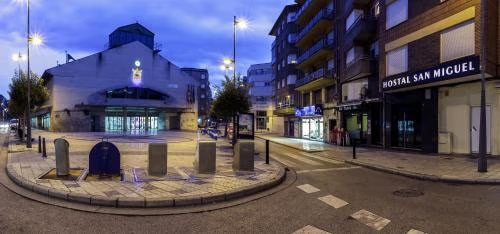 OpenReservations accepted
Hostal San Miguel



Services in Ponferrada
What you can find in town before the next stage.
- ATM
- Café
- Shop
- Tobacco
- Medical clinic
- Pharmacy
- Fountain
- Post office
- Train station
- Bus station
- Restaurant
Source: © OpenStreetMap contributors · updated December 2025
Town 35 of 49