

Stage town on the Camino
Portomarin
Lugo, Galicia, Spain
- places to stay
- 39
- Camino
- 1
- Elevation
- 388 m
Portomarín is a village that moved house: when the Belesar reservoir flooded old Portomarín on the Miño in the early 1960s, the fortified church of San Nicolás was carried up the hill stone by stone. For many it is the first night after Sarria, 92.2 kilometers before Santiago. An afternoon is enough, and the climb up the stairs is part of it.
How long to stay?
An afternoon is enough. The church, the stairs, the chapel and the main street with its arcades are all close together, and in an hour you have seen everything. You spend the rest of the day by the water or on a terrace. A rest day only pays off on Easter Sunday, when the town celebrates its schnapps festival.
Portomarín in Ninja numbers
- 92.2 kilometers are left from here to Santiago. If you started in Sarria, you have already done the first 22.3 of them.
- 82 steps make up the granite staircase up into town, 17 meters high, built from an arch of the medieval bridge.
- Over 1,300 people had to leave old Portomarín when the water rose in 1962.
- 344 meters above sea level is the lowest point of the stage from Sarria: the bridge over the reservoir, just before town.
- 725 meters high is the Sierra de Ligonde tomorrow, 381 meters above the water you crossed today.
Arriving: over the water and up the stairs
From Vilachá the path leads down to the reservoir, then over the long bridge across the dammed Miño. On the other bank the stairs wait: 82 granite steps up to the small Capela das Neves, which sits on an arch of the old bridge. Only at the top do you stand in the new Portomarín, a town from the 1960s with granite arcades that looks older than it is. If you are tired, you don't have to take the stairs: on the left, the road leads into town on a gentler slope.
In brief: a village moves house
In the Codex Calixtinus the town is called "Pons Minea", bridge over the Miño. The first bridge is said to have been built by the Romans in the 2nd century. According to tradition, Queen Urraca had it destroyed in 1112 to stop her husband Alfonso the Battler, and a man called Pedro Peregrino rebuilt it. In the Middle Ages, knightly orders shared the two banks: the Knights Hospitaller on the right, the Knights of Santiago on the left. The Hospitallers held the bridge and the pilgrim hospital, which is why their church looks like a castle.
Then came the electricity. For the Belesar hydroelectric plant, the water in the valley rose in 1962, and old Portomarín disappeared. Because the town had been declared a historic ensemble in 1946, the most important things were taken along: the church of San Nicolás, the façade of San Pedro, the bridge staircase, the chapel and the Pazo de Berbetoros from the 17th century. At low water, the remains of the old village and the piers of the medieval bridge still emerge below.
A town that moved: what to see
Everything is in the town center, a few minutes apart.
- San Nicolás: The late Romanesque fortified church from the end of the 12th and the beginning of the 13th century is the reason you are here. It belonged to the Hospitallers, who controlled the bridge and the pilgrim hospital from here, and its portal is considered a forerunner of the Pórtico de la Gloria, which you will see in Santiago. Look closely at the outer walls: the stones still carry the numbers used to put them back in the right place during the move. We did not find opening hours.
- Façade of San Pedro: That is all of this church that moved along. An inscription at the portal names the consecration in the year 1182.
- Stairs and Capela das Neves: The 82 steps and the chapel at the top are a piece of the old bridge, rescued across the water. A legend says that anyone who looks back while climbing will be punished in love. So you have a reason to look ahead.
- Pazo de Berbetoros: The 17th-century noble house also made the move and now stands in the new town.
Food and drink
Portomarín has three things you won't get like this elsewhere on the Camino: the empanada with eel from the Miño, the Tarta de Portomarín made with almonds, and the homemade orujo, the pomace brandy to which the town dedicates its festival on Easter Sunday. There are several bakeries, bars and supermarkets. In high season the kitchens are full between 19:00 and 21:00, so eat early.
Honestly
- The town is new, even if it looks old. Apart from the rescued buildings, almost everything dates from the 1960s. Old Portomarín lies under water.
- It is crowded. For most people who start in Sarria, Portomarín is the first evening, and it feels like it: groups, taxis, backpack transporters.
- The stairs come at the end of the day. After 22 kilometers, 82 steps are a lot. The road on the left is the more comfortable alternative.
- The public albergue has no dishes. You can only cook there with your own pot.
Where pilgrims sleep
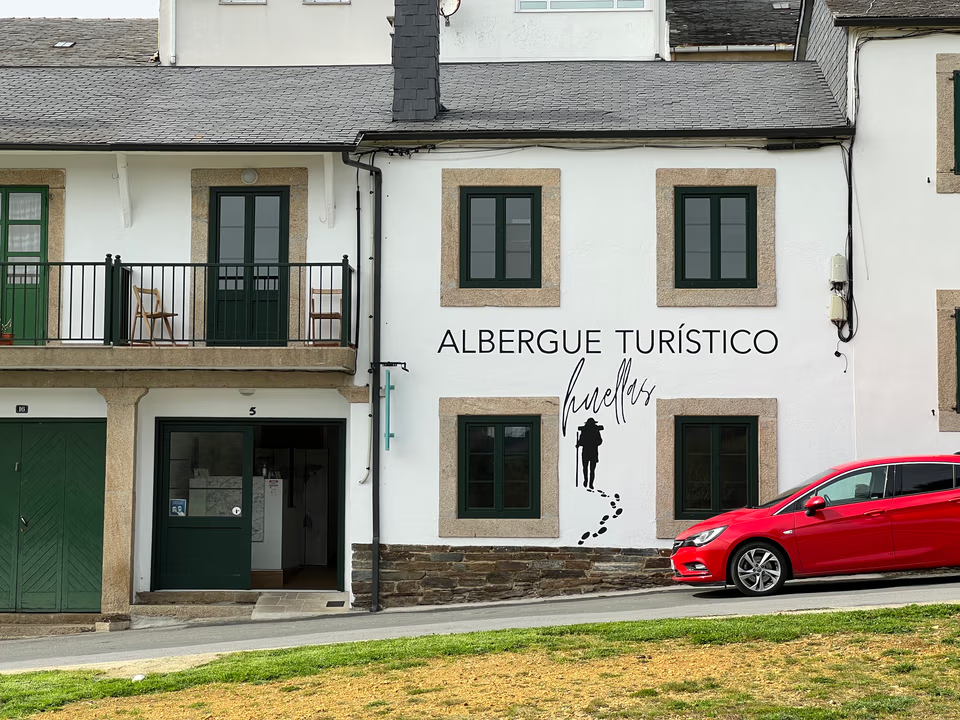
The Albergue de peregrinos de Portomarín belongs to the Xunta de Galicia and has stood in a converted school behind the church since 1993. It is open all year, for pilgrims only, costs €10 (as of October 2026), admission from 13:00, closing at 22:00. You can't reserve. The kitchen has no dishes. In addition there are many private albergues, mostly for €12 to 20 (as of October 2026), such as Pasiño a Pasiño in the center or Folgueira at the edge of town, both open all year. Many others open only from Easter to October or November. In July, in August, in Holy Week and on long weekends you should reserve private beds.
Ninja tips
- Take the stairs at least once anyway. If you don't climb them on arrival, do it in the evening without your pack. From the top you can see across the reservoir.
- Look for the numbers on San Nicolás. They are the proof of the move and the loveliest moment of this town.
- Look down at low water. At the end of a dry summer you can see the walls of the old village and the bridge piers below.
- Two stamps a day from here. On the last 100 kilometers, the pilgrim office in Santiago requires two stamps per day for the Compostela. The church, the albergue and many bars stamp.
- Start early. Tomorrow begins with a 381-meter climb, and at that hour the path is not yet crowded.
Practical tips for pilgrims
- Supplies: Supermarkets, pharmacies and ATMs in town.
- Health center: Phone 982 545 114.
- Tourist information: Phone 982 545 206.
- Buses: to Lugo and Sarria.
- Festivals: Orujo festival on Easter Sunday, patron saint festival on the first weekend of September.
Onward: up into the Sierra de Ligonde
You leave Portomarín along the Avenida de Chantada and go down to the water once more, to 346 meters. Then it climbs steadily: via Toxibó (km 688.8), Gonzar (691.8) and Castromaior (693.1) to the Hospital da Cruz and to Ventas de Narón, where the stage reaches its highest point at 725 meters. Via Ligonde with the Cruceiro de Lameiros from 1670 and Airexe you come to Portos, where a detour of about 2.5 kilometers each way branches off to the church of Vilar de Donas. Via Lestedo you reach Palas de Rei: 24.7 kilometers, 636 meters of ascent, 460 meters of descent. There are bars and albergues in almost every village along the way.
What awaits you tomorrow
Palas de Rei, the town whose name promises a Visigothic royal palace. Already the Codex Calixtinus knew it as the second-to-last stage stop before Santiago, and from the edge of town the pilgrims of the Middle Ages walked the last 67.5 kilometers together.
Deep dive: The village under the water
A short read, in case you want to learn more about Portomarín. About three minutes' reading.
The bridge over the Miño
The name says it all. Portomarín is the port on the Miño, and in the pilgrim guide of the twelfth century, the Codex Calixtinus, the town is simply called bridge over the Miño. Here every pilgrim had to cross the largest river in Galicia, and whoever held the bridge held power. The first one is said to date from Roman times. In the year 1112, according to tradition, Queen Urraca had it destroyed because she wanted to stop her own husband, King Alfonso the Battler. A man whom the sources call only Pedro Peregrino, Peter the Pilgrim, rebuilt it.
Two banks, two orders
In the Middle Ages the right bank belonged to the Knights Hospitaller, the order of knights that cared for pilgrims and the sick. The left bank was held by the Knights of Santiago. At the end of the twelfth century the Hospitallers built their church to Saint Nicholas, and they built it like a fortress, with battlements and thick walls, because it guarded the bridge and the hospital next to it.
The water comes
In the twentieth century Spain needed electricity. The Belesar reservoir was built in the valley of the Miño, and in 1962 the water began to rise. More than one thousand three hundred people had to leave their homes. Because the town had been declared a historic ensemble sixteen years earlier, it was not allowed to simply disappear. A new Portomarín was built up on the hill, the church of San Nicolás was carried up stone by stone, and every block was numbered so that it would return to its place. The numbers can still be seen today. The façade of the church of San Pedro, a noble house and the staircase of the old bridge moved along too.
What Portomarín gives you
When the summer has been dry, the old village comes back out. Then you see walls, paths and the piers of the bridge below, where pilgrims walked for centuries. Portomarín is a place that carried itself, stone by stone, to a new site. Tonight you carry your pack up the stairs, for the first time or for the twentieth. What to take along and what to leave behind, you decide constantly on this path. Here a whole village decided it.
Where to stay in Portomarin
The places pilgrims rate highest in Portomarin come first.
- Top #1
 OpenReservations accepted
Huellas Albergue-Turístico
- Top #2
 ClosedReservations accepted
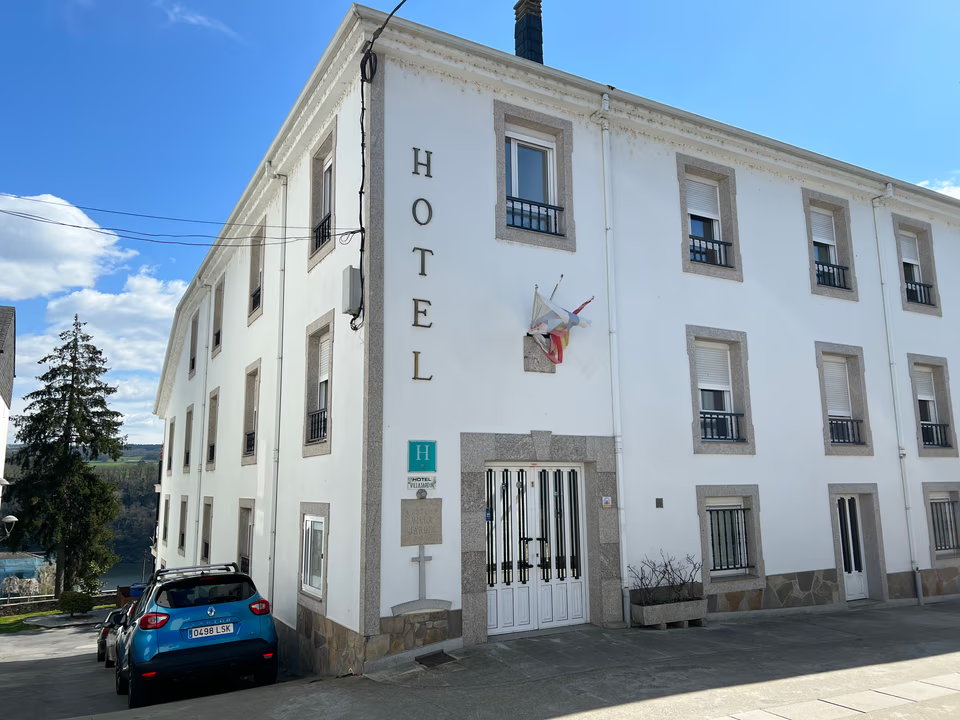
Hotel Villajardín
- Top #3
 OpenReservations accepted
Casona da Ponte


Services in Portomarin
What you can find in town before the next stage.
- ATM
- Café
- Shop
- Tobacco
- Medical clinic
- Pharmacy
- Fountain
- Post office
- Restaurant
Source: © OpenStreetMap contributors · updated January 2025
Town 42 of 49