


Stage town on the Camino
Saint-Jean-Pied-de-Port (SJPP)
Pyrénées-Atlantiques, Nouvelle-Aquitaine, France
- places to stay
- 37
- Caminos
- 8
- Elevation
- 171 m
Saint-Jean-Pied-de-Port is where the Camino Francés begins: in 2025 almost 55,000 pilgrims registered at the pilgrim office. The little town of the kings of Navarre lies at the foot of the Pyrenees, and everything that matters is on the Rue de la Citadelle. The next day you climb to 1,430 metres, in winter via Valcarlos.
Right now in Saint-Jean-Pied-de-Port (as of October 2026)
- Winter closure from 1 November: From 1 November to 31 March, the Napoleon route over the Lepoeder pass is closed by Navarre. Then you have to go via Valcarlos. If you ignore the closure and need rescuing, you may be billed for the costs. In December 2025 the fire brigade brought an exhausted pilgrim out of the closed section.
- Albergues closing: The parish albergue Kaserna closes on 26 October, and the Gîte de la Porte Saint-Jacques is already shut. Last winter the municipal albergue was also closed from early December to the end of February. Whether this will happen again this winter is not yet certain.
- No water on the mountain: At the end of October, Orisson and the Borda are usually closed, and the Fontaine de Roland has recently been only a thin trickle. Carry water for the whole stage.
How long to stay?
An afternoon is enough, but plan a buffer. Everything that interests you as a pilgrim lies along a single lane, the Rue de la Citadelle, and can be seen in two hours. An extra day is often worth it anyway: the train from Bayonne is cancelled again and again, and if fog or storm is forecast at the pass, it is better to wait here a day than to turn back up there. If you are here on a Monday, you also get the market.
Saint-Jean-Pied-de-Port in Ninja numbers
- 54,979 pilgrims registered at the pilgrim office in Saint-Jean in 2025, from 118 countries. Most came from France, followed by the USA, Spain and Korea.
- 30,345 Compostelas went in 2025 to pilgrims who had started here. That makes Saint-Jean the fourth-largest starting point of all Caminos, after Sarria, Porto and Tui.
- 776 kilometres is the distance from here to Santiago according to Camino Ninja.
- 1,430 metres is the height of the Lepoeder pass, which you already cross on the first day on the Napoleon route. Saint-Jean itself lies less than 200 metres above sea level.
Arriving: through the St. James gate into town
If you arrive on foot on the Via Podiensis or another French route, you enter the old town through the Porte Saint-Jacques at the top of the Rue de la Citadelle. Most pilgrims, however, arrive by train from Bayonne. The Rue de la Citadelle is the pilgrims' lane: here you find the pilgrim office, the municipal albergue and most of the gîtes. It leads downhill to the church and through the Porte Notre-Dame to the bridge over the Nive. From there, the next morning, you leave through the Porte d'Espagne towards the Pyrenees.
In brief: the town at the foot of the pass
The name says it: Saint-Jean "at the foot of the pass". At the end of the twelfth century the kings of Navarre refounded the town on this spot, after troops of Richard the Lionheart had destroyed the older settlement. Saint-Jean became the main town of Basse-Navarre, the northern part of the kingdom of Navarre, and the last stop before the crossing of the Pyrenees. Above the town stands the seventeenth-century citadel, which Vauban later inspected. Since 1998 the Porte Saint-Jacques has been part of the World Heritage of the Camino de Santiago in France.
Before the big climb: what to see
Everything lies along the Rue de la Citadelle and its continuation. Walk the lane once up and down, ideally on the evening before you start.
- Porte Saint-Jacques: The gate at the top of the old town is where pilgrims from France have arrived for centuries, and a World Heritage site since 1998. If you came by train, go up anyway and look back through the gate: this is how pilgrims who came on foot from Le Puy or Vézelay saw the town.
- Rue de la Citadelle: The cobbled lane is the living room of the Camino, with the pilgrim office, albergues and the old prison. Here in the evening you meet the people you will cross the pass with the next day.
- Église Notre-Dame-du-Bout-du-Pont: The Gothic church at the foot of the lane, right by the bridge, probably dates from the thirteenth century. According to tradition, King Sancho the Strong of Navarre founded it after the Battle of Las Navas de Tolosa in 1212. A good place for a quiet moment before setting off. Whether there is currently a Mass with a pilgrim blessing, you can find out at the pilgrim office.
- Porte Notre-Dame and the bridge over the Nive: Through the gate next to the church you reach the old bridge that locals like to call "Roman", although it dates from the seventeenth century. From here you see the houses with their wooden balconies reflected in the river.
- Citadel: A ramp takes you up to the fortress on the hill above the town. From the top you look over the valley and the vine terraces of Irouléguy, and you get a sense of the mountains that lie ahead of you tomorrow. Inside there is a school today.
- Prison des Évêques: The old prison at 41 Rue de la Citadelle now houses a small museum about the Basque game of pelota and the emigration of the Basques. Admission is free, and it is open only from Wednesday to Saturday, partly only in the morning.
Food and drink
You are in the Basque Country. Try the gâteau basque, a shortcrust cake with vanilla cream or cherry jam, and the sheep's cheese Ossau-Iraty. Almost everything here is seasoned with piment d'Espelette, a mild red chilli from the area. A glass of Irouléguy goes with it, the wine from the terraces you see from the citadel. For the first stage, it is best to buy cheese and bread. On the way there is hardly anything, especially out of season.
Honestly
- In spring and in September it is tight. At the beginning of May, 400 to 500 pilgrims start here every day. The beds in Saint-Jean, in Orisson and in Roncesvalles are quickly gone then.
- Orisson is booked out for months. If you want to split the stage, you have to reserve early. And Orisson is a private business, not a mountain hut: in April 2026 a pilgrim was refused shelter in the rain before the season opened.
- The train is a risk. The train from Bayonne has no seat reservations, is often full and is cancelled in case of strikes or construction work. Then there are only replacement buses or a shared taxi.
- The first stage is underestimated. The gendarmerie is called again and again to lost or hypothermic pilgrims. On a day with 18 °C in town it can be 7 °C up there.
- Look after your belongings. The gendarmerie warns of thefts in dormitories.
Where pilgrims sleep
- Refuge Municipal Ospitalia: the municipal albergue at 55 Rue de la Citadelle, with around 30 dormitory beds and one double room, dormitory from about €16. No reservations, you need a credencial, and on Sundays there are fewer places. The door is locked at 22:00. Pilgrims praise it as clean and friendly, but there is no cooking area.
- Refuge Accueil Paroissial Kaserna: the parish albergue at 43 Rue d'Espagne, with 14 beds and volunteer hospitaleros who cook dinner and breakfast. €25 with half board, no reservations, only for pilgrims without luggage transport. Season until 26 October.
We did not find a donativo albergue in Saint-Jean. Besides these there are many private gîtes, in the dormitory mostly between €17 and 26, often with dinner. In winter most of them are closed. The pilgrim office then has a list of the houses that are open.
Ninja tips
- Go to the pilgrim office before you lie down: At the Accueil Pèlerin at 39 Rue de la Citadelle, volunteers advise in many languages. They stamp your credencial, give you the weather forecast for the pass and tell you whether you should go via Napoleon or Valcarlos. If you arrive late, call ahead: +33 5 59 37 05 09.
- Take care at the Croix Thibault: There the asphalt road continues, the Camino branches off, and the turn is not always well marked. Many people get lost here.
- Shop early on Sundays: The big supermarkets are open only in the morning on Sundays. The bakery Ogitegia at 38 Rue d'Espagne also opens early in the morning on Sundays and Mondays.
- Don't start on 1 May: On 1 May and on weekends in spring the rush is greatest. Starting on a weekday eases the first nights.
- Plan B for the train: If the train is cancelled, the replacement buses wait right in front of Bayonne station. From Biarritz airport there are also shared shuttles for pilgrims, which you have to book in advance.
- Monday is market day: In the morning there are fresh products from the valley in the market hall, and in the afternoon bare-handed pelota is often played in the Trinquet Garat.
Practical tips for pilgrims
- Credencial: You get it at the pilgrim office, where you also get your first stamp.
- ATM: There are several in town. Withdraw enough cash before you start.
- Luggage: If you have your backpack transported, you cannot sleep in the parish albergue Kaserna. It only takes pilgrims who carry their own luggage.
- Start early: The municipal albergue opens at 6:30. Plan the whole day for the Napoleon route.
Onward: Napoleon or Valcarlos?
To Roncesvalles there are two ways, both around 24 kilometres long. The Napoleon route climbs steeply over the Lepoeder pass at a good 1,400 metres, through open mountain landscape with wide views, but is open only from 1 April to 31 October. After just under 8 kilometres you reach Orisson, where you can split the stage if you have a bed. The variant via Valcarlos is open all year, climbs less and mostly runs near the main road. It is less spectacular, but in fog, snow or doubts about your fitness it is the sensible choice. On both routes there are sections without reliable drinking water.
What awaits you tomorrow
Tomorrow you will be in Spain. Most Camino Ninja pilgrims spend the night after the first stage in Roncesvalles, a small place that consists almost only of the collegiate church, the old pilgrim hospital and a large albergue. In the evening you sit at dinner there with people you have walked over the mountain with all day. From here you continue west on the Camino Francés.
Deep dive: The town at the foot of the pass
A long read, in case you want to learn more about Saint-Jean-Pied-de-Port. About eighteen minutes' reading.
The lane in the evening
On the evening before setting out, the Rue de la Citadelle is full of people who do not yet know each other. They stand in new shoes outside the pilgrim office, they count the beds in the hostels, they look up to the Porte Saint-Jacques and down to the church by the bridge. Most of them have not yet walked a single kilometre. The next morning they will cross together a pass that people have been crossing for more than a thousand years.
Saint-Jean-Pied-de-Port is a very small town. In 2023, 1,479 people lived here. Yet in some months, hundreds of pilgrims register at the pilgrim office on a single day. There is hardly a place in the world where so many people begin something so big at the same time. To understand why it happens precisely here, you have to go back into the history of this valley, this pass and a kingdom that no longer exists.
A name as a programme
In French the town is called Saint-Jean-Pied-de-Port, Saint John at the Foot of the Pass. "Port" here is not a harbour but the old word for a mountain crossing. In Basque it is called Donibane Garazi, Saint John of Garazi. Garazi is the Basque name of the district that in French is called the Pays de Cize. And you will meet that name again shortly, because the pass you will cross tomorrow was called the Port de Cize in the Middle Ages.
The name, then, is a programme. This town was not founded because there was ore here or because a prince wanted to reside here. It grew up at the point where the road from the north meets the mountains. Anyone in the Middle Ages who wanted to go to Spain, traders, soldiers, kings or pilgrims, came past here before setting off on the climb. It has stayed that way to this day.
The destroyed village and the new town
The older settlement lay only a short distance away, at Saint-Jean-le-Vieux, old Saint John. In 1177 it was besieged by the troops of Richard the Lionheart, who was not yet King of England at the time but ruled as duke over Aquitaine and Gascony. They razed the place to the ground.
Shortly afterwards, the kings of Navarre refounded the town on its present site, on the Nive, protected by a castle on the hill. The castle of the kings of Navarre is first documented in 1189 under King Sancho the Sixth. The new town was meant to guard the river and the roads to the passes of Roncesvalles and Bentarte.
Saint-Jean became the chief town of a special part of Navarre. The kingdom, whose heart lay around Pamplona, reached northwards across the Pyrenees. This northern part was called the Merindad de Ultrapuertos, the land beyond the passes. In 1234 Navarre regained the territory, and a royal official based in Saint-Jean governed it. After a war between the people of neighbouring Labourd and the Navarrese, the borders were finally fixed in 1244 and 1245. In the fourteenth century the town wall was joined to the castle. Parts of this wall from the thirteenth century still stand in the upper town today.
Where the ways come together
For pilgrims, Saint-Jean was already a place they could not avoid in the twelfth century. We know this from one of the most famous books of the Middle Ages, the Codex Calixtinus. Its fifth part is a kind of guidebook for pilgrims, written around the middle of the twelfth century. It describes four routes through France to Santiago.
Three of them, it says, come together at Ostabat: the route via Sainte-Foy in Conques, the route via Saint-Léonard near Limoges and the route via Saint-Martin in Tours. These are the routes we now call the Via Podiensis from Le Puy, the Via Lemovicensis from Vézelay and the Via Turonensis from Tours. Only the fourth route, the one from Arles via Toulouse, runs further east over the Somport and does not meet the others until Puente la Reina.
Today, at the meeting point of the routes near Saint-Palais, a stone has stood since 1964, the Stèle de Gibraltar. The name has nothing to do with the strait. It is said to come from the Basque word Xibaltarre, meaning something like saviour or protector of pilgrims, which was rendered wrongly. Some thirty kilometres before Saint-Jean, then, the great French routes are already one. Together they pass through Ostabat and in through the Porte Saint-Jacques into the town.
How old these routes are is shown by one name. As early as 950, Gotescalc, the Bishop of Le Puy, set out for Santiago. His journey is regarded as the first documented pilgrimage by someone from beyond the Pyrenees. Exactly where he crossed the mountains is not recorded.
What the pilgrims' guide wrote about the Basques
The Codex Calixtinus is not a friendly guidebook when it comes to this region. It calls the land a region with a barbarous language, full of forests and mountains. It describes the Basques as wild and alien, in words that today can only be read as prejudice.
The author becomes particularly angry about the toll collectors. In Ostabat, in Saint-Jean and in Saint-Michel, he writes, the collectors of road tolls are "tan malvados", so wicked that they extort unjust dues from pilgrims by force. He demands that they be excommunicated and stresses that pilgrims are not obliged to pay any toll at all. Saint-Michel is a neighbouring village of Saint-Jean. The Codex describes it as a place at the foot of the pass, on the Gascon side.
It is a strange thought: the first guidebook to mention this town warns against it. But it also shows how many people must already have been on the move here back then. Where there is nothing to be had, nobody posts a toll collector.
The mountain of a thousand crosses
Then the Codex describes the pass you will cross tomorrow. The Port de Cize, it says, is "un monte muy alto", a very high mountain, with eight miles of ascent and eight miles of descent. From the top you can see as far as Castile, Aragon and France. On the summit lies a place called the Cross of Charlemagne. There the pilgrims knelt, prayed towards Galicia, and each left a cross behind, planted in the ground like a banner of the Lord. Up to a thousand crosses are said to have stood there.
The cross itself is old. Under the Latin name Crux Caroli Regis, the cross of King Charles, it appears as early as 980 in a charter of the diocese of Bayonne. It marked the border between the Kingdom of Navarre and the Duchy of Gascony, and at the same time between the dioceses of Bayonne and Pamplona. The Codex relates that Charlemagne set it up himself in 778 on his campaign to Zaragoza and prayed to St James there for the first time. That is a legend, but one that shows how closely the pass was already linked with the great emperor in the twelfth century.
Roland: what happened and what was made of it
This brings us to the most famous story of these mountains. In the summer of 778, Charlemagne's army withdrew from Spain back across the Pyrenees. In a dense forest, his biographer Einhard reports, Basques fell upon the rearguard. The narrow path forced the Franks into a long column, and the lightly armed attackers had the advantage. Among the dead were Eggihard, Anselm and a certain Hruodlandus, prefect of the Breton March. That is the only contemporary mention of the man the world knows as Roland. The attackers scattered, and the dead could not be avenged.
From this small defeat grew one of the great epics of Europe. The Old French Song of Roland was written some three hundred years later, in the eleventh century. In it Roland dies a hero at Roncesvalles, with his horn, the Oliphant, and his sword Durendal, in which Christian relics are set. In the song the Basque attackers have become Muslim enemies. The Codex Calixtinus relates that Roland split a rock with three blows of his sword, and that at Roncesvalles stand the hospital and the church in which this rock can be seen.
Exactly where the ambush took place, no one knows. Einhard mentions only the Pyrenees. And where the Cross of Charlemagne stood is also disputed. Scholars in the seventeenth century looked for it beneath the chapel of Ibañeta, others suspected it near Valcarlos, still others on the old Roman road over the Col de Cize. In 1910 a researcher named Louis Colas climbed the highest summit in the area to find it. He found only the remains of a military surveying column. When you stand at the top tomorrow, you are walking over a mountain where history and legend have grown so entwined that no one can fully separate them any more.
The church by the bridge
Down in the town, at the foot of the Rue de la Citadelle, stands the church that every pilgrim passes on the way to the bridge. Today it is called the Église de l'Assomption, the Church of the Assumption, but everyone calls it by its old name, Notre-Dame-du-Bout-du-Pont, Our Lady at the End of the Bridge. It stands right beside the gate through which you reach the bridge over the Nive.
According to tradition, King Sancho the Seventh of Navarre, known as the Strong, founded the first church on this site in thanks for the victory at the Battle of Las Navas de Tolosa in 1212. In that battle the Christian kingdoms of Spain together defeated the army of the Almohads. The foundation is not documented. And the sources do not agree on the age of the present building either: some place it in the thirteenth century, others in the fourteenth.
They do agree that, after Bayonne Cathedral, it is the most important Gothic building in the French Basque Country. The façade is built of pink sandstone from the Arradoy, the mountain above the town. Another description speaks of red schist. The Gothic portal with its columns dates from the fourteenth century, and on some stones you can still make out the marks the stonemasons used to sign their work. About the interior, the sources we found say very little. So go in and look for yourself.
The bridge next to it is fondly called the Roman bridge in town. It is not; it dates from the seventeenth century. But the pilgrims' way led out over this spot towards Spain, and for many, the climb still begins here today.
Bishops, prisoners and a schism
In the middle of the Rue de la Citadelle stands a house called the Prison des Évêques, the Bishops' Prison. The name sounds like a dark medieval tale, but it is a more recent invention, a kind of collage of two eras. One part is true: during the Great Western Schism, when at the end of the fourteenth and the beginning of the fifteenth century two, and at times three, popes contested the Church between them, bishops stayed in Saint-Jean. The other part is true as well: in the eighteenth, nineteenth and twentieth centuries the building served as a prison.
Only later were the two joined into one name. Today the building houses a small museum about the Basque game of pelota and about the many Basques who emigrated from here into the world. It is a good place to learn that even in a small pilgrim town not every lovely story is true.
A kingdom divided
In 1512 the old world of Navarre came to an end. The Duke of Alba conquered the kingdom on behalf of King Ferdinand of Aragon, Saint-Jean included. The Navarrese kings of the House of Albret fled to Béarn, on the north side of the mountains. What followed was nearly twenty years of back and forth. In 1516 King John the Third retook the town, but not the castle. In May 1521 Henry the Second captured it, and in June he lost it again. In 1522 the Spanish withdrew, and in January 1524 they came back. By 1523 the walls and tower of the old castle had already disappeared.
In the end, Emperor Charles the Fifth lost interest in this piece of land beyond the Pyrenees. In 1530 he had the remaining fortifications razed and left the north to the kings of Navarre. The south, with Pamplona, stayed with Spain. Since then, the border between Spain and the land that later became France has run right through old Navarre.
Saint-Jean had lost its role in these years. Because the town was so fiercely contested, Henry the Second moved the royal institutions to Saint-Palais. Later the court moved on to Pau. There a grandson of Henry was born who in 1589 became King of France as Henry the Fourth and called himself King of France and Navarre. In 1620 the small kingdom was united with France. How headstrong the people here remained is shown by a detail from 1789: the two deputies of the Third Estate from Lower Navarre did not vote in the Estates-General, because they held that they did not belong to the Kingdom of France.
The fortress above the town
Above the old town lies the citadel. It stands on the hill where the castle of the kings of Navarre once stood. Who built it is one of the small unresolved questions of this town. One source says a Chevalier Deville built it in 1628 under Cardinal Richelieu. Another rather names the engineer d'Argencourt in the time of King Louis the Thirteenth and sees the influence of Antoine de Ville only in the improvements of the years 1643 to 1648. Both agree on its purpose: the fortress was meant to keep Spain in check, which did not recognise the division of Navarre, and the Protestants, with whom peace was only made in 1629.
The famous fortress builder Vauban inspected Saint-Jean in 1680 and 1685. He drew up a great plan to enclose the whole town with new walls and bastions. Only part of it was built. Inside the citadel, the medieval castle was demolished and replaced by quarters for the governor, barracks, an arsenal, a chapel and a well. The complex is about 600 metres long and 150 metres wide.
The citadel has seen its wars. In 1793 and 1794 expeditions against Spain set out from here, and Basque chasseurs under the later Marshal Harispe distinguished themselves. In 1814 the fortress held out against British, Spanish and Portuguese troops; the war ended before it fell. In the First World War German prisoners of war were held here. A garrison was stationed in the citadel until 1923, and in 1935 it was put up for sale. Later the municipality bought it back.
And then came perhaps the most human episode in its history. During the years of the Spanish Civil War, five hundred Basque children found refuge within these walls, having fled the war on the other side of the mountains. Since 1963 the citadel has been a protected monument. Today it houses a school. Where soldiers once looked out towards Spain, teenagers now learn, and from the top you can see across the valley to the vineyards of Irouléguy.
Sons of the town
For such a small town, Saint-Jean has produced a surprising number of people who are remembered. Connected with it is Bernard Etxepare, who in the sixteenth century wrote the first printed book in the Basque language. Born here around 1530 was Juan Huarte de San Juan, a physician who reflected on the differences in human talents and is now regarded as an early forerunner of psychology. And in the nineteenth century Charles Floquet was born here, who became a lawyer and statesman.
The lane itself tells stories too. On the door of a bakery there is an inscription with the price of wheat in 1789, the year of the Revolution. And a family named Inchauspé has been weaving Basque linen here since 1848.
Pilgrims through the centuries
Over the centuries countless pilgrims have passed through this town, but only a few have left traces we can still read today. An Italian travel account from 1477 mentions Roncesvalles with the hospital of Orlando, as the Italians called Roland. Another Italian route description knew of an inn near Valcarlos called "La Campana", the Bell.
The most vivid storyteller is Domenico Laffi, a priest from Bologna. He walked to Santiago three times, in 1666, 1670 and 1673, together with another priest, and his account appeared in several editions up into the eighteenth century. On his way, Laffi came via Toulouse and Orthez to Roncesvalles. In Orthez he railed against a town full of heretics who, he said, had laughed at a Corpus Christi procession, and at the same time had to admit that the Protestant innkeeper had looked after them very well. In Roncesvalles he observed closely how Mass was celebrated there. Whoever sets out from Saint-Jean today stands in a long line of such people: devout, curious, full of prejudice and then surprised after all by the kindness of strangers.
The office in the Rue de la Citadelle
Today's stream of pilgrims has little in common with that of the Middle Ages. Most people no longer arrive on foot via Ostabat but by train from Bayonne. For them the Way only begins here, at the pilgrim office in the Rue de la Citadelle. The association of the Friends and Pilgrims of St James runs it with volunteers who come from all over the world and speak many languages. They issue pilgrim passports, give the first stamp, explain the weather forecast for the pass and count everyone who registers.
These figures tell a story of their own. In 2018, 57,881 pilgrims registered here; in 2019 it was 61,104 from 114 countries. Most came from France, followed by the United States, Spain, South Korea, Italy and Germany. The busiest month was September with over eleven thousand pilgrims; in January there were fewer than three hundred. Then came the pandemic. In May 2021 the office counted just 664 pilgrims; in May 2023 it was almost eleven thousand again. In 2023, 57,338 came in total, and in 2024 more than 58,000.
In 2025, 54,979 pilgrims from 118 countries registered, most of them from France, followed by the United States, Spain, Korea and Italy. Not all of them walk all the way to Santiago. But 30,345 people who had started here collected their Compostela at the pilgrim office in Santiago in 2025. That makes Saint-Jean the fourth-largest starting point of all the Ways of St James, after Sarria, Porto and Tui. For a town of fewer than one and a half thousand inhabitants, that is a huge number.
The mountain that wants to be respected
The first stage is considered one of the hardest on the entire Camino Francés. On the Napoleon route you climb from just under 200 metres to over 1,400 metres. At the top there is no village, hardly any shelter and in autumn often no water. The French gendarmerie of Saint-Jean patrols the roughly twenty kilometres up to the border from March to October, on foot and by car. On a day when 18 degrees were measured in town, it was only 7 up at the Croix Thibault. The gendarmes tell of pilgrims in flip-flops and T-shirts and of cases of hypothermia. "Il nous arrive d'intervenir sur des cas d'hypothermie", said a gendarme named Louis.
The mountain has cost lives. A chronicle of accidents that readers compiled beneath a specialist article begins in 2001: back then a pilgrim named Jorge Ferreira disappeared near Bentartea, and he was only found at the end of the winter. In November 2016 Juan Francisco Criado from Salamanca lost his way, fell into a ravine and died. In March 2017 the fire brigade brought a father and his son from Brazil, suffering from hypothermia, out of the Izandorre shelter.
Since the winter of 2015 to 2016, the government of Navarre has therefore closed the route over the Lepoeder pass every year from 1 November to 31 March. This was decided after consultations with Valcarlos, the Friends of the Way of St James in Navarre, the département on the French side, the Navarrese police and the emergency agency. Anyone setting out here in winter has to go via Valcarlos. Even so, in December 2025 an exhausted pilgrim had to be brought out of the closed section.
Can you ban a mountain?
This closure is not uncontroversial. The Camino author Antón Pombo called it paternalistic in an article in 2017. He asked whether you can put doors on a mountain at all, and pointed out that the even higher Somport on the Camino Aragonés is not closed. A closure by the calendar, he argued, does not do justice to the weather, which does not keep to dates. „Ningún responsable o gobernante quiere cargar con muertes“, he wrote, no one in charge wants deaths on their conscience. Instead, he proposed deciding daily on the basis of the weather forecast, providing better information, improving mobile phone coverage and walking in groups in bad weather.
Others counter that inexperienced pilgrims in particular underestimate the danger, that fog rolls in quickly from the sea, and that rescuers risk their own lives when someone gets lost in the snow. Both sides have arguments, and the debate is not settled. The only certainty is that the pilgrim office will tell you the evening before what the weather on the pass will be. Listen, and take the mountain seriously.
What Saint-Jean gives you
Saint-Jean is a place of beginnings, and a place where you can see how much has already begun before you. Through the gate at the top came people who had been on the road for weeks and months. Over the pass behind it have passed armies, traders and pilgrims. The Codex railed against the toll collectors, Laffi against the heretics, and both walked on anyway. In the citadel, children who had fled a war found refuge.
Most of those who walk through the Rue de la Citadelle in the evening do not yet know how their rucksack will feel after a week or whom they will meet along the way. That is the real magic of this place. Take a moment by the bridge over the Nive on the evening before you start. Behind you lies everything you have brought with you. Ahead of you lies a mountain on which a thousand crosses are said to have stood. Tomorrow something begins, and you do not yet know where it will lead you.
Where to stay in Saint-Jean-Pied-de-Port (SJPP)
The places pilgrims rate highest in Saint-Jean-Pied-de-Port (SJPP) come first.
- Top #1
 OpenReservations acceptedGîte d'étape BEILARISaint-Jean-Pied-de-Port
4.916 reviews
47€BreakfastBreakfast is includedCommunity DinnerAnd more - Top #2
 OpenReservations acceptedGite de la Porte Saint JacquesSaint-Jean-Pied-de-Port24€KitchenWi-Fi
- Top #3
 OpenReservations acceptedGîte La Vita è BellaSaint-Jean-Pied-de-Port17€BreakfastDinner Available
- Top #4
 OpenReservations acceptedGîte BideanSaint-Jean-Pied-de-Port18€MicrowaveWater BoilerPlates & UtensilsAnd more
- Top #5
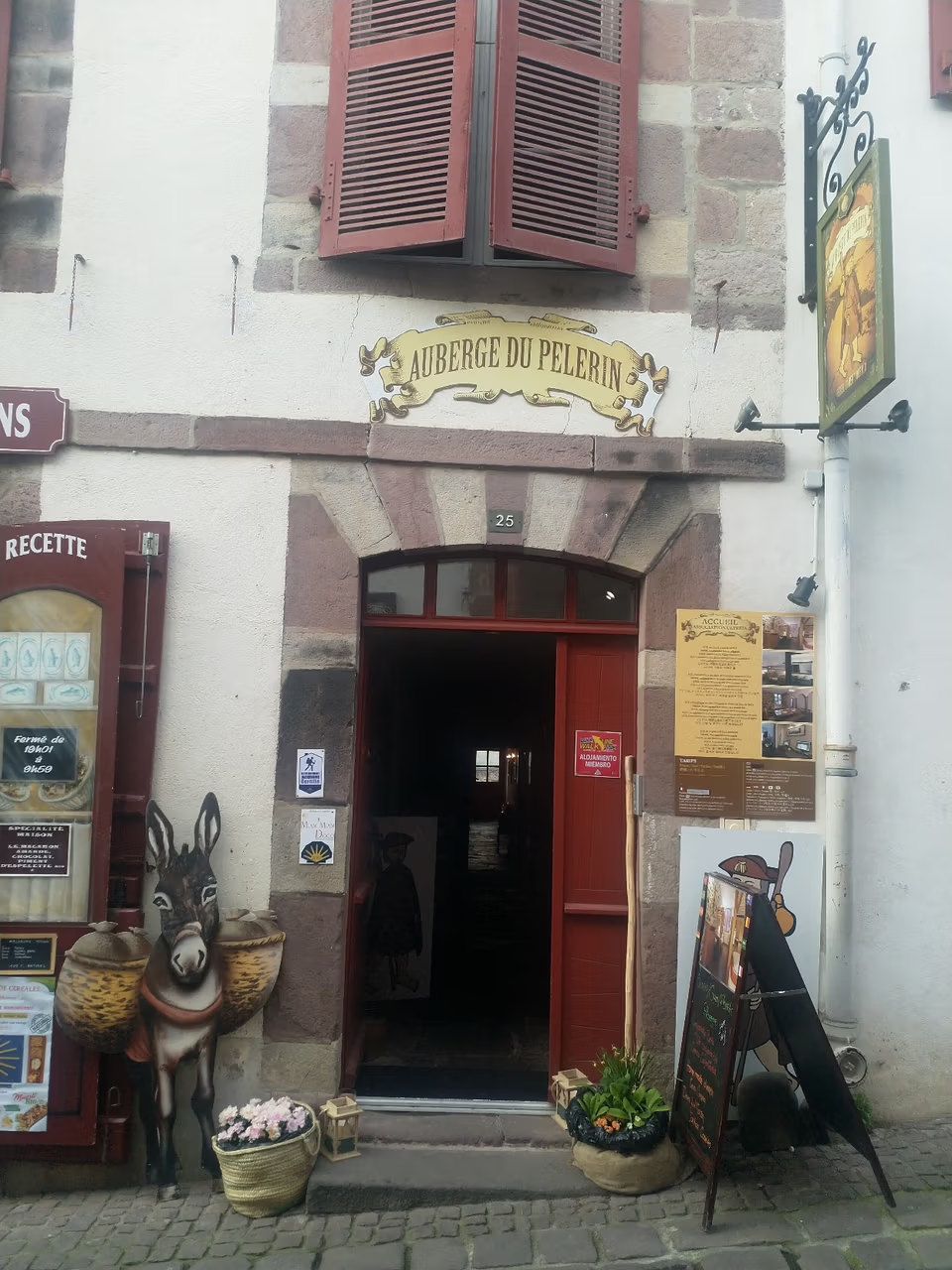 OpenL'auberge du PèlerinSaint-Jean-Pied-de-Port24€MicrowaveWater BoilerBreakfastAnd more
Services in Saint-Jean-Pied-de-Port (SJPP)
What you can find in town before the next stage.
- ATM
- Café
- Shop
- Medical clinic
- Pharmacy
- Fountain
- Post office
- Train station
- Bus station
- Restaurant
Source: © OpenStreetMap contributors · updated March 2026
Caminos through Saint-Jean-Pied-de-Port (SJPP)
Open a Camino to follow it on the map from Saint-Jean-Pied-de-Port (SJPP).
- Camino FrancésSt. Jean Pied de Port -> SantiagoView on map
- Via Podiensis(Camino Le Puy / GR 65) Le Puy -> St. Jean Pied de PortView on map
- Via Turonensis(Chemin de Tours) Paris -> St. Jean Pied de PortView on map
- Frances alternative 1st stageVia ValcarlosView on map
- Via Lemovicensis(Voie de Vézelay) Vézelay - Saint Jean Pied de PortView on map
- Saint Jean Pied de Port - IrunView on map
- Voie de la NiveView on map
- Voie de PiemontCamino del PiamonteView on map