

Stage town on the Camino
Sigüeiro
A Coruña, Galicia, Spain
- places to stay
- 9
- Camino
- 1
- Elevation
- 229 m
Sigüeiro is the last night on the Camino Inglés: 98.1 kilometres after Ferrol, only 15.9 to go to Santiago. A town on the Río Tambre with a medieval bridge, a park honouring the famous pilgrims of this route and only private hostels. An afternoon by the river is enough; tomorrow at noon you arrive.
How long to stay?
An afternoon is enough. Sigüeiro is an eve-of-arrival town. You get here after almost 25 kilometres from Hospital de Bruma, shower, walk along the Tambre and look at the plaques for the famous pilgrims of the English Way. There is no more programme than that, and you need no more: the real reason to sleep here is the short last day to Santiago.
Sigüeiro in Ninja numbers
- 98.1 kilometres on the Camino Inglés lie behind you since Ferrol. Just under two kilometres past the town you cross the 100 that count for the Compostela.
- 15.9 kilometres remain to the cathedral of Santiago de Compostela. Leave early and you are there around noon.
- 6 arches carry the bridge over the Tambre, built in the late Middle Ages.
- 224 metres above sea level is the river, the lowest point of the last stage. Before Santiago the way climbs once more to 345 metres.
Arriving: through the land of springs
From Hospital de Bruma it is 24.8 kilometres, through the hamlets of the municipality of Ordes and Baxoia. The area is full of springs and streams; in the rainy months the unpaved paths get very muddy. The way winds about before it reaches Sigüeiro through the industrial estate. Not a pretty welcome, but the town itself lies on the river, and there it gets quieter.
In brief: a town at the bridge
Sigüeiro is the main town of the municipality of Oroso and has always lived from the crossing of the Tambre. The stone bridge dates from the 13th or 14th century; in the 20th century it was thoroughly rebuilt and widened with concrete beams for traffic. Two powerful knights, Gómez Pérez das Mariñas and Álvaro Pérez de Moscoso, are said to have quarrelled fiercely on it. Whoever comes along the English Way today is reminded of earlier pilgrims at the edge of town: in the Parque do Carboeiro stand plaques for the famous pilgrims who walked this way before you.
By the Tambre: what to see
Everything is close together.
- Paseo dos Peregrinos Ilustres: At the edge of town in the Parque do Carboeiro, memorial plaques recall historic pilgrims who went to Santiago along the Camino Inglés. The right place for you to pause for a moment: you are walking in their footsteps, and tomorrow you arrive where they arrived.
- The bridge over the Tambre: Six arches, medieval origins, rebuilt later. From it you can see the way you will take to Santiago tomorrow.
- The riverside path along the Tambre: An afternoon stroll without a rucksack, along the water. Towards evening the Parque do Carboeiro with its birds is worth it.
Eating and drinking
The river sets the menu: trout is the typical dish of the municipality, and in May Sigüeiro holds its own trout festival. Below the Albergue Mirás there is a bar with a restaurant. You will find a few bars, restaurants and small shops in town.
Honestly
- No public hostel. In Sigüeiro pilgrims sleep only in private places, and that costs more than in the Xunta hostels of the previous days.
- In winter it gets thin. Most hostels close in autumn, one already in mid-October, the bigger ones at the end of November; only the smallest is listed as open all year. From December to February expect very little choice.
- The welcome is an industrial estate. And the last day ends in one too: before Santiago the way leads through the Polígono do Tambre and the northern districts.
Where pilgrims sleep
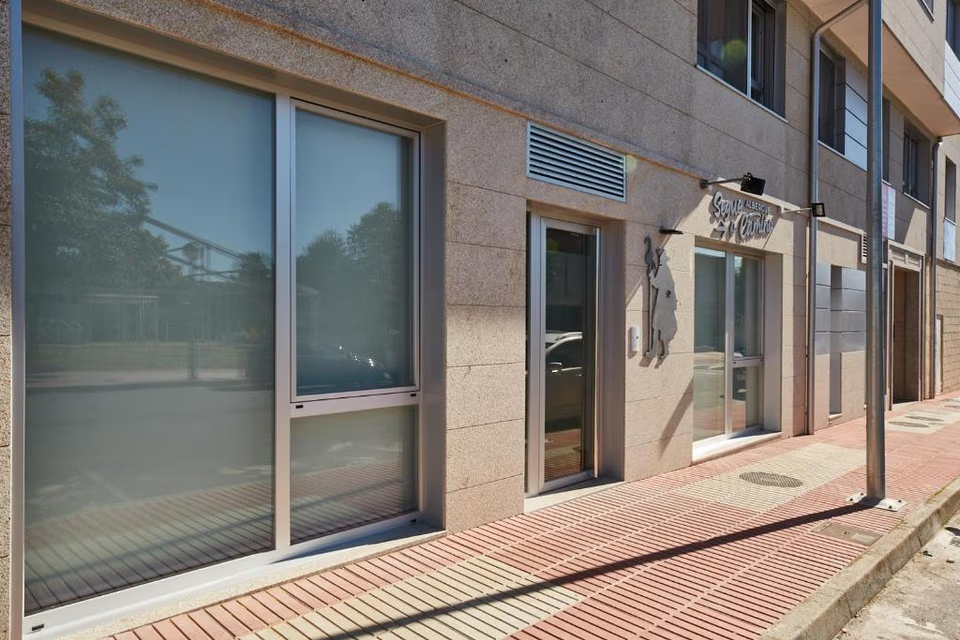
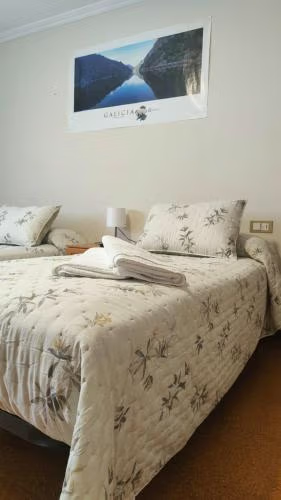
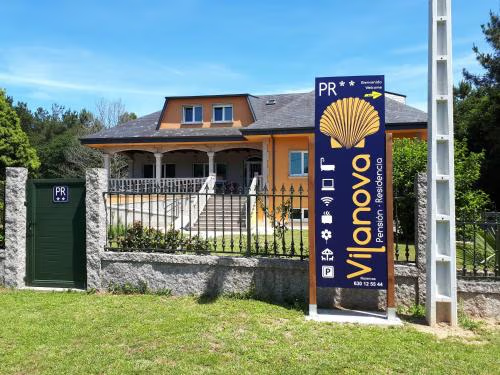
There is no public pilgrim hostel. The private hostels are all in the centre, on the way or at most a few steps from it: Albergue Camiño Real (open from mid-March to the end of November according to pilgrim portals, with a kitchen), Albergue Segue o Camiño (March to November), Albergue Mirás (Easter to mid-October) and the small Albergue Ultreia et Suseia, which is listed as open all year. A bed in a dormitory costs roughly €15 to €25 depending on the house, sometimes with breakfast (as of October 2026). On top of that there are a few guesthouses with rooms from just over €50.
Ninja tips
- Watch the waymarks in the morning. Two ways lead out of town: according to several pilgrim reports the yellow one past the church is barely marked, while the red-marked alternative is better signposted.
- Leave early. Then you are in Santiago around noon and have the afternoon for your arrival.
- Book outside the season. From mid-October the first hostel closes; from December hardly any beds are left.
- Go down to the river in the evening. That is when the Parque do Carboeiro is at its best, with the birds on the Tambre.
Practical tips for pilgrims
- Post office: Rúa Rosalía de Castro 3, Monday to Friday 8:30 to 14:30 (as of October 2026). Handy if you want to send something home before Santiago.
- Bus: There are intercity buses to Santiago, in case you need to go back after arriving or sort something out in advance.
- Stamps: On the last 100 kilometres you need two stamps a day, so on the Camino Inglés practically from day one. Get your stamp at the hostel in Sigüeiro and collect a second one along the way tomorrow.
Onward: the last 15.9 kilometres
Right after the town you cross the Tambre, at 224 metres the lowest point of the day. The first two thirds run through fields and woods on pleasant tracks and paths, always close to the N-550 national road, past Marantes (km 101.8), Formarís (km 106.5) and O Meixonfrío (km 110.6). At kilometre 108.5 you reach the highest point at 345 metres. At the end the way leads through the Polígono do Tambre industrial estate and the northern districts into the city. Allow a good four hours.
What awaits you tomorrow
Santiago de Compostela. After five days and 114 kilometres since Ferrol you stand before the cathedral, where the pilgrims on the plaques by the Tambre arrived too.
Deep dive: The last bridge
A short read, in case you want to learn more about Sigüeiro. About three minutes' reading.
A river before the goal
Before Santiago comes the Tambre. About a kilometre from the town it splits into two arms and forms a small island, the Illa do Refuxio, the island of refuge. Bridges take you across. The name suits a place where pilgrims have spent their last night for centuries.
Stone and strife
The bridge of Sigüeiro was built in the late Middle Ages, in the thirteenth or fourteenth century, of dressed stone and with six arches. It was altered in the fifteenth century, and again in the twentieth, when it was widened for cars. What is told about it is not a miracle but a quarrel. Two powerful knights of the area, Gómez Pérez das Mariñas and Álvaro Pérez de Moscoso, are said to have clashed here. Accounts differ on what it was about; one version says it was over a woman. All that is certain is that the river crossing mattered enough to fight over.
Older traces
Long before the knights, people buried their dead here. In the municipality of Oroso lie several prehistoric burial mounds, the mámoas of Vilar de Arriba, Coto do Lobo, Recouso and Gradamil. The pilgrims' way is only the youngest layer of a very old landscape.
What Sigüeiro gives you
At the edge of town the municipality has dedicated a walk to the pilgrims, the Paseo dos Peregrinos Ilustres, with plaques for the famous people who went to Santiago along the English Way. You walk past them, perhaps once more in the evening. Tomorrow you will be one of those who arrive. Sigüeiro is the place where you do not quite believe it yet. When this text was written, in autumn 2026, pilgrims slept here every night with only a bridge and half a day still ahead of them.
Where to stay in Sigüeiro
The places pilgrims rate highest in Sigüeiro come first.
- Top #1
 OpenReservations accepted
Albergue Segue o Camiño
- Top #2
 OpenReservations accepted
Albergue Camiño Real
- Top #3
 OpenReservations accepted
Albergue Mirás

Services in Sigüeiro
What you can find in town before the next stage.
- ATM
- Café
- Shop
- Tobacco
- Pharmacy
- Fountain
- Post office
- Restaurant
Source: © OpenStreetMap contributors · updated November 2025
Town 7 of 8