


Town on the Camino
Vilanova de Arousa
Pontevedra, Galicia, Spain
- places to stay
- 8
- Camino
- 1
- Elevation
- 3 m
Vilanova de Arousa is the harbour of the Variante Espiritual: here you board a boat and, like the dead apostle in the legend, sail across the Ría de Arousa and up the Ulla, past 17 stone crosses. Valle-Inclán was born here in 1866, and his birthplace is now a museum. An afternoon is enough.
Right now in Vilanova de Arousa (as of October 2026)
- Boat season ending: From April to October the pilgrim boat runs almost every day. After that it only sails if there is enough demand. In November 2025 a pilgrim reported that the boat did not run on any of three winter visits. Ask the day before at the latest.
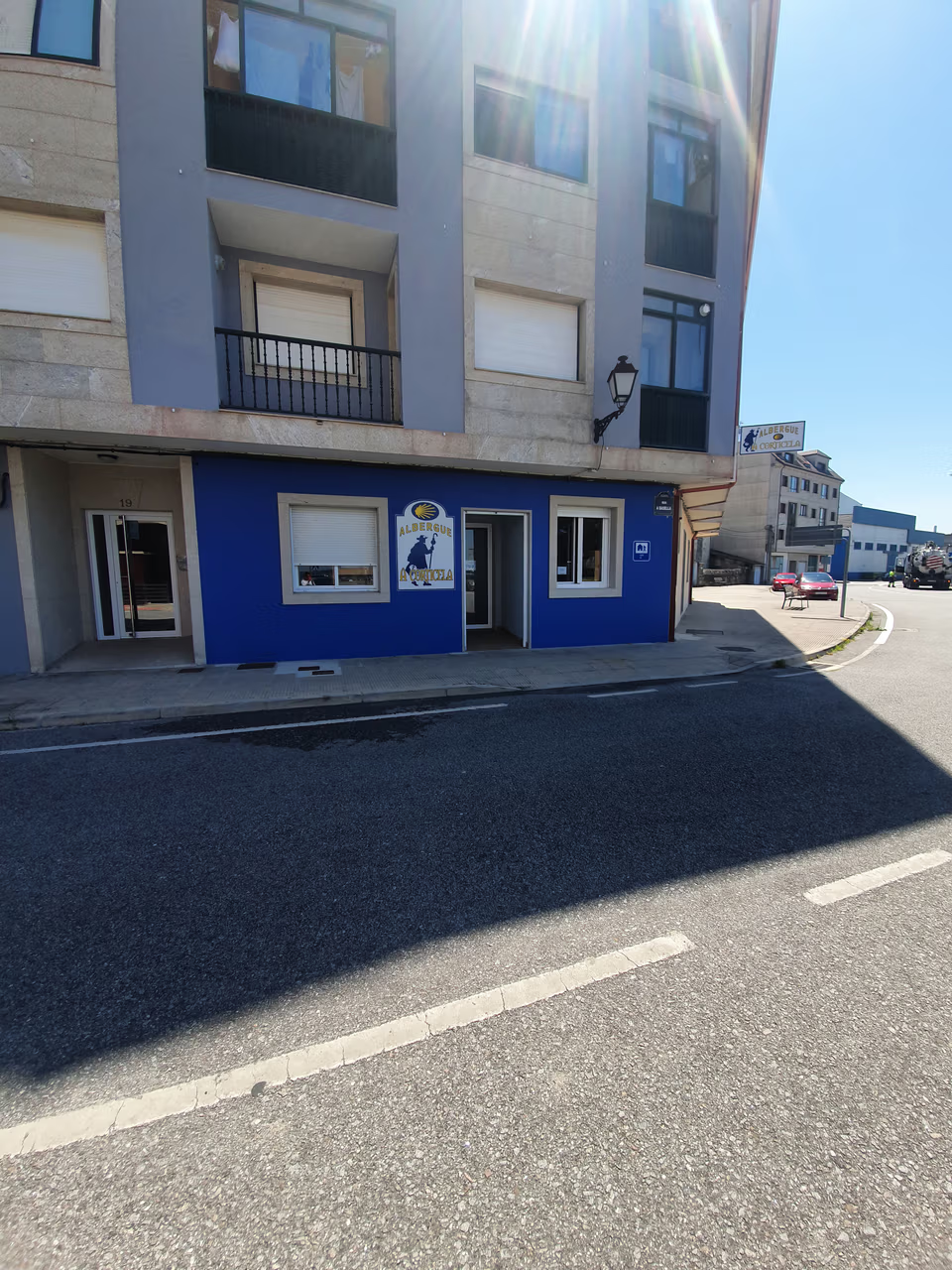
- Private hostels closing: A Corticela is open until 31 October, A Salazón until 1 November. The municipal hostel is open all year.
How long to stay?
An afternoon is enough. After a good 24 kilometres from Armenteira you arrive in the afternoon, and the boat usually leaves early the next morning. In between there is time for Valle-Inclán's birthplace, a walk to the tower of Cálago and an evening by the harbour. The most important thing is sorting out the boat for the next morning anyway.
Vilanova de Arousa in Ninja numbers
- 24.4 kilometres from Armenteira to here, according to Camino Ninja. The guides reckon just under 23 to 24 and call the stage easy.
- 17 stone crosses line the waterway to Pontecesures. Most were put up between 1963 and 1965. Spot them all and you have sharp eyes.
- Over 23,800 pilgrims walked the Variante Espiritual in 2024, extrapolated from mobile phone data for the Salnés municipalities. That was twice as many as in previous years.
- €30 to €32 is what the boat to Pontecesures costs (as of October 2026).
Arriving: from the forest to the sea
From A Armenteira the Variante Espiritual first takes you down the Ruta da Pedra e da Auga, the path of stone and water, through woodland, past mills and along the Río Armenteira. Then the Salnés opens up with vineyards and riverside paths, and you pass through Ribadumia and Ponte Arnelas. About 15 kilometres after Armenteira there is a stamp in a chapel. After around 21 kilometres you reach the coast. At the end you cross a long footbridge, the Pasarela de O Terrón. Turn left after it and you will see a glass building and the pier where your boat leaves tomorrow.
In brief: monks, Normans, mussels
On the hill of Cálago there was an Iron Age hillfort, and in the seventh century Saint Fructuosus is said to have founded a monastery here. Normans destroyed it in 884, and Almanzor's troops attacked in 997. In 1114 Cálago passed to the cathedral of Santiago, and later it became a priory of the monastery of San Martiño Pinario. Only the tower of the monastery remains.
Vilanova lives from the sea: from fishing, shellfish gathering and the mussel rafts in the ría. Ramón María del Valle-Inclán, one of Spain's great writers, was born here in 1866. Until 1997 the island of A Illa de Arousa also belonged to the municipality, and since 1985 it has been linked to the mainland by a bridge around two kilometres long. Today a little over 10,000 people live in the municipality.
The Traslatio: seventeen crosses on the water
The Variante Espiritual is the only Camino on which you travel part of the way by boat, and there is a reason for that. According to legend, the disciples Teodoro and Atanasio brought the apostle's body from Jaffa to Galicia in a stone boat with neither rudder nor sail, across the Ría de Arousa and up the Ulla to Iria Flavia, today's Padrón. This crossing is called the Traslatio.
In the 1960s José Luis Sánchez-Agustino López had the idea of marking this route with stone crosses. He presented it in A Toxa in 1963, and between 1963 and 1965 the crosses were put up with donations from institutions and private individuals, on islands, headlands and rocks. Today there are 17, the first on the islet of Malveira Grande and at the northern tip of Cortegada in the Atlantic Islands National Park. Since 1999 the Xunta has recognised the route as being of cultural interest. The municipalities promote it as the only Way of the Cross in the world on sea and river.
From the boat you see the mussel rafts, the island of Cortegada, the shores of Catoira with the medieval Torres do Oeste and finally the bridges over the Ulla. The last cross stands in Pontecesures on the Praza dos Valeiros. It was recovered from the water.
Between harbour and museum: what to see
Vilanova is not a museum town, but two things tell you where you are: the house of a writer who put the legend of Armenteira into verse, and the tower of a monastery older than the Camino.
- Casa-Museo Valle-Inclán (Pazo do Cuadrante): The house with the sundial it is named after once belonged to the estate of the Benedictine priory of Vilanova and then to Valle-Inclán's grandparents. He is said to have been born here in 1866. It was declared a monument in 1976, gutted by fire in 1994, bought and restored by the municipality, and has been a museum since 2002. You walk through the drawing room, bedrooms, dining room and kitchen of a nineteenth-century Galician family, camellias grow under an old magnolia in the garden, and there are first editions of his books. For pilgrims it is worth it for one connection: Valle-Inclán put the legend of Ero of Armenteira into verse, and in one of his novels a pilgrim is on his way to Compostela. Admission €3, reduced €1.50 (as of October 2026). Opening hours differ depending on the source, so it is best to call ahead: 986 555 493.
- Torre de Cálago: This plain, square tower is all that is left of the monastery of San Cibrán de Cálago, said to have been founded by Saint Fructuosus. In 1114 a man named Ramiro Muñiz gave the monastery to the cathedral of Santiago. A pilgrim reason: the Variante Espiritual links three monasteries, Poio, Armenteira and Cálago, and this is the last of them. Valle-Inclán was baptised in the parish of San Cibrán. The tower, next to the cemetery, is a listed monument but in need of restoration. We found no visiting hours, so you see it from outside.
- The pier and the harbour: In the evening it is worth walking to the pier beyond the Pasarela de O Terrón. That way you know where to go tomorrow morning, and you see the ría you will be sailing across. Vilanova is a fishing town with a fishing harbour and a seafront promenade.
- Xardín Umbrío: The shady park in the centre near the town hall bears the title of a collection of stories by Valle-Inclán. The museum's street is also named after one of his works, Luces de Bohemia. The writer is everywhere here.
Food and drink
Vilanova lives on mussels. The mussels from the rafts in the ría and the cockles are at home here. Since 1994 the town has celebrated the Festa do Mexillón e do Berberecho on the second weekend of August, with mussels a la marinera and steamed, cockles and empanada, plus a boat procession for the Virgen del Carmen. In June 2026 the festival was declared a Festival of National Tourist Interest. You are in the Salnés, Albariño country, and a glass of white wine from the valley you walked through today goes well with the mussels.
Honestly
- The municipal hostel is a sports hall. Most beds are in one large room, the showers are worn and there are only a few of them. In summer it gets hot, and in August it was full by 16:00. If you want a quieter night, book one of the private hostels.
- You cannot pin the boat down in advance. Departure depends on the tides and is usually between 7:00 and 8:00. Out of season it only runs on demand. Confirm the departure the day before.
- Early in the morning everything is closed. When the boat leaves at 8:00, nothing in town is open yet. Do your shopping the evening before.
- The walk to Pontecesures is not an equal alternative. It is 32 kilometres to Pontecesures according to Camino Ninja, the route is poorly marked after Vilagarcía and runs for a good stretch alongside railway and roads. One pilgrim nevertheless called it his best day, thanks to the boardwalks along the Ulla and the Torres do Oeste.
Where pilgrims sleep
- Albergue de peregrinos de Vilanova de Arousa: the municipal hostel in the town's multi-purpose pavilion, opened in 2013. €12 according to Camino Ninja, open all year, no reservations, credencial required. You can get in from early afternoon, and a staff member does the registration in the late afternoon. Pilgrims report a simple kitchen with a fridge.
- Albergue A Corticela: a small private hostel with ten beds close to the pier, €20, March to October. Everything is handled via WhatsApp.
- Albergue A Salazón: a private hostel with eleven dormitory beds and two rooms, €20 in the dormitory, March to early November. Pilgrims praise it as clean and attractive.
Ninja tips
- Book the boat the day before: The ticket office of the Barca del Peregrino is beyond the Pasarela de O Terrón, about 200 metres from the pier, and is open daily from 8:00 to 19:00. You can also book online. Have the departure time confirmed the evening before.
- Big boat or small boat: The big boat costs €30 and takes about an hour and a half. The small speedboats run by A Mare cost €32 and are open, with no roof (as of October 2026). Either way: wear a jacket, it gets cold on the water.
- At the pier 15 minutes early: A ticket on your phone is enough. On the big boat there is tea and a pastry, handy when no café in town is open yet.
- Stamp on board: Get a stamp on the boat. Whether the boat stretch counts towards the Compostela is answered differently. Collect stamps in Pontecesures and Padrón too, and if in doubt ask at the Pilgrim Office.
- Count the crosses: The captain points out the stone crosses. One pilgrim blog only counted ten out of seventeen. Sit by the window or at the rail.
- Get to the municipal hostel early: Arrive before 14:00 and you get a lower bunk. In summer it was full by 16:00.
- Pedronía in Padrón: Even via the Variante Espiritual you can get the Pedronía, the town's certificate, in Padrón.
Practical tips for pilgrims
- Shopping: There is a supermarket about five minutes from the municipal hostel and a restaurant about a hundred metres away. Buy breakfast for the boat trip the evening before.
- Post: Correos at Rúa Rosalía de Castro 7, Monday to Friday 8:30 to 14:30 (as of September 2026).
- Public holidays: On 15 January, San Mauro, and 16 September, San Cibrán, shops are closed and beds go early.
- Onwards without the boat: If no boat is running, you can walk about eight kilometres to Vilagarcía de Arousa and take the train to Pontecesures there.
Onwards: across the water to Padrón
The boat covers about 28 kilometres across the Ría de Arousa and up the Ulla to Pontecesures. From there it is another 2.8 kilometres on foot to Padrón, according to Camino Ninja, where the Variante Espiritual ends and you rejoin the Camino Portugués Central. From Padrón it is 25.3 kilometres to Santiago, according to Camino Ninja. If you walk, you take the land route via Vilagarcía de Arousa (8.3 kilometres), Carril and Catoira, 34.8 kilometres to Padrón according to Camino Ninja. The Ruta Padre Sarmiento also leads from Vilanova to Padrón.
What awaits you tomorrow
In the morning you cast off and follow the route the apostle took according to legend. After an hour and a half on the water you get off in Pontecesures, and just under three kilometres later you stand in Padrón before the stone to which the apostle's boat is said to have been moored. It lies beneath the altar of the Iglesia de Santiago, and you are allowed to see it.
Deep dive: A harbour for the apostle and a poet with one arm
A long read, in case you want to learn more about Vilanova de Arousa. About fifteen minutes' reading.
At the pier
It is early in the morning, and nothing in town is open yet. You are standing at a pier beyond a long footbridge, a glass building beside you, the water of the Ría de Arousa in front of you. You had the departure time confirmed last night, because here it is not the timetable that decides when you leave, but the sea. When the tides are right, the boat casts off.
What lies ahead of you now happens on no other Camino. For a few hours you stop walking. You sit down, look at mussel rafts, small islands and rocks, and at some point the wide bay becomes a river. You sail up the Ulla, just as, if you follow the old story, a boat carrying a dead apostle sailed up it almost two thousand years ago.
For most pilgrims Vilanova de Arousa is just an evening and a night. But this place has more to tell than it shows. It had a monastery older than the cult of Saint James. It produced one of Spain's great writers, a man with a long beard and only one arm, who put the legend of your last day into verse. And only for a few decades has it been the harbour of a way across the water.
A boat without rudder or sail
The story that carries this boat trip is a legend, and it goes like this. James, one of the twelve apostles, was executed in Jerusalem around the year 44. His disciples, who are called Teodoro and Atanasio, laid his body in a boat of stone, without rudder and without sail, and put to sea from Jaffa. The boat found its way across the whole Mediterranean and the Atlantic to the coast of Galicia. It sailed into the Ría de Arousa and up the Ulla to Iria Flavia, today's Padrón. There the disciples moored it to a stone and carried the dead man inland, to the place where the cathedral of Santiago stands today.
This crossing is called the Traslatio, the translation. Nobody has to believe it to enjoy the trip. But it is worth having the legend in mind when you are on the water. Because the landscape you sail through is the one the people of the Middle Ages imagined when they told this story: the open bay, the islands at its mouth, the water growing narrower, and the river leading into the hills.
You can see the stone to which the boat is said to have been moored tomorrow in Padrón. There you will also learn what it really is. Here in Vilanova, only the part of the story that takes place on the water begins.
The man with the crosses
That you can make this trip as a pilgrim today is owed above all to one man. José Luis Sánchez-Agustino López, born in 1935 and died in 2010, is described in the sources as a pioneer in promoting the Camino. In the nineteen-sixties he had an idea that was both devout and very practical. If the apostle's boat had passed this way, then the route on the water ought to be visible too. And just as crosses and arrows show pilgrims the way on land, stone crosses on the shore should do so here.
In 1963 he presented the project at a meeting on the province's tourism in A Toxa, a small island further out in the bay. Work began that same year, and by 1965 most of the crosses were standing. They were paid for with donations from institutions and private individuals. They stand on islands, on headlands, on rocks in the water, some in or near the harbours.
What began as one man's idea gained a structure. In 1999 a foundation was set up bearing the name of the route, Ruta Xacobea do Mar de Arousa e Ulla, and in the same year the Galician government declared the route to be of cultural interest. As late as 2004 a cross was added in Rianxo, next to the chapel of San Bartolomé. Sánchez-Agustino lived to see it.
Seventeen stones on the water
Seventeen crosses are counted today. The first two stand far out, on the islet of Malveira Grande and at the northern tip of the island of Cortegada, which belongs to the Atlantic Islands National Park. A cross on Punta Grandeiro bears a cross of Saint James at its head. Near Ribeira, on the other side of the bay, stands one whose shaft shows Christ and the apostle as a pilgrim. Off Punta Patiño near Rianxo rises a calvary with three crosses. Further up the river come crosses in Catoira and in Valga. The last one stands in Pontecesures, on the Praza dos Valeiros. It lay in the water for a time and was recovered.
The municipalities around the bay advertise this as the only Way of the Cross in the world on sea and river. Whether that is true is hard to check. What is certain is that you will experience nothing like it on any other Camino.
You will not see all the crosses. The authors of a pilgrim blog counted ten. The captain of the big boat points them out. Treat it as a game. Every cross you spot is a waymark, like the yellow arrows you have been following for weeks.
There is more to see on the way. The mussel rafts in the bay, the island of Cortegada, the shores of Catoira. There stand the remains of the Torres do Oeste, a fortress a bishop had built against the Vikings to protect the way up the river and with it Santiago. Every first Sunday in August since 1961, Catoira has re-enacted the Norman attack. At the end you pass under the bridges over the Ulla, and then you are in Pontecesures.
A young route
When you walk the Variante Espiritual, you are not walking a medieval pilgrim route. The crosses are sixty years old, and the route via Poio, Armenteira and Vilanova was only set up as a pilgrim way a little over ten years ago. One source gives the year 2012. The mayor of Vilanova, Gonzalo Durán, said in 2019 that work on the variant had begun six years earlier and was now well established.
Well established it certainly is. For 2024 the Salnés municipalities had pilgrim flows estimated using data from the mobile phone network. The result was more than 23,800 pilgrims on this variant, twice as many as in previous years. The Friends of the Portuguese Camino put the figure even higher. Both figures are estimates. According to the Friends' estimate, about one in five pilgrims passing through Pontevedra now takes this detour across the water.
Does the boat count?
Here lies a question that has occupied pilgrims for years, and it cannot be answered quite cleanly. For the Compostela you have to walk the last hundred kilometres. So what about a stretch you cover sitting in a boat?
The answers differ. A travel report from 2026 says the boat trip is part of the official route and comes with a stamp, so it counts. A large Spanish pilgrim website, on the other hand, wrote in 2025 that the variant is not yet officially recognised. As early as 2023 the operators of the same site advised someone asking to check with the Pilgrim Office in Santiago if in doubt.
In practice the stamp on board helps you, together with stamps from Pontecesures and Padrón. If you want to be completely sure, ask the Pilgrim Office beforehand. And perhaps it is fitting that precisely on the Spiritual Way there is a stretch that cannot be measured in kilometres.
A monastery older than the apostle in Galicia
Before there was a Camino, there were already monks in Vilanova. On the hill of Cálago there was an Iron Age hillfort, inhabited from roughly the fourth century before to the fourth century after Christ. In the seventh century Saint Fructuosus is said to have founded a monastery here, dedicated to Saint Cyprian of Carthage. Fructuosus was one of the great founders of monasteries in the northwest of the peninsula. Some sources place the foundation a century later.
The monastery is documented for the year 846. It was handed over to an abbot named Viliato and sixteen monks. That was a few decades after the apostle's tomb is said to have been discovered in Santiago. So the monks of Cálago were already there when the cult of Saint James was only just beginning.
It was never peaceful here. In 884 Normans from the north destroyed the monastery, which lay on the coast. It was rebuilt. In 929 King Alfonso the Fourth of León granted the monks the income from the nearby saltworks. In 997 came the troops of Almanzor, the commander from Córdoba who sacked Santiago that same year, and damaged the monastery again. In 1114 a man named Ramiro Muñiz gave Cálago, together with other properties in the Salnés, to the cathedral of Santiago. Later it became a priory of San Martiño Pinario, the great Benedictine monastery in Santiago whose façade you will see next to the cathedral in a few days.
Around 1810 the parish was moved to another church, and stones from the old monastery were used to build it. The monastery church fell into ruin. An artist drew it in 1905, a photographer captured it in 1906. Today only the tower still stands, plain and square, a listed monument and yet in need of restoration. Since 2017 the Galician government and the municipality have had excavations carried out here, and in 2020 a grave from the fifth or sixth century was found.
A child of Vilanova
On 28 October 1866 a boy was born in Vilanova, and three days later he was baptised in the parish of San Cibrán de Cálago, the parish of the old monastery. His baptismal name was Ramón José Simón Valle Peña. The world knows him as Ramón María del Valle-Inclán. He later took the second part of the name from an eighteenth-century ancestor.
His father was a sailor who also wrote. Both parents came from families of the minor nobility whose wealth was dwindling. The Vilanova of his childhood was a place without running water, without electricity, with poor schools and without adequate health care. But his father had a good library, and a tutor taught the boy Latin. And there was the ría. Valle-Inclán later described how he saw and heard it as a child.
He went to secondary school in Pontevedra and finished there in 1885. If you came through Pontevedra, you may have seen his statue. Then he studied law in Santiago, mainly because his father wanted him to. When his father died in 1890, he gave up his studies and went to Madrid and to Mexico. He became a writer.
Where exactly? A birth with three addresses
You would think the birthplace of such a famous man would be settled. It is not quite. The museum says he was born in the main room of his grandparents' house, the Pazo do Cuadrante, the house with the sundial that is now his museum. The Spanish Wikipedia names another old house, El Cantillo, on Calle San Mauro by the water, looking across to the island of Arousa.
And then there is the neighbouring town on the other side of the bay. A Pobra do Caramiñal, where Valle-Inclán later lived for years, also claims his birth. The poet himself had an answer to this that suits him. He was born, so he said, on a boat, in the middle of the water between the two towns.
You do not have to decide. But this morning, on the boat across the ría, you may think of this story. A man who had himself born on the water, and an apostle who, according to legend, arrived on the water. Vilanova seems to be a place where great arrivals like to be moved onto a boat.
The man with the beard and one arm
Anyone who has seen pictures of Valle-Inclán remembers two things: the long beard and the empty left sleeve. He lost the arm in the summer of 1899 in Madrid. In the Café Nuevo de la Montaña on the Puerta del Sol he got into a quarrel with the journalist Manuel Bueno, during which a cufflink drove into his left wrist. The wound became infected, and on 12 August 1899 the arm had to be amputated. Valle-Inclán was 33 years old. It is said that he stayed awake for almost the entire operation and asked for a cigar at the end.
He wrote novels, poems and plays. In his Sonatas he created the Marqués de Bradomín, an ageing seducer whose autumn is set in Galicia. In later plays he developed a form he called esperpento, a distorted mirror of reality. In 1921 he explained it in one sentence: „Esta modalidad consiste en buscar el lado cómico en lo trágico de la vida.“ Looking for the comic side in the tragedy of life. Perhaps not a bad thought for the last days of a long walk.
In 1912 he came back to the ría with his family, first to Cambados, then to A Pobra do Caramiñal. In 1925 he moved to Madrid for good.
Ero and the bird, once more
Last night you were in Armenteira, at the monastery the knight Ero is said to have founded in the twelfth century. You may know the story. Ero and his wife remained childless and founded monasteries instead. Bernard of Clairvaux sent four monks to Armenteira, and Ero himself became a monk and abbot. He asked the Mother of God to grant him a glimpse of paradise. Then he sat on a stone in the forest and listened to a bird. When he returned, nobody in the monastery knew him any more. He believed he had listened for three minutes. It had been three hundred years.
King Alfonso the Tenth included this legend in his songs to the Virgin in the thirteenth century, as Cantiga 103. And in 1907 Valle-Inclán brought it to people once more, in his collection of poems Aromas de leyenda, scents of legend, with fourteen poems about the landscapes, the superstition and the belief in miracles of Galicia. So the boy from Vilanova wrote down the story you took with you on your way yesterday. Between Armenteira and Vilanova lies a day on foot, and between them lies a piece of literature too.
A pilgrim to Compostela
In another book, Flor de santidad, flower of holiness, Valle-Inclán put a pilgrim at the centre. The story is set in rural Galicia around 1856. A young woman named Ádega, who lost her parents in a famine, works as a shepherdess for the harsh innkeepers of a roadside inn. A pilgrim on his way to Compostela comes by, and in him, as one literary scholar describes it, Christ and the devil blur together.
It is not a pious story. What happens between Ádega and the stranger is dark and violent, and in her visions Ádega reinterprets it as something holy, without anyone believing her. In it Valle-Inclán worked in stories he had heard as a child from relatives and servants, stories about the afterlife, about healing rituals and about Christ returning to earth.
For you as a pilgrim it is a strange mirror. In these days you are yourself the stranger with the staff passing by houses. In this book a pilgrim is believed capable of anything, the divine as well as the menacing.
Dying in Santiago
Valle-Inclán never quite left Galicia, and in the end he came back to where you are going too. In March 1935, ill, he was admitted to a friend's sanatorium in Santiago. On 5 January 1936 he died in Santiago, the city of the apostle. He refused the sacraments. He had written that he wanted at his side neither a discreet priest nor a humble friar nor a know-it-all Jesuit.
The next day he was buried in the Boisaca cemetery in Santiago, without a church service, in a simple coffin. The sculptor Francisco Asorey took his death mask. And Manuel Azaña, later President of the Republic, wrote of him that he would have wanted to be not the man of today but the man of the day after tomorrow.
So the story of the boy from Vilanova ends in Santiago. In his own way he too walked the path you are walking now, from the ría to Pontevedra and from there to Compostela, to study and in the end to die. He was not a pilgrim in the devout sense. But he did arrive there.
The house with the sundial
The house in which, according to the museum, he was born has its own history. It once belonged to the estate of the Benedictine priory of Vilanova, was later divided and passed to his maternal grandparents. It is called the Casa do Cuadrante, after the sundial. It is a traditional two-storey house on a walled plot. Downstairs were stables, storerooms and cellars, and the family lived upstairs.
In 1976 the Spanish state declared it a monument as Valle-Inclán's birthplace. In 1994 a fire destroyed the interior. The municipality bought the house and rebuilt it, and on 25 May 2002 it opened as a museum. Today you walk through a reconstructed nineteenth-century household. The museum explains that the large reception room was only used on feast days and that daily life took place in the kitchen and dining room. In the garden camellias grow under a very old magnolia. If you sit down there for a moment, you are at the place where, as the town is convinced, it all began.
Mussels, an island and a republic for a day
Today's Vilanova lives from the sea, from fishing, shellfish gathering and above all from the rafts on which mussels grow in the bay. Since 1994 the town has celebrated this every year on the second weekend of August with a festival of mussels and cockles, with a boat procession for the Virgen del Carmen, patron saint of seafarers. In June 2026 the Spanish tourism ministry declared the festival a Festival of National Tourist Interest. In doing so, the ministry described Vilanova as a place closely tied to the sea and the mussel rafts.
For a long time the island of A Illa de Arousa, which you can see from the coast, also belonged to Vilanova. Its history is idiosyncratic. On 7 October 1934 socialists there proclaimed a federal republic of the island, which lasted about a day. In 1952 the islanders had three wishes: electricity, a bridge and independence from Vilanova. The bridge came in 1985, around two kilometres long. Independence came on 1 January 1997, when the island became Galicia's newest municipality.
What Vilanova gives you
Vilanova is not a place where you stay long. You arrive, you sleep, and in the morning you cast off. But perhaps that is exactly its gift. Here you stop walking for a morning. After weeks in which every kilometre depended on your feet, something else carries you now, the water, the tides, a boat that someone else steers.
The people who told these stories knew that not every journey is made under your own power. The disciples in the legend had neither rudder nor sail. Ero only had to sit still and listen. And a poet who heard the ría as a child let himself be born on the water.
When you stand at the rail tomorrow and look out for the stone crosses, you do not have to believe any of it. You can simply look. At the mussel rafts, at the islands, at the river growing narrower. The day after tomorrow you will be in Santiago. Today you may let yourself be carried.
Where to stay in Vilanova de Arousa
The places pilgrims rate highest in Vilanova de Arousa come first.
- Top #1
 OpenReservations acceptedAlbergue A CorticelaVilanova de Arousa
4.07 reviews
20€MicrowaveWi-FiTVAnd more - Top #2

- Top #3

- Top #4

- Top #5
 OpenReservations acceptedPensión Mar de RosaVilanova de Arousa19€KitchenMicrowaveClotheslineAnd more
Services in Vilanova de Arousa
What you can find in town before the next stage.
- ATM
- Café
- Shop
- Pharmacy
- Restaurant
Source: © OpenStreetMap contributors · updated November 2025
Caminos through Vilanova de Arousa
Open a Camino to follow it on the map from Vilanova de Arousa.