

Town on the Camino
Viveiro
Spain
- places to stay
- 3
- Camino
- 1
- Elevation
- 5 m
Viveiro is the imperial gate of the Camino del Mar: you walk through the Porta de Carlos V and over a bridge that took 82 years to build. Plus a Holy Week of international standing, line-caught hake from Celeiro and the only pilgrim albergue on the whole way.
How long to stay?
Worth a rest day. Behind you lie 29.2 kilometres from San Cibrao, according to Camino Ninja. The old town with its gates, churches and lanes is quickly walked, but it deserves a second look without a rucksack. Above all, this is where the only pilgrim albergue of the way is. If you need a rest day on the Camino del Mar, this is the best place to take it.
Viveiro in Ninja numbers
- 99.3 kilometres lie between Ribadeo and Viveiro according to Camino Ninja, and there are still 172.7 to Ferrol. So you have done a good third.
- 82 years is how long the Ponte Maior took to build, from 1462 to 1544. It was finished under Emperor Charles V.
- Since 2013 the Holy Week of Viveiro has been recognised as a festival of international tourist interest.
- 15,120 people lived in the municipality on 1 January 2025, more than half of them in Viveiro, Covas and Celeiro. In summer there are many times that number.
Arriving: through Celeiro into the old town
From San Cibrao it is 29.2 kilometres according to Camino Ninja, finally via Area and the harbour of Celeiro. Viveiro lies at the mouth of the Landro in one of the great rías of the Cantabrian coast. Shortly before the old town, right on the path, stands the Gothic church of San Francisco, whose parish also bears the name Santiago. From there it is only a few hundred metres to the Praza Maior.
In brief: a town behind walls
Viveiro was a walled town. The wall protected against attacks and against the plague; only parts of it remain, built into houses and passageways. Three gates still stand: the Porta da Vila, the Romanesque Porta do Valado and the Porta de Carlos V. The most magnificent gate is a tribute: in 1540 a fire had devastated the town, the emperor granted tax relief for the rebuilding, and from 1548 the citizens set this gate up for him. In the 20th century it was to be demolished; instead it became a national monument in 1942.
Through the imperial gate: what to see
The old town is small, and you can comfortably manage the following stops in one afternoon.
- Igrexa de San Francisco: The church of the Franciscan convent dates from the 14th century, and its pointed-arch apse is considered one of the most beautiful Gothic chevets in Galicia. Look at it from the outside. Inside lie, among others, the tombs of the Romantic poet Nicomedes Pastor Díaz and of the Blessed Constanza de Castro; in the former convent stand the processional figures of Holy Week. For you as a pilgrim it is the church with the name Santiago, and it lies right on the path.
- Porta de Carlos V: The town's landmark, also called Castelo da Ponte. Above the round arch sit three coats of arms: a crowned lion above a bridge, five chalices for the five old churches of the town, and in the middle the coat of arms of Charles I. Lion and chalices are still found in the town's coat of arms today. Stop on the outer side, the one facing the bridge.
- Ponte Maior: A bridge at this spot is documented as early as 1224; the present one of granite blocks was begun in 1462 and completed in 1544. Of originally twelve arches, nine are visible, the outer ones round, the inner ones pointed. On one side stands the Cruz do Rollo, a cross that, according to legend, a knight had erected for a man he had killed here in a quarrel. At the other end waits the Capela da Misericordia of 1603.
- Santa María do Campo: The oldest church in the town, Romanesque and usually dated to the middle of the 12th century, stands at the highest point of the old town. A round-arched portal, rose window and two towers dominate the façade. Inside, the silver processional cross of the 16th century is considered one of the most beautiful in Galicia. The Holy Week processions begin here.
- Convent of the Concepcionistas and Lourdes grotto: Opposite the apse of Santa María, Conceptionist nuns still live in enclosure, founded in the 17th century. In front of the convent lies, since 1925, a replica of the grotto of Lourdes, freely accessible, often with burning candles. A quiet place for a prayer at the end of the stage.
- Rúa do Muro: The lane runs on the old wall walk of the town wall and, at a good one and a half metres wide, is one of the narrowest in Spain. With a rucksack it gets tight here.
Food and drink
Viveiro lives from the sea, and you taste it. The harbour of Celeiro, which you passed, is one of the important fishing ports of Galicia. Its speciality is merluza do pincho, hake traditionally caught on the line. Celeiro celebrates it in July with a festival of its own, at which it is served as empanada, caldeirada, Galician style or in green sauce. The town's menus also feature percebes, nécoras, cockles, sardines and bonito, plus the Galician classics octopus, empanada and lacón con grelos.
Honestly
- The only albergue of the way. Between Ribadeo and Ferrol there is, as far as we know, no second pilgrim albergue. In late summer 2026 one pilgrim wasn't sure he would get a bed. Reserve if you can.
- In summer Viveiro is full. The population roughly triples, and at the end of July or beginning of August the metal festival Resurrection Fest is added. Then every bed becomes scarce.
- Holy Week is an experience, but no secret tip. If you are here at Easter, you experience processions that have moved through the old town for centuries, and a full town.
- Churches with question marks. We found no opening times for San Francisco and Santa María. Expect to find some doors locked.
Where pilgrims sleep
The Oli Vita Hostel on the Rúa Nicolás Cora Montenegro is Viveiro's pilgrim albergue and, as far as we know, the only one on the whole Camino del Mar. It has 16 places in the dormitory, a bed costs from €20 according to Camino Ninja (as of November 2026); one pilgrim named €25 at the end of August 2026. The rooms have air conditioning, and the bathrooms are shared. One woman pilgrim praised the albergue and the friendly hospitaleros in September 2026.
Ninja tips
- Reserve beforehand. A single pilgrim house for a whole way fills up quickly, especially in summer.
- Climb the Monte San Roque. From the church of San Francisco a road leads to the summit, and from there you overlook the whole ría. In mid-August the people of Viveiro walk up for the romería.
- Plan the detour for tomorrow. Beyond Viveiro waits the Punta Fuciño do Porco with its wooden walkway over the cliffs. One woman pilgrim explicitly recommended it in September 2026. In high summer you recently needed a reservation for it.
Practical tips for pilgrims
- In Viveiro you find everything that you won't have in every village on the next stages: supermarkets, pharmacies, banks. Stock up here.
- During Holy Week (27 March to 5 April in 2026) and at the end of July the town is full; plan your bed and arrival especially early then.
Onward: over the bridge to Covas
Through the imperial gate and over the Ponte Maior you leave the old town; after 2.2 kilometres you are, according to Camino Ninja, in Covas with its long beach. It is 21.1 kilometres to O Vicedo, via the villages on the west side of the ría and Xilloi. If you make the detour to the Punta Fuciño do Porco, allow a good extra kilometre in each direction. After that the Camino del Mar becomes more rural, and you won't have this much choice of shops for a long time.
What awaits you tomorrow
Right behind the town the monument to the shipwrecked of 1810 on the rocks of Os Castelos on the beach of Covas, then the Ría de Viveiro from the other side. With the detour to the Punta Fuciño do Porco it becomes a day over the cliffs.
Deep dive: The night of the Magdalena
A short read, in case you want to learn more about Viveiro. About two minutes' reading.
A fleet against Napoleon
In October 1810 Spain was at war against Napoleon's troops. A Spanish-British fleet sailed from A Coruña, five frigates, two brigs and smaller ships, with around two thousand soldiers on board. Its destination lay far to the east on the Cantabrian coast: Santoña, which the French held occupied. The force was led by Joaquín Zarauz. The way there led exactly along the coast you are walking now.
The storm
At the beginning of November the fleet ran into a heavy night storm off the Galician coast. The frigate Santa María Magdalena, built in 1773 in Ferrol, lost her mainmast and went down in the Ría de Viveiro. The brig Palomo was thrown onto the cliffs. Of the five hundred and eight people on board the Magdalena only three survived. Among the dead were Zarauz himself and the ship's commander, Blas Salcedo. On the Palomo fifty of seventy-five men died.
A father and his son
When Salcedo was found, he held his son in his arms, who had drowned with him. This image went so deep that afterwards a royal order forbade fathers and sons or brothers from serving on the same ship. The dead whom the sea carried ashore were buried on the beach of Area and in the surrounding area, that is, where you walked towards Viveiro yesterday evening. The disaster entered poems and folk songs of the time.
What remains of the wreck
The wreck of the Magdalena lies off the beach of Covas. When it was found in the seventies of the twentieth century, it gave the impetus for the naval museum in Ferrol, where parts of her hull can be seen today. Cannons from the wrecks stand in a small park right behind the beach of Covas. On the dark rocks of Os Castelos at the western end of the beach a monument commemorates the dead.
What the story gives you
Tomorrow morning, when you leave Viveiro over the old bridge, after a good two kilometres you pass this monument. The ría then usually lies calm, and it is hard to imagine the storm. A ship from Ferrol went down here, and its remains lie today again in Ferrol, in the museum at the start of the Camino Inglés. When you arrive there in a few days, the circle closes. You walk the stretch the Magdalena did not manage, only in the other direction, and on foot.
Where to stay in Viveiro
Places to stay in Viveiro.
 OpenReservations accepted
Oli Vita Hostel
 OpenReservations accepted
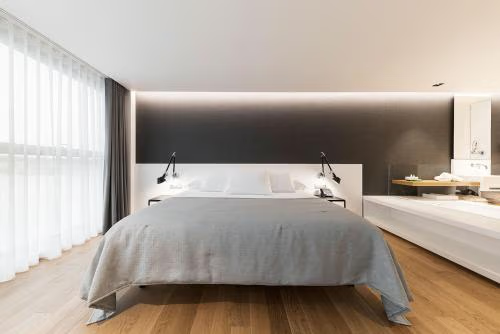
Hotel U Viveiro
 OpenReservations accepted
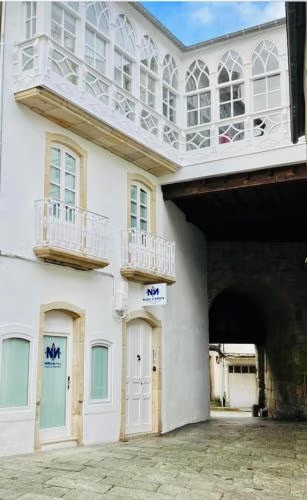
APARTAMENTOS NADA Ó NORTE Centro
Town 8 of 17