

Town on the Camino
Zwickau
Germany
- places to stay
- 22
- Caminos
- 2
- Elevation
- 267 m
Zwickau is a crossroads: the Saxon Way of St James and the Via Imperii meet here, and both lead to Hof. You come into the city over a wooden bridge carrying a water pipe from 1535, and walk past the 88-metre-high cathedral and Schumann's birthplace. An afternoon is enough, for car fans half a day more.
How long to stay?
An afternoon is enough, but if you love cars, plan half a day more. The Way leads straight through the old town: Dom St. Marien, Hauptmarkt, Robert-Schumann-Haus and Katharinenkirche lie practically on your route, and you can manage them on the afternoon you arrive. The August Horch Museum is a programme of its own, with around 160 vehicles on 6,500 square metres. It is closed on Mondays, in which case the afternoon is more than enough.
Zwickau in Ninja numbers
- 214.1 km lie behind you according to Camino Ninja, since Bautzen. It is another 93.9 km to Hof. Zwickau is the last big town on the Way before Hof.
- 88 metres is the height of Dom St. Marien, which makes it still the tallest building in the city. No signpost needed.
- 1535 is the date of the water pipe that the Röhrensteg carries over the stream. It is 255 years older than the bridge itself.
- €10 is the combined ticket for Robert-Schumann-Haus, Priesterhäuser and the Galerie am Domhof, valid on one opening day (as of November 2026). On the first Wednesday of the month, entry there is free.
- 2 Ways of St James run through Zwickau: the Saxon Way of St James and the Via Imperii. Both end in Hof.
Arriving: following the water into the city
From Oelsnitz you come via Reinsdorf, 21.0 km according to Camino Ninja. Beyond the first houses of Zwickau you descend to the Reinsdorfer Bach and cross the Röhrensteg, a covered wooden bridge in its present form of 1790. It carries a water pipe of 1535 made of hollowed-out tree trunks, which brings drinking water from Reinsdorf and Pöhlau into the city. So you walk the same route as the water, only a few centuries later.
Over the Muldendamm you reach the Paradiesbrücke, via Nicolaistraße the Katharinenkirche, and via the Alter Steinweg the Hauptmarkt with the Gewandhaus, town hall and Schumannhaus, then the cathedral. You could hardly ask for a finer way into a city.
In brief: silver, Reformation, coal, cars
Zwickau lay on the trade route from Saxony to Bohemia. In 1403 the whole town burned down, after which came an upswing, above all after the discovery of the Schneeberg silver mines in 1470. From 1521 Zwickau was Protestant, and already in 1520/21 Thomas Müntzer preached at the Katharinenkirche. The Anabaptists also came out of Zwickau.
Then it grew dark, literally: hard coal was mined here until 1977. After 1900 came the car. Zwickau is the birthplace of Audi, and the name is a translation: "Audi" is the Latin imperative of "horch!" (German for "listen!"), and Horch was the name of the founder, August Horch. After the Second World War the Trabant rolled off the line here, and today Volkswagen builds cars in Zwickau.
Two Ways of St James, one destination
In Zwickau you have to make a choice, though not about the destination. The Via Imperii begins its section through the Vogtland at Dom St. Marien and leads via Schönfels, Reichenbach and Plauen to Hof. The Saxon Way of St James, which this page follows, leaves the city via Brand and goes via Lengenfeld and Treuen into the Vogtland, likewise as far as Hof. Two Ways, one destination, and in Hof they meet again. If you meet a pilgrim in Zwickau who takes a different direction from tomorrow: you may well see each other again in Hof.
On the Saturday pilgrimage of 2026 on the Saxon Way of St James, Zwickau was destination and start at once: in July the stage ended at Dom St. Marien, and in August it continued from the Catholic church of St. Franziskus to Irfersgrün.
Between Mulde and cathedral: what to see
Almost everything important is on the Way or a few steps beside it. Without a rucksack you can easily do the old town in one afternoon.
- Röhrensteg: The covered wooden bridge over the Reinsdorfer Bach was built in its present form in 1790 and completely renovated in March 2019. The pipe of hollow tree trunks dates from 1535. For pilgrims it is the city's first greeting, and one that shows how long people have been building ways to Zwickau.
- Paradiesbrücke: Built in 1900 as a riveted steel bridge over the Mulde, 69 metres long, by the Königin-Marien-Hütte in the district of Cainsdorf. It is considered the younger sister of the Blue Wonder in Dresden. According to legend, Luther fled from Franciscan monks into an inn here, which has been called "Paradies" ever since. This is not documented, but the story suits a city that turned Protestant as early as 1521.
- Dom St. Marien: The church goes back to the 12th century and was completed between 1453 and 1565 as a late Gothic hall church, and the Baroque tower cap was added from 1671 to 1677. Inside are the winged altar attributed to Michael Wolgemut, the teacher of Albrecht Dürer, Peter Breuer's Lamentation of Christ and the Holy Sepulchre by Michael Hauffner, as well as the font and pulpit by Paul Speck from the 16th century. For pilgrims the cathedral is the place where the Ways come together in Zwickau: the Via Imperii begins here into the Vogtland. We did not find opening times, so ask the Nicolai parish.
- Katharinenkirche: A Gothic church with a winged altar by Cranach. Thomas Müntzer preached here in 1520 and 1521. On your way through Nicolaistraße you pass right by it.
- Robert-Schumann-Haus: Robert Schumann was born on the Hauptmarkt on 8 June 1810. The house has been a museum since 1956 and, by its own account, holds the world's largest collection of manuscripts, portraits and belongings of Robert and Clara Schumann. The room where he was born is furnished with the couple's furniture. Entry €9, concessions €7 (as of November 2026).
- Priesterhäuser: The museum of the city's history is housed here. Entry €7, concessions €5 (as of November 2026). If you want to understand the history of the city behind the cathedral and market, this is the place.
- August Horch Museum: In the historic factory halls where Audi came into being and where DKW and Trabant were later built, around 160 vehicles stand on 6,500 square metres. Audistraße 7, Tuesday to Sunday 9:30am to 5pm, last admission 4pm, entry €15, concessions €13 (as of November 2026). For pilgrims a contrast programme: a day on foot, an afternoon of engines.
Food and drink
Zwickau's speciality is the Zwickauer Bürgersteak: a pork loin steak stuffed with ham, gherkin, onions and mustard, fried in an egg coating. Just the thing after 21 kilometres.
Honestly
- We did not find a pilgrim hostel. In the biggest town of this section you sleep in a guesthouse, apartment or hotel, and that costs more than a pilgrim bed.
- We could not confirm a stamp point. Ask in the churches along the Way, best at the cathedral or the Katharinenkirche, and do not count on it.
- Much is closed on Mondays. The August Horch Museum is only open Tuesday to Sunday.
- The way out is long. Beyond the old town you go through residential streets, under the railway viaduct and along Hofer Straße and Brand to the city limits. Those are urban kilometres before you have the city behind you.
- The next stage is long. It is 31.1 km to Treuen according to Camino Ninja.
Where pilgrims sleep
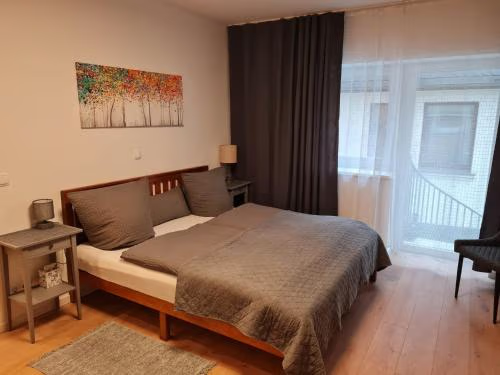
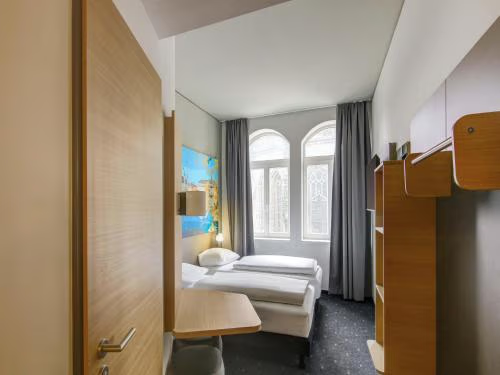
We did not find a pilgrim hostel, parish hostel or church accommodation in Zwickau. The Camino Ninja database lists guesthouses, apartments and hotels, many of them around the Hauptmarkt and the city centre, so right on the Way. We do not know of a pilgrim price.
Ninja tips
- First Wednesday of the month: Then entry to the Robert-Schumann-Haus, the Priesterhäuser and the Galerie am Domhof is free.
- Combined ticket instead of single tickets: For all three municipal houses you pay €10 on one opening day (as of November 2026). The Schumann-Haus alone costs €9.
- Split the stage to Treuen: 31.1 km is a lot. According to Camino Ninja, Lengenfeld is 25.0 km beyond Zwickau, Irfersgrün after 17.6 km.
- Stop briefly at the Röhrensteg. The bridge is not just a passage but a monument, under which water has flowed into the city for almost five hundred years.
- Decide deliberately: If you want to go to Plauen, the Via Imperii is your Way from the cathedral. If you stay with the waymarks of the Saxon Way of St James, you go via Treuen.
Practical tips for pilgrims
- Tourist information: Hauptstraße 6, in the middle of the old town.
- Getting there and away: Zwickau has rail connections to Hof, Dresden and Leipzig.
- Old town without a rucksack: Drop your things, then go. Cathedral, Hauptmarkt, Schumann-Haus, Priesterhäuser and Katharinenkirche lie close together.
Onward: 31 kilometres to Treuen
The Saxon Way of St James leaves the old town via Innere Plauensche Straße and the Georgenplatz, past the bus station to the Marienthaler Bachweg, past the Lutherkirche and under the railway viaduct to Hofer Straße with the Pauluskirche, and via Brand to the city limits. According to Camino Ninja it then goes via Rottmannsdorf, Hirschfeld, Irfersgrün, Waldkirchen and Lengenfeld to Treuen, 31.1 km in all. It is another 93.9 km to Hof.
The Via Imperii takes its own route from the cathedral via Schönfels and Reichenbach to Plauen and Hof.
What awaits you tomorrow
Treuen im Vogtland. On the way Waldkirchen awaits, and the Perlaser Turm near Treuen lies along the route. After a town with a cathedral, museums and a pedestrian zone, it gets quiet again, and after Zwickau that is perhaps just right.
Deep dive: The city everything passed through
A short read, in case you want to learn more about Zwickau. About four minutes' reading.
Over the bridge into the city
Anyone arriving in Zwickau on foot from the east enters the city over a wooden bridge. The Röhrensteg has stood in its present form since 1790, but what it carries is older: a water pipe from the year 1535, made of hollowed-out tree trunks, which brings drinking water from Reinsdorf and Pöhlau into the city. It is a good beginning for a city through which something has always passed. Water, goods, silver, ideas, coal, cars and pilgrims.
Silver and fire
Zwickau lay on the trade route from Saxony to Bohemia, and that made the city wealthy. In 1403 it burned down completely. The rebuilding fell in a fortunate time, for in 1470 the silver mines of Schneeberg were discovered, and Zwickau enjoyed an upswing. The Dom St. Marien in its present form dates from this time. Between 1453 and 1565 it was completed as one of the most important late Gothic hall churches of Upper Saxony. The winged altar is attributed to Michael Wolgemut, in whose workshop the young Albrecht Dürer learned his craft. Add to that Peter Breuer's Lamentation of Christ, a group of mourning figures around the dead Christ, and beside it the Holy Sepulchre by Michael Hauffner. Font and pulpit were made by Paul Speck in the sixteenth century. Between 1671 and 1677 the tower received a Baroque cap, and today, at eighty-eight metres, it is still the tallest structure in the city. Towards the end of the nineteenth century, figures of apostles, prophets and men of the Reformation were added to the buttresses on the outside. Anyone who walks around the cathedral thus sees both eras side by side, the old church and the new teaching.
The loud Reformation
In the years 1520 and 1521 a man named Thomas Müntzer preached at the Katharinenkirche. The Anabaptists also came out of the city. About the Paradiesbrücke there is a legend that Luther himself fled here from Franciscan monks into an inn that has been called Paradies ever since. Whether that is true is not documented. What is documented is that the city introduced the Reformation in 1521.
Music on the market square
On the eighth of June 1810, Robert Schumann was born on the Hauptmarkt. His father August ran a bookshop and a publishing house there and is regarded as the inventor of the paperback. Since 1956, the composer's hundredth death year, the house has been a museum. By its own account it holds the largest collection of manuscripts, portraits and personal belongings of Robert Schumann and his wife, the pianist Clara Wieck. The room in which he was born is furnished with the couple's furniture. Anyone who sits on the market square in the evening after a long day is therefore sitting a few steps from the room where Schumann was born.
Coal and engines
The nineteenth century brought coal. Hard coal was mined in Zwickau until 1977, and the mining official Karl Gottlob Wolf, who discovered the coalfield around Oelsnitz, through which you walked yesterday, also came from Zwickau. After 1900 came the car. Zwickau became the birthplace of Audi, and the name gives away the founder: Audi is the Latin word for "horch" (listen), and Horch was the name of August Horch. After the Second World War the Trabant rolled off the line in the same halls, and after reunification came Volkswagen. Today the August Horch Museum stands in the old factory halls. The city has grown smaller since. Before 1989 more than a hundred thousand people lived here, today it is around eighty-seven thousand.
Pilgrims on the Frankenstraße
The Saxon Way of St James, on which you came here, follows an old trade route, the Frankenstraße (Franconian Road). Its section from Zwickau into the Vogtland was opened in June 2013 and is waymarked throughout with the European scallop shell. A few kilometres before the city, in Reinsdorf, stands a church dedicated to Saint James, and the water that flows over the Röhrensteg into the city also comes from Reinsdorf. In Zwickau itself the Via Imperii, the old imperial road, crosses, whose Way of St James begins its route through the Vogtland at the cathedral. Pilgrimage here is not a memory of the Middle Ages but something people do today. In 2026 a circle of parishes and the association of the Saxon Way of St James invited people to walk together one Saturday a month. In July one of these stages ended at the cathedral, in August the next began at the Catholic church of Saint Franziskus.
What Zwickau gives you
In Zwickau two Ways of St James come together and part again. The Via Imperii begins its route through the Vogtland at the cathedral, the Saxon Way of St James takes another, via Treuen. Both end in Hof. Perhaps that is the invitation of this city: there is not just one right way. Water, silver, ideas and cars have each found their own route here. You will find yours too, and the destination stays the same.
Where to stay in Zwickau
Places to stay in Zwickau.
 Open
Pension Angelika
- Open
Pension Schwalbenhof
- Open
Pension am Dom
Town 12 of 15