

Camino de Barcelona South
The southern route of the Way of St. James from Barcelona: approximately 58 kilometers (GPS track) along the Llobregat River, following the route of the Roman Via Augusta and the ancient wheat road, up to the final ascent to the Monestir de Montserrat. The landscape is more barren than that of the northern route via Collserola—but it is richer in historical landmarks: a Roman bridge dating from 10 B.C., a gateway inscription from 1201, and a town named after a pilgrims’ hospital.
- 01At a Glance
- 02Overview
- 03The Wheat Road: Paved in 10 B.C., dated to 1201, blown up in 1939
- 04Other Names
- 05Who It's Ideal For—and Who It's Not So Ideal For
- 06Route & Landscape
- 07Stages, Terrain & Difficulty
- 08Highlights Along the Way
- 09How Pilgrims Find Their Way onto This Path
- 10Continue the pilgrimage?
- 11Preparation & Practical Information
- 12What the journey will cost you
- 13Getting Here
At a Glance
- Start / Finish: Barcelona (Old Town) → Montserrat Monastery
- Length: approx. 58 km (58.1 according to the route's GPS track; the guide lists 59.3 km in five stages)
- Stages: 5 short stages by carrier (11–13 km)
- Duration: 2–3 days (for those who follow the route: 5 short days)
- Regions: Catalonia — Barri Gòtic, Llobregat Corridor through the Baix Llobregat, Montserrat Massif
- Elevation gain: Approx. 1,080 m ascent, 370 m descent (GPS track of the route) — more than half of that on the last day
- Highest point: Monestir de Montserrat, 720 m — also the destination
- Difficulty: Easy — flat with plenty of asphalt; it only gets challenging on the final climb from Collbató
- Waymarking: Ceramic shell-shaped tiles in the pavement and municipal signposts; starting from Montserrat, the blue Generalitat markers
- Organisation: Associació d'amics del Camí de Sant Jaume de l'Hospitalet de Llobregat, together with the Consorci de Turisme del Baix Llobregat
- Connection: At the monastery gate, the Camino Catalán (249.1 km to Pina de Ebro)
Overview
The Camino de Barcelona South is the river route version of the Barcelona descent: Instead of going over Collserola, it follows the Llobregat — approximately 58 Kilometers (GPS track), from the Old Town through L'Hospitalet, Cornellà, and Molins de Rei to Martorell, where a Roman bridge dating from 10 B.C. spans the river, and then via Esparreguera and Collbató up to the Montserrat to 720 meters. Three of the five carrier stages remain below 65 meters in height—this path has no course; it has an end.
What it lacks in scenery, it makes up for in evidence. You walk along the line of the Via Augusta and the Camí Ral d'Aragó, known as the “Wheat Road”; along the route are a church consecration dating from 1101, a portal inscription from 1201, and two St. James chapels, one of which is first mentioned in a document from 1288. And the train runs parallel to the entire route: You can walk each stage individually and return to Barcelona in the evening—arguably the most comfortable Camino trial in Spain.
The Wheat Road: Paved in 10 B.C., dated to 1201, blown up in 1939
This street is not named after a saint; it is named after a product: Camí del Blat, Weizenstraße — grain from Aragón and Urgell was transported along this route to Barcelona, and pilgrims traveled along the trade route as well. The road itself is older than any pilgrimage: The Pont del Diable near Martorell, they rebuilt 10 B.C. Soldiers from three Roman legions, when the Via Augusta was reorganized following the founding of Barcelona. 1283 The bridge was given its Gothic arch on the night of January 23, 1939 Republican militiamen blew up its central section; it has stood again since 1962. The same bridge, three eras—and you walk across it.
At the five-kilometer mark, the town is called “The Little Hospital”: L'Hospitalet de Llobregat It owes its name to the Johanniter Hospice of Torre Blanca, which, at the end of the 12th century, took in travelers on the Via Augusta who could not make it to Barcelona before nightfall. The building is gone, but the name remains. A few streets away stands the church Santa Eulàlia de Provençana, consecrated on January 27, 1101, and on its portal the only authentic stone inscription along the route, dated to the exact month: “Anno Millessimo duecentessimo primo actum est hoc mense marcio a quodam magistro A” — completed in March 1201 by a certain Master A.
To be honest, this is also part of the story: There are no shell grave finds or medieval documents regarding the Way of St. James along the Llobregat River—what is documented are the road and its inns, not a pilgrimage route, and until the 18th century, the main road to Aragón didn’t even pass by Montserrat. However, the earliest recorded Montserrat monk on the way to Compostela is on file: Abbot Cesari from Santa Cecília traveled around 956 He traveled to Santiago and was consecrated there as Archbishop of Tarragona—though no one back home recognized him as such. The journey here was always also a journey marked by high expectations.
Other Names
The carrier determines the route cicle del Camí de Sant Jaume del Llobregat, the municipality of Molins de Rei simply refers to it as a “ramal complementari”—a supplementary branch; on hiking websites, it is listed as the “Molins de Rei variant.” The names of the route itself are older: Via Augusta, the Roman imperial highway, Camí Ral d'Aragó, the Royal Road to Aragón, and Camí del Blat, the Wheat Road. The name "St. James" was added later—pilgrims always traveled along this trade route.
Who It's Ideal For—and Who It's Not So Ideal For
This route is ideal for you if you’re more interested in history than in scenery: a Roman bridge, a dated inscription on a gateway, a town name on a hostel receipt—all along 58 kilometers. And it’s the most practical Camino route in Spain: You land in Barcelona, set out in the morning, and the R4 train stops at practically every stop along the way—whether you’re traveling with children, have sore knees, or are short on time, you can hop on at any point and stop whenever you like.
To be honest, though, it’s not for you if you’re looking for scenery. Three of the five stages run through Catalonia’s most densely populated plain, along industrial parks, highway access roads, and railroad embankments—a German Barcelona website calls it “industrial in character,” and that’s simply true for a good half of the route. There’s no solitude, and no pilgrim lodging on the way to Montserrat either. If you want both, take the northern route—if you want proof, click here.
Route & Landscape
The route leaves Barcelona heading southwest, straight through L'Hospitalet de Llobregat, and then follows the river: across Cornellà, Sant Joan Despí featuring the Ermita de la Mare de Déu del Bon Viatge — Our Lady of the Safe Journey — and Sant Feliu de Llobregat from the St. James Chapel at Cal Pau Torrents to Molins de Rei. Up to this point, you've never gone higher than 41 meters. Only above El Papiol according to Martorell That's where the relief comes into play—and at the end of the stage, the Roman arch of the Pont del Diable, which has spanned the Llobregat at the same spot for two thousand years.
From Martorell, the route turns north, and the character of the landscape changes: Across Abrera and Esparreguera the buildings become sparser, and the Montserrat stands as a jagged silhouette on the horizon—stretching for kilometers, it is the true subject of this trail. The final leg across Collbató It’s the only one that feels like mountain hiking: up to the monastery at 720 meters, which clings to the rock face. The trail gets steeper toward the end—one of the few Caminos where the last day is the most beautiful.
Stages, Terrain & Difficulty
Technically, nothing is difficult—the organizer rates all five stages as easy. The main challenge is the asphalt: On the first three stages, you’ll be walking almost entirely on paved surfaces, through town centers and along industrial roads—cushioned shoes are better here than trail running shoes. The only real climb comes on the last day, from Esparreguera via Collbató up to the monastery, and you’ll definitely feel it after the flat days. For those who want to go faster: The five short stages can easily be combined into two or three days—only the final stage can’t be split, as there’s no place to stay overnight in between.
- Barcelona → Cornellà de Llobregat (approx. 11 km) — Through L'Hospitalet along the Via Augusta; flat, with an elevation of no more than 37 m; entirely within city limits.
- Cornellà de Llobregat → Molins de Rei (approx. 11 km) — Via Sant Joan Despí and Sant Feliu de Llobregat, past the Ermita de la Mare de Déu del Bon Viatge and the Chapel of St. James at Cal Pau Torrents; highest point 41 m.
- Molins de Rei → Martorell (approx. 13 km) — Through El Papiol, where you’ll get your first real sense of being along a riverbank — and at the end of the route, the Roman arch and the Pont del Diable.
- Martorell → Esparreguera (approx. 12 km) — Past Abrera, the terrain finally begins to slope; from here on, Montserrat looms ahead of you as a silhouette.
- Esparreguera → Monastery of Montserrat (approx. 12 km) — Via Collbató, the long final climb to the monastery at 720 m — the only mountain stage on the route.
All stage distances are approximate and based on the organizer’s breakdown; the total length of 58.1 km (GPS track of the route) is the official measurement. With the Camino Ninja app, you’re in good hands—it has the entire route built in.
Highlights Along the Way
- Saint-Eulalie-de-Provence, The Hospitalet — A parish since 1045, consecrated on January 27, 1101; on the portal is a stone inscription from March 1201, dated to the month.
- Carrer Major, L'Hospitalet — the ancient Via Augusta; this is where the Order of St. John’s hospital, the Torre Blanca, once stood—the city owes its name to it.
- Hermitage of Our Lady of Good Voyage, Sant Joan Despí — Our Lady of Safe Journeys: a patron saint for travelers on a travelers’ route.
- Black Dog, Sant Joan Despí — Modernism by Josep Maria Jujol, Gaudí's most unconventional collaborator.
- Chapel of Saint James of Cal Pau Torrents, Sant Feliu de Llobregat — St. James Chapel along the way, small and easy to miss.
- Antic Camí Ral Pavement, Molins de Rei — Exposed paving stones from the Königsweg, one of 17 cultural heritage sites that the municipality has inventoried along its route.
- Devil's Bridge, Martorell — Romanesque, ca. 10 B.C.; rebuilt in the Gothic style in 1283; demolished in 1939; rebuilt in 1962; next to it is the Chapel of Sant Bartomeu, first mentioned in 1208.
- Chapel of Saint James of Castelló, Olesa de Montserrat — In the 15th century, a St. James’ Day Mass was held here, and it served as a landmark for pilgrims to Montserrat; today, it is a roofless ruin.
- Monastery of Montserrat — the Moreneta from the late 12th century, the Santa Cova at the site where the legend of 880 is said to have taken place, and the Escolania’s singing at noon.
How Pilgrims Find Their Way onto This Path
Most of them come by plane—and here, that can be taken almost literally: Barcelona-El Prat is located in the Llobregat Delta, just a few kilometers from the first stage. You can arrive at noon and set out from the old town the next morning. That’s where the routes split: If you’re heading from Barcelona to Montserrat, you can choose between this river route and the northern route Camino de Barcelona (Montserrat) across Collserola—which, with its 44 city signs from 2022, is the better-marked route. The landscape speaks for the north; history speaks for the south.
From the east, another Catalan branch leads to the same destination: the Camino Catalán Girona It runs 235.4 kilometers from Sant Pere de Rodes through Vic and Manresa to the monastery—it doesn’t take you along this route, but meets you at its end. If you’re traveling by train from France, you’ll reach the starting point in twenty minutes via Figueres and Barcelona Sants.
Continue the pilgrimage?
This trail does not end at the monastery gate; it continues on: From the Monestir de Montserrat, the Camino Catalán 249.1 kilometers via Igualada, Tàrrega, Lleida, and Fraga to Pina de Ebro, where the Camino del Ebro takes over and takes you upstream to Logroño—where you'll stand on the Camino Francés, about 600 kilometers from Santiago. Plan on six to seven weeks for the entire Barcelona–Santiago route.
From Tàrrega There is a more mountainous alternative: head north via Balaguer, Monzón, and Huesca to Santa Cilia de Jaca, and from there take the Camino Aragonés, which comes from Somport and also joins the Camino Francés at Puente la Reina. It is longer, but it passes through the Pre-Pyrenees rather than the Monegros semi-desert—a significant consideration in midsummer, as the Bujaraloz–Pina de Ebro stage, with temperatures reaching 36 degrees and no shade, is considered one of the toughest single-day stretches in Spain.
Preparation & Practical Information
The best times are Spring and Fall — Mild temperatures, a clear view of Montserrat, and manageable asphalt. July and August are unpleasant in the Llobregat Corridor: heat, hardly any shade, and scorching roads through towns. Winter is fine because the route runs almost at sea level; only the final climb gets slippery when it rains.
The most important truth of this path: There are no pilgrim lodgings between Barcelona and Montserrat. You can stay in hotels and guesthouses throughout the metropolitan area—or do as the locals do and commute: The R4 stops at practically every stop along the route, and if you’re staying in Barcelona, you can cover the entire distance in daily stages. At the end of the route, the monastery’s pilgrim hostel awaits: open since 2019, with 14 beds, volunteer hospitaleros, and no reservations—and you must sign up for the pilgrim’s blessing in advance, or you’ll miss it like so many before you.
One Pilgrim's Pass (Credencial) You'll need it for the monastery hostel and the Camino Catalán anyway—it's best to order it online in advance so it arrives in time for your departure. Locally, you can find it at the Església de Sant Jaume on Carrer de Ferran for €2, at the Amics associations, or at Montserrat Abbey (as of August 2026); you can get stamps at the parishes along the route and at Barcelona Cathedral. With the Camino Ninja app, you can plan your stages and accommodations all at once.
What the journey will cost you
Without hostels, this is the most expensive starting point for the Camino in Spain—if you’re staying overnight: guesthouses and budget hotels in the metropolitan area range from 55–90 €, while affordable hostels start at around 45 € (as of August 2026). On the other hand, the food is a real treat: The “menú del día” in the working-class towns along the Llobregat River usually costs €13–17 for a three-course meal with a drink—the same quality that costs twice as much in Barcelona.
Expect 70–110 € per day — or try the trick that almost everyone uses: Stay in Barcelona, do the stops as day trips, and take the R4 back in the evening. Then you'll be at 15–25 € per day for food and tickets. Once you reach your destination, it’s back to the pilgrimage lifestyle: The monastery hostel operates on a donation basis; the cogwheel train from Monistrol costs €9; and combination tickets from Barcelona range from €11.90 to €32.60 (as of August 2026).
Getting Here
Barcelona is one of the most accessible starting points on the Camino: Barcelona-El Prat It’s a ten-minute ride from the first leg of the journey; the Rodalies R2 North runs from Terminal 2 to Barcelona Sants, and the Metro L9 South serves both terminals; from France, you can take the TGV/AVE via Figueres to Sants. You can start in the Old Town at Plaça de Sant Jaume—pick up your Credencial just around the corner on Carrer de Ferran.
From the monastery, the FGC line will take you R5 From Plaça Espanya back: either by cable car from Montserrat-Aeri or by rack-and-pinion train from Monistrol de Montserrat—you’ll be back in the city in about an hour and a half. And the best part about this option: the train takes you the whole way.
- Airport: Barcelona-El Prat (BCN) — Rodalies R2 North to T2, Metro L9 South to T1/T2
- Long-distance train: Barcelona Sants (AVE/TGV via Figueres–Perpignan)
- Along the way: Rodalies R4 — Halts in L'Hospitalet, Cornellà, Sant Joan Despí, Sant Feliu, Molins de Rei, El Papiol and Martorell
- About the Monastery: FGC R5 from Plaça Espanya → cable car (Aeri) or cog railway (Cremallera from Monistrol, 9 €; combination tickets 11.90–32.60 €, as of August 2026)
- Continuing on the Camino Catalán: On foot from Montserrat — no transfer needed

Get your pilgrim credential and shell
Everything you need for the Camino de Barcelona South, shipped to your door.
Visit Camino Shop
Other Caminos
 Appenzeller Weg
Appenzeller Weg
52.6 km from Rankweil across the Rhine to St. Peterzell: St. James Chapel (1464), 163 Years of the Wedding Trail, connection to the Via Jacobi. Stages, costs, how to get there.
Read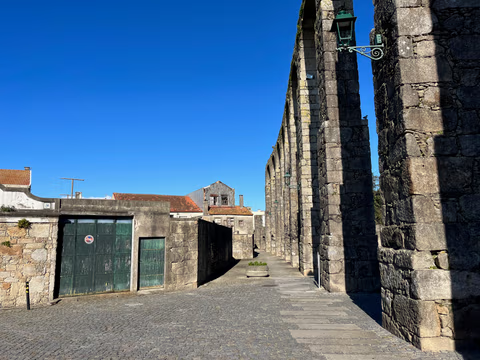
Aqueduct Trail – A path running along the Vila do Conde Aqueduct
From the Coastal Trail to the Camino Central: 12.9 km along the aqueduct from Vila do Conde to São Pedro de Rates. Route, stage, hostels, costs—explained honestly.
Read
Augsburg Way of St. James
The Augsburg Way of St. James runs 231.7 km in 11 stages from Oettingen in the Ries via Donauwörth, Augsburg, Bad Wörishofen and Ottobeuren to Ermengerst in the Allgäu — the Fuggerei, the Jakobervorstadt, a pilgrim of 1446 and Mozart's organ duel. Stages, hostels, costs.
Read

