

Camino Aragonés
The Camino Aragonés takes you 165.2 kilometers from Candanchú, below the Somport Pass, through Jaca, Sangüesa, and Monreal, down to Puente la Reina—the only one of the four classic main routes that is entirely downhill: You’ll arrive 1,218 meters lower than where you started. Around 1135, the Codex Calixtinus listed this route as the first of the four and identified Puente la Reina as the place where all the routes “converge into a single one”—today, the first route in the pilgrim’s guide is the quietest of them all.
- 01At a Glance
- 02Overview
- 03Jerusalem, the Great St. Bernard Pass—and a pile of rocks in the grass
- 04Other Names
- 05Who It's Ideal For—and Who It's Not So Ideal For
- 06Route & Landscape
- 07Stages, Terrain & Difficulty
- 08Highlights Along the Way
- 09How Pilgrims Find Their Way onto This Path
- 10Continue the pilgrimage?
- 11Preparation & Practical Information
- 12What the journey will cost you
- 13Getting Here
At a Glance
- Start / Finish: Candanchú (Spain, just below the Somport Pass, near the ruins of the Santa Cristina Hospital) → Puente la Reina (Navarre, Monument to the Pilgrim)
- Length: 165.2 km — the Spanish stage total comes to 165.4: a difference of two tenths over 165 kilometers—that's what you call consistency
- Ascent/Descent: ↗ 1,929 m / ↘ 3,147 m — a net descent of 1,218 meters: the only one of the four classic main routes that goes downhill. Highest point: Somport, 1,632 m, directly above the starting point
- Duration: 6–7 days on foot (6 stages following the standard Spanish route, 7 if taking the mountain route via San Juan de la Peña), 3–4 days by bike
- Marking: Yellow arrows and seashells; known as GR 65.3 in Aragón; a hiker reported in May 2025 that it was “perfectamente señalizado”—the trail is better marked than it is maintained
- Access route: The Via Tolosana ends exactly in Candanchú after 786.4 km from Arles—those coming over the Somport Pass continue on without interruption; the Voie de Piemont branches off into the Aspe Valley at Oloron-Sainte-Marie
- Connection: From Obanos/Puente la Reina, the Camino Francés begins—about 670 km to Santiago
- UNESCO: Part of the World Heritage Site since 1993—not under its own name, but as one of the two Pyrenean approaches to the Camino Francés: exactly the role assigned to it by Codex 1135
- Character: The least traveled of the four classic main routes—the most recent reliable estimate (2015) put the number of pilgrims at Somport at just over 500 per year, ranking it 34th among starting points; “Maravillosamente solitario” remarked a pilgrim in May 2025
Overview
Around 1135, the pilgrim's guide in the Codex Calixtinus lists the routes to Santiago, and it does two things that no other guide has done: It lists yours first —“El primero pasa por Saint-Gilles, Montpellier, Tolosa y Somport” — and he defines your goal as the goal of all four:“en Puente la Reina, en tierras españolas, confluyen en uno solo.” (Quoted here and below from the Spanish translation of Book V.) The route you're taking begins right after the pass: 165.2 Kilometers by Candanchú down to Puente la Reina — the only path in our graph whose endpoint is defined by a primary source. Since 1965 Does it say that there? Monumento al Peregrino and carves the phrase into stone: “Y desde aquí, todos los caminos a Santiago se hacen uno solo.” And who walks it? The latest reliable survey (2015) counted at Somport a good 500 pilgrims a year, Starting point—34th place—in Saint-Jean-Pied-de-Port and Roncesvalles combined, the total for that same year was 38,500. The first route in the pilgrim's guide is the least traveled of all today.
In addition, this trail has a number that no other trail has: ↗ 1,929 m vs. ↘ 3,147 m — it is the only one of the four classic main routes that leads net descent, 1,218 meters. And this number isn't just some statistical quirk: 3,147 minus 1,929 is exactly the difference in elevation between Candanchú and Puente la Reina. This calculation is spot on: This route is downhill. What he strings together as he falls is astonishingly dense—the Spain's first Romanesque cathedral in Jaca, begun in 1077, a 241-meter-long train station in the mountains, where refugees and tungsten trains passed each other, an abandoned village that was a Union reconstructs the octagonal puzzle of Eunate right along the route—and just one kilometer in, the foundation walls of a hospital that the Codex mentions in the same breath as Jerusalem calls.
Jerusalem, the Great St. Bernard Pass—and a pile of rocks in the grass
The pilgrim's guide from 1135 considers three Christian hospices to be indispensable, and it refers to them as pillars:“el hospital de Jerusalén, el hospital de Mont-Joux y el hospital de Santa Cristina, en el Somport”. Jerusalem. The Great St. Bernard Pass. And the Somport Pass. Two of them are world-renowned. The third is located near Candanchú in the grass: foundation walls, for the first time 1100 attested by a grant from King Pedro I, with its own order of knighthood in the 13th century, 1607 secularized, 1706 burned down, 1835 dissolved, 1991 unearthed in a documented campaign, 2006 Placed under protection. The Aragonese historic preservation authority lists it under the designation Unum Tribus Mundi — one of only three in the world. Your journey begins at a field of ruins that was once as important as the Hospital of Jerusalem.
One can read the Codex's list of places as if it were a missing persons report. Chapter III lists eight names between Somport and Puente la Reina:“Primero está Borce … el Hospital de Santa Cristina; después está Canfranc; más tarde Jaca; luego Osturit; después Tiermas con sus baños reales, que fluyen calientes constantemente; luego Monreal; por fin está Puente la Reina.” Five of them are inhabited places on your itinerary—a better ratio than on any other route. But Santa Cristina is a field of ruins, Osturit has not been identified to this day—no place by that name exists; researchers have simply not been able to locate it—and Tiermas With its “royal baths, whose waters flow constantly and are always hot,” it has been 1959 under the Yesa-Stausee; when the water level is low, the Roman baths reappear. Beneath that same water lies a section of the Roman road from Caesaraugusta to Beneharnum—the predecessor of this very route. Today, the route follows roughly the same path it did in the 12th century.
And yet this route is not a museum, but an active rescue operation. Arrés has been since 2001 A pilgrims' hostel with 22 beds, donation-based, with a communal dinner, run by volunteer hospitaleros. Ruesta, which lost its territory to the reservoir in 1965 along with its 368 residents, was 1988 the union CGT handed over, which it has been rebuilding ever since—and whose lodging operations, according to its own information,“en gran medida, del paso de peregrinos” depends: largely on the flow of pilgrims. On the 10. Juni 2026 Jaca has reopened its pilgrim hostel in the old military hospital—open year-round, on a donation basis, and run by the hospitaleros of the Spanish Federation; in the early 1990s, it was the first pilgrim hostel in Aragón. On a route that some 500 people set out on each year, each of these hostels is A decision that defies the statistics — and where you stay isn't a matter of comfort here. If you go down this path, you'll be part of the problem.
Other Names
The path is named after the country it passes through: Camino Aragonés, because it originates in the ancient Kingdom of Aragón and follows the Río Aragón. The Government of Aragón itself officially refers to it as Camino de Santiago francés por Aragón — For her, it is simply the Aragonese section of the Camino Francés, which is historically accurate: UNESCO has listed it since 1993 as one of the two Pyrenean routes along this pilgrimage path. Anyone looking for the pass will also find it as Ruta del Somport or Vía del Somport — and the pass's name reflects its meaning: Latin summus portus, “the highest pass.” In the hiking trail network, the route runs as GR 65.3, the mountain route via San Juan de la Peña as GR 65.3.2. On the French side, this same axis is called Via Tolosana or Voie d'Arles (GR 653) — it ends right where this trail begins.
Who It's Ideal For—and Who It's Not So Ideal For
This trail is for you if you enjoy long stretches and see solitude as a virtue, not a shortcoming. Four of the six stages are longer than 27 kilometers, There are rest stops almost exclusively at the beginning and the end, and one pilgrim counted about eight people in the hostels all the way to Puente la Reina—his verdict: “Maravillosamente solitario.” In return, you get more documented history along these 165 kilometers than anywhere else over 500: a cathedral dating from 1077, a royal crypt housing three generations of the House of Aragon, a train station with 365 windows, the only 12th-century Romanesque-Gothic Last Judgment scene on the Spanish Camino, and an octagon that has been the subject of dispute for 800 years. And you’ll end up at the place the Codex Calixtinus designated as the meeting point of all paths—with a monument that has confirmed this since 1965.
To be honest, though, it's not for you if you need structure. There aren't many places to shop: After Santa Cilia, there aren't any stores for days, You can withdraw cash in Jaca—or not at all, on Stage 5, there are 15.8 kilometers between Sangüesa and Izco without any reliable places to stop for a break—the hostel in Izco is permanently closed—there are fewer drinking fountains than on other routes, and bars aren’t open every day. Critic Antón Pombo calls parts of the route “tramos abandonados a su suerte”—left to their own devices. Such gaps should be planned out in advance, not along the way. And if your knees are an issue, take the elevation gain seriously: 3,147 meters of descent versus 1,929 meters of ascent. This trail doesn't require the stamina for mountains—it requires strong knees for the descents.
Route & Landscape
You'll start in Candanchú At about 1,560 meters, between ski lifts and the foundation walls of a medieval hospital, with the border pass directly above you. The first stage is pure high-mountain terrain and a descent of nearly a thousand meters: through the Río Aragón valley via Canfranc-Estación with its oversized train station, three-quarters of which burned down in 1944 Canfranc Pueblo, Villanúa featuring a witch's cave and a dolmen, Castiello de Jaca — and off to Jaca at 815 meters, where Spain's first Romanesque cathedral stands. From here on, everything changes: The mountains recede, and you head into the Canal de Berdún, a wide, long valley between the Pre-Pyrenees and the Sierras, passing through Santa Cilia and Puente la Reina de Jaca—the small town in Huesca, not your destination—and up to the hilltop village Arrés.
The second section consists of wheat fields, holm oaks, and water. Between Arrés and Ruesta lies the loneliest stretch of the entire route, with long distances between the villages—and then comes the Yesa-Stausee: about 2,000 hectares of water covering what used to be farmland, a Roman road, and three villages here before 1959. Ruesta lies on the shore as an abandoned village, with the ruins of a castle and a reopened inn. Across Undués de Lerda, the last town in Aragón, you cross into Navarre and head up to Sangüesa to the World Judgment Portal at Santa María la Real. From there, the route continues via Rocaforte and the Alto de Loiti into a land of rolling sierras; the final leg winds constantly up and down through the Sierra de Aláiz, brushes past Santa María de Eunate — the octagon is right next to your route — and ends at the Romanesque bridge at Puente la Reina: 346 meters above sea level, 1,218 meters below your starting point.
Stages, Terrain & Difficulty
The standard Spanish cuts are six stages, and it’s a challenging route: Four of the stages are over 27 kilometers long, and opportunities to split up are almost exclusively on Stages 1 and 6—in between, the hostel chain dictates the day, not your fitness level. The terrain consists mainly of nature trails, forest paths, and farm roads; the difficulty doesn’t lie in the elevation gain—1,929 meters of ascent over 165 kilometers is surprisingly little for a Pyrenean route—but rather in the stage length and the continuous descent. Snow and ice can linger at Somport until late spring. The kilometer figures below are taken from Spanish stage portals and are therefore marked “approx.”; the track measurements in our route database are the authoritative source: 165.2 km — The Spanish stage distance is 165.4; a deviation of two tenths confirms this, rather than contradicting it. The route is marked throughout with yellow arrows and seashells; in Aragón, as GR 65.3; “perfectamente señalizado” reported a hiker in May 2025.
- Candanchú → Jaca (approx. 30 km) — the long descent through the Aragón Valley, passing through both Canfrancs, Villanúa, and Castiello de Jaca. A high-mountain backdrop, nearly 1,000 meters of elevation loss — and the ruins of Santa Cristina at the start.
- Jaca → Arrés (approx. 25 km) — out to the Canal de Berdún, via Santa Cilia and Puente la Reina de Jaca (not the destination—it’s a different place!). Gently undulating terrain, lots of dirt roads; in Arrés, 22 “donativo” beds and a communal dinner await.
- Arrés → Ruesta (approx. 28 km) — the most isolated section of the trail, passing through Martes, Mianos, and Artieda on the way to the Yesa Reservoir and the abandoned village of Ruesta.
- Ruesta → Sangüesa (approx. 22 km) — the shortest stage, passing through Undués de Lerda, the last town in Aragón, and entering Navarre — with the Portal of the Last Judgment at the end of the stage.
- Sangüesa → Monreal (approx. 27 km) — via Rocaforte and the Alto de Loiti. The critical stretch: 15.8 km without reliable access to supplies; the hostel in Izco is permanently closed — be sure to bring enough food for the entire day.
- Monreal → Puente la Reina (approx. 31 km) — a constant series of ups and downs through the Sierra de Aláiz, past Santa María de Eunate (right on the trail!), through Obanos — the official junction with the Camino Francés — and the final 2.4 km to the bridge at Puente la Reina.
If you want more, take the official mountain route: The Camino San Juan de la Peña (GR 65.3.2) runs from Jaca through Santa Cruz de la Serós and past both monasteries of San Juan de la Peña to Arrés — 38.6 km with 1,059 meters of elevation gain Instead of 25 km, rated as “really difficult” by the trail portals and explicitly recommended to be split over two days (stay in Santa Cruz de la Serós or Santa Cilia; do not hike alone). A second option leads through the gorge Foz de Lumbier and extends Stage 5 to about 35 kilometers. And a word of humility: The Codex estimated the entire route as “tres cortas etapas”—three short stages from Borce to Puente la Reina. In the 12th century, however, stages were short only for riders; two of its three stage destinations, Jaca and Monreal, are still on your list today.
Highlights Along the Way
- Ruins of the Santa Cristina Hospital (Candanchú) — one of the “three pillars of the world” mentioned in the Codex Calixtinus, alongside Jerusalem and the Great St. Bernard Pass; first documented in 1100 by King Pedro I, burned down in 1706, dissolved in 1835, excavated in 1991, and protected since 2006. “Unum Tribus Mundi”—and your first kilometer.
- Estación Internacional de Canfranc — Opened on July 18, 1928, in the presence of Alfonso XIII: a 241-meter-long facade, 365 windows for 365 days. From 1940 to 1943, French customs chief Albert Le Lay, known as “el Schindler de Canfranc” smuggled refugees across the border here—among those documented are Marc Chagall and Joséphine Baker; in September 1943, he himself fled from the Gestapo. On March 27, 1970, a derailed freight train destroyed the L’Estanguet Bridge, bringing an end to international rail traffic; since the end of January 2023, the train station has been a five-star hotel.
- Laboratorio Subterráneo de Canfranc — 800 meters below the rock between the road tunnel and the old railroad tunnel, an underground laboratory is searching for dark matter. Above you is the passage from the Codex Calixtinus; below you is particle physics.
- Cueva y Dolmen de las Güixas (Villanúa) — A witch's cave and a dolmen, 11 kilometers before Spain's first Romanesque cathedral: This stage spans 4,000 years of religious history over 30 kilometers.
- San Pedro Cathedral, Jaca — Construction began in 1077 under Sancho Ramírez; it was Spain’s first Romanesque cathedral. In the same year, the king granted the city its charter: “ego volo constituere civitatem in mea villa que dicitur Iacca” — the *Fuero de Jaca*, a charter derived from pilgrimage traffic. Construction is currently underway on the Ajedrezado jaqués, the Jaca-style checkerboard band that has spread from here to the Romanesque churches along the entire Camino—you’ll recognize it all the way to Santiago. As of June 10, 2026, Jaca also has its pilgrim hostel back: open year-round, on a donation basis.
- San Juan de la Peña & Santa Cruz de la Serós (Mountain variant) — the monastery beneath the rock overhang, founded in 920; from 1071 onward, it was the first monastery in Spain to follow the Roman Rite; Ramiro I, Sancho Ramírez, and Pedro I lie in the Royal Pantheon—father, son, and grandson in the same rock niche. And the Grail? Whether the chalice that stands today as the Santo Cáliz in Valencia was ever here cannot be determined from historical records; it is traditionally accepted that King Martín I had it removed from here in 1399. The legend does not end with a disappearance, but with a location.
- Ruesta — Abandoned in 1965 when it had 368 residents because the reservoir took over the fields; since 1988, it has been owned by the CGT union, which has converted two houses into a hostel. The business depends “en gran medida, del paso de peregrinos”—here, providing overnight lodging is key to preserving the town.
- Yesa-Stausee — approximately 2,000 hectares of water covering three abandoned villages, a Roman road, and the hot springs of Tiermas, which the Codex praises as “con sus baños reales, que fluyen calientes constantemente.” At low water levels, the Roman baths reappear.
- Santa María la Real, Sangüesa — Donated to the Order of St. John by Alfonso I “the Battler” in 1131; the Burgundian sculptor Leodegarius immortalized himself with an inscription on the south portal. It is considered the only 12th-century Romanesque-Gothic depiction of the Last Judgment on the Spanish Camino—featuring Judas hanging from a noose.
- Santa María de Eunate — octagonal, surrounded by 33 arches; the name means “one hundred doors” in Basque. As for the Templar theory, honestly: “no existe ningún documento que lo acredite”—not a single document. What we do have are scallop shells in the graves around the church. There’s no proof of the secret; there is proof of the pilgrims. And best of all: Eunate lies right on the route of the Camino Aragonés—pilgrims on the Camino Francés have to take a detour, but you don’t have to go a single meter out of your way.
- Puente la Reina — the 11th-century Romanesque bridge, 110 meters long, with seven arches, built by a queen whose name became that of the town. And the Monumento al Peregrino from 1965, featuring the phrase recorded in the Codex 830 years earlier: “Y desde aquí, todos los caminos a Santiago se hacen uno solo.”
How Pilgrims Find Their Way onto This Path
The most natural feeder is the Via Tolosana — It runs 786.4 kilometers from Arles through Toulouse and the Aspe Valley to the Somport Pass and ends exactly at Candanchú, where this path begins. Together, they form the path that the Codex Calixtinus describes as first which lists the four: “El primero pasa por Saint-Gilles, Montpellier, Tolosa y Somport.” Anyone who crosses the pass isn’t just changing routes—they’re changing countries.
A second influx is coming from the French hinterland: The Voie de Piemont intersects with Oloron-Sainte-Marie The Arles Route, and its sponsoring association describes the junction verbatim: “La voie du Piémont coupe la voie d'Arles à Oloron-Sainte-Marie où l'on peut choisir de bifurquer vers Sarrance et Borce”: If you turn into the Aspe Valley there, you’ll end up at Somport via Borce—that is, here. If you arrive without having to walk part of the way, it’s easier than the trail’s reputation might suggest: Take the train to Jaca or Canfranc-Estación, then take the bus to the pass — or from the French side via Pau, Oloron, and Bedous (see “Getting There” for details). Your Pilgrim's Pass (Credencial) It's best to get it in advance; the hostel in Jaca can also issue it.
Continue the pilgrimage?
Technically, this route ends two and a half kilometers before the finish: “En la plaza de Obanos finaliza el Camino Aragonés … y se funde con el Camino Francés”—at the plaza in Obanos it merges with the Great Way. However, the union is celebrated in Puente la Reina, where, since 1965, the Monumento al Peregrino has borne the inscription from the Codex: “Y desde aquí, todos los caminos a Santiago se hacen uno solo.” From here on, the Camino Francés the remaining 670 kilometers or so to Santiago—via Estella, Logroño, Burgos, and León.
You should be prepared for the transition, because it’s a culture shock: After spending days with eight people at the hostel, you’ll find yourself on a trail that a quarter of a million people walk every year. That’s exactly what this place is all about—for 890 years, four paths have merged into one here. And anyone who immediately misses the quiet of the past week now knows firsthand why the old route over the Somport must be preserved.
Preparation & Practical Information
When: The peak season is April through October, with May, June, and September being ideal. Snow and ice can linger on the Somport Pass well into late spring—in winter, the pass is not an option. In March and November, several hostels may not yet be open or may already be closed: Arrés doesn’t open until April 1, Ruesta and Monreal open on March 1, and Monreal closes on October 31. If in doubt, call ahead—on this route, opening hours aren’t just a minor detail, but a key part of planning your stages.
Supply — the most honest part of this chapter: According to Santa Cilia There won't be any deliveries for several days, You can withdraw cash in Jaca — There aren’t any vending machines for quite a while after that, and donation-based hostels don’t have card terminals. On Stage 5, there are 15.8 kilometers between Sangüesa and Izco without any reliable places to stop for food; the hostel in Izco is permanently closed — you’ll need to bring enough food for the entire day on this stage. There are fewer public drinking fountains than on other routes; bringing two liters of water here is not an overcaution. Bars aren’t open every day and are closed on holidays.
Credentials and Equipment: As on all Spanish routes, you’ll need your pilgrim’s passport for the hostels and, at the end, the Compostela—it’s best to order it online in advance; you can get stamps at the hostels, at the Cathedral of Jaca, and—in a beautiful setting—at the Casa de Onat near Eunate. As for the gear, the elevation gain says it all: 3,147-meter descent. Bring walking sticks and cushioned, well-broken-in shoes, and plan the first leg conservatively—a 30-kilometer descent on the first day is a surefire way to end up with knee problems on the third. For the mountain route via San Juan de la Peña, the Portal’s recommendation is: split it over two days, and don’t go alone. And plan your daily stages in advance, because the lodging options are small, far apart, and subject to seasonal availability—the easiest way to do this is directly in the Camino Ninja app, where you can put together your stages and plan suitable accommodations at the same time.
What the journey will cost you
Expect 30 to 40 € per day (As of August 2026), you can travel on a budget starting at around 25 € — the hostels are pleasantly affordable because a large portion of them are donativo is up and running: the reopened hostel in Jaca (36 seats) as well as the Hospital de peregrinos in Arrés (22 seats), including a group dinner there. Where prices are posted, they are reasonable: Monreal 10 € (43 seats), Ruesta 16 € In a dormitory (double room: 58 €), the municipal hostel in Sangüesa costs around 5 €. For “donativo” accommodations, the unwritten rule is that 8 to 12 € is fair—and on a route with some 500 pilgrims a year, it’s precisely this amount that helps determine whether a house will reopen the following spring. In addition, there’s a “menú del día” for 12 to 16 €, breakfast for 3 to 5 €, and admission to Santa María de Eunate (2 €, 1.50 € for pilgrims); Private rooms and casas rurales start at around 40€ for a single room and 57€ for a double room. Since stores are few and far between, you’ll want to stock up in Jaca and Sangüesa rather than buying fresh groceries every day—and to reiterate the most important point: Withdraw cash in Jaca.
Getting Here
The easiest way to get there is via Zaragoza: A regional train runs three times a day to Jaca (about 3 hours and 30 minutes; 2 hours and 15 minutes from Huesca), continuing on for two of those hours until Canfranc-Estación — So you can basically take the train almost all the way to the second stage. From Jaca, the yellow bus operated by the Mancomunidad Alto Valle del Aragón will take you up to Candanchú and on to Somport; along the way, it stops in Castiello de Jaca, Villanúa, and both Canfrancs—in other words, at almost every stop on the first leg. Coming from France, you can take the TER from Pau about Oloron-Sainte-Marie according to Bedous and from there, take the cross-border bus line 550 via Urdos and the Somport Pass to Canfranc.
The Return trip from Puente la Reina is the easiest option of all: Buses take about 25 minutes to get to Pamplona (La Estellesa), where long-distance buses, trains, and a small airport await; Bilbao and Zaragoza are the nearest major airports—and anyone continuing on the Camino Francés doesn’t even need to plan a return trip. This route also has a curious twist: No trains have run over the Somport Pass since March 27, 1970, when a derailed freight train tore down the L’Estanguet Bridge. Although the EU has included the restoration of the Zaragoza–Canfranc–Pau line among its priorities, a report dated June 17, 2026, dryly notes: “El ritmo de ejecución actual genera inquietud sobre el cumplimiento de los plazos.” So, for the foreseeable future, you’ll cross the border faster on foot over the pass than by train.
- Getting to the starting point: Renfe regional train Zaragoza/Huesca → Jaca (3 times daily, two of which go to Canfranc-Estación), then local bus from Jaca to Candanchú/Somport (Mancomunidad Alto Valle del Aragón, about 5 trips daily, about 35 minutes, €1.35–3.05); Buses operated by Alosa/Avanza connect Jaca with Huesca, Zaragoza, and Pamplona.
- From France: TER Pau → Oloron-Sainte-Marie → Bedous, then take Bus Route 550 (Citram Pyrénées) via Urdos and the Somport Pass to Canfranc; 4–6 trips daily. ⚠️ The Aspe Valley is prone to landslides—the RN 134 was closed for months following the storms of September 2024; check the current status before traveling.
- Return trip: Puente la Reina → Pamplona by bus (about 25 minutes); from there, train, long-distance bus, and airport; major airports: Bilbao and Zaragoza; on the French side, Pau — or skip the return trip altogether and continue on the Camino Francés.

Get your pilgrim credential and shell
Everything you need for the Camino Aragonés, shipped to your door.
Visit Camino Shop
Other Caminos
 Appenzeller Weg
Appenzeller Weg
52.6 km from Rankweil across the Rhine to St. Peterzell: St. James Chapel (1464), 163 Years of the Wedding Trail, connection to the Via Jacobi. Stages, costs, how to get there.
Read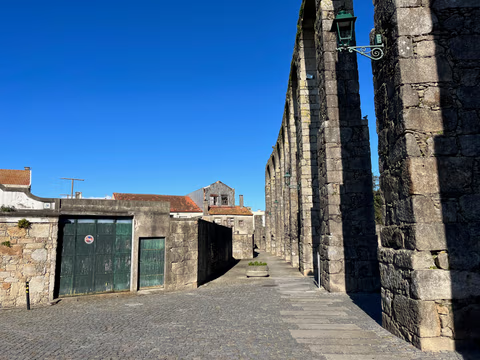
Aqueduct Trail – A path running along the Vila do Conde Aqueduct
From the Coastal Trail to the Camino Central: 12.9 km along the aqueduct from Vila do Conde to São Pedro de Rates. Route, stage, hostels, costs—explained honestly.
Read
Augsburg Way of St. James
The Augsburg Way of St. James runs 231.7 km in 11 stages from Oettingen in the Ries via Donauwörth, Augsburg, Bad Wörishofen and Ottobeuren to Ermengerst in the Allgäu — the Fuggerei, the Jakobervorstadt, a pilgrim of 1446 and Mozart's organ duel. Stages, hostels, costs.
Read

