

Pilgrimsrute Fyn
161.6 kilometres, 10 stages, highest point 81 metres: the Pilgrimsrute Fyn is the Funen section of the Danske Pilgrimsrute, from the Danehof castle in Nyborg through Funen farmland to Odense, to the tomb of Knud the Holy, the most important pilgrimage destination of the Danish late Middle Ages, then to the coast of the Little Belt, on foot across the old Lillebæltsbro of 1935 to Jutland, past the ruin of Koldinghus to Vejen, where the Hærvejen takes over. Run by the Foreningen af Danske Santiagopilgrimme since 1999. Frankly: the name is our Camino Ninja system, the operator says "Nyborg – Vejen"; a third of the route is not on Funen at all; no St James church, no hostel network — and from the end of the Zealand route you can only get here by train, because the Great Belt Bridge is closed to pedestrians.
At a Glance
- Start / Finish: Nyborg (Funen, east coast on the Storebælt) / Vejen (Jutland, junction with the Hærvejen)
- Length: 161.6 km
- Duration: 10 stages (Camino Ninja division), 8–11 days
- Elevation: ↗ 724 m / ↘ 685 m — the flattest of the Danish pilgrim routes
- Highest point: 81 m in the coastal hills of North Funen (km 68)
- Stages: 10 — Camino Ninja system on our waypoints; the operator cuts into five stages of 14 to 30 km
- Landscape: Funen farmland with avenues and church villages, Odense, North Funen's coast on the Little Belt, Lillebælt bridge, Kolding Fjord, open Kongeå country
- Operator: Foreningen af Danske Santiagopilgrimme (founded November 1999), section "Den Danske Pilgrimsrute: Nyborg – Vejen". The name "Pilgrimsrute Fyn" is Camino Ninja system
- Waymarking: scallop shell and yellow arrows, sparser than in Spain; maintained by the society's Stigruppen, GPS tracks from the operator
- Traces of St James: no St James church on the route — the saint of this stretch is Knud, slain in Odense in 1086; Hospitaller hospital in Odense from 1280
- Accommodation: no pilgrim hostel network — Danhostels, B&Bs, hotels, camping, shelters; all stage towns near a railway
- Feeders and connection: by train or bus across the Storebælt from Korsør, the end of the Pilgrimsrute Vestsjælland; in Vejen onto the Hærvejen to Padborg
- Best time: May to September
Overview
This route begins at the table where Denmark got its first constitution. At Nyborg Slot Erik Klipping signed his Håndfæstning in 1282, here the Danehof met until 1413, here judgement was passed on heirs to the throne and regicides — and two stages further, in Odense, lies a king who was slain in his church in 1086: Knud the Holy, canonised in 1101, his shrine the most important pilgrimage destination of the Danish late Middle Ages. From there the route turns north-west, through Kom-igen, which literally means "come again", via Væde, Paddesø and Fjelsted out to the Little Belt, where at Båring Strand and Vejlby Fed you walk with a view of Jutland. In Middelfart — the name has meant "middle crossing" since 1231 — you leave Funen on foot across the old Lillebæltsbro of 1935, pass the royally named inn Kryb i Ly, the ruin of Koldinghus and walk via Lunderskov into the Kongeå country to Vejen, where at kilometre 142.1 of the Hærvejen the route is handed over.
Frankly: the name is our Camino Ninja system, the operator simply calls the section "Nyborg – Vejen", and from Middelfart you are no longer on Funen at all — 57 of the 162 kilometres lie in Jutland. No St James church, no scallop find, no pilgrim hostel network as in Jutland, three towns with town prices, sparse waymarking because it requires permits in Denmark. And the start is an imposition for purists: from the end of the Zealand route in Korsør you can only get across by train or bus, the Great Belt Bridge is closed to pedestrians. What there is instead: the most accessible pilgrim route in Denmark — every stage town lies on a railway, the highest point at 81 metres — and two straits with two completely different answers. The Storebælt you ride. The Lillebælt you walk.
Other Names
The operator names this route after its endpoints: Den Danske Pilgrimsrute: Nyborg – Vejen, 159 kilometres, one of seven sections of a network of over 1,000 kilometres that the Foreningen af Danske Santiagopilgrimme has mapped, marked and maintained since 1999. Pilgrimsrute Fyn, by contrast, is our name — Camino Ninja system, with which we order the Danish routes by region, because region names are easier to remember than pairs of towns. The operator's name is the valid one; there is no separate route called "Camino Fyn", anyone using the term means this section.
Two things need saying. First: the name Fyn covers only two thirds. From Middelfart at kilometre 104.3 you are in Jutland, and the last 57 kilometres via Kolding to Vejen lie on the mainland. Second: the operator has a second Funen branch that we do not yet list — Odense – Bøjden across South Funen, 55 kilometres, with a ferry connection to Fynshav on Als as the southern access to the Hærvejen. If you find two routes on Funen, you have read correctly: both exist, and this one is the main line via Middelfart, which the operator cuts into the stages "Nyborg – Davinde", "Gadsbølle – Middelfart" and "Middelfart – Vejen". From Vejen the Danske Pilgrimsrute continues south on the trace of the Hærvejen, the old ox road.
Ideal For – and Less So For
Ideal if you have a good ten days, like walking through cultural landscape and do not experience towns as a disturbance: 724 metres of ascent over 161.6 kilometres is nothing, the highest point is at 81 metres, the daily stages of 13 to 23 kilometres are manageable even with moderate fitness. Ideal if you are looking for a route you can walk piece by piece: Nyborg, Odense, Middelfart, Taulov, Kolding, Lunderskov and Vejen all lie on railway lines — hardly any European pilgrim route breaks down into weekends so easily. Ideal for pilgrims from Copenhagen and Zealand who want to reach the Hærvejen: this is the way there. And ideal if you like history concrete: constitution, regicide, a fractured sacrum in a reliquary shrine.
Frankly, though, it is not for you if you are looking for solitude and wilderness. This is densely populated, well-farmed Denmark with tarmac sections, passages through villages and three larger towns on the route. Not for you if you expect a hostel network: there is no pilgrim hostel network of its own here like the Hærvejsherberger in Jutland — you sleep in Danhostels, B&Bs, hotels, on campsites or in shelters, and in Odense, Middelfart and Kolding you pay town prices. Not for you if you want to rely on signs: scallop shell and yellow arrows are there, but sparser than in Spain, maintained by volunteers, and without a GPX track you do not walk relaxed here. And not for purists: the route from Zealand ends in Korsør at the water, and the Great Belt Bridge is closed on foot — gaps like that are planned away beforehand, not on the way.
Route & Landscape
Funen: You start in Nyborg on the Storebælt, in front of the castle where the Danehof met, and walk via Vindinge, Ellinge and Hudevad westwards straight through Funen farmland — gentle ridges, field tracks, avenues, church villages — until via Fraugde you come to Odense, Denmark's third-largest city, with the shrine of Knud the Holy in Skt. Knuds Kirke and the Hospitaller monastery at Sankt Hans Kirke. Out of Odense the route turns north-west, via the aptly named village of Kom-igen and the villages of Væde, Paddesø and Fjelsted, then via Køstrup, Kærby and Båring out to the coast: at Båring Strand and Vejlby Fed you walk along the Little Belt, with a view of Jutland; in the coastal hills of North Funen lies the highest point of the route at 81 metres.
Across the Belt to Jutland: In Middelfart, the "middle crossing", the route leaves Funen — on foot across the old Lillebæltsbro of 1935, just under 1.2 kilometres, the first fixed link between Jutland and Funen. Then it turns Jutlandic: Skærbæk and Taulov with the royally privileged inn Kryb i Ly, Nørre Bjert and the Kolding Fjord, then Kolding with the castle ruin Koldinghus. Via Lunderskov, Store Andst and Gamst the route leads into the Kongeå country, an open, wide arable landscape that was border country from 1864 to 1920 — and ends in Vejen, where at kilometre 142.1 of the Hærvejen it does not come to an end but is handed over. Surface: field tracks, stretches of forest, coastal paths, passages through villages, bridge footway, plus tarmac sections; there is no measured share.
Stages, Terrain & Difficulty
We divide the 161.6 kilometres into ten stages averaging 16.2 kilometres — Camino Ninja system; the operator cuts into five longer pieces ("Nyborg – Davinde 24 km", "Gadsbølle – Middelfart 22 + 14 km", "Middelfart – Vejen 25 + 30 km") and arrives at 159 kilometres. Every stage boundary below is a waypoint of our route data, every kilometre figure the difference between two points, the total exactly the 161.6 kilometres of our route. If you walk more strongly, combine coastal stages 5 and 6 and Jutland stages 9 and 10 and you are in Vejen in eight days.
- Nyborg – Hudevad (23.1 km) — from the Danehof castle via Vindinge and Ellinge into the Funen interior; the operator's stage finish Davinde lies just beyond.
- Hudevad – Odense (21.3 km) — via Fraugde into the city of Knud the Holy; Skt. Knuds Kirke, Sankt Hans Kirke.
- Odense – Kom-igen (17.1 km) — out of Odense to north-west Funen, to the village whose name means "come again".
- Kom-igen – Fjelsted (15.9 km) — Væde, Paddesø and the Funen locality of Kryb-i-Ly; the highest point (81 m) lies in this section.
- Fjelsted – Båring Strand (14.1 km) — via Køstrup, Kærby and Båring out to the Little Belt.
- Båring Strand – Middelfart (12.8 km) — short coastal stage via Vejlby Fed to the "middle crossing".
- Middelfart – Taulov (15.0 km) — on foot across the old Lillebæltsbro to Jutland, Skærbæk, Kryb i Ly Kro.
- Taulov – Kolding (14.1 km) — via Nørre Bjert to the Kolding Fjord, finish Koldinghus.
- Kolding – Lunderskov (14.6 km) — into the open interior towards the Kongeå.
- Lunderskov – Vejen (13.6 km) — Store Andst, Gamst and the connection to the Hærvejen.
Technically there is nothing to master: field tracks, stretches of forest, coastal paths and tarmac sections that are part of it; the 724 metres of ascent are spread so evenly that you hardly notice them. The only real planning task is the overnight stops: without a continuous hostel network you have to know beforehand where you sleep — but almost every stage town lies on a railway line, which makes the route very forgiving. Windproof layer for the coast and the Kolding Fjord, shoes for tarmac, offline map.
Two Straits, Two Answers
This route has two stretches of water, and they say everything about it. The first lies before the start: the Zealand route ends in Korsør on the Storebælt, and the Great Belt Bridge — 18 kilometres of road and rail, opened in 1998 — is closed to pedestrians and cyclists. You ride across, 15 minutes by train, and the operator cuts its sections exactly at this point: Vestsjælland ends in Korsør, Fyn begins in Nyborg. The second stretch of water lies at kilometre 104: the Lillebælt at Middelfart, whose name has stood in Valdemar's Jordebog since 1231 as "Mæthælfar", the middle crossing — the place did not choose the route, the name described it. Here you walk. The old Lillebæltsbro, completed in 1935, just under 1.2 kilometres long, was the first fixed link between Jutland and Funen, and to this day it can be crossed "by car, train, bike and on foot"; if you like, you walk on the upper structure at 60 metres. One route, two straits, two completely different answers — one a hole in the network, the other its finest crossing.
What lies between the stretches of water is Danish constitutional and church history in two buildings. Nyborg Slot, first mentioned in 1193, completed around 1209, was a royal residence under Valdemar Sejr, and here Erik Klipping signed his Håndfæstning in 1282, which is called "Danmarks første grundlov": it obliged the king to summon the Danehof every year. It met in Nyborg on heirs to the throne, constitutional charters and regicides — "valg af tronarvinger, vedtagelse af håndfæstninger, domme over kongemordere" — for the last time in 1413. And in Odense, two stages further, lies the king whose murder changed the country: Knud the Holy, slain on 10 July 1086 in Skt. Albani Kirke together with his brother Benedikt, transferred to the new stone church in 1095, canonised by the pope in 1100/1101. His shrine made Odense the most important pilgrimage destination of the Danish late Middle Ages, and science has checked: the bones are those of a man aged 35 to 45, who died of several injuries, including a fracture of the sacrum — consistent with the assassination. Next to it Sankt Hans Kirke, from 1280 a monastery of the Knights Hospitaller, the hospital order from Jerusalem, which demonstrably cared for the sick here until Frederik II converted the monastery into a castle in 1575. A hospital order next to a pilgrimage tomb: that is what a pilgrim town looked like in the 14th century.
And then Jutland, where history has names. The Søholme inn of 1610 near Taulov has been called Kryb i Ly since 1737, because Christian VI called out "Kryb-i-ly!" to mowers in the rain — crawl into shelter — and thereupon gave the inn a royal privilege; the Funen locality of Kryb-i-Ly at kilometre 74 is a different place, we say that too. Koldinghus, probably laid out in 1268 by Erik Klipping as a border fortress against the dukes of Schleswig, burned to a ruin in the night of 29 to 30 March 1808 — while Spanish auxiliary troops from the Napoleonic Wars were quartered in it. Whether it was them, the museum still poses as an open question: "Var det de spanske soldater, der brændte slottet ned?" The quartering is documented, not the guilt. From 1972 to 1994 Inger and Johannes Exner preserved the ruin and added modern elements, Europa Nostra prize 1993. A route to Spain on which stands a castle possibly burned down by Spaniards — and which has not a single St James church, but a murdered king with a fractured sacrum. That is more honest than any invented scallop shell.
Highlights Along the Way
- Nyborg Slot — first mentioned in 1193, completed around 1209/10; here Erik Klipping signed the Håndfæstning in 1282, "Denmark's first constitution", and here the Danehof met until 1413; major restoration until 2028.
- Skt. Knuds Kirke, Odense — tomb and shrine of Knud the Holy, slain in Odense in 1086, transferred in 1095, canonised in 1100/1101: Denmark's most important pilgrimage destination of the late Middle Ages.
- Sankt Hans Kirke, Odense — church of the Hospitaller monastery, documented from 1280; the hospital order from the Holy Land ran nursing care here; rebuilt 1460–1475, from 1575 Odense Slot.
- Kom-igen — a village north-west of Odense whose name literally means "come again".
- Båring Strand and Vejlby Fed — the coastal kilometres on the Little Belt before Middelfart, with a view of Jutland.
- Skt. Nicolai Kirke, Middelfart — late Romanesque choir, 14th-century tower, altarpiece of 1650; Nicholas is the patron of seafarers, fitting at the place of the crossing.
- Middelfart — "Mæthælfar", the middle crossing, documented since 1231; porpoise hunting until the 19th century, 1,742 animals in the winter of 1854/55.
- Den Gamle Lillebæltsbro — first fixed link between Jutland and Funen, opened in 1935, just under 1.2 km, for cars, trains, bikes and pedestrians; Bridgewalking on the upper structure.
- Kryb i Ly Kro near Taulov — Søholme inn of 1610, named and privileged by Christian VI in 1737; rebuilt after the fire of 1973.
- Koldinghus — border castle, probably laid out in 1268 by Erik Klipping, burned out in the night of 29 to 30 March 1808, restored 1972–1994 by Inger and Johannes Exner, Europa Nostra prize 1993; today a museum.
- Kongeå country — between Lunderskov and Vejen the open landscape of the border of 1864 to 1920.
- Vejen — the junction: here the route meets the Hærvejen at kilometre 142.1.
How Pilgrims Reach This Route
Most come from Zealand — and the last step there is not one. The Pilgrimsrute Vestsjælland ends after 119.9 kilometres in Halsskov, the bridgehead of Korsør, and there it is over on foot: the Great Belt Bridge is closed to pedestrians and cyclists. You take the train or bus across the Belt to Nyborg, 15 minutes, several times an hour. The operator cuts its sections exactly at this break, and honest is honest: this is the only gap in the Danish route network that you cannot close on foot. If you have been walking longer, you come from Helsingør via the Pilgrimsrute Nordsjælland to Roskilde and Ringsted, or from Kastrup airport via the Pilgrimsrute København – Roskilde — the Danish network begins on the Swedish ferry coast in the north of Zealand.
If you travel directly it is easy: Nyborg lies on the main line Copenhagen–Odense–Fredericia, the journey from Copenhagen Airport takes around an hour and a half. From Germany you come via Hamburg–Flensburg–Fredericia. You get your pilgrim passport beforehand from the Foreningen af Danske Santiagopilgrimme, which has held the exclusive right to sell the credencial in Denmark since 1999, or from your own St James society.
Continuing the Pilgrimage?
In Vejen this route does not end, it is handed over. The town is kilometre 142.1 of the Hærvejen, the Jutland north–south axis on the ridge. From here it is another 105.9 kilometres south via Jels, Vojens, Rødekro and the pilgrimage church of Kliplev to Padborg on the German border — or, if you turn around, 142 kilometres north via Bække, Jelling and Nørre Snede to Viborg, where the two northern branches from Hirtshals and Frederikshavn arrive. Both are the same route, only marked the other way round: scallop shell southbound, St Olav's cross northbound.
If you want Santiago, you walk south. Two kilometres beyond Padborg, in Kruså, the Via Jutlandica begins from Flensburg via Schleswig, Rendsburg and Itzehoe to the Elbe, largely on the same old ox road. From there the European network runs via the Via Baltica towards Bremen, on to France, where from Paris the Via Turonensis forms the great southern strand, and in Saint-Jean-Pied-de-Port the Camino Francés begins. From Nyborg to the apostle's tomb is around 3,200 kilometres. The first 161.6 you will then have behind you.
Preparation & Practicalities
Best time: May to September. Funen and south-east Jutland are mild, but the wind comes off the water — on the coastal kilometres before Middelfart, on the bridge and on the Kolding Fjord a windproof layer is basic kit. Because the route has no elevation, you can plan well: 16 kilometres a day is a comfortable day here, not a sporting one. Waymarking and navigation: scallop shell and yellow arrows, sparser than in Spain — signage in Denmark requires permits, maintenance lies with volunteers of the society's Stigruppen. The operator provides GPS tracks; take one with you and plan your stages and lodgings most easily directly in the Camino Ninja app. Pilgrim passport: credencial from the Foreningen af Danske Santiagopilgrimme (exclusive right since 1999) or your own St James society, order early; stamps in churches, Danhostels and tourist offices. Language: Danish, English everywhere.
Accommodation: There is no continuous pilgrim hostel network on this section like the Hærvejsherberger in Jutland. You stay in Danhostels (Odense, Middelfart, Kolding), B&Bs, hotels, on campsites and in shelters, the open Danish huts, mostly free; the society organises free group walks on the section. Plan your nights beforehand, especially in the towns — and use the advantage of this route: because every stage town lies on a railway, you can also look for a bed one station further on. Supplies: supermarkets in all stage towns, water no problem. Packing list: windproof jacket, rain protection, shoes for tarmac and field track, offline maps, power bank, sleeping bag only for shelters.
What the Route Costs
You pay in Danish kroner, and frankly Denmark is expensive — but this route has no ferry, no mountain railway and no compulsory admission, and the towns have Danhostels. The figures are general Danish orders of magnitude, because there is no hostel directory of its own for this section (as of September 2026). Bed in a Danhostel or simple hostel 100–150 DKK (13–20 €), individual houses from 80 DKK (11 €); tent pitch at a hostel about 30 DKK (4 €); shelters mostly free. Regular campsite 230–280 DKK for two (31–38 €), hotel or B&B on average 580 DKK per night for two (78 €) — in Odense, Middelfart and Kolding rather more. Admission: churches free; Nyborg Slot and Koldinghus as museums charge; Bridgewalking Lillebælt is its own experience with its own price, the bridge itself you walk for free.
Realistic daily budget: 250–400 DKK (34–54 €) frugal with Danhostel or shelter and self-catering; 500–750 DKK (67–101 €) mid-range with B&B and a warm meal; 900–1,300 DKK (121–174 €) comfortable with hotels in Odense, Middelfart and Kolding. For ten stages that is roughly 2,500–4,000 DKK (335–535 €) frugal on the ground, plus pilgrim passport, train across the Storebælt and travel there and back. Two ways to save: cook — there are supermarkets in every stage town — and use the shelters, of which there are several around Odense and in the Kongeå country.
Getting There
To the start (Nyborg): Nyborg lies on the Danish main line Copenhagen–Odense–Fredericia; from Copenhagen Airport you are there in around an hour and a half, trains run several times an hour. From Germany you travel via Hamburg–Flensburg–Fredericia. If you come from Korsør, take the train or bus across the Great Belt Bridge — the crossing is closed on foot, 15 minutes' ride.
On the way and from the finish (Vejen): This is the easiest Danish pilgrim route to break off and resume — Odense, Middelfart, Taulov, Kolding and Lunderskov all have railway stations. Vejen lies on the Fredericia–Esbjerg line; via Lunderskov or Fredericia you reach Copenhagen, Aarhus and via Padborg/Flensburg Hamburg. If you continue as a pilgrim you need no train: the Hærvejen continues directly in Vejen. Natural dividing point: Middelfart — Funen 104.3 kilometres, Jutland 57.3.
- Rail Denmark: dsb.dk — Korsør–Nyborg, Odense, Middelfart, Kolding, Vejen
- Rail to/from Germany: bahn.de — Hamburg–Flensburg–Fredericia
- Bus Funen: fynbus.dk — regional buses Nyborg, Odense, Middelfart
- Bus South Denmark: sydtrafik.dk — Kolding, Vejen
- Operator, stages, GPS, pilgrim passport: santiagopilgrimme.dk — Foreningen af Danske Santiagopilgrimme
- Bridge: bridgewalking.dk — Den Gamle Lillebæltsbro, Bridgewalking

Get your pilgrim credential and shell
Everything you need for the Pilgrimsrute Fyn, shipped to your door.
Visit Camino Shop
Other Caminos
 Appenzeller Weg
Appenzeller Weg
52.6 km from Rankweil across the Rhine to St. Peterzell: St. James Chapel (1464), 163 Years of the Wedding Trail, connection to the Via Jacobi. Stages, costs, how to get there.
Read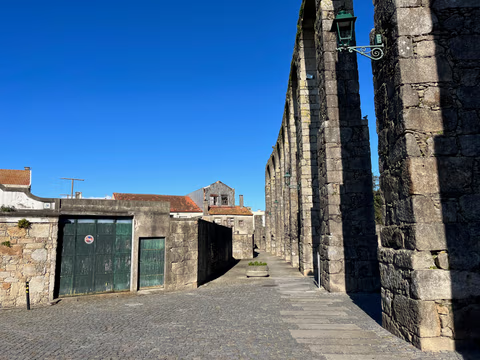
Aqueduct Trail – A path running along the Vila do Conde Aqueduct
From the Coastal Trail to the Camino Central: 12.9 km along the aqueduct from Vila do Conde to São Pedro de Rates. Route, stage, hostels, costs—explained honestly.
Read
Augsburg Way of St. James
The Augsburg Way of St. James runs 231.7 km in 11 stages from Oettingen in the Ries via Donauwörth, Augsburg, Bad Wörishofen and Ottobeuren to Ermengerst in the Allgäu — the Fuggerei, the Jakobervorstadt, a pilgrim of 1446 and Mozart's organ duel. Stages, hostels, costs.
Read

