

Hegauer Jakobsweg
The Hegauer Jakobsweg runs 71.5 kilometers from Kloster Wald to Konstanz, the western branch of the Via Beuronensis down to Lake Constance. It passes through Stockach, the carnival town on the edge of the Hegau, drops down to Ludwigshafen and Bodman on the Überlinger See, crosses the Bodanrück ridge by the Mindelsee and follows the Gnadensee via Allensbach and Hegne to Konstanz Minster. Three stages, 828 meters of ascent, and a high point of 697 meters in the forest between Mindersdorf and Ursaul. In Konstanz the Via Jacobi begins its run through Switzerland.
- 01At a Glance
- 02Overview
- 03Other Names
- 04Who It's Ideal For—and Who It's Not So Ideal For
- 05Route & Landscape
- 06Stages, Terrain, and Difficulty
- 07The Fool of Stockach Was the Only One Who Asked How to Get Back
- 08Highlights Along the Way
- 09The Reichenau Loop: a Monastery Older Than Almost Every Town on the Route
- 10How Pilgrims Find Their Way onto This Path
- 11Continue the pilgrimage?
- 12Preparation & Practical Information
- 13What the journey will cost you
- 14Getting Here
At a Glance
- Start / Finish: St. Bernhard abbey church in Kloster Wald / Konstanz Minster
- Length: 71.5 km
- Duration: 3 stages, avg. about 24 km; with the detour across Reichenau, more like 4 days
- Elevation: ↗ 828 m / ↘ 1,082 m
- Highest point: 697 m at km 17.9 in the forest between Mindersdorf and Ursaul
- Landscape: forest and wet meadows in the hinterland, the western end of the Überlinger See, the moraine ridge of the Bodanrück, reeds along the Gnadensee
- Waymarking: yellow shell on a blue background, marked toward Konstanz only
- Traces of St. James: the former Irish monastery of St. Jakob in Konstanz with its Schottenkapelle from 1589, the Mauritius Rotunda at the Minster as a station of the Schwabenweg
- Accommodation: inns, guesthouses and private rooms, the Gästehaus St. Elisabeth at Kloster Hegne; there are no pilgrim hostels with dormitories
- Connecting routes: Linzgauer Jakobsweg (branches off in Wald, also ends in Konstanz), Via Jacobi and Lindau – Héricourt from Konstanz
- Best time: May to October; in high summer, rooms by the lake are scarce
- Pilgrim passport / Certificate: pilgrim passport from the Jakobspilger-Gemeinschaft in Beuron; pilgrim certificate from 100 km on the Via Beuronensis, free of charge in exchange for a donation (as of October 2026)
Overview
The Hegauer Jakobsweg begins with nuns and ends with a bishop who was a pilgrim himself. In Kloster Wald, Burkard von Weckenstein founded a Cistercian convent for his two sisters in 1212, and the Baroque church where you set off was rebuilt in 1698 by an abbess named Jakobe von Bodman. At the finish stands the Mauritius Rotunda of Konstanz Minster, which Bishop Konrad had built around 940 after his pilgrimage to Jerusalem, as a replica of the Church of the Holy Sepulchre. In between lie 71.5 kilometers, and almost exactly halfway you walk through Bodman, the village that gave the whole lake its German name, Bodensee.
The route is the western of the two final sections of the Via Beuronensis, which a Beuron monk began waymarking in 2004 and which Santiago recognized in 2009. In Wald it parts ways with the Linzgauer Jakobsweg and takes the longer, quieter arc via Stockach and the Bodanrück. Honestly, though, it isn't a walk through the volcanic landscape its name promises: the cones of Hohentwiel and Hohenhewen stay on the western horizon. You see them from the heights on a clear day, but you never set foot on them.
Other Names
The operator lists it as Section F of the Via Beuronensis, "Kloster Wald – Stockach – Markelfingen – Konstanz"; in everyday use it's called the Hegauer Jakobsweg or simply the Hegauer Weg. The name is more historically accurate than the geology suggests: the medieval Hegau district reached south to the Überlinger See and Konstanz, while Stockach lay on its northeastern edge. In English you'll see Hegau Way of St. James.
Who It's Ideal For—and Who It's Not So Ideal For
Ideal if you're walking the Via Beuronensis from Tübingen and would rather arrive by the water than over the hills of the Linzgau. Also ideal for a long weekend: three days, a train station at the finish, and a World Heritage island as a possible fourth day.
Honestly, though, it's not for you if you hate getting lost: the operator itself warns, „Bitte die Schilder beachten, da überwachsene Graswege kaum zu finden sind!“ ("Watch the signs, as overgrown grass paths are hard to find!"), and the forest stretches on the first stage are among the trickiest parts of the entire Via Beuronensis when it comes to navigation. And it's not for you if you expect pilgrim camaraderie like in Spain: you'll mostly walk alone and sleep at inns.
Route & Landscape
Kloster Wald to Stockach (km 0–25.7): From the abbey church the path leads through forest and wet meadows to Sentenhart (km 7.2) with its church of St. Remigius, then on to Mindersdorf (km 15.9). Shortly after, at km 17.9, you reach the high point of 697 meters, deep in the woods, and descend via Ursaul (km 20.0) into the valley of the Stockacher Aach to Stockach (km 25.7).
Stockach to Konstanz (km 25.7–71.5): Beyond Stockach the lake opens up. In Ludwigshafen (km 32.4), with its St. Anne's chapel, and in Bodman (km 35.8) you stand at the far western end of the Überlinger See. Then the path climbs onto the Bodanrück, via Liggeringen (km 41.3) and its church of St. George, past the quiet Mindelsee and down to Markelfingen (km 48.3) on the Gnadensee. Radolfzell lies about two kilometers west of the route. Along the slope above the shore you continue to Allensbach (km 55.5), to Kloster Hegne (km 60.2) and along the edge of the Wollmatinger Ried via Wollmatingen to Konstanz (km 71.5).
Stages, Terrain, and Difficulty
We show the route in 3 stages, as the operator does; distances come from the Camino Ninja map, calibrated exactly to 71.5 km. If you want shorter days, split the second stage in Bodman or add a day in Allensbach for Reichenau.
- Kloster Wald → Stockach (25.7 km) — the loneliest stage, lots of forest, hardly anywhere to stop for food, over the route's high point; private rooms are available in Mindersdorf.
- Stockach → Markelfingen (22.6 km) — down to the Überlinger See at Ludwigshafen and Bodman, then the climb onto the Bodanrück and past the Mindelsee.
- Markelfingen → Konstanz (23.2 km) — along the slope above the Gnadensee to Allensbach, via Kloster Hegne and Wollmatingen to the Minster.
Nothing here is technically difficult: farm tracks, forest and grass paths, with more asphalt toward the end; the only noticeable climb leads from Bodman up onto the Bodanrück. More annoying than any hill are the mosquitoes in the wet meadows in summer and, on the final day, the roadworks on the B33 between Allensbach and Konstanz, which according to the operator will last until 2035. The route isn't waymarked in reverse.
The Fool of Stockach Was the Only One Who Asked How to Get Back
Stockach, first mentioned around 1150 as Stocka and securely documented as a town in 1283, has the most famous court on Lake Constance, and it's made up of fools. Tradition traces it back to Hans Kuony, court jester to Duke Leopold I of Habsburg. When the duke marched against the Swiss Confederates in 1315, Kuony sat on the council of war, and the Tschachtlan Chronicle puts this sentence in his mouth: „Da hand ir all geratten wa ir in dasz land koment, aber keiner hat geratten wa ir her wider usz koment.“ You've all worked out how to get into the country, but none of you how to get back out again. Shortly afterward, Leopold lost the Battle of Morgarten by Lake Ägeri.
Duke Albert the Wise is said to have granted the jester the right to hold a court in Stockach every year in 1351. There's no proof of that, and historians don't consider the chronicles reliable on this point. The word Narrengericht ("fools' court") is first documented in 1661 in Stockach council minutes, and in 1687 the fools wrote down their „Satzung und Ordnung“ (statutes and rules). To this day, the Hohe Grobgünstige Narrengericht zu Stocken, with up to 21 court fools, puts a politician on trial on Schmotziger Dunschtig, the Thursday before Lent; in 2026 it was Markus Söder, sentenced to two and a half buckets of wine, which comes to 150 liters.
For pilgrims, Kuony's line has a second punchline. On this route, nobody thought about the way back either: the shells point only toward Konstanz and on to Santiago. In practice: if you pass through Stockach during the Fasnet carnival, set aside a day, because the whole town is out on the streets.
Highlights Along the Way
- Kloster Wald (km 0) — founded in 1212, dissolved in 1806, home again since 1946 to Benedictine nuns who run the Heimschule Kloster Wald, a girls' boarding school; church of St. Bernhard from 1698.
- Stockach (km 25.7) — town of the Counts of Nellenburg, Austrian until 1805, scene of the Battle of Stockach and Liptingen in 1799.
- Ludwigshafen (km 32.4) — called Sernatingen until 1826, when Grand Duke Ludwig named the new harbor after himself and the village took on the name.
- Bodman (km 35.8) — in the 9th century the royal palace of Potamico, where Louis the German and Charles the Fat resided; Potamico became Bodan, and Bodan became Bodensee. Above the village rises the Frauenberg, where the castle of the lords of Bodman burned down after a lightning strike in 1307.
- Mindelsee (near km 45) — about 115 hectares, scooped out by the Rhine Glacier some 15,000 years ago, a nature reserve since August 15, 1938, with more than 20 species of orchid.
- Allensbach (km 55.5) — already named as Alaspach in Reichenau's founding charter of 724; today the town is best known for its Institute for Public Opinion Research.
- Kloster Hegne (km 60.2) — home of the Sisters of the Holy Cross since 1892; in the crypt lies the tomb of Sister Ulrika Nisch (1882–1913), beatified by Pope John Paul II on November 1, 1987.
- Wollmatinger Ried (between Hegne and Konstanz) — 767 hectares of wetland between Hegne, the Reichenau causeway and the Seerhein, protected since 1930 and a Ramsar site since 1976; in autumn, 20,000 to 40,000 waterbirds rest here.
- Konstanz Minster (km 71.5) — Mauritius Rotunda with the Holy Sepulchre from around 1260, venue of the Council of 1414 to 1418, which condemned Jan Hus here in 1415.
The Reichenau Loop: a Monastery Older Than Almost Every Town on the Route
No place on the Hegauer Weg appears in the records earlier than the island it skirts: in 724 the itinerant bishop Pirmin founded a Benedictine monastery on Reichenau, and Allensbach on the opposite shore belonged to it from the start. Walahfrid Strabo wrote his Hortulus about the monastery garden here around 841, and since 2000 the monastic island has been a UNESCO World Heritage Site. The Minster of St. Mary and St. Mark keeps relics of Mark the Evangelist and the Holy Blood relic, and in between, vegetable fields run right up to the churches of Oberzell and Niederzell.
In practice: from Allensbach the operator describes a variant via the island, crossing by ferry in season and returning on foot over the causeway, which was built up in 1838 and completed as a solid road in 1858. Between the Reichenau marina and the church of St. Martin in Wollmatingen, this stretch is waymarked in both directions. Plan for an extra half to full day and check the ferry times in advance.
How Pilgrims Find Their Way onto This Path
Most arrive on foot from the north. The Beuroner Jakobsweg leads from Tübingen across the Swabian Jura and past Beuron Archabbey to Meßkirch, where the Linzgauer Jakobsweg begins, and after its first nine-plus kilometers you reach Wald. There you choose: east via Überlingen and across the lake by boat, or west via Stockach and the Bodanrück – both end at the Minster.
For a direct start, you can reach Kloster Wald by bus from the surrounding area; Stockach has had a rail line to Radolfzell since 1867 and also works as a starting point for the second half.
Continue the pilgrimage?
Yes, Konstanz is a handover, not an ending. Several routes meet at the Minster:
- Via Jacobi — the main Swiss route, as the Schwabenweg through Thurgau to Einsiedeln Abbey and on over the Brünig Pass to Geneva, 447.3 kilometers
- Lindau – Héricourt — from Lake Constance down the High Rhine to Basel and on to the Burgundian Gate
- Oberschwäbischer Jakobsweg — arrives from Ulm via Ravensburg and the Meersburg–Konstanz ferry, and also ends here
Before you head off: west of the old town, on Schottenstraße, stood the Irish monastery of St. Jakob, founded according to tradition in 1142, documented from 1220, demolished in 1529/30. What remains is the Schottenkapelle St. Jakob from 1589.
Preparation & Practical Information
Pilgrim passport and app. As on all German Ways of St. James, you need a pilgrim passport (credencial) to stay in pilgrim accommodation and to receive the Compostela in Santiago at the end. It's best to order it online in advance so it reaches you in time for the start of your trip: the Beuroner Jakobspilger-Gemeinschaft sends it out via an order form on via-beuronensis.de. The association's pilgrim certificate is available once you've documented 100 kilometers on the Via Beuronensis – with 71.5 kilometers alone you fall short, but together with the Beuroner Weg from Tübingen you're well over. The easiest way to plan the route is in the Camino Ninja App, where you can put together your stages and plan suitable accommodation right along with them.
Accommodation. In Mindersdorf, locals offer private rooms; in Stockach, according to the operator, an inn offers pilgrim menus and pilgrim rates; Markelfingen has pilgrim rates and stamps; and Hegne has the Gästehaus St. Elisabeth at the convent. By the lake, the operator's warning applies: in high season, beds are hard to find – book early for July and August.
What the journey will cost you
The Jakobspilger-Gemeinschaft's pilgrim certificate is free, and a donation is welcome (as of October 2026). At inns and guesthouses in the hinterland, budget roughly 55 to 85 € per night with breakfast; on the Untersee and in Konstanz, more like 80 to 120 €.
With accommodation, a snack lunch and dinner, you'll spend 80 to 120 € per day. Honestly, you're paying Lake Constance prices here; in return, the train gets you home in a few hours at the end.
Getting Here
To the start. Kloster Wald has no train station; buses connect the village with Pfullendorf, Meßkirch and Sigmaringen.
From the finish. Konstanz is the terminus of the Black Forest Railway via Singen to Offenburg and connects to the Swiss network via Kreuzlingen. According to the operator, the Seehas commuter train runs every half hour between Konstanz and Radolfzell and also stops at Hegne, Allensbach and Markelfingen – handy for joining or bailing out.
- Rail: bahn.de — connections to Sigmaringen and Stockach and from Konstanz
- Info: via-beuronensis.de — stages F1 to F3, pilgrim passport and pilgrim certificate
Partners
Partner for Hegauer Jakobsweg
Camino Ninja is cooperating with official partners. For this camino the partner is:


Get your pilgrim credential and shell
Everything you need for the Hegauer Jakobsweg, shipped to your door.
Visit Camino Shop
Other Caminos
 Appenzeller Weg
Appenzeller Weg
52.6 km from Rankweil across the Rhine to St. Peterzell: St. James Chapel (1464), 163 Years of the Wedding Trail, connection to the Via Jacobi. Stages, costs, how to get there.
Read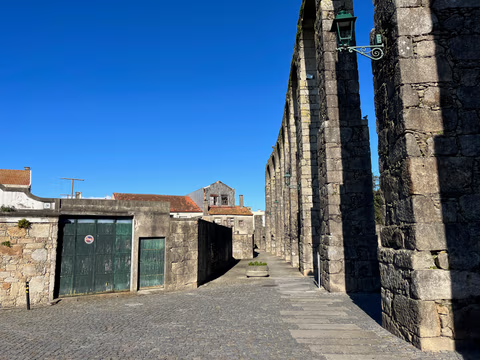
Aqueduct Trail – A path running along the Vila do Conde Aqueduct
From the Coastal Trail to the Camino Central: 12.9 km along the aqueduct from Vila do Conde to São Pedro de Rates. Route, stage, hostels, costs—explained honestly.
Read
Augsburg Way of St. James
The Augsburg Way of St. James runs 231.7 km in 11 stages from Oettingen in the Ries via Donauwörth, Augsburg, Bad Wörishofen and Ottobeuren to Ermengerst in the Allgäu — the Fuggerei, the Jakobervorstadt, a pilgrim of 1446 and Mozart's organ duel. Stages, hostels, costs.
Read

