

Oberschwäbischer Jakobsweg
The Oberschwäbischer Jakobsweg, the Upper Swabian Way of St. James, runs 167.6 kilometers from Münsterplatz in Ulm on the Danube to Konstanz Minster on Lake Constance. Along the way lie the shared church of Biberach, the pilgrimage church of Steinhausen, the basilica of Weingarten and the towers of Ravensburg, much of it following the Upper Swabian Baroque Route. Eight stages, 2,232 meters of climbing, a high point of 661 meters between Oberessendorf and Bad Waldsee, and at the end the car ferry from Meersburg to Konstanz. The route was waymarked in 1996 and 1997; in Konstanz the Via Jacobi takes over.
- 01At a Glance
- 02Overview
- 03Other Names
- 04Who It's Ideal For—and Who It's Not So Ideal For
- 05Route & Landscape
- 06Stages, Terrain, and Difficulty
- 07The Most Beautiful Village Church in the World Cost Its Abbot His Job
- 08Highlights Along the Way
- 09Felix Fabri and the Nuns Who Walked to Santiago in Their Heads
- 10How Pilgrims Find Their Way onto This Path
- 11Continue the pilgrimage?
- 12Preparation & Practical Information
- 13What the journey will cost you
- 14Getting Here
At a Glance
- Start / Finish: Münsterplatz in Ulm / Konstanz Minster on Lake Constance
- Length: 167.6 km, including the Meersburg–Konstanz ferry crossing
- Duration: 8 stages, averaging around 21 km; if you prefer shorter days, plan 9 to 10
- Elevation: ↗ 2,232 m / ↘ 2,311 m
- Highest point: 661 m at km 85.1, between Oberessendorf and Bad Waldsee
- Landscape: the Danube plain, the Riß valley, the moraine hills and moors of Upper Swabia, the Schussen valley, and finally orchards and vineyards above Lake Constance
- Operator / Waymarking: Stiftung Haus St. Jakobus – Schwäbische Jakobusgesellschaft in Oberdischingen, with volunteer trail stewards; yellow shell on a blue background
- Traces of St. James: St. James's Church in Grimmelfingen, Haus St. Jakobus in Oberdischingen, the parish church of St. Jakobus in Brochenzell, Santiago distance markers in Weingarten, Brochenzell and Markdorf, the Holy Sepulchre in the Mauritius Rotunda in Konstanz
- Accommodation: pilgrim beds at Haus St. Jakobus, otherwise inns, guesthouses, hotels and youth hostels; Spanish-style dormitories are practically nonexistent
- Connecting routes: Jakobsweg Nürnberg–Ulm and Fränkisch-Schwäbischer Jakobsweg in Ulm, Ulm – Pfullendorf from Oberdischingen, Via Jacobi and Lindau – Héricourt from Konstanz
- Best time: May to October; in spring the orchards by the lake are in bloom, and in May or June the Blutritt in Weingarten falls on the Friday after Ascension Day
- Pilgrim passport: free from Haus St. Jakobus in Oberdischingen (as of October 2026)
Overview
The Oberschwäbischer Jakobsweg begins beneath the church spire that was the tallest in the world until 2025 and ends at a chapel modeled on a tomb in Jerusalem. In between lie 167.6 kilometers through a land where almost every village has a church that would grace a city anywhere else. Ulm Minster stands 161.53 meters tall; its foundation stone was laid on June 30, 1377, and the spire was not finished until May 31, 1890. In Konstanz, around 940, Bishop Konrad had the Mauritius Rotunda built as a copy of the Church of the Holy Sepulchre. So you walk from a Gothic church that took 513 years to finish one tower to a rotunda whose model stands 3,000 kilometers to the east—and there you turn west.
As a modern pilgrimage route it is young. In the summer of 1996, prompted by the Council of Europe, the State Seminar for Teacher Training in Meckenbeuren and the St. James Society waymarked the section from Bad Waldsee to Meersburg; in 1997 the gap from Ulm to Bad Waldsee was closed and the route received an ecumenical blessing. The colors of the shell are no accident: „Blau und Gelb sind die Farben Europas“ (“blue and yellow are the colors of Europe”). Honestly, this is a walk through cultivated countryside, with farm tracks, village streets and a few kilometers of asphalt—the big moments happen in churches, not on summits.
Other Names
Its official name is Oberschwäbischer Jakobsweg, often also Jakobsweg Ulm–Konstanz. In English you will see Upper Swabian Way of St. James. Don't confuse it with the Oberschwäbischer Pilgerweg, a separate network of loop trails that Haus St. Jakobus also looks after. In Switzerland the continuation from Konstanz is called the Schwabenweg—because in the Middle Ages it was mostly Swabian pilgrims who took this route to Einsiedeln.
Who It's Ideal For—and Who It's Not So Ideal For
Ideal if you're looking for a Camino on your doorstep, with a train station at the start and the finish and stage towns where you can step off at any point. Ideal if Baroque churches, monasteries and free imperial cities appeal to you more than summits: between Biberach and Weingarten, within 54 kilometers, stand three of the most important church buildings in southern Germany. And ideal as a first pilgrimage, because the climbing is moderate and no stage is technically difficult.
Honestly, though, it's not for you if you expect the pilgrim community of the Camino Francés: here you often walk alone for days, and in the evening you're more likely to sit at the regulars' table of a village inn than in an albergue dormitory. Not for you if you're counting on 15 € a night—apart from Haus St. Jakobus, you'll pay guesthouse and hotel rates. And not for you if you're after silence and wilderness: the route crosses federal highways, industrial areas on the edges of Biberach and Ravensburg, and the densely settled hinterland of Lake Constance.
Route & Landscape
Ulm to Biberach (km 0–56.1): From Münsterplatz you leave Ulm heading southwest via Grimmelfingen (km 7.1) with its Protestant St. James's Church and follow the Danube plain to Erbach (km 13.9) and Oberdischingen (km 21.1), where Haus St. Jakobus stands on the Kapellenberg. Via Ersingen and Rißtissen (km 26.4), where the Romans built a fort at the Riß ford around AD 45, you head up the Riß valley via Schemmerberg and Äpfingen (km 43.2) to Biberach an der Riß (km 56.1). Maselheim lies about 2 km off the route.
Biberach to Konstanz (km 56.1–167.6): Beyond Biberach the land turns hilly: via Muttensweiler you reach Steinhausen (km 68.2); the monastery of Bad Schussenried stays a good 2 km to the west. Through forest and moor via Oberessendorf (km 81.1) and the route's high point you come to Bad Waldsee (km 90.7) with its town lake, then via Bolanden into the Schussen valley to Weingarten (km 110.2) and Ravensburg (km 116.5); Bergatreute and Baienfurt lie just under 2 km from the trail. Via Oberzell, Ettenkirch and Hepbach you walk through orchards to Markdorf (km 146.0) and down to Meersburg (km 158.0). The last kilometers are water: the ferry takes you to Konstanz-Staad, and from there you walk along the shore to Konstanz Minster (km 167.6).
Stages, Terrain, and Difficulty
We show the route in 8 stages, with days between 16 and 25 kilometers; distances come from the Camino Ninja map, calibrated exactly to 167.6 km, ferry crossing included. Oberschwaben Tourismus splits the route into 10 shorter stages, with extra overnight stops in Biberach and Ravensburg—both good places if you want to walk more slowly.
- Ulm → Oberdischingen (21.1 km) — through Grimmelfingen and Erbach along the Danube, ending at the pilgrim house on the Kapellenberg.
- Oberdischingen → Äpfingen (22.1 km) — flat, via Rißtissen and Schemmerberg up the Riß valley; Äpfingen is small, so book a bed ahead.
- Äpfingen → Steinhausen (25.0 km) — via Mettenberg to Biberach and its shared church of St. Martin, then into the hills to the pilgrimage church; alternatively, stay overnight in Biberach.
- Steinhausen → Bad Waldsee (22.5 km) — the loneliest stage, through forest and moor via Oberessendorf and over the high point at 661 meters.
- Bad Waldsee → Weingarten (19.5 km) — via Bolanden down into the Schussen valley to the basilica.
- Weingarten → Meckenbeuren (19.8 km) — through the old town of Ravensburg and via Oberzell to Brochenzell; the village of Meckenbeuren lies a good 1 km off the route.
- Meckenbeuren → Markdorf (16.0 km) — via Ettenkirch and Hepbach through orchards, with first views of the lake and the Alps.
- Markdorf → Konstanz (21.6 km) — via Stetten down to Meersburg, by ferry across Lake Constance and along the shore to the Minster.
The surface is mostly farm, forest and service tracks, plus village passages and a few kilometers of minor road. There are hardly any steep climbs, more a series of short rolls. What makes it tiring is rather the long stretch without a place to eat between Steinhausen and Bad Waldsee, and the wet: the moor paths around Oberessendorf turn muddy after rain.
The Most Beautiful Village Church in the World Cost Its Abbot His Job
At kilometer 68.2, out among the meadows, stands the pilgrimage church of Steinhausen, often called „die schönste Dorfkirche der Welt“ (“the most beautiful village church in the world”). Abbot Didacus Ströbele of the imperial abbey of Schussenried had Dominikus Zimmermann build and stucco it from 1728 to 1733; his brother Johann Baptist Zimmermann painted the ceiling fresco with two of his sons in 1731. The approved budget was 9,000 guilders. What the final bill came to was judged by others: after a visitation in 1733 the abbot was „abgesetzt und in das Kloster Allerheiligen im Schwarzwald verbannt“ (“deposed and banished to the monastery of Allerheiligen in the Black Forest”). He died in exile in 1748, living on a pension of 500 guilders a year from his old abbey. Stand under the fresco and you'll see what he risked it all for; the miraculous image at its center has been venerated here since around 1415.
Steinhausen is the key to this route. For long stretches it follows the Upper Swabian Baroque Route, a scenic road of some 500 kilometers that since 1966 has linked the monasteries and churches between the Danube and Lake Constance. At kilometer 110.2 comes the second punchline: the basilica of Weingarten was built from 1715 to 1724, 102 meters long with a dome 67 meters high, deliberately laid out at roughly half the dimensions of St. Peter's in Rome—the largest Baroque church building in Germany. A metal signpost there reads: about 2,400 kilometers to Santiago. The signs keep counting: in Brochenzell it's 2,379, in Markdorf 2,364 kilometers.
In practice, this means: in Steinhausen, Weingarten and Biberach, budget time for actually visiting the churches, not just for the stamp. Services and concerts limit sightseeing, and in Weingarten the Friday after Ascension Day is a state of emergency: at the Blutritt (Blood Ride), around 1,800 riders carry the Holy Blood relic through the fields—1,779 in 2024, and since 2022 women may ride too. According to tradition the relic came to the abbey in 1094 through Judith of Flanders; the ride has been documented since 1529 and is considered the largest equestrian procession in Europe. On that day, beds in Weingarten and Ravensburg are booked out long in advance.
Highlights Along the Way
- Ulm Minster (km 0) — 161.53 meters, the tallest church spire in the world until 2025, today the tallest in Germany; it's 768 steps up to the gallery at 143 meters; during the iconoclasm of June 19, 1531, more than 60 altars were removed. Stamp at the entrance.
- Oberdischingen (km 21.1) — the Baroque Herrengasse of the „Malefizschenk“ (“the criminal count”) Franz Ludwig Schenk von Castell, who ran a prison here and had the thief Elisabetha Gaßner executed in 1788; plus the Holy Trinity Chapel of 1712 and Haus St. Jakobus of 1794.
- Rißtissen (km 26.4) — a Roman fort from around AD 45, the Stauffenberg family castle, Roman stones in the church wall.
- St. Martin in Biberach (km 56.1) — shared by Catholics and Protestants since August 13, 1548, to this day: the nave belongs to both, the choir remains Catholic.
- Steinhausen pilgrimage church (km 68.2) — Dominikus Zimmermann's masterpiece of 1728 to 1733.
- Bad Waldsee (km 90.7) — Gothic town hall of 1426 to 1428, the collegiate church of St. Peter, a town lake left by the last Ice Age; the mystic Elisabeth Achler, the „Gute Beth“ (“Good Beth,” 1386–1420), is venerated here.
- Weingarten Basilica (km 110.2) — a Welf monastery since 1056, the Holy Blood relic, a Baroque basilica with the organ by Joseph Gabler.
- Ravensburg (km 116.5) — the free imperial city of the Great Ravensburg Trading Company, with the 51-meter Mehlsack tower and the Liebfrauenkirche of 1340 to 1380.
- St. Jakobus in Brochenzell (stage 6) — the church of St. James next to Humpis Castle; according to the signpost, still 2,379 kilometers to Santiago.
- Markdorf (km 146.0) — the Gothic parish church of St. Nikolaus of 1370, the summer palace of the prince-bishops of Konstanz, the Obertor gate of 1534; stamp in the yellow box.
- Meersburg (km 158.0) — the Old Castle, where Annette von Droste-Hülshoff died on May 24, 1848, and the New Palace of the prince-bishops.
- Konstanz Minster (km 167.6) — the Mauritius Rotunda with the Holy Sepulchre from around 1260, which pilgrims traditionally walked around three times; venue of the Council from 1414 to 1418, where Pope Martin V was elected in 1417.
Felix Fabri and the Nuns Who Walked to Santiago in Their Heads
The most famous pilgrim of this route never took a single step along it—at least not toward Santiago. Felix Fabri, born in Zurich around 1438, lived in Ulm as a Dominican friar and preacher from 1468 until his death in 1502. He went to Aachen in 1467, to Rome in 1476 and twice to the Holy Land, in 1480 and 1483/84; he himself called his „Evagatorium“ about the second journey the „weitschweifigste und abwechslungsreichste und dazu unterhaltsamste Mischung“ (“the most rambling, most varied and also most entertaining mixture”). In 1492 he wrote „Die Sionpilger“ (“The Pilgrims to Zion”) for Dominican nuns: a spiritual pilgrimage to Jerusalem, Rome and Santiago de Compostela that could be followed day by day inside the convent without ever leaving it. Fabri also recorded what pilgrims to Santiago sang—the antiphons „O beate Jacobe“ and „Ecce ego mitto“.
Devotion to St. James in Ulm goes back even further: a chapel of St. James was built there in 1181 and disappeared around 1538, at the end of the Reformation era. The core of the legend comes from the 12th-century Liber Sancti Jacobi, in which St. James appeared to Charlemagne and showed him the way to Galicia. By contrast, we know of no Santiago pilgrims recorded by name on exactly this route; the pilgrimage researcher Wolfgang Lipp reconstructed its course from many sources. Honestly, then, the route is a well-founded reconstruction—and Fabri's Sionpilger are a good reminder that 500 years ago, pilgrimage already began in the mind.
How Pilgrims Find Their Way onto This Path
Ulm is a hub: two Ways of St. James from Franconia end here, and the Oberschwäbischer Jakobsweg picks up both.
- Jakobsweg Nürnberg–Ulm — around 220 kilometers from the Imperial Castle through the Altmühl valley and over the Swabian Jura to Ulm Minster
- Fränkisch-Schwäbischer Jakobsweg — from Würzburg via Rothenburg ob der Tauber to Ulm
If you'd rather skip Upper Swabia, you can branch off at Oberdischingen: that's where the Ulm – Pfullendorf route of the Via Beuronensis begins, running over the Bussen and via Bad Saulgau to Pfullendorf, from where the Linzgauer Jakobsweg also leads via Überlingen to Konstanz.
Continue the pilgrimage?
Yes—in two directions. In Konstanz the Via Jacobi begins, Switzerland's main route: as the Schwabenweg through Thurgau to Einsiedeln, on over the Brünig to Geneva and there onto the Via Gebennensis to Le Puy. If you want to stay by the water, take the Lindau – Héricourt route, which already walks with you from Stetten via Meersburg and the ferry and leads from Konstanz down the High Rhine to Basel and into the Burgundian Gate.
Two sister routes that reach Lake Constance from the west also arrive in Konstanz:
- Linzgauer Jakobsweg — from Meßkirch via Pfullendorf and Überlingen, by boat to Wallhausen
- Hegauer Jakobsweg — from Wald Abbey via Stockach and Radolfzell along the Gnadensee
Preparation & Practical Information
Pilgrim passport and app. As on every Way of St. James, you need a pilgrim passport (credencial) to stay in pilgrim lodgings and to receive the Compostela in Santiago at the end. It's best to order it online in advance so it reaches you in time for the start of your trip; Haus St. Jakobus in Oberdischingen issues it free of charge and appreciates a donation (as of October 2026). You can get stamps at the entrance to Ulm Minster, in St. James's Church in Grimmelfingen, in St. Martinus in Erbach, at Haus St. Jakobus and in Markdorf from the yellow box. The easiest way to plan the route is in the Camino Ninja App, where you put together your stages and plan suitable accommodation right along with them.
Accommodation. The only true pilgrim house on the route is Haus St. Jakobus in Oberdischingen: beds made up, no sleeping bag needed, check-in from 3 p.m. Otherwise you'll sleep in inns, guesthouses and hotels, and in Ravensburg and Konstanz also in youth hostels. Small stage towns such as Äpfingen, Steinhausen and Oberessendorf have only a few beds—book there a day ahead, and on Lake Constance in summer much earlier.
Season. May to October is the best time. April and November are often wet, and the moor paths then get heavy going.
What the journey will cost you
At Haus St. Jakobus, with a pilgrim passport, you pay 25 € a night in a double or triple room, 35 € in a single room, 7.50 € for breakfast and 12.50 € for a hot dinner (as of October 2026); the house says that for pilgrims, an overnight stay should „nicht an den Kosten scheitern“ (“never fail because of the cost”). In inns and guesthouses, reckon roughly 50 to 90 € a night, toward the upper end in Meersburg and Konstanz.
The Meersburg–Konstanz ferry costs 4.30 € one way for foot passengers; tickets are sold at the harbor counter from about 9 a.m. to 7 p.m. (as of October 2026). With accommodation, breakfast, a snack lunch and dinner at an inn, reckon on 80 to 120 € a day. Honestly, that's more than double a day in Spain—but you save on the flight and the journey there.
Getting Here
To the start. Ulm Hauptbahnhof is an ICE hub with direct connections from Stuttgart, Munich, Frankfurt and Berlin; from the station it's a few minutes' walk to Münsterplatz.
From the finish. Konstanz has rail connections via Singen to Stuttgart and on the Black Forest Railway to Offenburg, and via Kreuzlingen into Switzerland. The ferry between Meersburg and Konstanz-Staad runs every 15 minutes during the day; Biberach, Bad Waldsee, Ravensburg and Markdorf are good places to bail out by train or bus.
- Rail: bahn.de — connections to Ulm and from Konstanz
- Ferry: stadtwerke-konstanz.de — timetable and fares for the Konstanz–Meersburg ferry
- Operator: haus-st-jakobus.de — pilgrim passport, pilgrim beds and route information

Get your pilgrim credential and shell
Everything you need for the Oberschwäbischer Jakobsweg, shipped to your door.
Visit Camino Shop
Other Caminos
 Appenzeller Weg
Appenzeller Weg
52.6 km from Rankweil across the Rhine to St. Peterzell: St. James Chapel (1464), 163 Years of the Wedding Trail, connection to the Via Jacobi. Stages, costs, how to get there.
Read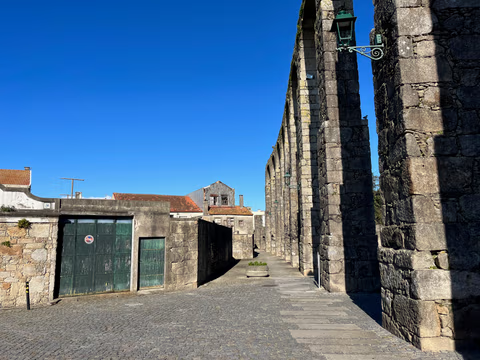
Aqueduct Trail – A path running along the Vila do Conde Aqueduct
From the Coastal Trail to the Camino Central: 12.9 km along the aqueduct from Vila do Conde to São Pedro de Rates. Route, stage, hostels, costs—explained honestly.
Read
Augsburg Way of St. James
The Augsburg Way of St. James runs 231.7 km in 11 stages from Oettingen in the Ries via Donauwörth, Augsburg, Bad Wörishofen and Ottobeuren to Ermengerst in the Allgäu — the Fuggerei, the Jakobervorstadt, a pilgrim of 1446 and Mozart's organ duel. Stages, hostels, costs.
Read

