

Linzgauer Jakobsweg
The Linzgauer Jakobsweg covers 63.2 kilometers from Meßkirch to Konstanz, passing Wald Abbey, the old free imperial city of Pfullendorf and the rolling hills of the Linzgau before dropping down to Überlingen on Lake Constance. There you board a boat to Wallhausen and walk along the shore via Litzelstetten to Konstanz Minster. Three stages, 718 meters of climbing, and a high point of 725 meters near Aftholderberg beyond Pfullendorf. It is the final section of the Via Beuronensis, and in Konstanz the Via Jacobi takes over.
- 01At a Glance
- 02Overview
- 03Other Names
- 04Who It's Ideal For—and Who It's Not So Ideal For
- 05Route & Landscape
- 06Stages, Terrain, and Difficulty
- 07Through Bethlehem to Jerusalem: A Way of St. James Walked by Holy Land Pilgrims
- 08Highlights Along the Way
- 09How Pilgrims Find Their Way onto This Path
- 10Continue the pilgrimage?
- 11Preparation & Practical Information
- 12What the journey will cost you
- 13Getting Here
At a Glance
- Start / Finish: Meßkirch in the Linzgau / Konstanz Minster on Lake Constance
- Length: 63.2 km, including the boat crossing from Überlingen to Wallhausen
- Duration: 3 stages, as defined by the operator, averaging about 21 km
- Elevation: ↗ 718 m / ↘ 920 m
- Highest point: 725 m at km 22.9 between Aftholderberg and Großstadelhofen
- Landscape: Forest and wet meadows between Meßkirch and Pfullendorf, the moraine hills of the Linzgau, and finally Lake Überlingen and the Bodanrück peninsula
- Waymarking: yellow scallop shell or ray bundle on a blue background, with the focal point showing the direction of travel, waymarked toward Konstanz only
- Traces of St. James: St. Jakob parish church in Pfullendorf, St. Jodok in Überlingen, once the church of the Confraternity of St. James, with frescoes of the St. James legend, and the Holy Sepulcher in the St. Maurice Rotunda in Konstanz
- Accommodation: Inns, guesthouses and hotels; there are no pilgrim hostels with dormitories
- Connecting routes: Beuroner Jakobsweg in Meßkirch, Hegauer Jakobsweg from Wald, Ulm – Pfullendorf in Pfullendorf, Via Jacobi from Konstanz
- Best time: April to early October, while the boat is running
- Pilgrim passport / Certificate: Pilgrim passport from the Jakobspilger-Gemeinschaft in Beuron; the free pilgrim certificate is issued for 100 km or more on the Via Beuronensis, so only in combination with a feeder route (as of October 2026)
Overview
The Linzgauer Jakobsweg is a route to Santiago that passes through Bethlehem and ends in Jerusalem. Bethlehem is a hamlet in the woods at kilometer 13.1, and Jerusalem stands inside Konstanz Minster: after 940, Bishop Konrad had a half-scale (1:2) copy of the Church of the Holy Sepulcher built there. In between lie 63.2 kilometers through the Linzgau, the hill country between the Danube and Lake Constance, with an abbey, an old free imperial city, a castle ruin with a hermit, and half an hour on a boat.
As a Way of St. James, it's young. Starting in 2004, Brother Jakobus Kaffanke, a monk from Beuron, had the Via Beuronensis waymarked; in 2009 Santiago recognized the network as a pilgrimage route, and this section is its last. The Wikipedia article calls it the „Normalweg ab Meßkirch bis Konstanz“ (the standard route from Meßkirch to Konstanz), the eastern, shorter variant. Honestly, this is no route for solitude and wilderness: it's cultivated countryside with farm tracks, village streets and plenty of bustle by the lake – but in 63 kilometers it packs in more history than the map would ever lead you to expect.
Other Names
The route is named after its landscape, Linzgauer Jakobsweg, occasionally Linzgauer Jakobusweg. The operator simply calls it Section D of the Via Beuronensis, with stages D1 to D3. In English you'll also see Linzgau Way of St. James.
Who It's Ideal For—and Who It's Not So Ideal For
Ideal if you have a long weekend and want to crown it with a finish on the water. Ideal as a link, too: if you finish the Beuroner Jakobsweg in Meßkirch, you simply carry on here the next morning, and if you're heading from Konstanz into Switzerland, these three days get you across.
Honestly, though, it's not for you if you're looking for hostels and pilgrim community like in Spain: you'll sleep in inns and often walk alone. Not for you if you want to walk in winter – the boat from Überlingen only runs in season, and there is no winter timetable for 2026/27. And not for you on a bike: according to the operator, parts of the second stage are „nur zu Fuss zu gehen“ (to be walked on foot only).
Route & Landscape
Meßkirch to Pfullendorf (km 0–18.8): From Meßkirch you walk via Schnerkingen (km 1.4), where a pilgrim stamp awaits at the chapel, through forest and wet meadows to Wald (km 9.2) and its former Cistercian convent. This is where the Hegauer Jakobsweg branches off to the west. The Linzgauer stays to the east, passes through the forest hamlet of Bethlehem (km 13.1) and reaches Pfullendorf (km 18.8) with its church of St. Jakob.
Pfullendorf to Konstanz (km 18.8–63.2): Beyond Pfullendorf the path climbs to Aftholderberg (km 22.2) and shortly afterward to its highest point, 725 meters at km 22.9, before rejoining the town variant at St. Martin's Chapel near Großstadelhofen (km 24.0). Via Kirnbach and Großschönach (km 29.0) with the Ramsberg you continue to Taisersdorf (km 31.0); Herdwangen-Schönach lies just under a kilometer off the route. Past Hohenbodman (km 34.7) the land falls away to Owingen (km 37.7) and down to Überlingen (km 43.6) on the lake. The boat takes you to Wallhausen (km 46.8) on the Bodanrück; from there you walk via Litzelstetten (km 53.6), with views of Mainau Island, down the Lorettosteig to the shore and over the Rhine bridge to the Minster in Konstanz (km 63.2).
Stages, Terrain, and Difficulty
We show the route in 3 stages, as the Jakobspilger-Gemeinschaft does; distances come from the Camino Ninja map, calibrated exactly to 63.2 km.
- Meßkirch → Pfullendorf (18.8 km) — forest, meadows and wetlands, via Wald Abbey and Bethlehem into the free imperial city.
- Pfullendorf → Überlingen (24.8 km) — the long stage: over Aftholderberg to the highest point, past the Ramsberg, via Hohenbodman and Owingen down to the lake; no shops until Owingen.
- Überlingen → Konstanz (19.6 km) — about three kilometers of it on the boat to Wallhausen, then across the Bodanrück via Litzelstetten to the Minster.
Nothing here is technically difficult: forest, field and meadow paths, plus village roads; on meadows the path isn't always visible, so watch for the waymarks there. There's more downhill than uphill, because you arrive at the lake about 200 meters lower than the Linzgau. Waymarking runs toward Konstanz only – if you walk it in reverse, you'll need the map in the app.
Through Bethlehem to Jerusalem: A Way of St. James Walked by Holy Land Pilgrims
The earliest pilgrims on this route weren't headed for Santiago but for Jerusalem. Rudolf von Pfullendorf, born around 1100 as Count of Ramsberg, moved his seat to Pfullendorf in 1155, set out for the Holy Land in 1180 and died there on January 9, 1181. His daughter Ida became the great-grandmother of Rudolf of Habsburg. And Bishop Konrad of Konstanz, after his second journey to Jerusalem, built the St. Maurice Rotunda, where the stone Holy Sepulcher was created around 1260 – for, as Wikipedia puts it, „Gläubige aus der Umgebung, die sich die weite Reise ins Heilige Land nicht leisten konnten“ (local believers who could not afford the long journey to the Holy Land). They walked around the tomb three times and received an indulgence for it; after Konrad was canonized in 1123, even more came.
St. James enters the picture in Überlingen. The wealthy burgher Burkhart Hipp endowed the church of St. Jodok in 1424; in 1462 it was consecrated as the church of the Confraternity of St. James, which ran a pilgrim hostel in the 15th century. On the north wall, twelve frescoes from the late 15th century tell the legend of St. James, including the miracle of the gallows and the miracle of the chickens – the very story for which chickens still live in the cathedral of Santo Domingo de la Calzada today. In the 18th century the paintings were whitewashed; around 1903 the restorer Victor Mezger uncovered them again.
In practice, this means: in Überlingen, set aside an hour for St. Jodok and the Minster before heading to the boat landing, and in Konstanz allow time for the rotunda behind the Minster choir. Anyone who has walked from Bethlehem to Jerusalem is more than welcome to circle the tomb three times before carrying on toward Santiago.
Highlights Along the Way
- Kloster Wald (km 9.2) — founded in 1212 by Burkard von Weckenstein for 55 marks of silver, for his sisters Judintha and Ita; an abbey in its own right from 1217, Baroque buildings under Abbess Antonia von Falkenstein 1721–1727, passed to Hohenzollern-Sigmaringen in 1806; since 1946 a boarding school with a girls' residence, high school and workshops.
- Pfullendorf (km 18.8) — town charter granted on June 2, 1220 by Frederick II, free imperial city from 1282 to 1803; St. Jakob, completed in 1480/81 by Hans von Savoyen and remodeled in Baroque style in 1750, the pilgrimage church of Maria Schray, and the Obere Tor gate with its tower from 1505.
- Ramsberg (km 29.0) — castle of the Counts of Ramsberg and Pfullendorf from the 11th century, half of it sold in 1409 to the Heilig-Geist-Spital hospital in Überlingen; St. Wendelin's Chapel with frescoes from 1467, and since 1993 the Klause St. Benedikt hermitage, where Brother Jakobus Kaffanke lives as a hermit.
- Hohenbodman (km 34.7) — keep of the castle of the Lords of Bodman, burned down in 1642 by Konrad Widerholt's troops, today a lookout tower with views across the Linzgau; St. George's Chapel and an ancient linden tree.
- Überlingen (km 43.6) — free imperial city until 1803, St. Nicholas Minster, built from 1350 to 1576, with the high altar by Jörg Zürn from 1613 to 1616; the Swedish Procession commemorates the siege of 1634.
- Wallhausen (km 46.8) — first mentioned in 1187 as Villa Walarhusin, when Barbarossa issued a charter here; until the 1950s the harbor was a transshipment point for timber and granite, and today the boat from Überlingen docks here.
- Konstanz Minster (km 63.2) — the finish, with the St. Maurice Rotunda and the Holy Sepulcher; the Via Jacobi begins at the Minster.
How Pilgrims Find Their Way onto This Path
Almost everyone comes from the north via the Via Beuronensis. The Beuroner Jakobsweg from Tübingen via Beuron Archabbey ends in Meßkirch, and the Linzgauer is its direct continuation. In Pfullendorf the Ulm – Pfullendorf route joins, which the operator calls the Habsthaler Jakobsweg; Wikipedia explicitly recommends continuing „in Pfullendorf vorzugsweise weiter auf dem Linzgauer Jakobsweg zum Bodensee“ (from Pfullendorf preferably on the Linzgauer Jakobsweg to Lake Constance).
The alternative begins as early as Wald: there the Hegauer Jakobsweg splits off and runs west via Stockach, Bodman and Allensbach to Konstanz – longer at 71.5 kilometers, and without a boat. The two routes meet again at the Minster.
Continue the pilgrimage?
Yes – and Konstanz is made for it. The Via Jacobi begins at the Minster, as the Schwabenweg via Kreuzlingen through Thurgau to Einsiedeln and on to Geneva; Fischingen Abbey along the way was founded back in 1138 as a lodging for pilgrims traveling from Konstanz to Einsiedeln. If you'd rather stay by the water, take the Lindau – Héricourt route down the High Rhine toward Basel and the Burgundian Gate. The Oberschwäbischer Jakobsweg from Ulm also ends in Konstanz – so four German feeder routes meet here.
Preparation & Practical Information
Pilgrim passport and app. As on all German Ways of St. James, you need a pilgrim passport (credencial) to stay in pilgrim lodgings and to receive the Compostela in Santiago at the end. It's best to order it in advance so it reaches you in time for the start of your journey: the Beuroner Jakobspilger-Gemeinschaft sends it out via an order form on via-beuronensis.de. The community's pilgrim certificate is only awarded for 100 kilometers or more on the Via Beuronensis – at 63.2 kilometers you won't get there on this route alone, but together with the Beuroner Jakobsweg you easily will. The easiest way to plan the route is in the Camino Ninja App, where you can put together your stages and plan suitable accommodation along the way.
The boat. Personenschifffahrt Giess & Giess runs the MS Seegold from Überlingen, Pier 4, to Wallhausen in about 30 minutes, in 2026 from April 2 to October 4, nine times a day. The operator notes: „Ab 2025 gibt es im Winter keine Überquerung mehr, wurde leider eingestellt!“ (Since 2025 there is no crossing in winter anymore – sadly discontinued!) Fog and storms can cancel a sailing. Out of season, take the bus to Meersburg, catch the ferry to Konstanz-Staad and walk the last 6 kilometers or so along the shore.
Accommodation and season. There is no hostel network; Pfullendorf and Überlingen have tourist information offices that can help with rooms. In July and August Überlingen and Konstanz are packed, so book early there. On the second stage, carry provisions – there's nothing to buy until Owingen.
What the journey will cost you
The boat from Überlingen to Wallhausen costs 6 € one way, 10 € with a bike, and dogs ride free; tickets are sold only on board and at the BSB counter in Überlingen, and the Deutschland-Ticket is not valid. The Meersburg–Konstanz ferry costs 4.30 € for foot passengers (as of October 2026). At inns and guesthouses, budget roughly 55 to 90 € per night with breakfast, more in Überlingen and Konstanz during the season.
With accommodation, a packed lunch and dinner, you'll spend around 80 to 120 € per day. Honestly, that's more than a day in Spain – but after three days you're back home by train.
Getting Here
To the start. Meßkirch hasn't had passenger trains since 1954; take the train to Sigmaringen or Stockach and continue by bus from there. If you're coming off the Beuroner Jakobsweg, you're already there.
From the finish. Konstanz has rail connections via Singen to Stuttgart and on the Black Forest Railway to Offenburg, and via Kreuzlingen into Switzerland; Zurich Airport is easy to reach. Überlingen is on the railway along the north shore and makes a good place to stop after the second stage.
- Rail: bahn.de — connections to Sigmaringen, Stockach, Überlingen and from Konstanz
- Boat: personenschifffahrt-bodensee.de — timetable and fares Überlingen–Wallhausen
- Info: via-beuronensis.de — stages D1 to D3, pilgrim passport and certificate
Partners
Partner for Linzgauer Jakobsweg
Camino Ninja is cooperating with official partners. For this camino the partner is:


Get your pilgrim credential and shell
Everything you need for the Linzgauer Jakobsweg, shipped to your door.
Visit Camino Shop
Other Caminos
 Appenzeller Weg
Appenzeller Weg
52.6 km from Rankweil across the Rhine to St. Peterzell: St. James Chapel (1464), 163 Years of the Wedding Trail, connection to the Via Jacobi. Stages, costs, how to get there.
Read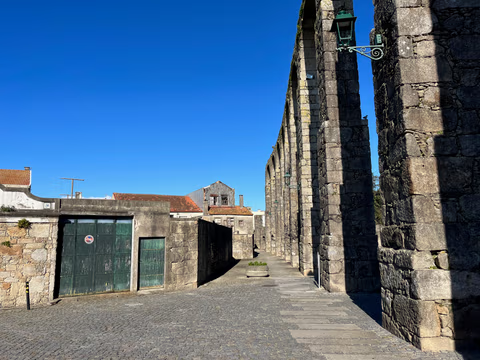
Aqueduct Trail – A path running along the Vila do Conde Aqueduct
From the Coastal Trail to the Camino Central: 12.9 km along the aqueduct from Vila do Conde to São Pedro de Rates. Route, stage, hostels, costs—explained honestly.
Read
Augsburg Way of St. James
The Augsburg Way of St. James runs 231.7 km in 11 stages from Oettingen in the Ries via Donauwörth, Augsburg, Bad Wörishofen and Ottobeuren to Ermengerst in the Allgäu — the Fuggerei, the Jakobervorstadt, a pilgrim of 1446 and Mozart's organ duel. Stages, hostels, costs.
Read

