

Camino de la Ría de Muros-Noia
The Camino de la Ría de Muros-Noia runs 80.2 kilometers from the fishing port of Muros on the north shore of the ría via O Cruceiro de Roo, the medieval Ponte Nafonso and the old town of Noia inland, then past the monastery of San Xusto de Toxosoutos and through Bertamiráns to Santiago de Compostela. It follows the route that sea pilgrims from England, Flanders and Scandinavia took from their ships to the Apostle's tomb from the 12th century on, among them the Venetian Pietro Querini in 1431. Since December 15, 2020, the Santiago cathedral chapter has recognized it as a Way of St. James; for the Compostela you also walk the short south branch from Porto do Son to Noia.
- 01At a Glance
- 02Overview
- 03Other Names
- 04Who It's Ideal For—and Who It's Not So Ideal For
- 05Route & Landscape
- 06Stages, Terrain, and Difficulty
- 07Pietro Querini: This Route's Most Famous Pilgrim Didn't Come on Foot
- 08Highlights Along the Way
- 09How Pilgrims Find Their Way onto This Path
- 10Preparation & Practical Information
- 11What the journey will cost you
- 12Getting Here
At a Glance
- Start / Finish: Muros (km 0.7 on the Camino Ninja map) / Cathedral of Santiago de Compostela
- Length: 80.2 km; plus the south branch Porto do Son → Noia for the Compostela
- Duration: 4 stages, averaging about 20 km; 5 walking days with the south branch
- Elevation: ↗ 1,622 m / ↘ 1,389 m
- Highest point: 442 m at km 56.6 near O Codeso, between San Xusto and A Calle (Urdilde)
- Landscape: hillside path above the ría with views of Monte Louro, hamlets with hórreos, the Tambre estuary, oak and eucalyptus forest inland, and finally the valley of A Maía
- Operator / Waymarking: Asociación de Concellos do Camiño de Santiago da Ría de Muros Noia (nine municipalities); yellow arrows on blue rectangles, and since late 2024 wooden posts with a shell and distance
- Traces of St. James: Muros and Noia as medieval pilgrim ports, the chapel of the Virxe do Camiño in Muros, the Apostle as a pilgrim on the portal of San Martiño in Noia
- Accommodation: guesthouses, hostales and country houses; the only pilgrim albergue is Portus Apostoli in Noia
- Connecting routes: Porto do Son → Noia (south branch, required for the Compostela); in Santiago, the end of the Camino Francés and the Camino Portugués Central
- Best time / Certificate: May to October; Compostela only with both branches of the ría
Overview
This route begins where the ships used to drop anchor. In the Middle Ages the Ría de Muros e Noia was one of Compostela's harbors: in 1147 the English fleet of the Second Crusade anchored here, in 1189 a German fleet of the Third, and the men walked to the Apostle's tomb before sailing on to Lisbon. At first everything went through Noia; then, when its harbor silted up in the 15th century, through Muros. The sea pilgrims didn't come over the mountains, they came across the Atlantic, and the walk to Santiago was their last stage, not their first.
Almost 800 years later it became a pilgrimage route with a certificate again. "El 15 de diciembre de 2020 el Cabildo catedralicio declaró el Camino de Muros-Noia como Ruta Jacobea y el derecho a la obtención de la compostela," writes the association of municipalities: the cathedral chapter declared the route a Way of St. James, with the right to the Compostela. Since then you walk two days by the water and two days through forests and hamlets, mostly on your own: in 2024 the Pilgrim's Office issued 365 Compostelas for this route. That's how many arrive on the Camino Francés in a single morning.
Other Names
In Galician the route is called Camiño de Santiago da Ría de Muros Noia, in Spanish Camino de la Ría de Muros-Noia or Camino de Muros-Noia; the municipalities also market it as the Camino Marítimo de Santiago. In Galicia the main branch from Muros is known as the Ramal muradán, the south branch as the Ramal sonense. For a while the name Camino Inglés del Sur was floated, after the English sea pilgrims, but it never caught on. As part of the Via Querinissima, the cultural route following in the footsteps of Pietro Querini, the route also shows up in Italian and Norwegian brochures.
Who It's Ideal For—and Who It's Not So Ideal For
Ideal if you want to walk a complete Way of St. James with a Compostela in one week and find the crowds on the last 100 kilometers of the Camino Francés too much. Ideal if you love harbors, granite villages and history: Muros and Noia have some of the best-preserved old towns on the Galician coast. And ideal if you want to walk without herd pressure. On some days you won't meet another pilgrim here.
Honestly, though, it's not for you if you're looking for albergue life: apart from Portus Apostoli in Noia there is no pilgrim albergue, so you sleep in guesthouses and country houses and pay accordingly. Not for you if asphalt wears you down: a good half of the route is paved, and on the third stage there's also a stretch along the AC-543 highway. And not for you if you hate logistics: for the Compostela you also have to walk the south branch from Porto do Son and get there by bus or taxi.
Route & Landscape
Muros to Noia (km 0–41.2): You leave Muros heading east past the chapel of the Virxe do Camiño and walk the old royal road along the hillside above the ría, sometimes on cobbles, sometimes through pine and eucalyptus forest, through hamlets like Bornalle (km 9.5), Tal (km 11.8) and Solleiros (km 13.5). Behind you the cone of Monte Louro stays in view; ahead, the ría opens up. The headland of Punta Uía and Broña beach lie a little below, not on the route. At O Cruceiro de Roo (km 22.9), a roadside village in the municipality of Outes, the first day ends. After that you walk through forest to A Serra de Outes (km 26.5) and down into the delta of the Tambre, which you cross on the Ponte Nafonso (km 35.2). Via Orro and Vista Fermosa you reach Noia (km 41.2); just before town, the south branch from Porto do Son joins the route.
Noia to Santiago (km 41.2–80.2): After Noia the sea is behind you. The route climbs via Ponte (km 43.8) and San Paio (km 48.2) to the monastery of San Xusto de Toxosoutos (km 50.7) by the San Xusto waterfall, then via Cedofeito and Fontefría to the highest point at O Codeso (442 m, km 56.6). Via Agrafoxo you come to A Calle near Urdilde (km 60.4). On the last day you walk via Pedre and Gundín into the valley of A Maía, to Bertamiráns (km 69.0), the largest town in the municipality of Ames, and via Fraíz (km 74.5) and Vidán (km 76.9) toward the cathedral. For the last five-plus kilometers from Fraíz, the route shares its line on the Camino Ninja map with the Senda Litoral.
Stages, Terrain, and Difficulty
We show the route in 4 stages. The distances come from the Camino Ninja map, calibrated exactly to 80.2 km; Gronze and the municipalities give between 22.4 and 24.4 kilometers for the first stage, depending on where in Muros you start.
- Muros → O Cruceiro de Roo (22.9 km) — hillside path above the ría with sea views, lots of short ups and downs, hamlets with hórreos and parish churches.
- O Cruceiro de Roo → Noia (18.3 km) — forest tracks to A Serra de Outes, the Ponte Nafonso over the Tambre delta, arrival in the Gothic old town.
- Noia → A Calle (Urdilde) (19.2 km) — the long, steady climb into the hinterland, the monastery and waterfall of Toxosoutos, highest point at O Codeso (442 m).
- A Calle (Urdilde) → Santiago de Compostela (19.8 km) — gently downhill through A Maía and Bertamiráns, a quiet entry via Vidán.
On top of that comes a day for the south branch Porto do Son → Noia, which most people slot in between the second and third stages: bus to Porto do Son, walk back to Noia. Nothing is technically difficult; after rain, cobbles and forest paths get slippery. Gronze rates the third stage the hardest at 3 out of 5 points, the others at 2.
Pietro Querini: This Route's Most Famous Pilgrim Didn't Come on Foot
On April 25, 1431, the carrack Gemma Querina sailed from Candia on Crete with 68 men aboard and 800 barrels of Malvasia wine in the hold, bound for Flanders. Her master was the Venetian merchant Pietro Querini. On the voyage north the ship had to be repaired in the ría, and Querini used the break to make the pilgrimage to Compostela, though according to Gronze he went on horseback. So the man after whom this route's European cultural route is named today actually rode it.
Then the real story began. On September 14 the Gemma Querina passed Cape Finisterre; soon after, the rudder broke in a storm, and the Atlantic drove the wreck north for weeks. On December 17 the men took to the lifeboats, and on January 14, 1432, the last survivors washed up on Sandøy near Røst in the Lofoten Islands. The fishermen there rescued them and showed them the stockfish that Querini took home with him; on October 12, 1432, he was back in Venice. In the Veneto they still cook baccalà alla vicentina from it today. A pilgrimage route that starts in Muros and ends in a fish recipe in Vicenza: you'll find that only here.
Querini's account is one of the oldest records of pilgrims in this ría, but not the only one. In 1524 King Charles I had to step in personally; Gronze quotes: "el mismísimo rey Carlos I intercede ante el gobernador de Galicia para que libere a 50 peregrinos franceses." Fifty French pilgrims were sitting in jail in Muros, and it took the king himself to get them out. Arrive in Muros today and you get a friendlier welcome: the wooden posts along the route carry the emblem of the Via Querinissima alongside the shell and the distance.
Highlights Along the Way
- Muros (km 0.7) — founded in 1286 by King Sancho IV, granted to the church of Compostela by Ferdinand IV in 1298, a protected historic ensemble since May 1970; arcades by the harbor, the Gothic Colegiata de San Pedro, the tide mill at Pozo do Cachón and the chapel of the Virxe do Camiño, next to which a leper hospice took in pilgrims from 1421.
- Hillside path above the ría (km 3–22) — the old royal road with views of Monte Louro and the beaches; the most beautiful seaside stretch of the whole route.
- Ponte Nafonso (km 35.2) — a long bridge across the Tambre estuary, according to the Xacopedia first built under Alfonso II (791–842) and named after Alfonso IX (1188–1230), who had it rebuilt; all around, salt marshes in a Natura 2000 protected area.
- Noia (km 41.2) — the "portus apostoli" that Ferdinand II had restored in 1168; Santa María a Nova with its cemetery of guild gravestones, and San Martiño with the Apostle James as a pilgrim on the portal.
- San Xusto de Toxosoutos (km 50.7) — a 12th-century monastery church in the forest by the river, with a waterfall of about 20 meters next to it; a country house in the old mill grounds offers rooms.
- O Codeso (km 56.6) — 442 meters, the highest point, with a view back to the ría.
- A Maía and Bertamiráns (km 65–70) — the valley of the Sar, which Gronze calls "por siempre unida a la figura humana y literaria de Rosalía de Castro" (forever bound to Rosalía de Castro, the woman and the writer); the poet, born in Santiago in 1837, grew up in nearby Ortoño.
- Entry via Vidán (km 76.9) — quiet outskirts instead of an industrial zone; the cathedral towers appear only late.
How Pilgrims Find Their Way onto This Path
Most people take the bus from Santiago to Muros, since the ría is just a bus ride west of the city. Many tack the route onto another one: if you've arrived in Santiago on the Camino Francés, the Camino Portugués Central, the Camino Primitivo or the Camino Inglés, you ride out to the sea and walk in a second time, this time on the sea pilgrims' route. Muros is also close after the Camiño a Fisterra or the Camiño a Muxía; from the Costa da Morte you can reach the ría by bus.
The second way in is the south branch Porto do Son → Noia on the opposite shore. It ends in Noia on this route and is mandatory for the Compostela; which branch you walk first is up to you.
Preparation & Practical Information
Pilgrim passport and app. As on all Spanish routes, you need a pilgrim passport (credencial) to stay in albergues and to receive the Compostela at the end. It's best to order it online in advance so it reaches you in time for the start of your trip. Collect two stamps a day, on the south branch too; without it you won't reach the 100 kilometers. The waymarking is new and not dense everywhere in the hamlets; the easiest way to plan the route is right in the Camino Ninja App, where you put together your stages, plan suitable accommodation along the way and carry the track offline.
Accommodation and season. The only pilgrim albergue is Portus Apostoli in Noia, opened in 2026 in a former tannery, with four-bed rooms. Otherwise you sleep in guesthouses and hostales in Muros, O Cruceiro de Roo and Noia, in a country house near San Xusto or around A Calle; in Urdilde options are scarce, so book ahead. May to October is the best time; from October to April it rains about every other day, and in August the rooms by the sea are full.
What the journey will cost you
In Muros, guesthouses start at 49 €, more upscale ones at 88 €, and the surf hostel in Louro has dorm beds from 28 €. In O Cruceiro de Roo hostales run 40 to 56 €, in Noia 44 to 80 €, the country house near San Xusto 45 to 60 €, near Urdilde from 80 €; in Santiago you pay 20 to 25 € in private albergues (as of October 2026). For the price at Portus Apostoli, it's best to ask directly.
Budget 55 to 85 € a day with a room, breakfast at a bar and the menú del día; two people sharing a double room pay less each. Honestly, this route costs more than the big Caminos because there are no albergues, but in return you get berberechos (cockles) from the ría for dinner instead of yesterday's pilgrim menu.
Getting Here
To the start. Santiago de Compostela has an airport with direct flights from Germany, Austria and Switzerland and a train station with Renfe connections to Madrid, A Coruña and Vigo. From the bus station, Monbus runs several times a day via Noia to Muros; the same buses take you from Noia to Porto do Son for the south branch.
From the finish. The route ends at the cathedral. From Santiago you can continue by plane, train or long-distance bus.
- Bus: monbus.es — lines Santiago – Noia – Muros and Noia – Porto do Son
- Route: caminoriamurosnoia.gal — association of municipalities with track, official guide and service providers
- Train: renfe.com — trains to Santiago de Compostela

Get your pilgrim credential and shell
Everything you need for the Camino de la Ría de Muros-Noia, shipped to your door.
Visit Camino Shop
Other Caminos
 Appenzeller Weg
Appenzeller Weg
52.6 km from Rankweil across the Rhine to St. Peterzell: St. James Chapel (1464), 163 Years of the Wedding Trail, connection to the Via Jacobi. Stages, costs, how to get there.
Read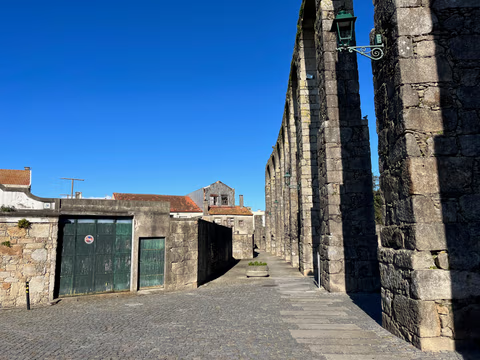
Aqueduct Trail – A path running along the Vila do Conde Aqueduct
From the Coastal Trail to the Camino Central: 12.9 km along the aqueduct from Vila do Conde to São Pedro de Rates. Route, stage, hostels, costs—explained honestly.
Read
Augsburg Way of St. James
The Augsburg Way of St. James runs 231.7 km in 11 stages from Oettingen in the Ries via Donauwörth, Augsburg, Bad Wörishofen and Ottobeuren to Ermengerst in the Allgäu — the Fuggerei, the Jakobervorstadt, a pilgrim of 1446 and Mozart's organ duel. Stages, hostels, costs.
Read

