

Camiño a Muxía
The Camiño a Muxía runs 87.8 kilometres from the cathedral of Santiago de Compostela to the Costa da Morte, ending at the Santuario da Virxe da Barca on the rocks of Muxía. For the first 60 kilometres or so, as far as Hospital, it shares its route with the Camiño a Fisterra, then turns north: via Dumbría, the 27-metre hórreo of San Martiño de Ozón and the Romanesque monastery church of Moraime to the sea. Four stages, 2,239 metres of ascent, highest point 477 metres at Monte Aro, and at the end the legend of the Virgin's stone boat and the Muxiana as your certificate.
- 01At a Glance
- 02Overview
- 03Other Names
- 04Who It's Ideal For—and Who It's Not So Ideal For
- 05Route & Landscape
- 06Stages, Terrain, and Difficulty
- 07The Boat of Stone: Why This Route Ends at the Sea
- 08Fisterra or Muxía? Two Ends, One Coastal Path
- 09Highlights Along the Way
- 10How Pilgrims Find Their Way onto This Path
- 11Continue the pilgrimage?
- 12Preparation & Practical Information
- 13What the journey will cost you
- 14Getting Here
At a Glance
- Start / Finish: Cathedral of Santiago de Compostela / Santuario da Virxe da Barca in Muxía (km 87.6); the Camino Ninja map ends at the sanctuary on the headland
- Length: 87.8 km; the first 60 km or so as far as Hospital on the same route as the Camiño a Fisterra
- Duration: 4 stages, avg. around 22 km; classically also 3 stages via Negreira and Olveiroa
- Elevation: ↗ 2,239 m / ↘ 2,479 m
- Highest point: 477 m at km 47.1 between A Gueima and Lago, in the Monte Aro area
- Landscape: Eucalyptus and oak woods along the Tambre, the Xallas uplands with views of the Fervenza reservoir, villages with hórreos, and finally wind, granite and the Atlantic
- Operator / Waymarking: Xunta de Galicia; yellow arrows and granite markers with the scallop shell, from Hospital a separate branch to Muxía
- Credencial / Certificate: Credencial with stamps; at the finish the Muxiana from the municipality of Muxía, free of charge at the tourist office (as of September 2026)
- Traces of St. James: Legend of the stone boat in which Mary appeared to the apostle at Muxía; the monastery of Moraime as a pilgrim hospice since the 12th century; a hamlet called Hospital at the fork in the way
- Accommodation: Xunta albergues in Negreira, Olveiroa and Muxía (10 €), municipal hostels in Vilaserío and Dumbría, plus private albergues and pensiones
- Connecting routes: Camiño a Fisterra-Muxía (28.7 km coastal path between the two ends), Camiño a Fisterra from Hospital
- Best time: April to June and September to October; in winter the Xunta hostels stay open, but expect rain and storms on the coast
Overview
The Camiño a Muxía is the quieter of the two routes linking Santiago with the Atlantic. Those who arrive in Compostela and don't want to stop yet carry on west – most to Fisterra, a good third to Muxía. In 2024 the municipality of Muxía issued 17,201 Muxianas, Fisterra 27,304 Fisterranas. As far as the hamlet of Hospital at kilometre 60.1 the two routes run together; there stands the granite marker with two arrows, left to Fisterra, right to Muxía. From there the Muxía branch is shorter, emptier, and ends not at a lighthouse but at a church on the rocks above the sea.
The route is old. In the Middle Ages pilgrims went on from Santiago to the coast, the Bohemian nobleman Leo of Rožmitál in 1465 just like the Hungarian knight György Grisaphan in 1355. According to a charter of King Alfonso VII from 1119, the monastery of Moraime shortly before Muxía expressly took in "poor monks and arriving pilgrims". Then the route fell asleep; only in the 1990s did the Galician Camino association AGACS re-mark it, and from 2001 the Xunta developed it with its own hostels. To be honest, for all its legends it remains a route along country roads and forest tracks – the great moments come at Ponte Maceira, Ozón, Moraime and right at the end.
Other Names
In Galician the route is called Camiño a Muxía, in Spanish Camino a Muxía; the Xunta lists it as a branch of the Camiño de Fisterra e Muxía (in Spanish Camino de Fisterra y Muxía), and in English you will read Way to Muxía or Muxía Way. Older guidebooks speak of the Epílogo, the epilogue, because it only begins after Santiago. The certificate at the finish is the Muxiana, the counterpart to the Fisterrana of Fisterra.
Who It's Ideal For—and Who It's Not So Ideal For
Ideal if you still have three or four days left after the Compostela and want to end your Camino not in the cathedral but at the sea. Ideal if Fisterra is too crowded for you: on the Muxía branch from Hospital you often walk alone, and Muxía has stayed a fishing village.
To be honest, though, it's not for you if you expect a hiking trail: a good half of it runs on tarmac and minor roads, and the stage across the Xallas uplands is long, without shade and without a bar for many kilometres. Not for you if you depend on hostel beds with a reservation – the Xunta albergues don't take bookings. And not for you if you're looking for beach weather in Muxía: the Costa da Morte, the Coast of Death, gets its name because here the Atlantic pounds against the rocks, even in summer.
Route & Landscape
Santiago to Negreira (km 0–21.0): From the Praza do Obradoiro you head out through the Carballeira de San Lourenzo, via Roxos (km 6.4) and the Alto do Vento (km 8.9) down into the Tambre valley. At Ponte Maceira (km 17.1) you cross the river on a bridge from the 13th and 14th centuries, between mills and the Pazo de Baladrón. Via the chapel of Barca you reach Negreira (km 21.0) with the Pazo do Cotón.
Negreira to Muxía (km 21.0–87.8): Beyond Negreira the route climbs through pine and oak woods to Vilaserío (km 33.9) and As Maroñas (km 40.9), then over the ridge by Monte Aro – 477 metres at km 47.1 – with views of the Fervenza reservoir down to Olveiroa (km 55.0). At Hospital (km 60.1) the route parts from the Camiño a Fisterra and turns north: Dumbría (km 65.9), Senande (km 71.2), Quintáns (km 76.4) and San Martiño de Ozón (km 77.8) with its 27-metre hórreo. Via Os Muíños (km 82.0) and the Romanesque church of Moraime (km 83.1) you reach the beach of Lourido and Muxía (km 86.7); the last kilometre leads through the village and out onto the headland to the Santuario da Virxe da Barca (km 87.6).
Stages, Terrain, and Difficulty
We show the route in 4 stages with even days of 21 to 24 kilometres. The classic division is into 3 days – Negreira, Olveiroa, Muxía – with a final day of around 33 kilometres; if you choose it, you sleep in Olveiroa (km 55.0) instead of Santa Mariña and Dumbría. The elevation figures come from our map points.
- Santiago de Compostela → Negreira (21.0 km) — ↗ 585 m / ↘ 690 m. Out of the city, over the Alto do Vento into the Tambre valley and across the bridge of Ponte Maceira to Negreira.
- Negreira → Santa Mariña (21.0 km) — ↗ 620 m / ↘ 405 m. Wooded and quiet, via Vilaserío with its municipal hostel and As Maroñas; in Santa Mariña there are only a few beds.
- Santa Mariña → Dumbría (23.9 km) — ↗ 500 m / ↘ 655 m. Over the high ground by Monte Aro (477 m) to Olveiroa, at Hospital the parting from the Camiño a Fisterra, then down to Dumbría.
- Dumbría → Muxía (21.9 km) — ↗ 535 m / ↘ 725 m. Via Senande, Quintáns and the hórreo of Ozón to Moraime and on to the coast; the finish is the Santuario da Virxe da Barca.
The surface is half tarmac, otherwise forest and farm tracks, none of it technically difficult. What is tiring is the length of the days and the weather: on the uplands between As Maroñas and Olveiroa there is hardly any shade and nowhere to stop for many kilometres, and on the coast the wind blows. The Xunta rates the stage Olveiroa–Muxía as hard, 32.7 kilometres and a good eight hours.
The Boat of Stone: Why This Route Ends at the Sea
The legend says that the apostle James preached on this coast and lost heart. Then Mary appeared to him in a boat made of stone to encourage him – and the boat still lies on the shore below the Santuario da Virxe da Barca: the Pedra de Abalar as the hull, the Pedra dos Cadrís as the sail, the Pedra do Timón as the rudder. Pilgrim accounts from the 15th and 16th centuries already know the ritual: the Pedra de Abalar, a granite slab of around 8.70 by 7 metres, rocked – except under a murderer or someone excommunicated. Under the Pedra dos Cadrís pilgrims crawl through nine times, against back and kidney pain. A storm broke the Pedra de Abalar in 2014, and for eleven years it lay still; since September 2025 it moves again.
The church above was built from 1716 at the expense of the Count of Frigiliana; the towers were only added in 1958. On Christmas Day 2013 lightning struck and the sanctuary burned out almost completely; the Baroque altarpiece by Miguel de Romay was lost, the late-Gothic statue of Mary from the 14th century was saved. On 31 May 2015 the church was reopened after emergency repairs costing 760,000 euros, and a second restoration phase by the Xunta for around 416,000 euros was in preparation in 2026. To be honest, that means you may find scaffolding when you arrive.
In practice this means: walk the last 900 metres from the village to the sanctuary on the evening you arrive and once more the next morning; the stones lie freely accessible below the church. The Romaría da Barca takes place in mid-September, according to Xacopedia between 9 and 15 September with the Saturday as the main feast day – then Muxía is full and so are the hostels.
Fisterra or Muxía? Two Ends, One Coastal Path
The question comes up at Hospital at the latest. Fisterra has the lighthouse, the 0.000 kilometre marker and the sunset, plus 300 pilgrims a day in high season; Muxía has the stone boat, the church by the sea and around 130 pilgrims a day – that is what the Xunta's sensors counted in August and September 2025. If you want both, you don't have to choose: between Fisterra and Muxía the Camiño a Fisterra-Muxía runs 28.7 kilometres along the coast via Lires, waymarked in both directions.
Muxía has a second story that has nothing to do with the Camino and yet touches every pilgrim: on 13 November 2002 the tanker Prestige broke apart off the Costa da Morte, and on 19 November it sank; around 60,000 tonnes of heavy fuel oil polluted the coast, and Muxía was considered kilometre zero of the disaster. On the headland next to the sanctuary, since 12 September 2003, stands A Ferida, "The Wound", an eleven-metre-high split granite block of 400 tonnes by the sculptor Alberto Bañuelos, which the insurer Aegon gave to the municipality in thanks to the thousands of volunteers. And in 2010 Emilio Estevez's film "The Way" ended here: Martin Sheen scatters his son's ashes into the sea, not in Fisterra but in Muxía.
Highlights Along the Way
- Ponte Maceira (km 17.1) — Bridge from the 13th and 14th centuries over the Tambre, toll station of the archbishops of Santiago; according to legend the bridge collapsed here under the Roman soldiers pursuing the disciples of St. James – the coat of arms of Negreira shows the scene. Mills, chapel of San Brais from the 18th century.
- Negreira (km 21.0) — Pazo do Cotón with fortified tower and chapel, Xunta hostel since 2001.
- High ground by Monte Aro (km 47.1) — 477 metres, the highest point of the route, with views of the Fervenza reservoir in the Xallas valley.
- Hospital (km 60.1) — the fork: the granite marker with two arrows, left Fisterra, right Muxía; the name recalls a pilgrim hospice.
- Hórreo of San Martiño de Ozón (km 77.8) — 27.3-metre-long granary on 22 pairs of feet next to the Romanesque church and the 14th-century monastery; one of the three largest on the Costa da Morte.
- San Xulián de Moraime (km 83.1) — Benedictine monastery, documented at the end of the 11th century, raided by Normans in 1105 and by Saracens in 1115, endowed by Alfonso VII in 1119; Romanesque church of the 12th century, portal modelled on the Pórtico da Gloria, wall paintings of the seven deadly sins discovered in 1970.
- Santa María de Muxía (km 86.7) — Gothic parish church, handed to the Cistercians by Pope Innocent III in 1203, with a Rosary chapel from the late 14th century; next to it stood a pilgrim hospital in 1589.
- Santuario da Virxe da Barca (km 87.6) — the finish: church of 1716 on the headland, in front of it the stones of the boat, next to it A Ferida from 2003.
How Pilgrims Find Their Way onto This Path
Almost everyone arrives in Santiago on foot. That is where the Camino Francés, the Camino Portugués Central, the Camino del Norte, the Camino Primitivo and the Camino Inglés end – anyone who has collected their Compostela there simply adds on the three to four days to Muxía.
If you think of it the other way round, you come along the coast: the Camiño a Fisterra ends in Fisterra, and from there the Camiño a Fisterra-Muxía leads to Muxía – many pilgrims walk Santiago–Fisterra–Muxía as a loop and take the bus back from Muxía.
Continue the pilgrimage?
On foot yes, but only along the coast: from the Santuario the Camiño a Fisterra-Muxía runs 28.7 kilometres via Lires to Fisterra, with the lighthouse on the cape as the second end. The section is waymarked in both directions; with the stamp from Lires you also receive the Fisterrana in Fisterra.
If you've had enough after that, take the bus from Muxía or Fisterra back to Santiago. There is no connection to another Camino in Muxía – this is where the land ends.
Preparation & Practical Information
Credencial and app. As on all Spanish routes, you need a pilgrim passport (Credencial) to sleep in the hostels and to receive the Muxiana at the end. It's best to order it online in advance so that it reaches you in time for the start of your journey; if you're continuing from Santiago, simply keep using your old one. With the Camino Ninja App you have the map and track offline; the easiest way is to plan the route directly in the app, where you put together your stages and book suitable accommodation at the same time.
The Muxiana. The certificate is issued by the municipality of Muxía at the tourist office, Casa das Beiras, Rúa Virxe da Barca 49, Tuesday to Saturday with a lunch break, free of charge (as of September 2026). You need a Credencial with stamps from Santiago onwards, at least two per day. The office is closed on Mondays; some hostels in the village then issue the Muxiana as a stand-in.
Hostels and season. The Xunta albergues in Negreira (19 beds), Olveiroa and Muxía (32 beds) open between 1 pm and 10 pm, no reservations, one night, walkers before cyclists. Add to that the municipal hostels in Vilaserío and Dumbría and private albergues – in Santa Mariña and Dumbría the supply is tight, and during the Romaría it gets crowded. The best time is spring and autumn; in summer the Xallas uplands are hot, in winter it rains on the Costa da Morte on more days than not.
What the journey will cost you
The formalities are free: Muxiana free of charge, Credencial a few euros. The Xunta hostels cost 10 € per night, the municipal hostel in Dumbría according to sources from 5 €, private albergues in Vilaserío, Olveiroa and Muxía 15 to 20 € in the dormitory, in Muxía around 10 € Xunta, 13 to 20 € private (as of September 2026). The Muxía–Santiago bus with Monbus is under 10 €.
Reckon with 30 to 40 € per day with hostel, bar breakfast, supermarket and pilgrim menu; in pensiones 50 to 70 €. To be honest, prices here are more relaxed than on the last 100 kilometres of the Camino Francés.
Getting Here
To the start. Santiago de Compostela has an airport with direct flights from many European cities, a railway station with Renfe connections to Madrid, A Coruña and Vigo, and a bus station next to the railway station. The route begins on the Praza do Obradoiro in front of the cathedral.
From the finish. From Muxía, Monbus runs several times a day to Santiago, around 1 hour 45 minutes, under 10 € (as of September 2026); the line stops in Dumbría on the way, which also works if you break off after the third stage. Taxis to Santiago cost many times more – better to share between three or four.
- Bus: monbus.es — Santiago – Muxía line, timetable and tickets
- Route and stages: caminodesantiago.gal — official Xunta site with list of hostels
- Muxía: concellomuxia.com — municipality, Xunta hostel, tourist office for the Muxiana ---

Get your pilgrim credential and shell
Everything you need for the Camiño a Muxía, shipped to your door.
Visit Camino Shop
Other Caminos
 Appenzeller Weg
Appenzeller Weg
52.6 km from Rankweil across the Rhine to St. Peterzell: St. James Chapel (1464), 163 Years of the Wedding Trail, connection to the Via Jacobi. Stages, costs, how to get there.
Read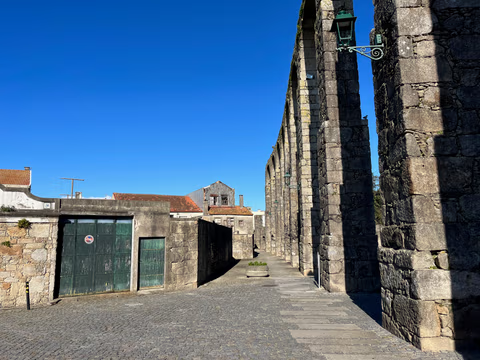
Aqueduct Trail – A path running along the Vila do Conde Aqueduct
From the Coastal Trail to the Camino Central: 12.9 km along the aqueduct from Vila do Conde to São Pedro de Rates. Route, stage, hostels, costs—explained honestly.
Read
Augsburg Way of St. James
The Augsburg Way of St. James runs 231.7 km in 11 stages from Oettingen in the Ries via Donauwörth, Augsburg, Bad Wörishofen and Ottobeuren to Ermengerst in the Allgäu — the Fuggerei, the Jakobervorstadt, a pilgrim of 1446 and Mozart's organ duel. Stages, hostels, costs.
Read

