

Camino Slovenia (Prekmurje-Styria)
268.5 kilometres, 13 stages, 4,348 metres of ascent, highest point 747 metres: the Camino Slovenia (Prekmurje-Styria) starts in Kobilje, where the Via Pannonia from Budapest reaches the border, and runs across the Prekmurje plain past the St James church of Dobrovnik to Ljutomer, up into the vineyards to Jeruzalem, via Ormož and the Teutonic Order castle of Velika Nedelja to Ptuj, Slovenia's oldest documented town, to the pilgrimage hill of Ptujska Gora, past Studenice and Žiče Charterhouse to Vojnik, over Šentjungert and a village called Galicija into the Savinja plain, up to 747 metres beyond Vransko and through the Tuhinj valley to Kamnik, then via Vodice and Medvode to Ljubljana. Seven churches of St James stand along the way; in Hraše hangs Slovenia's only known depiction of the apostle as a pilgrim. Frankly: the route is the work of an association between 2011 and 2014, there is no hostel network and there is a lot of climbing — but it follows the Ljubljanska cesta, the most important medieval road from Hungary to Italy, and its lord, Ulrik II of Celje, rode to Compostela himself in 1429/30.
- 01At a Glance
- 02Overview
- 03Other Names
- 04Ideal For – and Less So For
- 05Route & Landscape
- 06Stages, Terrain & Difficulty
- 07The Stamp of Galicija — and Slovenia's Only Pilgrim St James
- 08Highlights Along the Way
- 09How Pilgrims Reach This Route
- 10Continuing the Pilgrimage?
- 11Preparation & Practicalities
- 12What the Route Costs
- 13Getting There
At a Glance
- Start / Finish: Kobilje (Prekmurje, Hungarian border) / Ljubljana, church of sv. Jakob
- Length: 268.5 km
- Duration: 13 stages (Camino Ninja division), 2 weeks
- Elevation: ↗ 4,348 m / ↘ 4,248 m — 16 metres of ascent per kilometre, „more demanding than the Spanish Camino due to the many slopes", as the cycling association itself puts it
- Highest point: 747 m at km 195.5 on the climb beyond Vransko into the Tuhinj valley; lowest point 169 m at km 10.5 on the Prekmurje plain
- Stages: 13 — Camino Ninja system based on our waypoints; the operator divides the route into ten sections without kilometres
- Landscape: Prekmurje plain, vineyards of the Jeruzalemske gorice, Drava plain, Haloze, Konjice hills, Savinja plain, Tuhinj valley, foothills below the Kamnik Alps, Sava valley
- Operator: Društvo prijateljev poti sv. Jakoba v Sloveniji (founded 2000), routes waymarked 2009, this branch researched from 2011, opened and blessed on 27 July 2014 in the St James church of Dobrovnik
- Waymarking: yellow shell and yellow arrow, metal shells reading „Jakobova pot", crosses at wrong turnings; GPX track expressly recommended by the association
- Traces of St James: seven churches of St James — Dobrovnik (1333), Ormož (14th c.), Galicija (1272/1422), Kamnik, Hraše, Stanežiče, Ljubljana (1613–1615); in Hraše the only known depiction of St James as a pilgrim in Slovenia; statue of St James in Ptujska Gora
- Accommodation: no hostel network — hostels, apartments, monasteries, parish houses, farms; book ahead, order the credential (romarska listina) from the association
- Connecting routes: feeder Via Pannonia from Budapest to Kobilje; in Ljubljana Camino Slovenia (Primorska) towards Trieste and Camino Slovenia (Dolenjska)
- Best time: April to June, September to October; Prekmurje is hot and shadeless in high summer
Overview
The way begins at a state border and ends in a capital, and between them lies a road older than both: the Ljubljanska cesta, in the operator's words „the most important mediaeval link from the Kingdom of Hungary via the present Slovenian territory to Italy". On it you walk out of flat Prekmurje past the St James church of Dobrovnik and the pilgrimage church of Turnišče to Ljutomer, climb through the vineyards to Jeruzalem — yes, that is the village's name —, come via Ormož and the Teutonic Order castle of Velika Nedelja to Ptuj, which appears in Tacitus for the year AD 69, to the pilgrimage hill of Ptujska Gora with 82 carved faces beneath a cloak, past Studenice and the charterhouse of Žiče, where the entire Carthusian order held its chapter for twenty years, over Šentjungert and a village called Galicija into the Savinja plain, up to 747 metres beyond Vransko and through the Tuhinj valley to Kamnik, and finally along the Sava to Ljubljana, where all Slovenian Ways of St James converge at the church of sv. Jakob.
Frankly: no pilgrim is documented on exactly this route, the association researched it between 2011 and 2014 and had it blessed in Dobrovnik on St James's Sunday 2014, and there is no hostel network. What there is: seven churches of St James in 268 kilometres, in Hraše the only known depiction of the apostle as a pilgrim in Slovenia — „these are the only known portrayals in Slovenia", the operator writes —, four place names left over from pilgrimage, and a lord who went himself: Ulrik II Celjski rode to Compostela in 1429/30 with 60 horsemen, the money borrowed from his father. His grave lies six kilometres from the route. That is enough to know, from Kobilje to Ljubljana, in whose footsteps you walk.
Other Names
In Slovenian the way is called Jakobova pot or Pot sv. Jakoba, this branch precisely Prekmursko–štajerska veja, the Prekmurje-Štajerska branch; on its English page the operator calls it „The Prekmurje – Styria (Štajerska) Way", and because it starts at the Hungarian border it also goes by Ogrska pot, the Hungarian way, within the association. Slovenian media lump all branches together as „slovenski camino". Look at the operator's map and you find this as one of four: the Dolenjska branch comes from the Croatian border, the Primorska branch leads to Trieste, the Gorenjska branch to the Three Peaks of Svete Višarje — this one is the longest.
Two things to keep apart. First: Štajerska is Slovenian Lower Styria, not Austrian Styria — the kinship of names is real, the land behind it is a different one. Second: „Jakobova pot" is also the name of the cycling route in Slovenia — same places, separate association, its own 265-kilometre route; the prices below come from it, because the walking association publishes none. And a correction on our own account: our Via Pannonia page gives an older length for this branch — the 268.5 kilometres of our route data are authoritative, the operator says 265 to 270.
Ideal For – and Less So For
Ideal if you want a Way of St James on which St James is more than a logo: seven churches bear his name, in one he hangs as a pilgrim, in one he stands as a statue, and a village on the route is called Galicija. Ideal if monasteries interest you — Žiče Charterhouse, the first Carthusian monastery outside France and Italy, seat of the General Chapter from 1391 to 1410, and the Dominican convent of Studenice from 1237, whose church is regarded as Slovenia's most precious Romanesque monument. Ideal for art: Ptujska Gora with its Virgin of Mercy relief of 1410, Turnišče with frescoes from the Aquila workshop of 1380/90, Ptuj as the country's oldest town. And ideal if you have two weeks: 268.5 kilometres are a holiday, not a sabbatical — and with the Via Pannonia before it, a chain from Budapest to Ljubljana.
Frankly, though, it is not for you if you expect the Spanish system. There is no hostel network; you sleep in hostels, apartments, monasteries, parish houses and on farms, and you book that in advance. Not for you if you want flat land: 16 metres of ascent per kilometre, and the cycling association says so itself — „our routes are more demanding than the Spanish Camino due to the many slopes". Not for you if you need company: few people walk the Slovenian branches, on some days nobody. Not for you if you want to trust waymarks alone — the association expressly recommends GPX tracks, „posebej pozimi ali v Ljubljani", and writes about its own website: „Društvo ne jamči za točnost podatkov na spletni strani." Gaps like these are planned away beforehand, not on the road: load the track, order the credential, and book the beds between Špitalič and Šentjungert and in the upper Tuhinj valley first.
Route & Landscape
You start in Kobilje, a few hundred metres past the Hungarian border, in Prekmurje, the flattest corner of Slovenia. The first 30 kilometres are plain: Dobrovnik with the St James church in which this way was blessed in 2014, Turnišče, where two churches share a partition wall, Odranci, Mota, Ljutomer; at kilometre 10.5, at 169 metres, lies the lowest point. Then the land tilts: beyond Ljutomer you climb through the Železne dveri into the Jeruzalemske gorice, the vineyards of Prlekija, and stand in Jeruzalem — village, church, view. Via Veličane, Svetinje and Ivanjkovci down to Ormož with its Gothic St James church, via Hajndl to the Teutonic Order castle of Velika Nedelja and across the Drava plain via Moškanjci and Dornava to Ptuj.
From Ptuj the long, hilly middle section begins. Via Apače and Lovrenc to the pilgrimage hill of Ptujska Gora, into the vineyards of the Haloze to Makole, past Studenice to Zgornje Poljčane and via Mlače up to Špitalič with the charterhouse of Žiče. Via Stare Slemene and Bezovica down to Vojnik, six kilometres north of Celje, up again to the church of St Cunigunde at Šentjungert at 517 metres, via Galicija into the wide Savinja plain: Polzela with the Knights of Malta castle of Komenda, Braslovče, Vransko. Beyond Vransko the serious part: the way climbs at kilometre 195.5 to 747 metres, the highest point, and drops into the Tuhinj valley — Bela, Češnjice, Zgornji Tuhinj, Snovik with Slovenia's highest thermal spa, Mekinje, Kamnik, the Andechs town below the Kamnik Alps. The rest is foothills and river valley: Vodice, Valburga near Smlednik with the St James church of Hraše, then along the Sava via Medvode and Stanežiče to Ljubljana. Surface: field and cycle paths in Prekmurje, vineyard lanes, forest and cart tracks in Haloze and the Konjice hills, asphalt in the Savinja plain and before Ljubljana.
Stages, Terrain & Difficulty
We divide the way into 13 stages — Camino Ninja system, and we say so expressly: the operator divides the branch into ten sections but gives no kilometres. Every stage boundary below is a waypoint from our route data, every kilometre figure the difference between two waypoints; the sum is exactly the 268.5 kilometres of our route, 20.7 a day on average. The ascent is unevenly spread: the first three stages are flat to rolling, the work of the way lies between Špitalič and Šentjungert and on the climb beyond Vransko.
- Kobilje – Ljutomer (32.5 km) — Dobrovnik, Turnišče, Odranci, Mota; plain, lowest point 169 m at km 10.5; can be split at Turnišče.
- Ljutomer – Ormož (17.7 km) — Železne dveri, Jeruzalem (330 m), Svetinje, Litmerk; vineyards, constant up and down.
- Ormož – Ptuj (28.8 km) — Hajndl, Velika Nedelja, Podgorci, Moškanjci, Dornava; flat Drava plain.
- Ptuj – Ptujska Gora (15.1 km) — Apače, Lovrenc na Dravskem Polju; short, climb to the pilgrimage hill.
- Ptujska Gora – Zgornje Poljčane (18.7 km) — Makole, Studenice, Podboč; Haloze.
- Zgornje Poljčane – Špitalič (18.4 km) — Mlače; into the Konjice hills to Žiče Charterhouse.
- Špitalič – Galicija (25.2 km) — Stare Slemene (402 m), Bezovica, Vojnik, Šentjungert (517 m); the hilliest stage of the middle section.
- Galicija – Braslovče (17.2 km) — Velika Pirešica, Polzela; Savinja plain, easy.
- Braslovče – Vransko (14.3 km) — Podvrh, Stopnik, Čeplje, Brode; short, before the climb.
- Vransko – Zgornji Tuhinj (19.7 km) — highest point 747 m at km 195.5, Bela, Češnjice v Tuhinju, Golice; the queen stage.
- Zgornji Tuhinj – Kamnik (19.5 km) — Gradišče, Snovik (thermal spa), Sela, Markovo, Mekinje; rolling Tuhinj valley.
- Kamnik – Medvode (25.0 km) — Tunjiška Mlaka, Gora pri Komendi, Vodice, Valburga (St James church of Hraše); foothills.
- Medvode – Ljubljana (16.4 km) — Medno, Stanežiče, Dvor; Sava valley, arrival at the church of sv. Jakob.
If you want shorter days, split stage 1 at Turnišče and stage 3 at Velika Nedelja; to soften the queen stage, stop at Bela or Češnjice. Conversely, the short stages 4 and 9 can be joined to their neighbours — then you are through in eleven days. Poles pay off on stages 6, 7 and 10.
The Stamp of Galicija — and Slovenia's Only Pilgrim St James
At kilometre 156.4 you stand in a village called Galicija, in front of a church of St James the Greater: according to legend built as a chapel by miners in 1272, a vicarage church in 1422, bell tower of 1677, a Latin chronogram above the portal. Where the name comes from, the etymologist Davorin Trstenjak answered three ways in the 19th century: from „galice", the crow that sits in the village arms; from the sun sanctuaries of the ancient Slavs, where „poganskega sončnega boga nadomestil apostol Jakob"; or from Galicia itself — the nobility went on pilgrimage to the apostle's grave and brought back „kult in ime sv. Jakoba, kateremu so pozneje zgradili tudi cerkev". None of the three can be proven. What can be proven: here you get a St James stamp in your romarska listina, 2,400 kilometres before the other Galicia. And Galicija is not alone. Jeruzalem is so called because German knights in the 13th century set a tower on the vineyard hill and inside it a „kopijo jeruzalemske podobe Žalostne Matere božje, ki so jo prinesli iz Palestine" — and because, so the legend goes, looking out over the hills they said: „svoj Jeruzalem smo našli in ne potrebujemo ničesar drugega". Velika Nedelja, the Great Sunday, bears the date of a battle: Easter Sunday, 18 April 1199, Frederick of Pettau and the Teutonic Order against the Hungarians — out of which, around 1210, grew the commandery „with the hospital of the Virgin Mary". And Špitalič takes its name from the hospital of Žiče Charterhouse, „a guesthouse featuring an infirmary" for lay brothers and guests. Four place names left over from pilgrimage; the institutions behind them were dissolved by Joseph II in 1782, the Knights of Malta were gone by 1780. The names have stayed.
The climax comes 90 kilometres after Galicija, unobtrusively, at Hraše next to Valburga: a small St James church in which the apostle is shown as a pilgrim — with hat, staff and shell, as every Spanish church shows him. The operator writes the sentence that sets this way apart from all other Slovenian ones: „Both portrayals are very frequent in Spain; however, these are the only known portrayals in Slovenia." Seven churches of St James lie along the 268 kilometres — Dobrovnik, where the way was blessed by the Bishop of Murska Sobota on St James's Sunday, 27 July 2014, and where Jože Zel painted three scenes from the apostle's life in the presbytery in 1982; Ormož with its Madonna of around 1400 from the Ptujska Gora workshop; Galicija; Kamnik; Hraše; Stanežiče; and at the end Šentjakob in Ljubljana, in 1598 the first Jesuit church of the Slovene lands, Baroque building of 1613 to 1615 with the high altar by Francesco Robba. Plus the statue of St James in the basilica of Ptujska Gora, whose Virgin of Mercy relief of 1410 gathers 82 faces beneath Mary's cloak — the founder Bernhard III of Pettau, his wife, Minorites, nobles, clerics: a medieval group portrait in stone, a Basilica minor since 16 May 2010.
And then the man. Ulrik II Celjski, Count of Celje, lord of this land, is the most tangible Santiago pilgrim the way has. The Slovenska biografija dates his knightly journey to spring 1430: on 21 March he is admitted to the Aragonese order of knighthood at the court of King Alfonso V in Segorbe, on 16 April he receives from Juan II of Castile the „ogrlica ribje luske", the collar of the fish scale, and then he „obiskal še Santiago de Compostela". The cycling association of the Slovenian Ways of St James has researched that he rode through the Tuhinj valley with 60 horsemen in 1429 — exactly where this way climbs to its highest point at kilometre 195.5 — and borrowed the money for it from his father; Hungarian scholarship counts him for 1430 among the Compostela pilgrims of the Kingdom of Hungary, „népes kísérettel", with a large retinue. Frankly: 1429 or 1430 is disputed, and the route through the Tuhinj valley is association research, not a charter. Ulrik died on 9 November 1456 in Belgrade and lies in the Minorite monastery of Celje, six kilometres from the waypoint Vojnik. Shell burials, pilgrim badges: none on this way. But a count with 60 horsemen, a pilgrim St James in a village church and a stamp in Galicija — that is more than most ways have.
Highlights Along the Way
- Dobrovnik — St James church, first documented 1333, present building 1794–1796 by Prince Miklós II Esterházy, St James fresco by Jože Zel (1982); the way was opened and blessed here on 27 July 2014.
- Turnišče — pilgrimage church Marijinega vnebovzetja, oldest part mentioned 1267, frescoes 1380–1390 from the workshop of Johannes Aquila; on 15 August it „zbere tudi do 15.000 ljudi".
- Jeruzalem — church Žalostne Matere Božje of 1652 on the site of a 13th-century crusader tower; miraculous image with three faces, view over the vineyards.
- Ormož — 14th-century St James church with a Madonna of around 1400 from the Ptujska Gora workshop, frescoes of 1632.
- Velika Nedelja — Teutonic Order castle, first mentioned 1273; the place name recalls Easter Sunday 18 April 1199; national monument since 2008, today a museum.
- Ptuj — Slovenia's oldest documented town: AD 69 in Tacitus, when Marcus Antonius Primus won over the commanders for Vespasian in Poetovio; 2019 „Vivat Poetovio!".
- Ptujska Gora — basilica Marije Zavetnice s plaščem, building permission 1398 from Boniface IX, completed 1410; Virgin of Mercy relief with 82 figures, statue of St James; Basilica minor since 16 May 2010.
- Studenice — Dominican convent, founded 1237 by Sofija Rogaška, church of the Three Kings with its 800th anniversary in 2019, „the most precious Romanesque monument in Slovenia"; dissolved 1782.
- Špitalič and Žiče Charterhouse — founded 1165 by Ottokar III, „the first Carthusian monastery outside of its order's native lands"; seat of the General Chapter 1391–1410, over 2,000 manuscripts in 1487, dissolved 1782; Špitalič bears the name of the monastery hospital.
- Šentjungert — 14th-century church of St Cunigunde at 517 metres, view over the Savinja plain to the Boč.
- Galicija — church sv. Jakob starejši, according to legend built as a chapel in 1272, vicarage church 1422, bell tower 1677; one of the three interpretations of the name leads to Spain.
- Polzela — Grad Komenda, the strongest of the three Knights of Malta commanderies on Slovenian soil, in the order's hands until 1780; church of sv. Marjeta first mentioned 1255.
- Tuhinj valley and Terme Snovik — highest point of the way (747 m) beyond Vransko, then Slovenia's highest thermal spa right on the route.
- Kamnik — seat of the Counts of Andechs, Mali grad with Romanesque chapel and 11th-century crypt, 15th-century Franciscan monastery with a library of incunabula, the Šutna lane, traces of Plečnik.
- Komenda — Knights of Malta parish, parish priest Altwinus de Sancto Petro attested 1147–1154; Peter Pavel Glavar founded a school here in 1751 and with „Pogovor o čebelnih rojih" wrote the first Slovenian scientific text — about bees.
- Hraše near Valburga — St James church with the only known depiction of St James as a pilgrim in Slovenia.
- Ljubljana, Šentjakob — 1598 „the first Jesuit church in the Slovene Lands", Baroque building 1613–1615, high altar by Francesco Robba, Marian column 1682, square by Jože Plečnik; meeting point of all Slovenian Ways of St James.
How Pilgrims Reach This Route
The way begins literally at the state border, and so it has a real feeder: the Via Pannonia runs 442.3 kilometres from Budapest via Lake Balaton, Hévíz and the Őrség to Kobilje — and there, „at the state border with Hungary at Kobilje", this branch takes over. Coming from Budapest you do not change route, only country and association; the trail is the same Ljubljanska cesta on which the Hungarian Compostela pilgrims of the 15th century already headed west.
If you are not coming from Hungary, you arrive crosswise: from Murska Sobota or Lendava the bus goes to Kobilje, both are reachable by rail and coach, Ljubljana and Graz are the gateways. Coming from Austria, the Jakobsweg Graz brings you to Maribor — 30 kilometres north of Ptuj, with no waymarked connection to this branch; from there the Camino Slovenia (Maribor) leads up the Drava towards Dravograd. And because the way ends in Ljubljana, it can conveniently be walked in blocks: Ljutomer, Ormož, Ptuj, Poljčane, Celje near Vojnik, Kamnik and Ljubljana all lie on rail or good bus lines.
Continuing the Pilgrimage?
Yes, in three directions — Ljubljana is the hub of the Slovenian network. According to the operator, all branches meet in the church of sv. Jakob: „the pilgrimage ends in the church of St. Jacob in Ljubljana, which is the meeting point of all three Slovenian Ways of Jacob." Westwards the Camino Slovenia (Primorska) leads across the Karst to Trieste — the continuation towards Italy and thus towards Santiago. South-eastwards the Camino Slovenia (Dolenjska) runs to the Croatian border; walk it backwards and you come from Croatia to Ljubljana. The association's Gorenjska branch to the Three Peaks of Svete Višarje does not have a page with us yet.
From Trieste you go via Aquileia onto the Via Postumia across northern Italy to Genoa, along the Ligurian coast on the Via Aurelia to Arles, on the Via Tolosana to the Somport, on the Camino Aragonés to Puente la Reina and on the Camino Francés to Santiago. With the Via Pannonia behind you, you are part of a chain from Budapest to Finisterre — Ulrik II needed horses and 60 riders for it in 1430; you need a track and time.
Preparation & Practicalities
Best time: April to June and September to October. The Prekmurje summer is hot and shadeless, the vineyards are at their best in autumn; in winter the way is tricky without a track, says the association. Waymarking and navigation: yellow shell and yellow arrow, metal shells inscribed „Jakobova pot", crosses at turnings that indicate the wrong direction. The association expressly recommends GPX tracks, „posebej pozimi ali v Ljubljani", and writes about its own information: „Društvo ne jamči za točnost podatkov na spletni strani." Take the track; stage and accommodation planning is easiest directly in the Camino Ninja app together with stages and accommodation. Credential: „Pred romanjem si morate priskrbeti romarsko listino" — you order the association's pilgrim passport in advance, it comes cash on delivery. Stamps are in boxes at the St James churches and at the overnight stops; the association recommends carrying your own ink pad, „blazinico za žige, kot jo imajo planinci". After arrival and submission of a copy you receive the Slovenian „compostela". Language: Slovenian; in Prekmurje many understand Hungarian, German and English in the towns.
Accommodation: no hostel network — „Na poti boste prenočevali v hostlih, apartmajih ter tudi v samostanih in župniščih": hostels, apartments, monasteries, parish houses, plus farms and guesthouses. In Ljutomer, Ormož, Ptuj, Poljčane, around Celje, in Kamnik and Ljubljana the choice is good; between Špitalič and Šentjungert and in the upper Tuhinj valley thin — book there first. The association and the parishes help with arrangements. Food: shops and gostilne in all larger places, thin in the hills — carry a day's food on stages 6, 7 and 10. Packing list: shoes for farm track and asphalt, rain gear, poles for stages 6, 7 and 10, sun protection for the Prekmurje plain, offline maps, power bank, swimwear for Snovik. Hungary/Slovenia border: Schengen, but carry your ID anyway.
What the Route Costs
You pay in euros. Slovenia is no longer a bargain country, but affordable — and on this way you pay for rooms, not for beds in a dormitory. Documented figures (as of September 2026) come from the cycling association of the Slovenian Ways of St James, the Kolesarsko društvo slovenskih Jakobovih poti; the walking association publishes no prices: pilgrim passport €5, final certificate €5, pilgrim flag €8, annual membership €20, voluntary contribution to trail maintenance €20, plus €1 church donation per St James church and €1 Mass donation per day. For accommodation with half board plus lunch the same association reckons around €50 per person per day. Guide values for the rest: guest room or farm €30–50 per person, hostel bed in Ptuj, Kamnik or Ljubljana €25–35, parish or monastery lodging for a donation, set menu in a gostilna €12–20, admission to Terme Snovik around €20.
Realistic daily budget: €35–45 frugal with parish or monastery lodging and self-catering; €50–70 mid-range with guest room or hostel and half board; €80–110 comfortable with a hotel in Ptuj, Kamnik or Ljubljana. For 13 stages that is roughly €500–900 on the ground, plus travel there and back. You can save in two places: monasteries and parishes are cheaper than hotels, and you take the Snovik spa once, not three times.
Getting There
To the start (Kobilje): Kobilje has no station. The nearest stations are Murska Sobota and Ljutomer on the Ormož – Murska Sobota – Hodoš line (connection towards Hungary), from there a regional bus to Dobrovnik and Kobilje. If you fly, land in Ljubljana and take the train or bus to Murska Sobota; Graz and Zagreb are alternatives. If you arrive on foot from Hungary, you have no travel problem — the Via Pannonia ends in Kobilje.
Along the way and from the finish (Ljubljana): Ljutomer, Ormož, Ptuj, Poljčane, Celje (bus to Vojnik), Kamnik and Ljubljana are stations — the way can be walked in blocks. Ljubljana is main station, coach hub and airport city in one: trains to Vienna, Munich, Zagreb, Trieste and Villach, buses to all neighbouring countries, Jože Pučnik Airport 25 kilometres to the north.
- Rail Slovenia: potniski.sz.si — Slovenske železnice, lines Ljubljana – Kamnik and Ljubljana – Celje – Ptuj – Ormož – Murska Sobota – Hodoš
- Bus Prekmurje: apms.si — Avtobusni promet Murska Sobota, connections Murska Sobota – Dobrovnik – Kobilje
- Operator: jakobova-pot.si — Društvo prijateljev poti sv. Jakoba v Sloveniji, stage descriptions, romarska listina
- Cycling association and prices: jakobova-kolesarska-pot.si — Kolesarsko društvo slovenskih Jakobovih poti
- Ljubljana Airport: fraport-slovenija.si — Jože Pučnik, bus and shuttle into the city

Get your pilgrim credential and shell
Everything you need for the Camino Slovenia (Prekmurje-Styria), shipped to your door.
Visit Camino Shop
Other Caminos
 Appenzeller Weg
Appenzeller Weg
52.6 km from Rankweil across the Rhine to St. Peterzell: St. James Chapel (1464), 163 Years of the Wedding Trail, connection to the Via Jacobi. Stages, costs, how to get there.
Read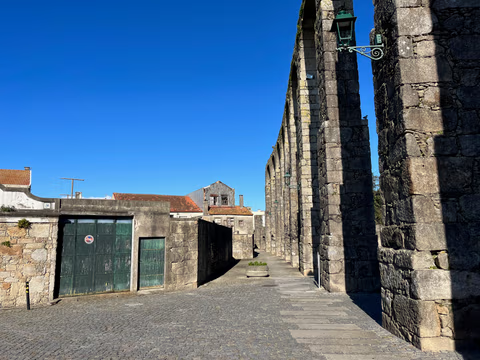
Aqueduct Trail – A path running along the Vila do Conde Aqueduct
From the Coastal Trail to the Camino Central: 12.9 km along the aqueduct from Vila do Conde to São Pedro de Rates. Route, stage, hostels, costs—explained honestly.
Read
Augsburg Way of St. James
The Augsburg Way of St. James runs 231.7 km in 11 stages from Oettingen in the Ries via Donauwörth, Augsburg, Bad Wörishofen and Ottobeuren to Ermengerst in the Allgäu — the Fuggerei, the Jakobervorstadt, a pilgrim of 1446 and Mozart's organ duel. Stages, hostels, costs.
Read

