

Fischerpfad (Fishermen's Trail)
226.5 kilometers along Europe’s wildest coastline—always along the Atlantic Ocean, from S. Torpes to Lagos. Not an official Way of St. James, but one of Portugal’s most beautiful and most popular pilgrimage routes.

- 01At a Glance
- 02Overview
- 03Other Names
- 04Who This Route Is Ideal For—and Who It's Not So Ideal For
- 05Route & Landscape
- 06Stages, Terrain & Difficulty
- 07Not an official Way of St. James—but still a pilgrimage route for many
- 08Highlights Along the Way
- 09How Pilgrims Find Their Way onto This Path
- 10Preparation & Practical Information
- 11What the journey will cost you
- 12Getting There
At a Glance
- Start / Finish: S. Torpes → Lagos (or Lagos → S. Torpes)
- Length: 226.5 km
- The stage: 13
- Duration: about 12–15 days
- Difficulty: moderate to challenging
- Official Way of St. James: No – no Camino for the Compostela calculation
- Best time of year: March–June and September–October
Overview
The Fishermen's Trail is not the Way of St. James and does not lead to Santiago de Compostela. Nevertheless, it is one of the most frequently walked pilgrimage routes in Portugal—simply because it is one of the most beautiful coastal hiking trails in the world. 226.5 kilometers along the Atlantic Ocean, through the Southwest Alentejo and Vicentina Coast Natural Park: Cliffs, dunes, fishing harbors, deserted beaches.
The name comes from the fishermen who have been using these paths for centuries to reach their fishing spots along the coast. The area retains a correspondingly unspoiled character: sandy paths right by the sea, no towns, no asphalt—just wind and open space. If you’re looking for solitude and scenery rather than company and pilgrimage stamps, this is the place for you.
Many pilgrims combine the Fishermen's Trail with an official route along the Way of St. James: They walk along the coast and turn onto the Portuguese Way or the Coastal Road...to continue their pilgrimage toward Santiago.
Other Names
In Portuguese, the trail is called Fishermen's Trail, in English Fishermen's Trail. It is part of the Vicentina Route, a network of hiking trails in southwestern Portugal that also includes the Historic Trail ( Historical Trail) belongs to.
Who This Route Is Ideal For—and Who It's Not So Ideal For
Ideal if you’re looking for nature, solitude, and breathtaking coastal scenery. The Fishermen’s Trail rewards anyone who isn’t bothered by limited infrastructure and is flexible about accommodations. It’s well-suited as a standalone experience or as a prelude to an official Camino de Santiago.
Less suitable if you’re aiming for the Compostela or rely on a dense network of pilgrim accommodations. No public network of hostels, hardly any stamp stations, and no dedicated albergues. Sandy sections tire your legs more than solid ground—if you don’t plan for this, you’ll be in for a surprise.
Route & Landscape
From S. Torpes South of Sines, the trail follows the Atlantic coast almost entirely along cliff paths and beach access points. The first stages wind through the flat Alentejo region, with wide beaches and small fishing ports such as Porto Covo and Vila Nova de Milfontes. At Cabo Sardão White storks nest right on the steep cliffs—a phenomenon unique in the world.
From Odeceixe As the route enters the Algarve, it becomes more dramatic: the cliffs grow taller, the gorges deeper, and the coves wilder. At Arrifana The ruins of an Islamic monastery-fortress stand on a rocky outcrop overlooking the sea. The final stretches lead across the Cape St. Vincent – the westernmost point of mainland Europe – all the way to the Ponta da Piedade Just outside Lagos.
Stages, Terrain & Difficulty
The Fishermen’s Trail is divided into 13 stages ranging from 10 to 23 kilometers. Sandy sections are more exhausting than solid ground; several stages follow cliff paths with significant ups and downs. Some beach crossings—particularly Praia da Bordeira (Stage 8) and Boca do Rio (Stage 12)—are impassable at high tide. Always check the tide times before embarking on long stages.
The most difficult stages are 5, 6, and 11. The stage that Rota Vicentina particularly recommends is Stage 8 (Arrifana → Carrapateira) with spectacular cliffs up to 100 meters high and one of the most impressive coastal landscapes along the entire route.
Not an official Way of St. James—but still a pilgrimage route for many
Important Note: The Fisherman's Trail is not an official Camino and is not recognized by the Cathedral of Santiago de Compostela for the purpose of calculating the Compostela. There are no dedicated pilgrim hostels, and the route does not lead to Santiago.
Nevertheless, thousands of people walk it every year in the spirit of pilgrimage—as a spiritual retreat, as the start of a longer pilgrimage, or simply as one of the most beautiful trails there is. Some lodgings stamp the pilgrim’s passport (Credencial), especially in Lagos and Sagres—but this isn’t always guaranteed. Anyone who wants to switch to an official Way of St. James afterward should turn onto the Camino Português or the Camino de la Costa in Lagos.
Special feature: The Fisherman's Trail is in Fully signposted in both directions. You can hike it from S. Torpes to Lagos (north → south) or in the opposite direction—both routes are officially marked.
Highlights Along the Way
- Cabo Sardão – White storks nest on the steep cliffs. This is unique in the world.
- Azenha do Mar – a tiny fishing village with a natural harbor, nestled among cliffs.
- Bordeira Beach – Huge beach with dunes; impassable at high tide, so set out early.
- Ribat of Arrifana – Ruins of an Islamic monastery-fortress from the 11th–12th centuries.
- Cape St. Vincent – the westernmost point of mainland Europe.
- Ponta da Piedade – Spectacular rock formations just outside Lagos.
- Odeceixe Beach – The border between the Alentejo and the Algarve, where the river flows into the sea.
How Pilgrims Find Their Way onto This Path
You can reach the starting point, Porto Covo, by bus from Lisbon (Rede Expressos, about 2.5 hours)—the Fishermen’s Trail isn’t part of the Camino de Santiago, but many pilgrims add it on before or after a Camino as a “Atlantic getaway.”
And for those who want to head back toward Santiago afterward: From the Algarve, the Road to Faro to Lisbon, and the Via Nascente runs northward from the Algarve through the Portuguese hinterland—both routes will take you back to the official trail network.
Preparation & Practical Information
The best times to visit are March through June and September through October: pleasant temperatures (15–22 °C), coastal vegetation in bloom, and few crowds of tourists. In summer (July/August), the heat is intense; in winter, some streams may be impassable after rain.
The range of lodging options is significantly more limited than on the well-known Camino de Santiago routes. In the larger towns along the route (Vila Nova de Milfontes, Odeceixe, Aljezur, Sagres, Lagos), there are hotels and guesthouses; in smaller towns, the selection is very limited. Early booking is recommended from April through October—the easiest way to do this is directly in the Camino Ninja app, where you can plan your stages and accommodations together.
You can bring a pilgrim's passport (Credencial) with you, but don't count on being able to get it stamped everywhere. However, you should definitely have it with you when you reach your destination in Lagos or for the subsequent Camino de Santiago.
What the journey will cost you
Portugal is inexpensive: As a rough estimate, plan on spending 30–50 € – depending on the type of lodging and meals. Small guesthouses usually cost 40–70 € per night (Single rooms), hostels are slightly less expensive. Food in fishing towns is inexpensive. There is no network of public pilgrim hostels like on the Spanish routes—plan your budget accordingly. (As of July 2026)
Getting There
Starting Point S. Torpes: The best way to get there is via Sines, which can be reached by bus from Lisbon’s Oriente Station. S. Torpes does not have its own train station. Alternative starting point: Porto Covo (end of Stage 1), accessible directly by bus from Lisbon.
Lakes – End point and alternative starting point – has regular train service along the Algarve as well as long-distance buses to Lisbon and Porto. Lagos is the more easily accessible destination and serves as a good starting point for hikers traveling from south to north.
- Rede Expressos – Long-distance buses in Portugal – Routes to Sines and Lagos.
- CP Comboios de Portugal – Trains along the Algarve to Lagos.
- Rota Vicentina (rotavicentina.com) – official website with GPX tracks and stage information.

Get your pilgrim credential and shell
Everything you need for the Fischerpfad (Fishermen's Trail), shipped to your door.
Visit Camino Shop
Other Caminos

Appenzeller Weg
52.6 km from Rankweil across the Rhine to St. Peterzell: St. James Chapel (1464), 163 Years of the Wedding Trail, connection to the Via Jacobi. Stages, costs, how to get there.
Read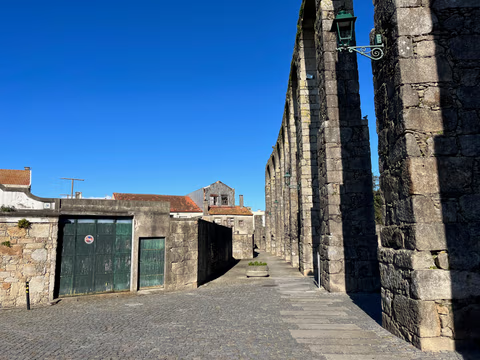
Aqueduct Trail – A path running along the Vila do Conde Aqueduct
From the Coastal Trail to the Camino Central: 12.9 km along the aqueduct from Vila do Conde to São Pedro de Rates. Route, stage, hostels, costs—explained honestly.
Read
Ave Trail (Costa Station – Central Station)
A 9.2-kilometer route connecting two of Portugal's most popular pilgrimage trails: If you want to switch from the Coastal Route to the Central Route in Vila do Conde after the first day, take this short connecting path to Arcos.
Read


