

Stage town on the Camino
Águeda
Distrito de Aveiro, Região do Centro, Portugal
- places to stay
- 7
- Caminos
- 2
- Elevation
- 9 m
Águeda is a classic stage end on the Camino Portugués Central, 295.3 kilometres from Lisbon after a flat day through the Bairrada. In summer, colourful umbrellas hang over the lanes; the rest of the year it is a quiet riverside town. Tomorrow brings one of the prettiest stages before Porto.
How long to stay?
An afternoon is enough. Águeda is not a town of great monuments. It is a good place to arrive: do your washing, sit by the river, wander the lanes of the old town, go to bed early. Between July and September the evening walk under the umbrellas is worth it. If you need a rest day, Coimbra or Porto is the better place for it.
Águeda in Ninja numbers
- 295.3 kilometres lie behind you since Lisbon. There are 324.0 left to Santiago on the Camino Portugués Central. So you are almost halfway.
- 25.3 kilometres from Mealhada, with hardly any climbing: 174 metres up, 215 metres down. Just before town you reach the lowest point of the day at 8 metres.
- 2012 was the first year umbrellas hung over the streets. Since then, the Umbrella Sky Project has travelled the world.
- 8 kilometres beyond Águeda you cross the Marnel tomorrow on a medieval bridge with five arches.
Arriving: through the Bairrada to the river
From Mealhada the way runs through the Bairrada wine country, past Anadia and a string of small villages. The land is flat, and the last kilometres drop into the plain of the Rio Águeda. The town lies on both banks of the river, with the Praça da República right by the water. The Santo António pilgrim hostel is not in the centre but on Rua da Misericórdia, a good kilometre from the town centre.
In brief: a town that gave itself colour
For a long time Águeda was above all an industrial town. People called it the bicycle capital, and one avenue is still known as the „Avenida das Bicicletas“. It rarely appears in guidebooks. In 2006 the town launched the AgitÁgueda festival to bring its centre back to life: concerts, street theatre, parades in July. Out of this festival came the idea, in 2012, of stretching hundreds of colourful umbrellas over the lanes. The idea went around the world, and other towns have copied it.
Umbrellas and stone: what to see
Everything is close together in the centre, a good kilometre from the hostel.
- Umbrella Sky: The colourful umbrellas hang over several streets of the old town in the summer months, according to travel reports from 1 July to 30 September. If you arrive in that period, walk through them once in the evening. Outside those months, only the colourful façades and street art remain.
- Igreja de Santa Eulália: The town's main church was begun in the 15th century. Gothic, Renaissance and Baroque can all be seen in it, because building went on for centuries. We have not found Mass times.
- Praça da República and the river: The square on the Rio Águeda is the best place for the evening.
Eating and drinking
Águeda lies on the edge of the Bairrada, and the dish of the region is suckling pig, Leitão assado à Bairrada. The town also has a sweet speciality of its own, the Pastel de Águeda. The hostel serves no meals, but you can cook for yourself; according to pilgrims, a supermarket is a few minutes away. For restaurants, head into the centre.
Honestly
- The hostel is on the edge of town. It is a good kilometre to the centre. After 25 kilometres, nobody likes walking that twice.
- Without the umbrellas, Águeda is unspectacular. If you come in spring or autumn, you will find a friendly but ordinary small town.
- Little choice of pilgrim beds. There is one pilgrim hostel and one hostel. In summer it is worth calling ahead.
Where pilgrims sleep
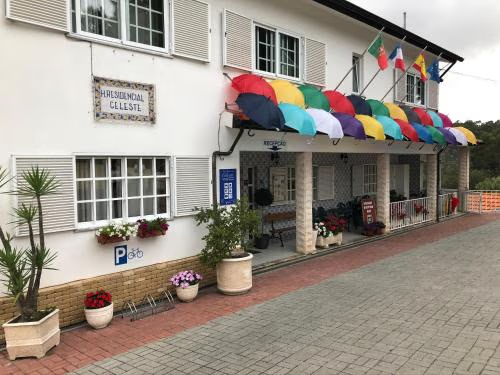
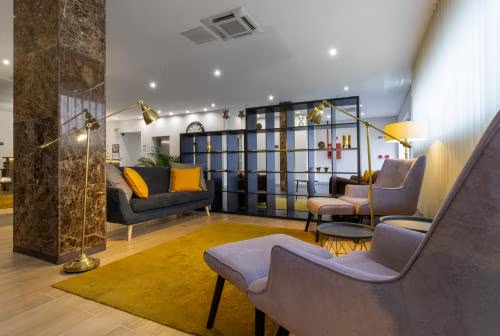
The Albergue de Peregrinos Santo António is private. A couple opened it in April 2014 next to the Residencial Celeste, and the two houses share a reception. Since then a kitchen, bathrooms and more beds have been added. A dormitory bed costs from €15 (as of October 2026). The rooms are small, some with their own bathroom. In 2025 and 2026 pilgrims almost unanimously praised the cleanliness, the well-equipped kitchen, the garden with terrace, and the washing machine and dryer. Fátima pilgrims are only accepted with their own Fátima credencial.
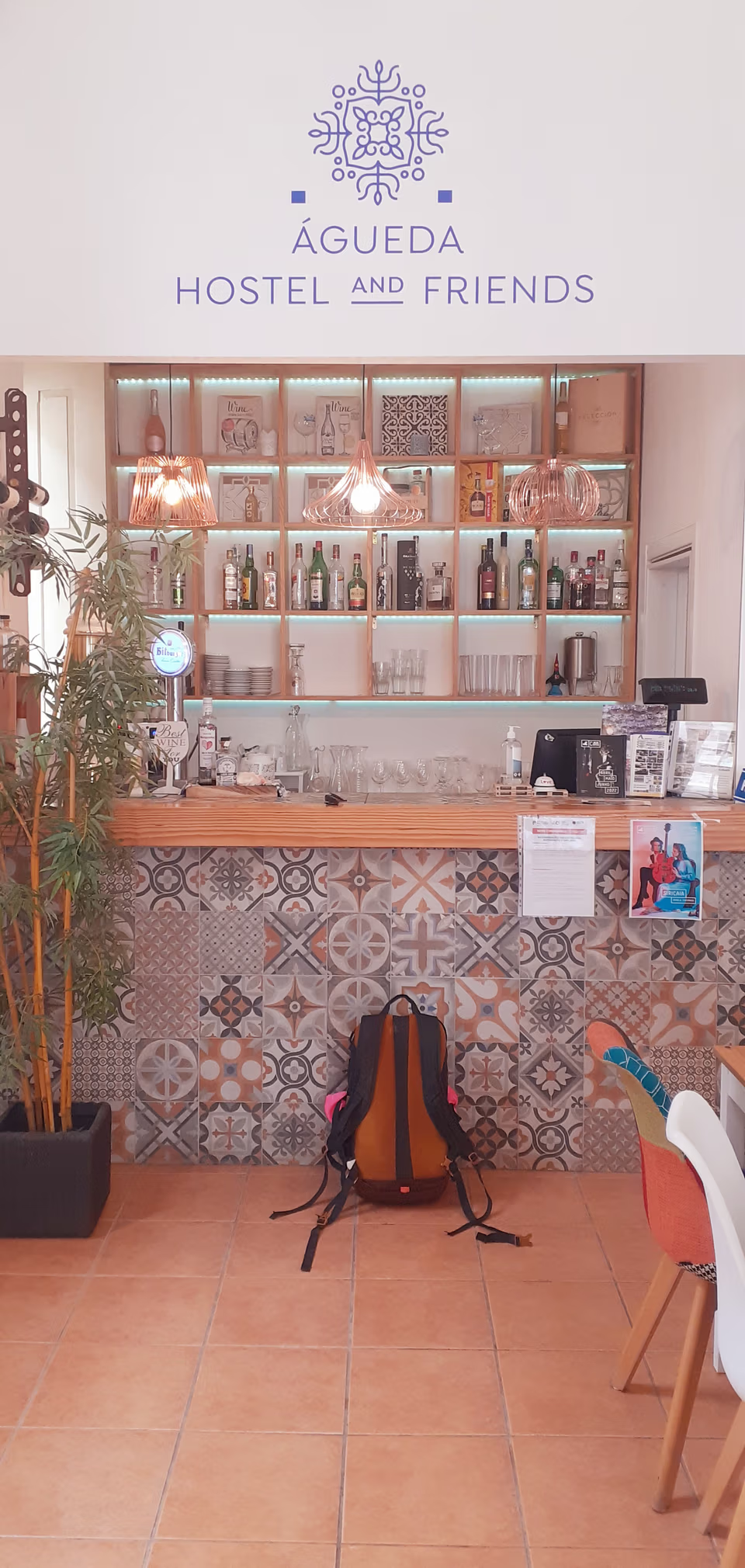
A second budget option is the Águeda Hostel & Friends, which has a dormitory. There is no parish or donativo hostel in Águeda.
Ninja tips
- Shop before you arrive, or right after. The hostel serves no meals, but it has a good kitchen, and the supermarket is close.
- Go into the centre in the evening, not the afternoon. Shower and wash first, then stroll into the old town, in summer under the umbrellas.
- Take your time at the Ponte do Marnel tomorrow. The bridge at Lamas do Vouga is one of the loveliest spots on this section.
Practical tips for pilgrims
- Stamp: at the hostel.
- Laundry: washing machine and dryer at the hostel.
- Stage planning: The next stage is short at 16.1 kilometres. If you want to go further, São João da Madeira is 45.7 kilometres away; that is too much for most people.
Onward: over the Marnel and the Vouga
The way leaves Águeda along the river. From Pedaçães it gets prettier, with farm tracks through lush greenery. At Lamas do Vouga (km 303.3) you cross the Marnel on the Ponte medieval, also called Ponte do Cabeço de Vouga, and then the Vouga on a viaduct. The final stretch runs through eucalyptus forest to the edge of Albergaria-a-Velha (km 311.4). The stage is 16.1 kilometres, with 216 metres of ascent and 106 metres of descent.
What awaits you tomorrow
Albergaria-a-Velha, a town named after a pilgrim hostel. In 1117 the mother of Portugal's first king obliged a nobleman to keep a house open here for the poor and for pilgrims. More than nine centuries later, you sleep in the hostel that bears her name.
Deep dive: The town under the umbrellas
A short read, in case you want to learn more about Águeda. About two minutes' reading.
A town without great monuments
Águeda was never a town people made a detour for. It lay on the old road between Coimbra and Porto, by the river, in the Bairrada wine country. Its main church was begun in the fifteenth century and built on for centuries. Later came factories, and Águeda became known as the town of bicycles. Even so, it hardly appeared in the guidebooks.
A festival and an idea
In 2006 the town decided to make its centre louder. It invented a festival for July, with concerts, street theatre and parades. It was called AgitÁgueda, which means something like Águeda in motion. Six years later, hundreds of colourful umbrellas were stretched over the lanes for the first time. The idea went around the world.
What Águeda gives you
When this text was written, in autumn 2026, the umbrellas were not hanging; summer was over. Perhaps that is Águeda's real lesson: a place does not have to be famous to make itself beautiful. It needs an idea and people who join in. Today you have an unspectacular day behind you, flat and long. Tomorrow will be prettier. And that, too, is part of the way.
Where to stay in Águeda
The places pilgrims rate highest in Águeda come first.
- Top #1
 OpenReservations accepted
Albergue de peregrinos Santo António
- Top #2
 OpenReservations accepted
Águeda Hostel & Friends
- Top #3
 OpenReservations accepted
Residencial Celeste

Services in Águeda
What you can find in town before the next stage.
- ATM
- Café
- Shop
- Tobacco
- Medical clinic
- Pharmacy
- Fountain
- Post office
- Train station
- Bus station
- Airport
- Restaurant
Source: © OpenStreetMap contributors · updated January 2026
Town 16 of 43