

Town on the Camino
Alcoutim
Portugal
- places to stay
- 5
- Camino
- 1
- Elevation
- 12 m
Alcoutim looks across the Guadiana to Sanlúcar, its Spanish neighbour. In the castle courtyard Portugal and Castile made peace in 1371, and today tourists fly over the border on a wire. An afternoon is enough, because 37.6 kilometres lie behind you and 45.1 to Mértola lie ahead.
How long to stay?
An afternoon is enough, but take it. You arrive from Castro Marim after 37.6 kilometres, so probably rather late. The rest of the day is plenty for the castle with its small archaeological museum, the main church and a look across the river. You don't need a rest day here, but you do need a good night: the next stage to Mértola is 45.1 kilometres long, and the first village with a bed comes after 13.8 kilometres.
Alcoutim in Ninja numbers
- 64.2 kilometres is how far you have walked since Tavira, according to Camino Ninja. To Trancoso, the end of the Via Nascente, there are still 597.0 to go.
- 37.6 kilometres is the stage from Castro Marim. On the way you pass riverside villages such as Foz de Odeleite, Álamo and Guerreiros do Rio, and the last of them, Laranjeiras, lies a good 10 kilometres before the finish.
- 31 March 1371: on this day the peace between King Fernando of Portugal and Henry II of Castile was signed in the castle of Alcoutim.
- 720 metres is the length of the zip line from Sanlúcar to Alcoutim. Because Spain is an hour ahead, according to the operator you land an hour before you set off.
Arriving: a river that divides and connects
Since Vila Real de Santo António the Via Nascente has followed the GR15, the Grande Rota do Guadiana. The river is the border with Spain, and in Alcoutim you can see it: directly opposite lies Sanlúcar de Guadiana with its own fortress, the Castillo de San Marcos. A passenger ferry shuttles between the two towns. From the castle wall you look across. Alcoutim is the last larger town of the Algarve on your route: beyond the Vascão, a tributary that the route crosses before Mértola, the Alentejo begins.
In brief: a border castle and a peace treaty
Around 1240 the troops of King Sancho II conquered the area. He then had a new castle built on the site of today's town, and the work dragged on into the second half of the 13th century. On 9 January 1304 King Dinis granted Alcoutim its town charter and had the wall built with three gates, named after the Guadiana, Tavira and Mértola. On 31 March 1371 the first of the three wars that King Fernando fought against Castile ended in the castle courtyard. Part of the peace was a marriage promise: Fernando was to marry a daughter of the Castilian king. A good year later, on 5 May 1372, he married Leonor Teles instead, and the treaty was no longer worth the parchment.
In the war of independence after 1640 there was fighting on the border again, and under Afonso VI the defences were strengthened, as an inscription at the Tavira Gate recalls. In the 18th century the castle fell into ruin and for a time served as a slaughterhouse. It has been restored since the 1960s, and since 2000 there has been a museum inside.
Opposite: what to see
Everything important lies close together between the castle hill and the river. For the castle you need an hour; the rest is looking.
- Castelo de Alcoutim and Núcleo de Arqueologia: the rectangular castle, built from the local slate, stands on a hill above the Guadiana. In its middle, since 2000, there has been a small archaeological museum with finds from the Neolithic to modern times. Unusual is the exhibition on Islamic board games, whose boards were scratched into stone slabs. From the wall you look across to Sanlúcar, and in the evening the castle is lit up. According to a travel website it is open from April to September from 9am to 7pm, and from October to March from 9am to 5pm; the ticket is also valid for other museums in town. We don't know how current these details are.
- Igreja Matriz de São Salvador: the first church was built around the middle of the 14th century with a single nave. In the second half of the 16th century the Counts of Alcoutim had it rebuilt with three naves. Portal, columns and capitals came from Tavira and probably come from the workshop of the stonemason André Pilarte. It counts as one of the best examples of early Renaissance in the Algarve. So if you come from Tavira, you walk past stones that took the same road. We found no opening or service times.
- Castelo Velho: outside the town lies the older fortification, an archaeological site from Islamic times with wide views over the land. We haven't checked how far it is from the town; ask at the youth hostel, which recommends the way there.
- The river: down at the landing stage the ferry leaves for Sanlúcar, and on the bank the zip line from Spain ends. For swimming, the youth hostel recommends the river beach Pego Fundo on warm days.
Honestly
- The stage to get here is long. 37.6 kilometres from Castro Marim is a lot when it is warm. The regional tourist board recommends the route for autumn, winter and spring anyway, not for summer.
- Tomorrow won't be easier. It is 45.1 kilometres to Mértola. If you don't want to walk that in a day, split the stretch, and there are only a few beds for that (see below).
- At the youth hostel you can't check in until 6pm. For pilgrims that is late. According to the operator the reception is staffed round the clock, so ask whether you can leave your rucksack beforehand.
- The zip line is closed in winter. If you are here in November, you only see it from below.
Where pilgrims sleep
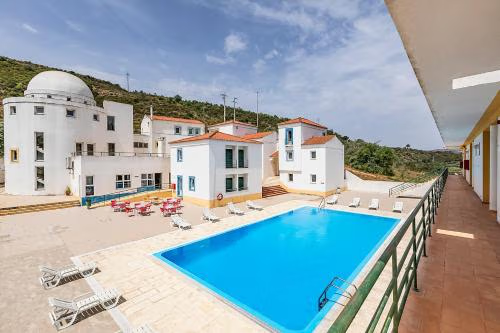
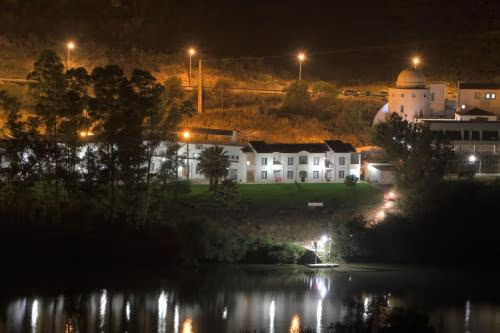
Alcoutim has no albergue in the strict sense, but it does have a youth hostel: the HI Alcoutim – Pousada de Juventude. It has dormitories with four, six and eight beds, all air-conditioned, plus double and family rooms, a guest kitchen and a pool that is open from June to October. A night costs from €20 according to the website (as of November 2026). There are also a few private guesthouses and pensions in town.
Ninja tips
- Shop here for tomorrow. According to pilgrim reports there are no settlements between Alcoutim and the village of Mesquita, and after that it hardly gets better.
- Split the stage in Mesquita. After 13.8 kilometres the village has, according to pilgrim reports, a small albergue with four beds and a restaurant where you should order food in advance. Call ahead, there are only four beds.
- Expect slow kilometres. In 2021 pilgrims described the stretch to Mesquita as hilly, with narrow, partly overgrown paths; for around 16 kilometres they needed more than five hours.
- Take the ferry to Spain. If you have an afternoon to spare, cross over to Sanlúcar. Over there you are in another country and another time zone.
- At Lombardos, stay on the arrows. The official route makes a detour there. The shortcut leads over a narrow dam wall without a railing, a few metres above the ground. With a rucksack the detour is the better choice.
Onward: over the Vascão into the Alentejo
From Alcoutim the Via Nascente leads north, away from the bank and into the hills. According to Camino Ninja you reach Mesquita after 13.8 kilometres, Colgadeiros after 18.2, Vicentes after 21.7 and Lombardos after 29.9. On the way you cross the Vascão and leave the Algarve. After 45.1 kilometres you are in Mértola, where the GR15 ends and the way follows the signs of the Caminhos de Santiago.
What awaits you tomorrow
Mértola, the first big destination in the Alentejo. When you arrive, a church stands above the Guadiana that used to be a mosque and has kept its prayer niche. And the castle above it was in the 13th century the first seat of the Order of Santiago in Portugal. Whether you get there in one day or two, you decide this evening.
Deep dive: A peace in the castle courtyard
A short read, in case you want to learn more about Alcoutim. About two minutes' reading.
Two castles, one river
When you stand on the wall of Alcoutim, you see the castle on the other side. Sanlúcar de Guadiana lies so close that you could almost call across the river. In between flows the Guadiana, and for centuries it was not a road but a front line. Alcoutim was built to hold that front. After the conquest around 1240 King Sancho the Second had the castle built anew, King Dinis gave the town its charter in 1304 and drew a wall with three gates around it.
The spring of 1371
The best-known day in the history of Alcoutim was a day without a battle. King Fernando of Portugal had laid claim to the throne of Castile and had made war on Henry the Second. On 31 March 1371 peace was made in the courtyard of Alcoutim. As was usual at the time, the peace included a wedding: Fernando was to marry a daughter of the Castilian king. But Fernando chose Leonor Teles, a woman from his own nobility who had been married to another. On 5 May 1372 he married her. The promise made at Alcoutim was broken, and until Fernando died he fought two more wars against Castile.
What remained
The castle lost its purpose when the border grew quieter. In the 18th century it was half abandoned and served as a slaughterhouse. Only since the 1960s has it been put back in order, and since the year 2000 a small museum in it has shown what was found in the ground, including stone slabs into which people scratched the boards for their games many centuries ago.
What Alcoutim gives you to take along
Today a small ferry crosses between the two banks, and anyone who wants can fly over from Spain on a wire and land an hour before they set off. The river is still the same, but it no longer divides. Perhaps that is a good thought for the evening before a long stage: borders that were once hard can become light. Some promises don't hold, some peace treaties do. Tomorrow you walk on north, away from the river.
Where to stay in Alcoutim
Places to stay in Alcoutim.
 OpenReservations accepted
Brisas do Guadiana
 OpenReservations accepted
HI Alcoutim – Pousada de Juventude
 OpenReservations accepted
Hotel D'Alcoutim
Town 3 of 25