

Town on the Camino
Alken
Germany
- places to stay
- 16
- Camino
- 1
- Elevation
- 85 m
Alken lives with the view across: on the Bleidenberg, from where the archbishops of Cologne and Trier besieged Burg Thurant in 1248, now stands the pilgrimage church, and opposite it the castle the two of them then shared. Down in the village waits a church first recorded in 1015. Trier is still 139.6 kilometres away.
Right now in Alken (as of October 2026)
- Michaelskapelle: The old church of St. Michael is open only until the end of October, on Sundays and public holidays from 14:00 to 17:00. After that, until May, only on a guided visit by arrangement.
- Burg Thurant: In October daily 10:00 to 17:00, from 1 to 15 November 10:00 to 16:00. From 16 November to the end of February the castle is closed.
How long to stay?
An afternoon is enough. Alken is a small wine village, and the main things lie close together: the pilgrimage church on the Bleidenberg, which you pass anyway, the old church of St. Michael with its ossuary, and above it Burg Thurant. For the castle you need one more short, steep climb. In winter both are closed, and you are left with the Bleidenberg.
Alken in Ninja numbers
- 17.6 kilometres from Koblenz-Stolzenfels to Alken, according to Camino Ninja. The stage is short, but it has a hill at the end and a steep descent.
- 764 mountain pilgrimages to the Bleidenberg had been counted by the parish of Oberfell by 2012, one every year since 1248.
- About 800 metres and 180 metres of descent is the path of the Sieben Fußfälle from the Bleidenberg down to Alken.
- 2 keeps stand on Burg Thurant, one for Cologne and one for Trier. Since 1248 a wall has divided the two halves.
- 139.6 kilometres from here to the Abbey of St. Matthias in Trier, according to Camino Ninja.
Arriving: over the Bleidenberg
On the Mosel-Camino, Alken is the first stage town. From Koblenz-Stolzenfels you climb past the palace into the Koblenz city forest, pass the remains of a Roman temple of Mercury, go through Waldesch and Naßheck, over the A 61 and down to the Aspeler Bach. Then you climb again beside the Oberfeller Bach to the Wallfahrtskirche Bleidenberg, 1.1 kilometres before Alken according to Camino Ninja.
From the Bleidenberg you see Alken and Burg Thurant for the first time. Then it goes steeply down, past the stations of the Sieben Fußfälle, on a stony path that one hiking portal calls a via ferrata. At the bottom you pass through an old town gate and arrive at the old church of St. Michael in Von-Wiltberg-Straße.
In brief: one castle for two archbishops
Alken is old. The name probably goes back to a Celtic river name, and a place called Alkana is recorded as early as the tenth century. Around 1200, Count Palatine Heinrich, a brother of Emperor Otto IV, had Burg Thurant built above the village after returning from the crusade. When its garrison raided the lands of Trier, the archbishops of Cologne and Trier besieged the castle for around two years and took it in 1248. Afterwards they divided the castle and the district of Alken between them, until the end of the Holy Roman Empire.
Around 1330, Archbishop Balduin of Trier had Alken fortified and raised to a town. In 1689 French troops destroyed the castle. In 1911 Robert Allmers bought the ruin and partly rebuilt it. Today it belongs to the Allmers and Wulf families.
Hill against castle
What makes Alken special is best seen from above: the Bleidenberg and Burg Thurant face each other. The hill's name probably comes from the Bliden, the medieval throwing machines. From here the besiegers are said to have bombarded the castle. After the victory, Archbishop Arnold II of Isenburg had the pilgrimage church built up there, on the remains of an older chapel of Mary. Indulgences are recorded for 1253 and 1296.
The castle on the other side is still divided in two, with a Cologne tower and a Trier tower. The Way of the Cross of the Sieben Fußfälle links the victors' church with the village below the castle. If you walk down the Bleidenberg to Alken as a pilgrim today, you walk exactly this line.
Between the Bleidenberg and the castle: what to see
Everything is close together, but never at the same height. Plan a second steep climb for the castle.
- Wallfahrtskirche Bleidenberg: The Gothic church was probably built after 1248, and since 1952 it has been dedicated to the Holy Trinity. After secularisation it was auctioned for demolition in 1818, partly torn down and rebuilt from 1851. Since 1962 it has had a roof again. Since 2012 a pilgrim stone has stood in front of it, the first on the Mosel-Camino. It was set up by a group from Oberfell, Alken and Kobern who, since 2009, have walked with the Matthias brotherhood of Mayen to the tomb of St. Matthias in Trier. The church is open every day all year, and the entrance is on the north side.
- Old church of St. Michael (Michaelskapelle) with ossuary: The church is first recorded in 1015 and is one of the oldest on the Moselle. Until 1849 it was Alken's parish church. In the choir vault sits Christ as Judge of the World, painted around 1350. Through a large iron grille you can look into the ossuary with the bones of earlier villagers. From 1648 a Way of the Cross led from here to the Bleidenberg, and the church was part of the pilgrimage. Open on Sundays and public holidays from May to the end of October, 14:00 to 17:00, phone 02605 8360 (as of October 2026).
- Burg Thurant: From the church of St. Michael it is about 350 metres, but steeply uphill. You will see the castle chapel with old frescoes, a hunting lodge with armour and weapons, and the Cologne tower, from which you look out over the lower Moselle. The Trier tower is not open. The castle is private, and there is an admission fee. We could not find the current price.
- New parish church of St. Michael: It was built from 1846 to 1849 in rubble slate in the Gothic Revival style. Inside stands a Baroque altar of St. Michael from 1708.
Food and drink
We found no reliable pilgrim tips for places to eat in Alken. Alken is a wine village with winegrowers' farms, and the old customs tower on the riverbank is now a restaurant. On Burg Thurant there is a kiosk. In Von-Wiltberg-Straße there is a café bakery.
Honestly
- The descent is hard. The Sieben Fußfälle are steep and stony. After rain it gets slippery. Take your time.
- The turn-off at the Bleidenberg is easy to miss. One pilgrim overlooked it in 2013 and walked via Oberfell, with about 150 metres of extra climbing. Watch carefully for the turn-off at the Bleidenberg.
- There are hardly any pilgrim beds. Apart from one small hostel there are only guesthouses, holiday flats and winegrowers' farms. One pilgrim found the first two days the hardest for getting a bed in 2020. Book early.
- In winter a lot is closed. The Michaelskapelle opens only from May to October, and the castle closes in mid-November.
- Alken has no railway station. A bus runs to Koblenz. The nearest station is in Löf on the other side of the Moselle.
Where pilgrims sleep
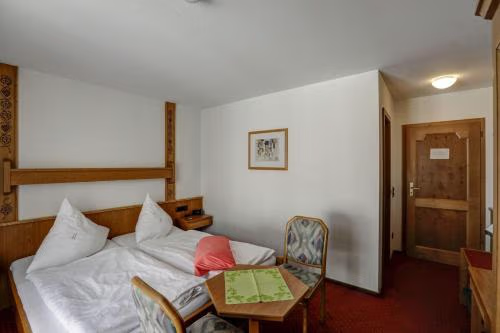
- Pilgerherberge am Bleidenberg: At Bachstraße 14 in the village. According to Camino Ninja it has three places. We could not find out who runs it or what it costs. Ask ahead.
Otherwise you sleep in guesthouses, holiday flats and winegrowers' farms. Single rooms start at around €55 (as of October 2026). According to a hiking portal, the next pilgrim hostel on the route is the Klickerterhof near the Kompes Köpfchen viewpoint, just before Karden.
Ninja tips
- The first photo: At the top of the Bleidenberg you see Alken and the castle for the first time. Stop here before it gets steep.
- A stamp at the motorway: The route passes the Mosel-West service area on the A 61. In 2020 a pilgrim got a stamp at a service area on the way to Alken without even asking: the staff at the counter had seen the shell on his rucksack.
- The pilgrim stone: In front of the pilgrimage church stands the first pilgrim stone of the Mosel-Camino. The Pilgerfreunde Oberfell set it up in 2012 as their starting point on the Moselle.
- Two towers, one view: At the castle, the Cologne tower is the lookout tower. The Trier tower is a water store and stays closed.
- A short detour to the Teufelslay: South of Alken, opposite Löf, lies the Teufelslay viewpoint.
- A film in the chapel: In the old church of St. Michael a multimedia show tells its thousand-year story, made for the anniversary in 2015.
Practical tips for pilgrims
- Stamp: In 2013 you got the stamp at Café Becker. Whether that is still the case, we don't know. We found no current stamp point in Alken.
- Bleidenberg church: Phone +49 2605 8472736. The mountain pilgrimage takes place every year on the first Sunday after Pentecost.
- Getting there and away: You reach Alken by bus 301 from Koblenz. Löf, Hatzenport and Treis-Karden have railway stations.
- For tomorrow: For the stage to Karden, the tourism office recommends sturdy shoes, rain gear and enough to drink. The descent before Karden is steep.
Onwards: across the Moselle to Burg Eltz
On the Mosel-Camino you cross the upstream Moselle bridge to the Eifel side and reach Löf, 1.9 kilometres according to Camino Ninja. A narrow path to the right of the railway runs below the Rabenlay to Hatzenport, 5 kilometres. Then you climb to the Küppchen, a hang-gliding launch site, and go via Lasserg and the Antoniuskapelle down into the Elzbach valley to Burg Eltz, after 12.4 kilometres. Beyond the castle it is steeply up to the Rotherhof, on to the Kompes Köpfchen viewpoint and then steeply down to Karden, 17.7 kilometres.
What awaits you tomorrow
Treis, 18.8 kilometres away according to Camino Ninja, across the Moselle from Karden. On the way you pass Burg Eltz, which was never destroyed. And in the collegiate church of St. Castor in Karden stands a figure of St. James. It is the first figure of St. James on the route that we know of.
Deep dive: Hill against castle
A long read, in case you want to learn more about Alken. About fifteen minutes' reading.
The view from above
If you come along the Mosel-Camino from Koblenz, you see Alken first from above. All morning you have walked through forest, over a plateau, past a transmitter mast and a motorway. Then you stand on the Bleidenberg in front of an old church, and the Moselle valley opens up below you. Across the way, on a spur of slate, stands a castle with two round towers. Below it lies a small village by the river.
This view is not only beautiful. It is a battle plan. From right here, in the thirteenth century, the throwing machines of two archbishops are said to have taken aim at the castle. The church you are standing at was built by the victors. And the path you are about to walk down has linked this church with the village below the castle for almost four hundred years. If you want to understand Alken, you have to understand this facing pair: hill against castle, Cologne against Trier, pilgrimage against feud.
A name from Celtic times
Alken is one of the old places on the Moselle. The name probably goes back to a Celtic river name, Alkana, perhaps for the stream that flows into the Moselle here. According to the tourist office, one part of the village still carries a Celtic name today, Olk. From Roman times, people tell of a Villa Alcana.
The place appears in writing in the first half of the tenth century, as Alkana. The Abbey of Echternach already owned property here at that time. A local gazetteer considers further mentions from the years 1008 to 1015, 1052 and 1093 to be forgeries made in the eleventh century. The same gazetteer reports that in 1093 a Count Palatine named Heinrich endowed the monastery of Maria Laach, which he had founded, with estates in Alken. The Laacher Hof in Moselstraße recalls this, and today it is a winery.
People lived on the castle hill early on, too. In late Roman times, in the fourth and fifth centuries, there was a small fortified hilltop settlement there. And on the Bleidenberg opposite, archaeologists have found the remains of a Celtic wall that probably protected the whole plateau. So long before the Middle Ages, the two heights above Alken were places where people dug themselves in.
A Count Palatine back from the Holy Land
Burg Thurant begins with a crusader, about a hundred years later. He too was called Heinrich. This Count Palatine of the Rhine was a son of Henry the Lion and a brother of the Welf Otto, who later became Emperor Otto IV. Heinrich went to the Holy Land and came back around 1198. Shortly afterwards he had a castle built above Alken to secure his brother's claims on the Moselle.
Where its name comes from is a fine story, but a story all the same. According to tradition, Heinrich named the castle after Toron, a fortress in what is now southern Lebanon that the crusaders had besieged in vain. He is said to have found it impregnable. A local gazetteer offers a more sober explanation: the word might come from Moselle Romance, turún, the tower. In the documents the castle is called Thurun in 1198, castrum Turunh super Mosellam around 1216, the castle of Turunh above the Moselle, and Thoron in 1248.
Impregnable it certainly was not. In 1214 the last Welf Count Palatine died without a son, and Emperor Frederick the Second gave the Palatinate with Thurant to the Wittelsbachs. Straight away the Archbishop of Cologne moved in. Engelbert the First captured the castle around 1216 and held it until his death in 1225. The Pope, Honorius the Third, indirectly called on him in 1218 to give it back. Instead, Engelbert had a tower of his own built in front of the castle. Only years later did the castle return to the Counts Palatine, and in 1243 Archbishop Konrad von Hochstaden expressly gave up all of Cologne's rights. It looked as if the quarrel was over.
The castellan who raided his neighbours
It was not. The Count Palatine's officer at the castle was now a man named Berlewin, known as Zorno, a marshal from Alzey. He and his men, the sources report, used Thurant as a base for raids on the surrounding country. But that country lay in the sphere of the archbishops of Trier and Cologne. A robber knight in a hilltop castle above the Moselle, right between their lands, was something neither of them would accept.
So the rivals joined forces. Archbishop Arnold the Second of Isenburg from Trier and Konrad von Hochstaden from Cologne besieged Thurant together. Exactly when they began is not quite clear. Some sources give 1245, others 1246 or 1247. They agree that the siege lasted about two years.
From the Bleidenberg the besiegers are said to have bombarded the castle with Bliden, great throwing machines that hurled stones. A castle database describes a different cause for the end: the besiegers cut the castle off from the outside world, and in September 1248 the garrison surrendered because it had run out of food. Perhaps both belong together.
On 17 November 1248 a peace treaty set down what was to happen next. The castle and the village of Alken passed to the two archbishoprics jointly. With Thurant, the Count Palatine lost his last stronghold on the lower Moselle. The treaty survives to this day.
One castle for two lords
What came next is rare, and you can still see it at the castle today. The two victors did not divide Thurant on paper, but in stone. A dividing wall separated the northern part, which belonged to Cologne, from the southern part, which went to Trier. Each half got its own entrance, its own living and working buildings and its own keep, the Cologne tower and the Trier tower. Each half had its own castellan. The Cologne part was the smaller one.
Specialists call this a double castle, and only a few survive. Most of the masonry you see today dates from after 1248. The division lasted for centuries. The district of Alken, too, remained the joint property of both prince-electors, until the end of the Holy Roman Empire. As late as 1718 the administration of justice in the village was described as simultanea jurisdictio, the joint jurisdiction of two lords over a small Moselle village.
Around the castle grew a network of vassals. Among them were the lords of Eltz, whose castle you will reach tomorrow, the lords of Winningen and of Waldeck, and, from 1414 to 1436, an officer who took his name from the village, Thys von Alken. Around 1330, Archbishop Balduin of Trier had Alken fortified and raised to a town. The wall connected the castle with the village. In 1332 a privilege of Emperor Louis the Bavarian lists Alken among the places with Frankfurt town law. Later the sources call Alken a market village again, and finally a village. But parts of the wall and the Fallertor still stand.
The victors' church
Up on the Bleidenberg, even before the siege, there was a small chapel dedicated to Mary. After the victory, Archbishop Arnold had a new, larger church built there, Gothic and with three aisles. It is thought to have been built in memory of the siege. A church on the hill where the throwing machines stood: that is perhaps the strangest twist of this place.
Pilgrims soon came. In 1253 the church is named for the first time in a letter of indulgence, another followed in 1296, and more were added in the centuries that followed. An indulgence promised the faithful remission of the punishment for their sins if they visited the church, and so the Bleidenberg became a much-visited place of pilgrimage. The parish of Oberfell counts its mountain pilgrimage from 1248. In 2012 it celebrated the 764th. Since 1680 the church has had three altars, an altar of Mary, an altar of St. Nicholas and an altar of the Cross. In 1753 and 1754 the chapel was enlarged once more.
Alken was part of the pilgrimage too. After the Thirty Years' War, from 1648, a Way of the Cross led from the church of St. Michael in the village up to the Bleidenberg. Its seven stations are called the Sieben Fußfälle, the seven prostrations. It is the path you walk down as a pilgrim today. It is about 800 metres long and drops about 180 metres. The pilgrims of old went up it, from station to station. You go down it, on tired knees. The direction is different, the path is the same.
A demolition that never happened
Then came the age of Napoleon. From 1803 pilgrimages were banned, and the images at the stations fell into decay. At first there was another plan for the church on the Bleidenberg: it was to become the parish church for Alken and Oberfell. In 1805 the plan was dropped. In 1809 permission was requested to demolish the old church. In 1818 it was auctioned for demolition, together with the farm beside it.
It was never completely torn down. Parts fell, the rest remained. Around 1851 rebuilding began, and in 1852 Mass was celebrated again in the restored choir. The nave stayed open to the sky for a long time. Only in 1962 was the whole church roofed again. Ten years earlier, in 1952, it had received a new dedication. The pilgrimage to Mary became a pilgrimage to the Holy Trinity, celebrated on the first Sunday after Pentecost.
What you see today is the work of volunteers. In 1994 the church choir Cäcilia from Oberfell founded a committee that restores the church and raises money for it with serenade concerts. Since 2023 a volunteer team has been developing the church further, as an open place for worship and culture. For October 2025 the city of Koblenz invited people to a guided visit with a member of this team. It was also to be about the effort of keeping such a building standing, and instead of an entry fee a donation to the church was requested.
A thousand years of St. Michael
Down in the village stands the second church of this story. The old church of St. Michael, which many call the Michaelskapelle, is considered one of the oldest churches on the Moselle. It is first named in a document of 1015, in a foundation for the annual commemoration of Archbishop Megingaud of Trier. A local gazetteer is more cautious. It regards the early documents mentioning Alken from the years 1008 to 1015 as later forgeries and names the church of St. Michael only for 1256. In 2015 Alken celebrated its thousandth anniversary.
For a long time it was not even a parish church of its own. The mother church lay on the other side of the Moselle, in Löf, the first place you will reach tomorrow. In 1146 the community was allowed to choose its own priest, in 1446 it got its own clergyman, and in 1616 Alken became an independent parish. In 1296 twelve prelates in Rome issued a letter of indulgence for the church.
The building has a Romanesque core. The west tower dates from the thirteenth century, and the sacristy bears the year 1547. When you go in, look up into the choir first. There Christ sits enthroned as Judge of the World, flanked by Mary and John the Baptist, painted around 1350. In the other sections of the vault the twelve apostles were shown, and not all of them can still be made out. On the walls of the nave there were paintings from the fifteenth century, the Passion of Christ on one side and the ten plagues of Egypt on the other. In the seventeenth century they were painted over, and in 1928 part of them was uncovered again.
The church also tells of the lords of Wiltberg. In 1571 an altar of Mary had to make way for a funerary monument to Count Heinrich von Wiltberg. In 1883 this epitaph was sold, and today it is in the Landesmuseum in Bonn. In 1662 a Wiltberg donated a painting of the Coronation of Mary. At the top of the stairs stands a Pietà from 1686, and at the end of the Way of the Cross a large Ecce Homo from 1787. Among the saints in the altars and pictures you will find Nicholas, patron of boatmen, Urban, patron of winegrowers, and Matthias, the apostle whose tomb in Trier is the goal of this route.
In 1849 the new parish church was consecrated, a Gothic Revival building of rubble slate. The old church was abandoned, but not demolished. In 1898 a first renovation began, and on 28 May 1935, after a long restoration, a service was held here again. Since around 1980 a St. Michael brotherhood has cared for the church. At great expense it has had the old frescoes secured and uncovered. In 1987 a winged altar from South Tyrol was added.
The dead beneath the church
Beneath the church lies the ossuary. The churchyard around it was small, so it was cleared again and again. The bones were laid in the ossuary, layer upon layer. You can look in through a large iron grille.
In the 1970s the Anthropological Institute of the University of Mainz examined the bones. The oldest date from the early fourteenth century, the most recent from the eighteenth. In 126 of the 151 skeletons the researchers could still determine the blood group. These are people from Alken, from five centuries. One hiking portal calls the ossuary bizarre. You can also see it differently: here lies the village you looked down on from the Bleidenberg.
A house built of castle stones
After the lords of Alken, a noble family that died out at the end of the fifteenth century, came the lords of Wiltberg in 1495. From 1495 to 1530 Nikolas von Wiltberg was the officer at Thurant. The castle was already in poor condition by then, and in 1542 it was described as dilapidated. When the Wiltbergs built their manor house in Alken in 1616, they used stones from Thurant for it. The castle became a quarry for the village below it. The house is now called the Wiltburg and has a Baroque doorway. According to other accounts, its core dates back to the fourteenth century, when it was a manor house of the archbishops of Trier.
In Oberstraße stands the Malteserhaus, with a gateway and a stone spiral staircase in its courtyard. It was probably once a hospital. All that is certain is that there was a hospital in Alken in 1656, and that it was dilapidated. Whether pilgrims were taken in there, the sources we found do not say.
The French, ruins and a painter from London
The seventeenth century brought war to the Moselle. In 1673 and 1674 French troops extorted money from the village under threat of fire. In 1689, in the War of the Palatine Succession, they destroyed Burg Thurant. What remained were the two keeps and a dwelling from the sixteenth century. In 1798 Alken became a French commune, and Napoleonic troops destroyed the knights' hall in the Cologne part of the castle in 1812 or 1813. In 1816 Alken passed to Prussia.
In 1839 a traveller with a sketchbook came by, the Englishman William Turner. He drew Alken in pencil, looking downstream, and turned it into a watercolour that same year. In the sketch the castle presides at the centre, on a vertiginous mount, as the Tate in London puts it. At the foot of the rock you can make out the pointed tower of the Michaelskapelle.
In 1911 Robert Allmers bought the ruin, a publisher and car manufacturer who later headed the Reich Association of the Automotive Industry. In 1915 and 1916 he had parts of it rebuilt, among them the gatehouse. In the Second World War American artillery and a fire destroyed the manor house. It was rebuilt on the old foundations from 1960 to 1962 and is still lived in today. Since 1973 the castle has belonged to the Allmers and Wulf families.
What nobody knows for sure
A lot is told about Thurant, and not all of it fits together. When was the castle built? A castle database gives 1195 as the first mention, a local gazetteer dates the building to shortly after 1198, and the English Wikipedia sees the first certain mention only in 1209 and suggests construction between 1198 and 1206. The Tate gives 1197. They all mean roughly the same thing: around 1200, shortly after the crusade. Nobody knows more precisely.
Even more intriguing is the name of the hill you stood on. The usual explanation traces it to the Bliden, the besiegers' throwing machines. A local gazetteer gives the earliest form, Blithenberch, from the year 1247, in the middle of the siege. But it also offers a completely different reading: the Middle High German ze deme bliden berge would simply mean at the friendly hill. And there is a legend that the castle was bombarded with lead balls, hence Bleidenberg. The gazetteer drily notes that guns are only recorded in the region from the fourteenth century.
So perhaps the hill is not named after the weapons that fired from it, but simply after its friendliness. You can choose. Both suit the place where the victors built a church.
A new route in an old place
Since the summer of 2008 the Mosel-Camino has been waymarked all the way, from Koblenz-Stolzenfels to the Abbey of St. Matthias in Trier, with the yellow shell on a blue background. The idea for the waymarking came from Karl-Heinz Jung, who combines waymarks with nature conservation and hangs nest boxes and insect hotels along the Ways of St. James. In 2013 a pilgrim found the shells on the first kilometres on such nest boxes. A birdhouse showed him the way to Santiago.
In Alken and Oberfell there are pilgrims, too, who do not come from far away. A group of young men from Oberfell, Alken and Kobern who call themselves the Pilgerfreunde Oberfell have walked since 2009 with the Matthias brotherhood from Mayen to the tomb of the apostle Matthias in Trier. In 2011 they decided to create a starting point of their own on the Moselle. For Trinity Sunday, 3 June 2012, they invited people to the blessing of their pilgrim stone, after the festive High Mass of the 764th mountain pilgrimage. Since then it has stood in front of the church on the Bleidenberg, the first pilgrim stone on the Mosel-Camino. In the invitation they described the church as a year-round port of call for visitors and walkers.
Others came from further away. In October 2013 Rainer Steinhausen walked the route, missed the turn-off at the Bleidenberg and made a detour via Oberfell. He described the church as a quiet place to get in the right frame of mind. In the autumn of 2020 Jakob Engel came to Alken, on the last part of a 45-day walk that had begun in Görlitz and ended in Trier. Two minutes before he reached his lodging, it started to rain.
What Alken gives you
Alken is a place of opposites that face each other. A castle and a hill, two archbishops in one castle, a wall between two towers, a church above and a church below, and between them a path with seven stations. Whoever comes here has the first day of the Mosel-Camino behind them, and most of the days still ahead.
Perhaps what you take from here is how quickly the meaning of a place can change. Where throwing machines stood, a church has stood for almost eight hundred years, and people climb up to it every year. A castle that two lords divided with a wall is today a house where a family lives, and a lookout tower. And a path that pilgrims once climbed, you now walk downhill, on your way to the tomb of an apostle in Trier and perhaps on to Santiago.
Tomorrow you cross the bridge to Löf, where Alken's mother church once stood. Behind you remain the hill and the castle, which have been looking at each other for almost eight hundred years.
Where to stay in Alken
Places to stay in Alken.
 Open
Pilgerherberge am Bleidenberg
 OpenReservations accepted
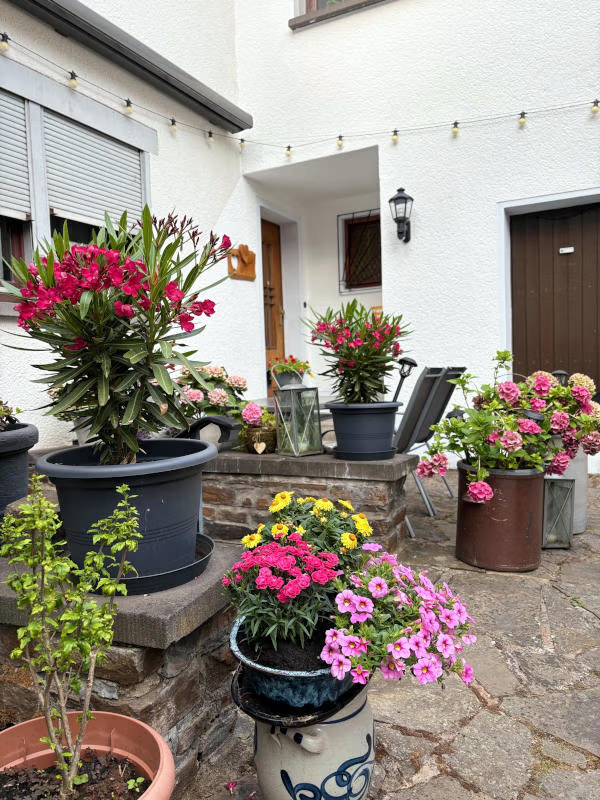
Winzerhof Brachtendorf
 Open
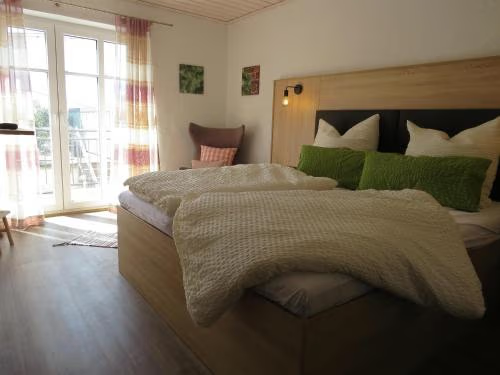
Ferienwohnung Christ

Services in Alken
What you can find in town before the next stage.
- Café
- Shop
- Fountain
- Post office
- Train station
- Bus station
- Restaurant
Source: © OpenStreetMap contributors · updated April 2026