

Mosel-Camino
The Mosel Camino takes you on an 8-stage, 157.1-kilometer journey from Koblenz-Stolzenfels to the Benedictine Abbey of St. Matthias in Trier—the only apostle’s tomb north of the Alps. It is a high-altitude trail, not a riverside path: It bypasses the bends of the Moselle via the Hunsrück and Eifel hills, gaining 3,899 meters in elevation along the way—and follows a relic that traveled the same route 700 years before you.
- 01At a Glance
- 02Overview
- 03753 Miracles on the Way to a Grave That Is Not Recorded
- 04Other Names
- 05Who It's Ideal For—and Who It's Not So Ideal For
- 06Route & Landscape
- 07Stages, Terrain & Difficulty
- 08Highlights Along the Way
- 09How Pilgrims Find Their Way onto This Path
- 10Continue the pilgrimage?
- 11Preparation & Practical Information
- 12What the journey will cost you
- 13Getting Here
At a Glance
- Start / Finish: Koblenz-Stolzenfels (the banks of the Rhine below Stolzenfels Castle) → Trier, St. Matthias Benedictine Abbey — the only apostle's tomb north of the Alps
- Length: 157.1 km (approx. 180 km including all detours) — a high-altitude trail through the Hunsrück and Eifel regions that bypasses the Moselle loops and crosses from one bank to the other several times
- Elevation gain: ↗ 3,899 m / ↘ 3,867 m — just under 500 meters of elevation gain per day between 68 and about 435 meters in elevation; the 7,685 m figure circulating elsewhere is a GPX counting error
- Duration: 8 stages (7–9 days) — the St. James Brotherhood of Trier also offers a 9-stage version that makes the two long days less strenuous
- Waymarking: A yellow scallop shell on a blue background with yellow arrows—well over a thousand signs and stickers, maintained by volunteer trail sponsors; getting lost is practically impossible, but you should still pack a GPX file
- Access route: The Lahn-Camino and the Rhine-Camino end across the river in Oberlahnstein; the Left Bank Rhine Way of St. James passes through Stolzenfels; along the way, the Eifel-Camino joins the route in Klausen, and the Via Coloniensis in Trier-Biewer
- Connection: In Trier, the Trier–Le Puy Way of St. James begins at the same church door—the Mosel-Camino covers the first week of the journey to Santiago
- Best time: March through October; September offers the best balance of weather, lush hillsides, and winding-down wine festivals
- Character: A culturally rich, short Camino route with no chain of hostels—only two pilgrim hostels along the entire route; the usual option is a winery, and you’ll need to book in advance
Overview
The Mosel-Camino is named after a river it barely touches: 157.1 kilometers from Koblenz-Stolzenfels to the Benedictine Abbey of St. Matthias in Trier, home to the only apostle’s tomb north of the Alps—but instead of meandering along the riverbank, the trail veers up into the Hunsrück and Eifel hills, cutting across the bends of the Moselle and paying the price with 3,899 meters of elevation gain. Its origins are also unusual: no club, no government agency, no regional association — in the summer of 2008 two private individuals, Karl-Josef Schäfer and Wolfgang Welter, laid out the route. It has two names, well over a thousand stickers, and trail sponsors who volunteer to replace the stickers.
Long before you, a relic proved that this is the right direction. Around 1220 a knight built above Kobern—on the other side of the Moselle, across from your first stage—the hexagonal Matthiaskapelle modeled after the Church of the Holy Sepulcher: for the head of the Apostle Matthias, which he is said to have brought back from the crusade. Then the head moved on: in 1347 to Sayn Castle, in 1381 to the Ehrenbreitstein above Koblenz, around 1420 to Trier Cathedral—and since 1927 it has rested in St. Matthias, right where your path ends. St. Matthias’s head traveled this route 700 years ahead of you—you’ll cover it in eight days, a journey that took the relic seven centuries.
753 Miracles on the Way to a Grave That Is Not Recorded
Stage 6 takes us to the second-largest pilgrimage site in the Diocese of Trier, and it begins with a day laborer: in 1440, Eberhard — small farmer and winegrower — places an image of Our Lady of Sorrows in a twelve-foot-tall wayside shrine, in 1442 he builds a hermitage next to it measuring "drei Schritten Länge, zwei Schritten Breite"; his name became the name of the town: Eberhardsklausen, now Klausen. When Anna von Esch is healed after receiving Communion in the chapel—which has not yet been consecrated—the pastor of Piesport protests—and the dispute among the clergy only serves to make the town all the more credible. In 1449 the archbishop consecrates the church, in 1459 the Windesheim canons take over, and one of them, Wilhelm von Bernkastel, records between 1485 and 1536 in his Historia domestica monasterii Everhardi Clusae exactly 753 miracles from the years 1447 to 1536 — cures of blindness, deafness, and paralysis, available in printed books of miracles from 1640 onward. Today, more than 100,000 pilgrims visit each year.
And now the destination, 25 kilometers further on: In St. Matthias in Trier, where the apostle's remains were found during demolition work in 1127, there is no book of miracles — just a pilgrimage guide and a devotional book from 1652. What’s more: Historical research disputes the claim that any relics of Matthias are actually located in Trier. That hasn't changed a thing. Since the 11th century, the Matthiasbruderschaften (St. Matthias brotherhoods) have been making pilgrimages to the apostle's shrine—today, about 160 groups a year, most of them walking for three to four days, and most of them during the two weeks around Pentecost. 25 kilometers before the finish line, they counted 753 miracles. At the finish line: not a single one—and yet the pilgrimage has continued for 900 years. Walking was never dependent on the evidence.
To get the full picture, we must also acknowledge this: There was no medieval “Mosel-Camino”—no itinerary, no document, no trail name prior to 2008. The route is new, but it runs through ancient terrain: The Jakobuskapelle in Zell-Kaimt is first mentioned in 1143 and still bears the patronage of St. James to this day; the Bleidenberg above Alken has a letter of indulgence from 1256 — 40 days of indulgence for people who hike up the mountain—exactly what you'll be doing on Stage 1. And the end of this old world has a date: In the same week of July 1802, the French administration closed no fewer than three monasteries along this route. The Mosel-Camino doesn't claim to have a history—it collects it.
Other Names
There are several ways to write this, and they all mean the same thing: Moselcamino, Mosel Camino, Mosel-Jakobsweg or simply “Jakobsweg von Koblenz nach Trier”. It doesn't have a medieval name because it didn't exist in the Middle Ages—the name dates back to 2008 and comes from the two men who laid the route. You'd better clear up two misunderstandings right away: The Eifel-Camino, which joins the route in Klausen, is also called "Matthiaspilgerweg" — so anyone searching for that term will end up with the neighboring route from Andernach, which is also about 160 kilometers long. And occasionally, the umbrella term “Mosel-Eifel-Camino” appears when someone describes both routes in the same breath. This always refers to the Koblenz-Stolzenfels → Trier St. Matthias line.
Who It's Ideal For—and Who It's Not So Ideal For
This path is for you if you're looking for a first long-distance pilgrimage route in Germany: a week-long hike with excellent trail markings, and in the evenings, you won’t be staying in a dormitory but at a winemaker’s inn. It’s ideal if churches and monasteries aren’t just stops along the way for you, but the very reason for the hike—along the 157-kilometer route, you’ll find an apostle’s tomb, a pilgrimage site attracting over 100,000 pilgrims a year, the Romanesque “Moseldom” in Karden, and six former monasteries. And it’s ideal if you enjoy traveling by train: The Moselle railway line runs alongside the trail almost the entire way, so you can hike each stage individually, stop, and pick up where you left off later.
To be honest, though, it's not for you if you imagine the "Moselweg" to be a flat riverside path. The Camino flees the shore: 3,899 meters of elevation gain over 157 kilometers, two stages of over 24 kilometers each, and the descents to Alken, Karden, and Bullay are brutal. It’s also not for you if you’re hoping for a place to stay on the fly: There are exactly two pilgrim hostels all along the way—the “Alte Lateinschule” in Traben-Trarbach and the “Eberhardsklause” in Klausen—everything else is a bed-and-breakfast, guesthouse, or winegrower’s room, and must be booked in advance. And you'll hardly find any fellow pilgrims here: on the Mosel Camino, you're often the only one with a scallop shell on your backpack.
Route & Landscape
The route begins on the Rhine, not on the Moselle: below Schloss Stolzenfels, which Schinkel and Stüler transformed between 1836 and 1842 from a Kurtrier customs fortress—destroyed in 1689—into the crowning achievement of Rhine Romanticism. From there, the Camino immediately veers away from the water, passing the remains of a Roman Temple of Mercury, and doesn't reach the Moselle until the evening of the first day — in Alken below the Double Castle Thurant, whose two keep towers (“Trierer Turm” and “Kölner Turm”) commemorate a reconciliation agreement from 1248. This pattern repeats itself for eight days: Down to the river, up to the hill, and down again. Here, the Moselle winds through bends that would be absurd to traverse on foot—the Zeller Hamm alone stretches nearly 14 kilometers—and the trail cuts across them, partly over the Hunsrück and partly over the Eifel hills, crossing from one bank to the other several times. The reward comes right away on Stage 2: Behind Lasserg, the trail descends into the Elzbach Valley, and right in the middle of the path stands Burg Eltz — first documented in 1157, never conquered, and in the same family for 34 generations.
What you get from up high are views that no one can see from the riverbank: the Moselle loop from the Marienburg on the Petersberg, the view from the Kompesköpfchen down toward Karden, the Graacher Schanzen above Bernkastel, the panoramic view from the Brauneberg. In between, the trail winds through steep slopes whose names you'll recognize from the wine rack — Zeller Schwarze Katz, Brauneberger Juffer, Graacher Himmelreich — and near Bullay passes the Calmont on the opposite bank: on this route, Europe's steepest vineyard, with a slope of up to 65 degrees, is a view, not a chore — if you want to do the via ferrata, you’ll need to make a detour across the river and set aside an extra half-day. The trail is at its quietest between Monzel and Klüsserath: dirt roads, forest chapels, and the pilgrimage church of Klausen. And on the last day, the scenery first takes an unexpected industrial turn—Quint, Ehrang, Biewer—and then suddenly becomes Roman: the Kaiser-Wilhelm Bridge, the Old Crane, the Roman Bridge, St. Matthias.
Stages, Terrain & Difficulty
Eight stages are the standard — this is how the operator's guidebook and the St. James Brotherhood of Trier list it, the latter also offering a 9-stage version that breaks down the two long days, 3 and 4, into three shorter ones via Beilstein and Zell. According to our route database, it is 157.1 kilometers with 3,899 meters of ascent and 3,867 meters of descent; the stage distances listed below are taken from the stage guides and are therefore marked as “approx.” What makes the route challenging isn’t the terrain—forest, field, and vineyard trails, along with short stretches of asphalt—but the elevation profiles: You’re constantly moving between 68 and about 435 meters, yet you still end up with nearly 4,000 meters of elevation gain because the trail makes up for every loop with a ridge. It’s hard to get lost—the trail markings are considered exemplary—but they’re maintained by volunteers, not by the authorities: download the GPX file to your phone. And the real factor to consider when planning is where to sleep: Your destination for the day isn't determined by your fitness level, but by where your lodging is located.
- Koblenz-Stolzenfels → Alken — approx. 18 km — Starts on the banks of the Rhine below Stolzenfels Castle, passes the ruins of a Roman Temple of Mercury, continues through Waldesch and the Hünenfeld to the Church of the Holy Trinity on the Bleidenberg (indulgence charter from 1256; since 2012, the first pilgrim stone along the route); a steep descent along the Way of the Cross from 1648 to Alken, below the Thurant double castle.
- Alken → Treis-Karden — approx. 18 km — Cross the Moselle Bridge to the Eifel side toward Löf and Hatzenport; after Lasserg, head into the Elzbach Valley — right along the route: Eltz Castle. From the Kompesköpfchen viewpoint, descend steeply to Karden and the “Moseldom,” St. Castor.
- Treis-Karden → Bullay — approx. 28 km — The long day, and the most beautiful: via Wildburg into the Flaumbach Valley to the Maria Engelport Monastery (guesthouse and restaurant—you can split the stage in half here), on to Beilstein with the Metternich Castle ruins, then over the Hunsrück Heights to the Lindenhäuschen Chapel and down to Bullay. Across the way, unrivaled: the Calmont.
- Bullay → Traben-Trarbach — approx. 24 km — Up the winding road to Marienburg in the Zeller Hamm (consecrated in 1157), down to Zell-Kaimt to St. Jakobus (chapel first mentioned in 1143), through Zell (Schwarze Katz), via Enkirch and Starkenburg to Traben-Trarbach — Lodging: “Alte Lateinschule” pilgrim hostel, one of only two along the route.
- Traben-Trarbach → Osann-Monzel — approx. 17 km — A relaxing stage featuring notable vineyards: via the Graacher Schanzen to Bernkastel and Kues (the Cusanus Foundation, home to the heart of Nikolaus von Kues), through the vineyards via Lieser and the Brauneberg to Monzel.
- Osann-Monzel → Klüsserath — approx. 19 km — The pilgrimage stage: to Klausen to the pilgrimage church of the Visitation of Mary (miraculous image from around 1440, over 100,000 pilgrims a year — this is where the Eifel-Camino joins the route; “Eberhardsklause” pilgrim hostel), then quietly past forest chapels to Klüsserath at the mouth of the Salm River.
- Klüsserath → Schweich — approx. 14 km — The shortest day, via Ensch through vineyards and woods to Schweich — good for a half-day rest or for moving up the final leg.
- Schweich → Trier St. Matthias — approx. 20 km — Longer and steeper than expected: through the forest to Trier-Quint, across the Ehranger Heide to Trier-Biewer (this is where the Via Coloniensis joins the route), then over the Kaiser-Wilhelm Bridge, past the Old Crane and along the Roman Bridge to the Benedictine Abbey of St. Matthias. At the Apostle’s Tomb: pilgrim stamp and pilgrim’s blessing.
If you want to make the route easier, take the Brotherhood’s 9-stage version (Treis-Karden → Beilstein → Zell → Traben-Trarbach instead of Days 3 and 4) or split the 28-kilometer stage in half at the Maria Engelport Monastery; if you’re feeling athletic, you can combine stages 6 and 7 to make it a seven-day trip. And since the Moselle railway line runs alongside the trail almost the entire way, the train serves as your safety net: You can cut the trip short, skip a stage, or send your luggage ahead on almost any day.
Highlights Along the Way
- Schloss Stolzenfels, Koblenz — The Trier customs fortress of Archbishop Arnold II (1242–1259), destroyed in 1689, rebuilt in the Neo-Gothic style from 1836 to 1842 under Lassaulx, Schinkel, and Stüler; Frederick William IV’s entry on September 14, 1842. “The outstanding masterpiece of Rhine Romanticism,” part of the Upper Middle Rhine Valley UNESCO World Heritage Site since 2002—your kilometer zero.
- Matthiaskapelle Kobern-Gondorf (Prologue before the start, by regional train on the opposite bank) — A hexagonal central structure built around 1220–1240, modeled after the Church of the Holy Sepulcher in Jerusalem, and constructed to house the head of the Apostle Matthias, which has rested at your destination in Trier since 1927. Open to visitors only on summer weekends.
- Shrine on the Bleidenberg, Oberfell — Consecrated in 1250 on Trinity Sunday; a letter of indulgence from 1256 granting 40 days of indulgence; the Alken Way of the Cross has been in place since 1648; the first pilgrimage stone of the Mosel-Camino has stood here since 2012.
- Thurant Castle above Alken — Built in 1198–1206 by Count Palatine Henry the Long; besieged in 1246–1248 by the archbishops of Trier and Cologne; the settlement agreement of November 17, 1248, is considered one of the oldest German documents. Since then, there have been two keep towers: the Trierer Turm and the Kölner Turm, with a wall between them.
- Burg Eltz — First mentioned in 1157 in a document by Frederick Barbarossa (“Rudolfus de Elze”); never conquered or destroyed; in the same family for over 800 years; today in its 34th generation; featured on the 500-DM bill in 1961. The trail runs right past it; guided tours are available from April 1 through November 1.
- St. Castor Collegiate Church, Karden — the “Moseldom”: Castor (d. c. 400) was a student of Maximin, Bishop of Trier; construction of the Romanesque choir began in 1186; the earthenware altarpiece, dating from c. 1425–1430, is considered the oldest fired earthenware altarpiece in the Rhineland. The monastery was dissolved in 1802.
- Maria Engelport Monastery in the Flaumbach Valley — Founded around 1220 by Knight Emelrich von Monreal, “porta angelica”; became a Premonstratensian monastery in 1272; dissolved in 1802; reestablished by the Oblates in 1903; home to the Sisters of Adoration since 2014. Guesthouse, monastery shop, restaurant — right in the middle of the longest stage.
- The Calmont (from the other side) — Europe’s steepest vineyard, with slopes up to 65 degrees, located between Bremm and Ediger-Eller on the other side of the Moselle. This trail offers a view, not a challenge—the via ferrata over there requires sure-footedness and an extra half-day.
- Marienburg auf dem Petersberg — Augustinian convent founded in 1146; the church was consecrated on October 18, 1157, by Archbishop Hillin; dissolved by Pope Leo X in 1514/15; destroyed in 1650; auctioned off in 1803. The view across the 14-kilometer-long Zeller Hamm is the best along the entire route.
- St. Jakobus der Ältere, Zell-Kaimt und die Schwarze Katz — St. James Chapel is first mentioned in 1143; inside is a Romanesque limestone plaque dating from around 1220 honoring the donors Sifrid and Friderun; the tabernacle is shaped like a grapevine. A few steps further on in Zell: The “Schwarze Katz” vineyard has been named since 1863 after a cat named Mori, who jumped onto a barrel and influenced Aachen merchants’ decision to buy it.
- Burgruine Starkenburg — Here, in the summer of 1328, Loretta von Sponheim held Balduin von Luxemburg, the Archbishop of Trier, captive for a month; she was excommunicated — and got her way. You walk to the tomb, which belongs to the archdiocese, and pass the castle where a widow held the archbishop hostage.
- St.-Nikolaus-Hospital / Cusanusstift, Bernkastel-Kues — Founded in 1458 by Nicholas of Cusa for 33 men in need over the age of 55 — 33, like the number of years Christ lived. It houses the most significant surviving private library of the Middle Ages; the cardinal’s heart rests in the chapel, while his body lies in Rome. The most famous son of this path returned only as a heart.
- Our Lady of the Visitation Pilgrimage Church, Klausen — Miraculous image of the Pietà, ca. 1440 (oak, 20 cm); Antwerp Passion Altar, ca. 1480; Rieger organ from 2007; “Eberhardsfässchen” on the tower; Klausener sugar pipes as souvenirs. Second-largest pilgrimage site in the Diocese of Trier; the Eifel and Mosel-Camino routes converge at the foot of the church—the pilgrim stele there was consecrated on April 23, 2010.
- Benediktinerabtei St. Matthias, Trier — the only apostle’s tomb north of the Alps, rediscovered in 1127 during demolition work. You can reach the tomb via a staircase—or an elevator—leading down to the crypt; pilgrim stamps and blessings are available at the abbey, and a monk is assigned specifically to serve as the pilgrim chaplain. Your destination—and the starting point of the route to France.
How Pilgrims Find Their Way onto This Path
The most natural route ends two kilometers before the starting line, on the other side of the Rhine. The Lahn-Camino runs for about 140 kilometers from Wetzlar and ends at the Hospitalkapelle St. Jakobus in Oberlahnstein — that medieval pilgrims’ hospital, which was first mentioned in a document dated November 24, 1330 (“provisor hospitalis pauperum in Laynstein”), and in whose soil the grave of a pilgrim on the Way of St. James was unearthed in 1982—the fourth such grave ever found in Germany. So, two kilometers before your starting point, there’s a true St. James pilgrim; the trail itself dates back to 2008—but the people who walked it in spirit had been there long before. The Mosel-Camino was built precisely for these arrivals: “Mit der Eröffnung des Mosel-Caminos im Jahr 2008 ist für die Pilger der Anschluss an den Lahn-Camino geschaffen worden” writes the St. James Brotherhood of Trier. One snag remains: the ferry from St. John’s Church to Stolzenfels no longer exists — if you want to cross over, take the northern Horchheim railroad bridge—it’s a detour of a few kilometers that you should plan for in advance rather than discover along the way.
Two more trails lead up from the Rhine Valley: the Rhein-Camino from Kaub, which ends at the same point, Oberlahnstein (both marked by the Taunus Club in 2001), and the Linksrheinische Jakobsweg from Cologne to Bingen, the Koblenz section of which runs past the Deutsches Eck to the Stolzenfels district—it passes right by your starting point. Along the way, the route is joined by another path: In Klausen, at the foot of the pilgrimage church, the Eifel-Camino from Andernach joins the route; it was marked from 2008 onward with pilgrimage stones made of basalt lava—from there, you walk to Trier together. And in Trier-Biewer, just before the finish line, comes the Via Coloniensis from Cologne. This route gathers its pilgrims just as the Moselle gathers its streams.
Continue the pilgrimage?
This journey does not end in Trier; it is passed on — at the same church door. The Jakobsweg Trier – Le Puy begins at the Abbey Church of St. Matthias, where you have just arrived, and runs 886 kilometers through Metz, Toul, Langres, Dijon, Beaune, and Cluny to Le Puy-en-Velay; in France, it is called “Chemin des Allemands”, the "Path of the Germans"—not because of an old document, but because almost exclusively Germans walk there today. In Le Puy, the Via Podiensis takes over, via Conques, Cahors, and Moissac to the Pyrenees, where the Camino Francés begins. Anyone who continues on from St. Matthias still has about 2,400 kilometers to go to Santiago — the Mosel-Camino is the first week of it.
Besides, you won't be the only one arriving in Trier: The Hunsrücker Jakobsweg ends here, joining the Way of St. James Fulda – Bingen from eastern Hesse at Bingen; so do the Eifel-Camino and the Via Coloniensis — Trier is the hub where German trails converge before one of them continues on to France. Those who aren't continuing on can get their stamp and the Trier Pilgrim's Certificate: To do this, you'll need to provide proof of the last 100 kilometers, which is easily done by taking the Mosel-Camino from Traben-Trarbach or Monzel.
Preparation & Practical Information
Book in advance—that’s the most important thing to remember about this route. There are exactly two pilgrim hostels along the 157-kilometer route: the "Alte Lateinschule" in Traben-Trarbach (Stage 4) and the “Eberhardsklause” in Klausen (Stage 6); both will ask to see your pilgrim passport. Everything else consists of inns, guesthouses, and winemakers' guest rooms, and during the season, towns along the Moselle are packed—including grape harvests and wine festivals. The website mosel-camino.info offers a list of accommodations for download but expressly disclaims any guarantee of completeness “aufgrund allzu häufig sich ändernder Rahmenbedingungen”: Check it shortly before departure and call directly. Anyone who’s daunted by the 28-kilometer Stage 3 can split it at Maria Engelport Monastery — the guesthouse and restaurant are located right in the middle.
Think in terms of elevation gain, not kilometers. A total of 3,899 meters of elevation gain over eight days works out to just under 500 per day, but the climbs aren’t evenly distributed: Bleidenberg, Marienburg, and the transitions between the Hunsrück and Eifel highlands are short and steep, and the descents to Alken, Karden, and Bullay are hard on the knees—trekking poles aren’t just for show here. Water is available at the stage towns, but not on the high ground in between: Between Beilstein and Bullay and between Monzel and Klüsserath, you’ll be walking long stretches without a place to stop, so be sure to bring two liters with you. Get your pilgrim's passport in advance from the St. James Brotherhood in Trier or your diocese—and be sure to collect stamps consistently, because you’ll need proof of the last 100 kilometers to receive the Trier pilgrim certificate.
Best time to visit: March through October, and September is the compromise most often recommended in route guides—20 to 25 degrees, the steep slopes still green, and the wine festivals largely over. In midsummer, the south-facing slopes become hot and shade-free; in winter, the vineyard paths are slippery and many wineries are closed. The guidebook is by Karl-Heinz Jung and Wolfgang Welter, “Mosel-Camino”, Conrad Stein Outdoor Handbook Volume 291 (6th edition, 2025, 96 pages, 16 maps); GPS tracks are available in the guide and on the operator’s website—be sure to bring them along, as the trail markings are maintained by volunteers, not by official authorities. Plan your daily stages in advance, because the lodging options are limited and unevenly distributed—the easiest way to do this is directly in the Camino Ninja app, where you can put together your stages and plan suitable accommodations at the same time.
What the journey will cost you
The Mosel-Camino isn't a cheap route, but it's one where you can plan your budget (all prices as of August 2026). The two pilgrim hostels offer the most affordable accommodations along the route: Traben-Trarbach (“Alte Lateinschule”) approx. 27 €, Klausen (“Eberhardsklause”) about 25 € per night. Otherwise, at a winemaker's guest room, guesthouse, or bed-and-breakfast you'll pay about 35 to 40 € for a single room with breakfast; expect to pay 10 to 12 € for a main course at a Moselle restaurant. In total, trip reports come to 35 to 47 € per day per person — for eight days roughly 300 to 400 € excluding travel. There are two factors to consider: book directly instead of through travel sites (which, based on experience, saves ten to fifteen euros per night), and adjust your overnight stops—Bernkastel-Kues and Traben-Trarbach are tourist towns with tourist prices, while Monzel, Ensch, and Klüsserath are significantly cheaper. Plus, there are the small expenses that are easy to forget: pilgrim’s passport, admission fees for Stolzenfels Castle and Eltz Castle (guided tours only from April 1 to November 1), and train tickets—the Moselle route is the best “emergency exit” insurance you can have (as of August 2026).
Getting Here
To Koblenz-Stolzenfels: This route is one of the easiest of all the German Way of St. James routes because the starting point and destination are both located at long-distance train stations. Koblenz Hauptbahnhof is an ICE/IC stop on the Rhine Line (Cologne, Mainz, Frankfurt); from the train station, the city bus takes you in about 15 minutes to the stop Stolzenfels Schlossweg; from there it's just a few minutes to the banks of the Rhine below the castle. Anyone coming from the Lahn-Camino is on the wrong side of the Rhine in Oberlahnstein: the former ferry route from St. John's Church to Stolzenfels no longer exists — what remains is the northern Horchheimer Eisenbahnbrücke, a detour of a few kilometers that you should plan for.
Back from Trier: From St. Matthias, it's about two kilometers or a few minutes by bus to the Trier Hauptbahnhof, with connections to Koblenz (Moselle route), Saarbrücken, Cologne, and Luxembourg; the nearest airports are Luxembourg-Findel, Frankfurt-Hahn, and Cologne/Bonn. The real trick to this route, however, are the intermediate entry points: the Koblenz–Trier Moselle railway line runs alongside almost the entire route, with stops in Kobern-Gondorf, Hatzenport, Treis-Karden, Bullay, and Schweich. To be honest: Not every stage town has a rail connection — the Mosel Wine Train runs from Bullay to Traben-Trarbach; you can only reach Bernkastel-Kues by bus (from Wittlich). Still, almost everything is accessible—this route can be broken down into smaller segments like almost no other.
- Getting to the starting point: Koblenz Central Station (ICE/IC, Rhine Line), then take the city bus to “Stolzenfels Schlossweg” (about 15 min); Coming from the Lahn-Camino, take only the northern Horchheim railway bridge—the ferry to Stolzenfels no longer operates.
- Return trip: From Trier Central Station to Koblenz, Saarbrücken, Cologne, and Luxembourg; from St. Matthias, about 2 km on foot or a few minutes by city bus. Airports: Luxembourg-Findel, Frankfurt-Hahn, Cologne/Bonn.
- Intermediate entry: Train stops along the Moselle line in Kobern-Gondorf, Hatzenport, Treis-Karden, Bullay, and Schweich; Traben-Trarbach via the Moselle Wine Railway from Bullay; Bernkastel-Kues only by bus from Wittlich—each leg can be done separately.
Partners
Partner for Mosel-Camino
Camino Ninja is cooperating with official partners. For this camino the partner is:


Get your pilgrim credential and shell
Everything you need for the Mosel-Camino, shipped to your door.
Visit Camino Shop
Other Caminos
 Appenzeller Weg
Appenzeller Weg
52.6 km from Rankweil across the Rhine to St. Peterzell: St. James Chapel (1464), 163 Years of the Wedding Trail, connection to the Via Jacobi. Stages, costs, how to get there.
Read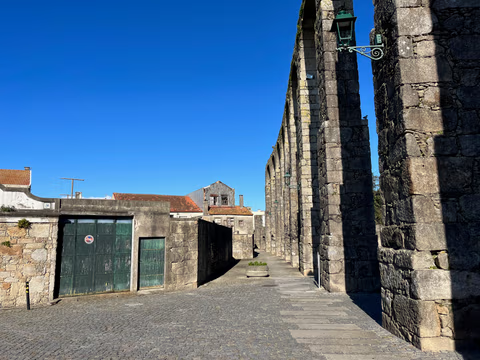
Aqueduct Trail – A path running along the Vila do Conde Aqueduct
From the Coastal Trail to the Camino Central: 12.9 km along the aqueduct from Vila do Conde to São Pedro de Rates. Route, stage, hostels, costs—explained honestly.
Read
Augsburg Way of St. James
The Augsburg Way of St. James runs 231.7 km in 11 stages from Oettingen in the Ries via Donauwörth, Augsburg, Bad Wörishofen and Ottobeuren to Ermengerst in the Allgäu — the Fuggerei, the Jakobervorstadt, a pilgrim of 1446 and Mozart's organ duel. Stages, hostels, costs.
Read

