

Town on the Camino
Treis
Germany
- places to stay
- 9
- Camino
- 1
- Elevation
- 88 m
Treis-Karden is a town with two banks: on the left of the Moselle, in Karden, stands the collegiate church of St. Castor, the "Moseldom", where tradition says the hermit Castor lived around 350. On the right lies Treis beneath its two castles. A 195-metre bridge links them, and Trier is still 120.8 kilometres away.
Right now in Treis-Karden (as of October 2026)
- Burg Eltz: The castle before Karden can only be visited until 1 November, then not again until 1 April.
- Stiftsmuseum: The season ended in mid-October. According to the 2025 schedule it reopens in May, Friday to Sunday.
- Martberg: The main temple is only open at weekends until the end of October. The site itself stays freely accessible.
How long to stay?
An afternoon is enough. If you come down from the Kompesköpfchen into Karden in the afternoon, you still have time for the collegiate church and the walk through the old collegiate quarter, for which the tourist office allows about 30 minutes. You have already had the real highlight of the day: Burg Eltz lies right in the middle of the stage. Treis-Karden is more worth a rest day in summer, when the Stiftsmuseum and the Martberg temple are open.
Treis-Karden in Ninja numbers
- 120.8 kilometres is what Camino Ninja gives from Treis to Trier. So you have almost a quarter of the Mosel-Camino behind you.
- 5.3 kilometres before Karden, according to Camino Ninja, lies Burg Eltz. You walk right past a banknote motif: from 1965 to 1992 the castle was on the 500 Deutsche Mark note.
- 195.10 metres is the length of the Moselle bridge between Karden and Treis. The first one was finished in 1925; in 1945 retreating German troops blew up its three middle arches.
- 1.58 by 2.74 metres is the size of the fired-clay altar in St. Castor, made around 1425 to 1430. It is the largest surviving medieval clay altar in Germany.
- Almost 1,000 years is how long the collegiate foundation of St. Castor existed, until Napoleon dissolved it in 1802. Its provost, as archdeacon, administered a fifth of the old Archdiocese of Trier.
Arriving: from the Kompesköpfchen to the other bank
On the Mosel-Camino you come from Alken, 18.8 kilometres away according to Camino Ninja. Over the Moselle bridge you cross to Löf, walk on to Hatzenport and, after Lasserg, down into the Elzbach valley to Burg Eltz. Behind the castle you cross the Elzbach and climb steeply to the former forester's house Rotherhof, then follow the Buchsbaumwanderpfad to the Kompesköpfchen viewpoint.
From there the path drops steeply down to Karden, straight to the collegiate church of St. Castor. According to Camino Ninja, Karden is 1.1 kilometres before Treis: you cross the Moselle bridge to the Hunsrück side, where the Way continues the next morning.
In brief: a hermit, a collegiate foundation and a castle
Karden was a Roman roadside village called Cardena, with a large potters' quarter. Around 350 the priest Castor from Aquitaine is said to have founded the first Christian community here. At his grave a collegiate foundation grew up, whose provost from the Middle Ages onwards administered a fifth of the Archdiocese of Trier as archdeacon. In 1802 Napoleon dissolved the foundation, and the collegiate church became the parish church.
Treis is first mentioned in 762 as "trisgodros villa publica". In the twelfth century emperors, counts palatine and archbishops fought over its castle until Trier won. In 1332 Treis became a town; in 1689 French troops destroyed the castles. On 7 June 1969 the two places became one municipality.
Two banks, one Way
Treis-Karden is a place divided by the Moselle. Karden lies on the left, with its "cathedral", the collegiate quarter, the railway station and the tourist office. Treis lies on the right, larger, with its two castles. The Mosel-Camino uses both: you arrive from the Eifel side and carry on along the Hunsrück side.
For a long time the river was an obstacle here. The ferry often stopped running for weeks during floods or ice, and Treis only built the first bridge in 1924 and 1925, at its own expense. Still, each bank has always reached for the other: since the seventeenth century the Corpus Christi procession has crossed the Moselle on a boat, a tradition of the collegiate foundation.
From the Moseldom to the Martberg: what to see
The church and the collegiate quarter lie right on the Way. For the Martberg you need an hour on foot to get there.
- Stiftskirche St. Castor: The "Moseldom" is regarded as the oldest church on the Moselle between Trier and Koblenz. The lower storey of the west tower was finished in 1072, the choir and transept were built from 1183, and the nave was complete around 1300. The Baroque cap of 1699 carries the star of the Three Kings instead of a weathercock. Inside stands the clay altar with the Adoration of the Magi, with Castor himself in a niche of its base. Look in the south aisle for the Stephanusaltar: beside the stoning of Stephen stands James the Greater, donated in 1628 by two canons. The church is open during the day.
- The collegiate quarter: The canons lived all around the church. The tourist office's walk leads from the Georgskapelle of around 1340 along the St.-Castor-Straße, with timber framing from 1587 onwards, to the Lindenplatz, past the late Romanesque provost's house, which is still lived in today. The tithe house of 1238, where the foundation stored its dues, is now the Stiftsmuseum, with finds from Celtic and Roman times. It is open from May to mid-October, Friday to Sunday, 14:00 to 16:30; adults pay €5 (as of 2025).
- Burg Eltz: It stands in the middle of your stage, 5.3 kilometres before Karden according to Camino Ninja. In 1157, in the time of Frederick Barbarossa, it first appears in the record, and it still belongs to the same family. From 1331 to 1336 Archbishop Balduin of Trier besieged it from a small counter-castle, the Trutzeltz, whose wall remains still stand above the castle. You can only visit it on a guided tour of 35 to 40 minutes, from 1 April to 1 November, daily 9:30 to 17:00; adults €14 (as of October 2025).
- The Martberg: Between Pommern and Karden, 180 metres above the Moselle, the Celtic Treveri worshipped their god Lenus in the first century before Christ. The Romans turned it into a temple district to which pilgrims came for more than 500 years, seeking healing. So there were pilgrims here long before Castor. The Lenus-Mars-Weg takes you up from Karden in an hour. The site is freely accessible; the main temple is open from May to the end of October on Saturdays and Sundays, 11:00 to 17:00, admission €2 (as of 2025).
Food and drink
We have not found reliable pilgrim tips on local restaurants. More important is what you take with you for tomorrow: between Beilstein and Bullay you walk long stretches with nowhere to stop. Take two litres of water and something to eat. At the Kloster Maria Engelport, a good seven kilometres beyond Treis, there is an inn.
Honestly
- There is no pilgrim hostel. In Treis and Karden you sleep in guesthouses or inns, and in the wine season the Moselle villages are full. Book ahead.
- The descent is hard on the knees. From the Kompesköpfchen down to Karden it is steep, at the end of a long day. Poles help.
- In winter much is closed. Burg Eltz closes after 1 November, the Stiftsmuseum already in mid-October. If you come in late autumn, you will see only the walls of both.
- Burg Treis is closed. According to the cultural landscape portal KuLaDig it cannot be visited for safety reasons until further notice, and the Wildburg next to it is a private home.
- The next stage is long. To Bullay it is 26.1 kilometres over the Hunsrück heights, according to Camino Ninja. If you do not want that, split it at the Kloster Maria Engelport or in Beilstein.
Where pilgrims sleep
There is no pilgrim hostel in Treis-Karden. The beds are spread across guesthouses, inns and holiday flats on both banks, which you should call ahead. The people behind the Mosel-Camino provide a list of places to stay on their website.
Above Karden, not far from the Kompesköpfchen, the Klickerter Hof took in Mosel-Camino pilgrims by reservation during a pilgrim day of the Jakobusgesellschaft around 2018. We have not been able to find out whether this still applies. Ask beforehand.
If you walk on, after 7.3 kilometres according to Camino Ninja you will find a guesthouse at the Kloster Engelport, which roughly halves the stage to Bullay. The next real pilgrim hostels on the Way are not until Traben-Trarbach and Klausen.
Ninja tips
- James at the Stephanusaltar: In the Moseldom James is not the main saint, but he is there, in the south aisle beside the stoning of Stephen.
- A break at the Burgschänke: On a pilgrim day of the Jakobusgesellschaft the group had lunch at the Burgschänke at Burg Eltz and held a meditation at the ruin of the Trutzeltz on Psalm 31: "Herr, ich suche Zuflucht bei dir, denn du bist mein Fels und meine Burg" – "In you, Lord, I take refuge, for you are my rock and my fortress."
- Castor's feast on 13 February: If you come in winter, you may catch the feast of the local saint. Then men carry his shrine through the congregation.
- No stamp at the office on Sundays: The tourist office is only open on Saturday mornings and not at all on Sundays. If you arrive on Saturday afternoon or Sunday, ask your accommodation for a stamp.
- The train as a joker: Regional Express trains between Koblenz, Trier and Saarbrücken stop at the station in Karden. That lets you stop here, join here or skip a day.
Practical tips for pilgrims
- Pilgrim stamp: at the tourist office at Karden station, St.-Castor-Straße 87, phone +49 2672 9157700. Open May to October Monday to Friday 9:00 to 12:00 and 14:00 to 17:00, Saturday 9:00 to 12:00; November to April Monday to Thursday 9:00 to 12:00 and 14:00 to 16:00, Friday 9:00 to 13:00 (as of 2025).
- Pilgrim passport: Get it in advance from the St. Jakobusbruderschaft Trier or your diocese. For the Trier pilgrim certificate you need the last 100 kilometres stamped.
- Waymarks: a yellow shell on a blue background, maintained by volunteers. Take the GPX track with you.
Onwards: through the Flaumbach valley to Beilstein
In Treis you follow the Hauptstraße to the edge of the village, climb below the Wildburg towards Beurenkern and, after the Beurenhof, turn into the Flaumbach valley. After 7.3 kilometres according to Camino Ninja you reach Maria Engelport, a monastery founded around 1220 by the knight Emelrich von Monreal, where Sisters of Adoration have lived since 2014.
Then the Way leads through the forest to Beilstein, 13.5 kilometres from Treis according to Camino Ninja. If you want to go further, you climb over the Hunsrück heights past the Lindenhäuschen chapel and down to Bullay, 26.1 kilometres from Treis. The St. Jakobusbruderschaft Trier offers a nine-stage version that only goes from Treis-Karden as far as Beilstein.
What awaits you tomorrow
Tomorrow Beilstein is the goal, a Moselle village with the church of the Capuchin friary and the Metternich castle ruin. You take one connection with you from Treis: in 1652 the Metternich family received a castle-guard fief at Burg Treis, after the lords of Winneburg and Beilstein had died out. If you feel like it, walk down the Heinz-Rühmann-Filmtreppe there, the film staircase named after the actor.
Deep dive: A hermit, two banks and a castle in the forest
A long read, in case you want to learn more about Treis-Karden. About twenty minutes' reading.
The view from the Kompesköpfchen
When you stand on the Kompesköpfchen, after a long day from Alken past Burg Eltz, below you lies a town that the Moselle cuts in two. On the left, on your side, Karden presses against the slope, and above the roofs rises a white church tower with a Baroque cap. Opposite lies Treis, and above Treis two castles. In between, a bridge with three arches over the river.
What you see is older than any shell on a waymark. On the hill behind you, people were praying two thousand years ago. Down in the valley, in the fourth century, lived a hermit at whose grave a collegiate foundation arose that for almost a thousand years administered a fifth of the Archdiocese of Trier. And the castle opposite was once so fought over that an emperor spent the night in Treis in order to destroy it.
This text tells that story. It begins with the pilgrims who came long before the Christians, and then leads you through the church you are about to walk down to.
Pilgrims before the pilgrims
Between Karden and the neighbouring village of Pommern rises the Martberg, some 180 metres above the Moselle. In the first century before Christ the Celtic tribe of the Treveri worshipped their chief god Lenus up here. The Treveri are the people after whom Trier was later named, the city you are now walking towards.
When the Romans came, the sanctuary did not disappear. It grew. Around the year 200 there were numerous temples on the hill, and one was dedicated to the god Mars. That is where the hill gets its name, mons martis, the mountain of Mars. And pilgrims came. They sought healing from their illnesses, and they brought offerings, which archaeologists have found in large numbers.
The state office for the preservation of monuments has partly excavated the site with the help of the German Research Foundation. In the process something emerged that had never been shown in Germany before: a Celtic cult site that was visited without interruption for more than 500 years, into late antiquity. Only with Christianity did the sanctuary fall into decay and into oblivion, except for the name of the Roman god.
Down in the valley lay a roadside village, Cardena. It had a large potters' quarter, and the potters made, among other things, votive gifts of the kind offered to the gods. If you like, Karden was already a place that lived from pilgrims in Roman times.
Castor, the hermit
Into this valley, in the fourth century, came a young priest. His name was Castor, and everything we know about him comes from accounts of his life written centuries after his death. According to the tradition of the Church of Trier he was a pupil of Bishop Maximin of Trier, in the days of the emperor Constantius and the great Athanasius, as an old encyclopaedia puts it. Athanasius, the combative bishop of Alexandria, lived for a time in exile in Trier back then. Maximin trained Castor and ordained him a priest. Perhaps Castor, like his teacher, came from Aquitaine in the south of France.
Then Castor settled in Karden, as a hermit. The historian Ferdinand Pauly, who wrote the history of the foundation for the Germania Sacra in 1986, stresses this explicitly: according to the account of his life, Castor was not a missionary travelling from village to village, but a man seeking solitude. He is said to have built a church of Our Lady in Karden, in or beside which he was later buried.
He did not stay alone. Bishop Maximin sent him a man named Potentinus with his two sons, Felicius and Simplicius. Tradition describes Potentinus as a pilgrim from Aquitaine. The four lived together, ascetic and withdrawn, and a small community grew up around them. When Potentinus and his sons died, a small memorial church was built for them in the Karden churchyard. Castor himself died at a great age, around the year 400. His feast day is 13 February.
A cave near Karden, where he is said to have lived, is still marked with a white cross today.
The boatmen's salt
People tell a story about Castor that suits this river so well you would like to believe it. It is a legend, and that is how it should be told.
One day a boat loaded with salt was making its way up the Moselle, towed by horses on the bank. Castor asked the boatmen for a little salt. They laughed at him and sailed on. Then a storm rose, so violent that the waves threatened to swallow the boat. In their fear the boatmen called out to the holy man. Castor knelt on the bank and prayed, and the storm died down as suddenly as it had come. The boatmen, the legend says, were pagans, and they let themselves be converted. And they thanked Castor with plenty of salt.
Whether the Moselle boatmen really took off their hats for centuries afterwards when they passed his cave, as people say today, cannot be proven. But the story tells something true about this place: Karden always lived from the river and with the river, and anyone who needed help here often needed it on the water.
A grave that moves
After Castor's death his grave was forgotten. Only Bishop Wiomad of Trier, who ruled in the second half of the eighth century, had the bones searched for again and brought into a church that was then dedicated to Saint Paulinus. That church has been found. In excavations since 1965 archaeologists uncovered the remains of a three-aisled basilica of about 21 by 15 metres, built over a Frankish cemetery of the sixth and seventh centuries.
Castor did not stay in Karden in one piece for long. In the year 836 Archbishop Hetti of Trier had large parts of the relics brought to Koblenz, to a new church he had built there with the support of the emperor Louis the Pious. The translation took place on the feast of Saint Martin; the next day Hetti consecrated the church in Castor's name, and eight days later the emperor came with his family. The Basilica of Saint Castor still stands in Koblenz at the Deutsches Eck, and Castor is the patron saint of Koblenz. Karden lost the saint's head at that time.
What remained was an arm. For it, in the fifteenth century, a shrine of fir wood was made, with the symbols of the Evangelists on the roof and the apostles on the long sides. At the front you see Mary with the Child, at the back Christ, at the sides Peter and Castor himself. In the eighteenth century the foundation gave away small pieces, in 1776 to Forst, in 1778 to Weiler near Mayen. In the French Revolution the shrine was empty. At the beginning of the nineteenth century Karden received three small pieces back. The arm itself is now considered lost.
On Castor's feast, 13 February, men carry the shrine through the congregation. A report from 1790 mentions an old custom: people walked underneath the shrine in order to be as close to the saint as possible. The Church later forbade it.
How much of Castor lies in Karden?
Here it is worth being honest, because the story of Castor rests on thinner evidence than the many streets named after him would suggest.
According to Pauly, the oldest version of his life probably dates back to the ninth century, some five hundred years after his death. Other experts date the account of his life as we have it as late as the thirteenth century. The cultural landscape portal of the Landschaftsverband Rheinland simply calls the traditions about Karden's beginnings "wenig glaubwürdig", not very credible. On top of that, the church in which Castor's bones lay in the eighth century was dedicated to Paulinus at the time. Only in the tenth or early eleventh century did Castor become established as patron; he is first securely recorded in 1084.
The question of the grave also remains open. In the courtyard of the cloister there is a small vault, 2.20 by 1.30 metres. The excavator Eiden thought it was the saint's grave. Pauly writes soberly that this cannot be proven archaeologically.
And yet: that Christians lived here in the fourth century is no fairy tale. At the south-western edge of the Roman village a late Roman Christian cemetery was found, along with a fragment of an inscription with a dove and a tree of life, and in the neighbouring village of Müden a Christ monogram. Who exactly Castor was, we do not know. But that someone like him was here is quite likely. You can walk into the church with this uncertainty, the way pilgrims go to many saints' graves, including the one in Santiago.
A fifth of the archdiocese
From the small community at the grave grew one of the most powerful church institutions on the Moselle. Archbishop Ratbod of Trier, who ruled around 900, made Karden the seat of an archdeacon, a deputy of the bishop for a large district. Soon the office was firmly tied to the provost of the foundation. From Karden a fifth of the old Archdiocese of Trier was administered, an area that stretched from Andernach to Bacharach in the east and from Wittlich to Traben-Trarbach in the west. You reach Traben-Trarbach in two days. Then you are still within the district of the provost of Karden.
In 1178 Pope Alexander the Third placed the foundation under his protection. In 1183 fourteen canons lived here, clergy who prayed together but lived in their own houses. A charter of 1137 allowed them to fetch building wood and firewood from the neighbouring community of Treis. So the two banks already depended on each other back then.
Its income came, among other things, from the tithe, the dues that farms and parishes had to pay. At the end of the eighteenth century ten farms and 53 villages owed it dues. All of it was stored in the tithe house of 1238, the building that now houses the Stiftsmuseum.
The Moseldom grows
The church you are about to stand in was not built all at once. Its oldest part is the west tower. Studies of the tree rings in its timber have shown that its lower storey was finished in 1072. Its walls are up to 1.20 metres thick.
In 1183 the chapter under Provost Folmar decided to enlarge the church. The charter contains a lovely half-sentence: it speaks of the enlargement of the house of God that had recently been begun. By 1216 the two towers beside the choir and the transept were almost finished. In 1247 Bishop Theoderich of Wierland consecrated the choir on behalf of Archbishop Arnold of Isenburg of Trier. The nave with its low aisles was completed around 1300. So one building holds the transition from Romanesque in the east to early Gothic in the nave.
Experts argue about one date. For a long time a charter of Archbishop Bruno was read as saying the church was consecrated in 1121. Pauly considers that a misunderstanding: the charter is only dated by the annual feast of the church's dedication and does not reveal the year of the consecration. Others still give 1121 as the year of consecration today.
The last major change came in 1699. The court architect of the Electorate of Trier, Johann Christoph Sebastiani, added two storeys and a Baroque cap with a lantern to the west tower. At the very top no weathercock turns. Instead there is the star of the Three Kings, the kings you will also see on the high altar in a moment.
What you see inside
It is best to enter the church through the Romanesque south portal. The door is made of Swiss stone pine, with more than thirty hand-forged iron bands in the shape of lilies. The door handle recalls the old right of church sanctuary. Anyone who was being pursued could cling to this ring and ask for protection. Whether anyone ever did so here is not known.
At the front in the choir stands the reason art historians come to Karden: an altar of fired clay, probably from the area, made around 1425 to 1430. It is 1.58 metres high and 2.74 metres wide, the largest surviving medieval clay altar in Germany. It shows Mary with the Child and the Three Kings bringing their gifts, together with, unusually, the apostles Peter and Paul. Pauly reads it less as an altar of the Magi than as homage to Christ as Redeemer. And in a niche of the base stands Castor, the hermit, small among the great.
In the south aisle stands the Stephanusaltar. It was consecrated as early as 1295 by Bishop Emmanuel of Cremona. Its Renaissance superstructure was donated in 1628 by the brothers Johann Jakob and Kaspar Mertloch from Boppard, two canons of the foundation. In the centre you see the stoning of Stephen, the first martyr. And beside it stands James the Greater, the apostle whose grave in Santiago is the goal of all the Ways of Saint James. In a church that belongs to a hermit from the Moselle he is a guest, but one you know.
On the walls, remains of paintings from the second half of the thirteenth century have survived: a Last Judgement, a Crucifixion in which Castor holds a model of his church, and the heavenly Jerusalem. That too is an image of arriving.
In the north choir tower, in a small Romanesque chapel, stands the shrine of Castor, borne on an iron tomb chest made in 1954 by the smith Felix Vallendar. The organ in the gallery was built in 1728 by Johann Michael Stumm, a scion of a well-known family of organ builders. And in the tower stands the late Romanesque font of basalt lava, around which a story of its own has grown.
A font and a dance
Around 1800, so they say in Karden, the collegiate church was to be demolished. The French had dissolved the foundation. The parish church at that time was the Liebfrauenkirche by the cemetery, and that is where the font stood. During a dance held for the French soldiers, so the story goes, men from Karden secretly carried the font into the collegiate church. The story is also used to explain the differently shaped little columns of the font. When the commission came, it found the font in Sankt Castor and declared the collegiate church the parish church. The Liebfrauenkirche was demolished.
The story is too good to leave out and too neat to believe. Its author is thought to have been the teacher Aloys Frölich. Pauly objects that the sources on the baptismal rights of the collegiate church contradict it. What is true is what you can see: the Liebfrauenkirche was demolished after 1802, and only its Romanesque tower remained standing in the cemetery. Today it serves as the cemetery chapel, and on the first floor there is a memorial chapel for the dead of the Second World War.
A cardinal with a benefice in Karden
Among the canons of Karden was one whose name you will hear more often on the Mosel-Camino. Nicholas of Cusa, born in 1401 in Kues on the Moselle, philosopher, church reformer and later cardinal, held a canonry at Sankt Kastor in Karden from 1430. It was one of many benefices, incomes from church offices, that he collected over his life. How long he kept it is not entirely clear. One source gives 1446, another the period until after 1452.
Did he influence the clay altar? The art historian Claudia Hermes suggested so in 1996. The altar was indeed made in the years in which Nicholas became a canon, but the influence is not proven. How the altar came about, who paid for it and who shaped it, no charter tells us.
In three days you will reach Bernkastel-Kues. There, in 1458, Nicholas and his siblings founded the Sankt-Nikolaus-Hospital, for 33 needy old men. His heart rests in its chapel. His body lies in Rome.
The castle opposite
Look across from the bridge to Treis. On the hill south-west of the village stands the ruin of Burg Treis, and about 200 metres further on the Wildburg. Burg Treis has a story that begins with an emperor.
In the year 1121 the emperor Henry the Fifth spent the night in Treis. He had come to destroy a castle that a Count Otto had built against him. We know this from a charter of the foundation of Sankt Kastor in Karden, on the other side of the river. How the siege ended is not recorded there. Otto, who called himself von Rheineck from 1126, was the son of a man who had once had himself elected anti-king. It was about power in the Moselle country.
In 1148 things became serious once more. Count Palatine Hermann von Stahleck occupied the castle in September and fortified it. Otto von Rheineck handed it over to Archbishop Albero of Trier, who besieged the count palatine until he withdrew and acknowledged Trier's right to the castle. For the Rheineck family it ended badly: Hermann von Stahleck had Otto's son imprisoned at the Schönburg near Oberwesel, where he was strangled. For Trier a long rule began. For more than 350 years Treis was a castle of the archdiocese. Archbishop Hillin had a tower built in the 1150s, and under Archbishop Balduin there were six castle-guard fiefs for knights who held the castle on the archbishop's behalf.
In 1332 Treis received town rights and a town wall. In 1689, in the War of the Palatinate Succession, French troops destroyed the castles, and Burg Treis was never rebuilt. In 1838 a miller built the Wildburgmühle on its grounds, and until the 1950s vines grew on the western slope. In 1956 a private individual bought both castles, had the ruin secured and the Wildburg converted into a home. In 2021 the municipality bought Burg Treis back. When this text was written, in autumn 2026, it was closed for safety reasons.
The castle in the forest and the feud with the archbishop
You have already met Archbishop Balduin of Trier once today without knowing it. It was he who besieged Burg Eltz, which you walked past today.
Burg Eltz is different from the castles on the Moselle. It does not stand on a summit but deep in the valley of the Elzbach, on a rocky spur, hidden in the forest. In 1157, in the time of the emperor Frederick Barbarossa, it first appears in the record, as an important fortress on the trade routes between the Moselle and the Eifel. Ever since, it has belonged to the same family, for more than thirty generations. It owes its special shape to a division of the inheritance. Eltz is a Ganerbenburg, a castle of several co-heirs. Because the shares were too small for each to build a castle of its own, they kept building together, each line its own house. That is how the houses of Rübenach, Rodendorf and Kempenich came about.
From 1331 to 1336 came the Eltz feud. Johann von Eltz and other imperial knights resisted the policy of Archbishop Balduin, who wanted to extend his rule on the Moselle. Balduin had a small siege castle built on a rocky outcrop above the castle, the Trutzeltz, and bombarded Eltz from there with catapults and early firearms. After two years of siege the knights gave in. Johann remained burgrave, but now as the archbishop's vassal. The wall remains of the Trutzeltz still stand.
When in 1689 the French destroyed many castles on the Rhine and the Moselle, including those in Treis, Eltz was spared. Its lord, Hans Anton zu Eltz-Üttingen, was a senior officer in the French army and had the castle taken off the list. From 1845 to 1888 Count Karl zu Eltz restored the complex for around 184,000 marks, so carefully that the old fabric was preserved. From 1965 to 1992 it appeared on the 500 Deutsche Mark note.
On a pilgrim day of the Jakobusgesellschaft, pilgrims rested at the ruin of the Trutzeltz and meditated on a verse from Psalm 31: In you, Lord, I take refuge, for you are my rock and my fortress. In a place where one castle besieged another, the verse takes on a sound of its own.
Plague, Roch and a boat on the river
Between 1627 and 1633 the plague raged on the lower Moselle. In some places half of the people died, in some up to nine out of ten. In 1629, 95 men and women in Karden founded a plague confraternity and placed themselves under the protection of Saint Roch. Roch was himself a pilgrim: the legend tells that on his way to Rome he went to the plague victims. To this day Karden celebrates the Rochus-Kirmes on the Sunday after his feast day, 16 August.
From the same period comes a custom that links the two banks. Since the seventeenth century the Corpus Christi procession has crossed the Moselle on a boat, a tradition that goes back to the foundation. With club banners and firing of salute mortars the parish moves from one bank to the other. One of the church banners, donated in 1909, shows Castor with his church and the Moselle river.
The end of the foundation
In 1794 the French revolutionary troops reached the Moselle, and with them came the end of a world. In 1802 Napoleon dissolved the foundation of Sankt Kastor, after almost a thousand years. The collegiate church became the parish church, and the property was auctioned off. The old pulpit of 1713 was sold. The Georgskapelle, which had grown out of a hermitage around 1340, became a horse stable after 1805. In 1826 the north and east wings of the cloister were auctioned for demolition. Only the south wing survives.
Some things came back. In 1856 the Georgskapelle became a Protestant church; since 1968 it has been called the Georgskapelle again. After the Second World War, Dean Franz Brühl bought a Baroque pulpit from Dahnen in the Eifel, a village destroyed in the war, to replace the one that had been sold. It has stood in Sankt Castor since 1957. A painting showing Christ on the cross as a vine, with the twelve apostles in its tendrils, lay in the church attic for decades and was rediscovered in 1956. On the Moselle, hardly any image could fit better.
A bridge built twice
For centuries people in Treis and Karden crossed by ferry. During floods or ice it often stopped running for days or weeks, and then traffic between the Hunsrück and the Eifel came to a halt. In 1876 Mayor Franz Aloys Cadenbach applied to the Prussian government in Koblenz for a permanent bridge. Nobody responded. In 1910 Mayor Keßler tried again with finished plans. Again nothing. In between, pontoon bridges helped, in 1901, 1908, 1914 and 1918.
In 1924 Treis took matters into its own hands. A committee around the mayor and the wine estate owner Jakob Petry submitted a petition in March, and on 25 March the municipal council decided to build the bridge at its own expense. In July work began; in November a flood swept the scaffolding away. On 8 October 1925 the bridge was finished, after 250,000 working hours and at a cost of around one million Reichsmarks instead of the planned 600,000.
It stood for only twenty years. In 1945 retreating German troops blew up the three middle arches, and fires and fighting around the bridge destroyed a large part of the old houses, especially in Treis. The French occupying power had it rebuilt quickly. 150 prisoners of war cleared the rubble, the old piers were reused, and in April 1947 traffic was rolling again. On 19 April 1948 the new bridge was officially handed over. It is the one you walk across today. In 1969 the two banks became one on paper too: Treis and Karden merged into a single municipality.
The Way comes back
Pilgrims came to this valley long before there was a Mosel-Camino: to the temples on the Martberg and to Castor's grave. The Way you are walking is nevertheless young. In the summer of 2008 Karl-Josef Schäfer and Wolfgang Welter opened it as a private initiative, as a link from the Lahn-Camino to Trier. Since then the yellow shell on a blue background has led from Koblenz-Stolzenfels to the Abbey of Sankt Matthias, and volunteers keep the waymarks in order.
One of the men who rebuilt Schloss Stolzenfels at the start of your Way also left a trace in Treis. Johann Claudius von Lassaulx designed the parish church of Sankt Johannes der Täufer, a neo-Gothic hall church of the local greywacke, built from 1823 to 1831.
On the pilgrim day of the Jakobusgesellschaft, the day ended where your day ends too: with evening prayer at the collegiate church of Sankt Castor.
What Treis-Karden gives you
Treis-Karden is not a place where you arrive. It is a place where you cross over. From the Eifel to the Hunsrück, from one long day into an even longer one, from evening into morning. The bridge under your feet was built for that, and the procession on the boat reminds people every year that the river can be crossed in other ways too.
Take two small figures with you from the Moseldom. One is Castor in the base of the clay altar, the hermit about whom we know so little and at whose grave people nevertheless prayed for almost a thousand years. The other is James at the Stephanusaltar, the apostle you are walking towards, who stands only at the edge here. Perhaps that is the most honest attitude for a pilgrim: to know that the goal is far away, and still to stop where others before you have sought refuge.
Tomorrow you walk up through the Flaumbach valley, past the Wildburg, to Beilstein and perhaps on to Bullay. Trier is still 120.8 kilometres away.
Where to stay in Treis
Places to stay in Treis.
 OpenReservations accepted
Pension "Am Markt"
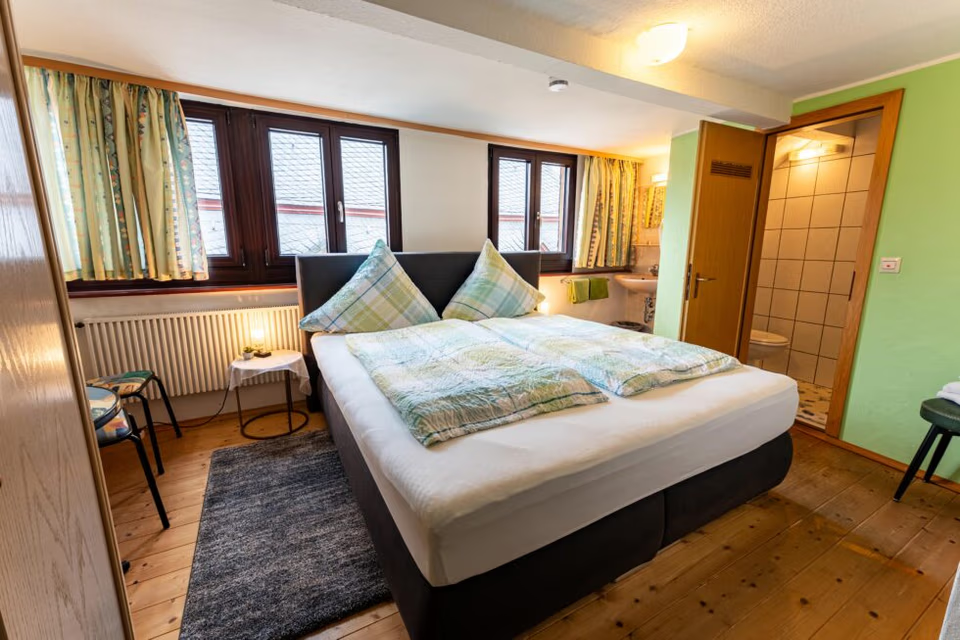 OpenReservations accepted
Gasthaus Gräf
 OpenReservations accepted
Pension Gästehaus La Mula


Services in Treis
What you can find in town before the next stage.
- ATM
- Café
- Shop
- Pharmacy
- Fountain
- Train station
- Bus station
- Restaurant
Source: © OpenStreetMap contributors · updated April 2026