

Town on the Camino
Almodôvar
Portugal
- places to stay
- 9
- Camino
- 1
- Elevation
- 289 m
Almodôvar is the place of the first letters: in the Museu da Escrita do Sudoeste stand gravestones bearing the oldest script of the Iberian Peninsula, about 2,500 years old and still undeciphered. For pilgrims, after 101 km the white little town is the first town in the Alentejo, with everything you need. Only a pilgrim albergue is missing.
How long to stay?
An afternoon is enough, just not on a Monday. Almodôvar is small enough for a stroll without your rucksack: parish church, convent, medieval bridge, market hall and two museums all lie close together. The heart of it is the script museum, and that is closed on Mondays and public holidays, just like the Museu Severo Portela. If you need a rest day after two days through the serra, this is a good place to take it, because a long, shadeless stage into the Campo Branco follows. For the sights alone you don't need one.
Almodôvar in Ninja numbers
- 101.0 km since Faro, 351.8 km still to go to Benfica do Ribatejo (according to Camino Ninja). With Almodôvar you've done more than a fifth, and left the mountains behind.
- 2,500 years old are the signs on the stelae in the script museum. The credencial in your rucksack is a newcomer by comparison.
- 23 pieces were lent to the script museum by the National Museum of Archaeology in Lisbon when it reopened in 2024 after its extension.
- More than 200 shoemakers Almodôvar is said to have had at one time. A good place to think about your own shoes.
- 1285 is when King Dinis gave the place its first town charter; in 1297 it passed to the Order of Santiago, which kept a commandery here until the late 18th century. So you have arrived in a place of Saint James.
Arriving: the white oasis after the serra
The last stage from Ameixial leads over the Vascão into the Alentejo, through Santa Cruz and Guedelhas, and it is a tough one: 35.3 km, often without a shop or fountain. Shortly before the end you have to cross the Ribeira de Oeiras, and after rain that can mean wading through the water. The official guide to the Caminhos de Santiago in the Alentejo promises that Almodôvar appears behind the last rise "como um oásis branco, resplandecente", like a white, shining oasis.
The Caminho Português Central do Sul meets the road 267 on the edge of town and crosses the Ribeira de Cobres. You have a choice there: the new road bridge or, according to the guide about a hundred metres off to the side, the old medieval bridge. From there it goes to the parish church of Santo Ildefonso. Up to here, volunteers of the Associação Espaço Jacobeus have marked the route from Faro. Since Ameixial you have also been walking on the Caminho Central of the Alentejo and Ribatejo, which in 2021 became the first Camino in Portugal to be officially certified.
In brief: the round one, the Order, the cobblers
The name dates from Moorish times: al-Mudawwar, the round one, because the town was enclosed by a wall and had a castle. Nothing of either can be seen any more. After the Christian conquest, in 1239 the area lay on the western border of the holdings that the Order of Santiago administered from Mértola. King Dinis gave Almodôvar its first foral on 17 April 1285, in 1297 it passed to the Order, and King Manuel I confirmed a new town charter in 1512.
Later Almodôvar became a small craftsmen's town, above all for shoes. According to oral tradition this began in the late 19th century. Today a cobbler figure by the sculptor Aureliano Aguiar at the do Sapateiro roundabout recalls it. In 2011 the whole municipality had 7,449 inhabitants; in 1981 it was still 10,637.
Stones nobody can read yet
Long before Moors and knights of the Order came, people in this area wrote. On Iron Age gravestones, about 2,500 years old, they scratched signs that are now called the Escrita do Sudoeste, the Script of the Southwest. It is considered the oldest script of the Iberian Peninsula, and the exciting thing about it: to this day it has not been deciphered.
In 2007 Almodôvar built these stones a museum of their own, the Museu da Escrita do Sudoeste, MESA for short. Stelae like these were also found in the serra you have just come through, for instance in the parish of Ameixial. For a pilgrim this has a nice punchline: since Faro you have received a stamp in your credencial every day, a kind of script of the way. Here lie the first traces of people wanting to record anything at all in this land. Nobody can read them any more, but someone wanted them to stay.
On foot through the white town: what to see
Almodôvar is a place for a quiet stroll in the late afternoon. Almost everything lies in the centre around the Rua Serpa Pinto, the bridge on the edge of town.
- Museu da Escrita do Sudoeste (MESA): The museum shows gravestones with the oldest script of the Iberian Peninsula and finds from the Iron Age, when the Conii lived here. It has been open since 2007, was extended and modernised, and returned to its building in the Rua do Relógio in June 2024; during the building work it was housed in the convent. Since then it also shows 23 loans from the National Museum of Archaeology. Open Tuesday to Thursday 10:00–18:00, Friday to Sunday 10:00–13:00 and 14:00–18:00, closed on Mondays and public holidays (as of November 2026). We found no admission price. If you look at only one thing in Almodôvar, make it this.
- Igreja Matriz de Santo Ildefonso (parish church): A church of this name is documented as early as the 13th and 14th centuries. The present building went up in 1592 to plans by the royal architect Nicolau de Frias, commissioned by the Order of Santiago. Inside there are gilded carved altars, a baptistery with a depiction of the Baptism of Christ, and a ceiling painted by the Almodôvar painter Severo Portela. Since 2012 it has been protected as a Monumento de Interesse Público. For pilgrims it is the end point of the stage. We found no opening or Mass times.
- Convento de Nossa Senhora da Conceição (convent): A former Franciscan convent from the 17th century, a Monumento de Interesse Público since 1993. Today it is the Fórum Cultural, with a tourist information office, exhibition rooms, an auditorium and a restaurant in the old refectory. The church has gilded carved altars from the late 17th and early 18th centuries, an organ restored in 2016–2017 and a ceiling with pictures of Mary. According to one directory, the church is open Monday to Friday 9:00–13:00 and 14:00–18:00, at weekends 14:00–18:00. Ask at the tourist information office about a stamp and beds.
- Medieval bridge over the Ribeira de Cobres: Three arches, 25 metres long, 3.6 metres wide, built of slate with brick arches. It is dated to the 12th to 13th century and protected as an Imóvel de Interesse Público. Until the 19th century the traffic to the south, towards the Algarve and Mértola, went over it; in 1758 it was the only bridge over the stream. Pilgrims can take it right on arrival, instead of the new road bridge next to it.
- Museu Municipal Severo Portela: The 16th-century building used to house the town hall and prison. Today it displays pictures, drawings and studies by the painter Severo Portela, who also designed the ceiling of the parish church. There is also an exhibition on the shoemakers and traditional footwear, which has a special note after a hundred kilometres in your own shoes. Open Tuesday to Friday 10:00–18:00, Saturday and Sunday 10:00–13:00 and 14:00–18:00, closed on Mondays and public holidays (as of November 2026).
Food and drink
In Almodôvar you can finally shop properly again. The market hall in the Rua da Ferraria is housed in an Art Deco building and is open on weekdays and Saturdays from 8:00 to 13:00: fruit, meat, fish, bread. Typical of the area are cheese, honey, bread, sausage, herbs and medronho, the schnapps made from the fruit of the strawberry tree that grows in the serra. There is a restaurant in the refectory of the old convent.
Honestly
- No pilgrim albergue. Almodôvar has guesthouses and pensions, but no albergue for pilgrims. Book ahead, the choice is limited.
- Monday is the wrong day. Both museums are closed on Mondays. If you arrive on Sunday evening, plan your stroll for the evening and, if need be, skip the script museum.
- The way here is the hardest part. The 35.3 km from Ameixial, with the ford through the Ribeira de Oeiras, are better walked in two days, with a night in Santa Cruz. If you go straight through anyway, you arrive tired.
- Tomorrow will be hot and shadeless. Beyond Almodôvar the Campo Branco begins, the cereal steppe, with 29.5 km to Castro Verde. The guide calls this stretch the hardest of the three stages around Almodôvar.
Where pilgrims sleep
We found no pilgrim albergue in Almodôvar, whether municipal, church-run or by the bombeiros (as of November 2026). Pilgrims sleep in private guesthouses and holiday flats in the town; some lie directly on the through road EN2, others a little further out. You'll find the accommodation in the app under Almodôvar. If you're looking for a cheap bed, ask at the tourist information office in the convent whether there are solutions for pilgrims.
Ninja tips
- Arrive over the old bridge. Shortly before the town you have the choice between the new bridge and the medieval one. The detour is tiny: turn right, and after about a hundred metres left.
- Take your shoes seriously. If you have blisters after the serra, you've come to the right place: Almodôvar is a shoemaking town, and the Museu Severo Portela shows the old shoemaking craft. For serious cases there is a health centre (+351 286 660 200) and a pharmacy.
- Market hall in the morning. It closes at 13:00 and is shut on Sundays. If you arrive in the afternoon, you'll miss it; if you take a rest day, go in the morning.
- Plan water for tomorrow. From Almodôvar, two to three litres count as standard. On the stage to Castro Verde, A-dos-Neves is, according to the guide, a good place to rest and cool off.
- Rosário as a stopover. If you don't want to walk the 29.5 km to Castro Verde in one go, according to the guide you can stay overnight in Rosário, 15.3 km beyond Almodôvar. We haven't verified accommodation there, so clarify beforehand.
- Close the gates, mind the dogs. Tomorrow you'll walk through pastures with gates; close each one behind you. Near Monte da Filipeja there may be free-roaming sheepdogs, according to the guide.
When it rains
Rain in this area falls almost only between October and March (in Ameixial in the serra, 35 km to the south, on average 472 mm a year). For a wet afternoon, Almodôvar does nicely:
- Museu da Escrita do Sudoeste: Tuesday to Thursday 10:00–18:00, Friday to Sunday 10:00–13:00 and 14:00–18:00 (as of November 2026).
- Museu Municipal Severo Portela: Tuesday to Friday 10:00–18:00, at weekends 10:00–13:00 and 14:00–18:00 (as of November 2026).
- Convento de Nossa Senhora da Conceição: church, exhibitions in the former dormitory and the restaurant in the refectory under one roof.
- Market hall: weekdays and Saturdays 8:00–13:00.
Practical tips for pilgrims
- Stamp: Ask first at the tourist information office in the Convento de Nossa Senhora da Conceição.
- Supplies: Health centre, pharmacy and post office (CTT) are in the town; according to the guide, here you find all the usual services for the first time in a long while.
- Contact Câmara Municipal: +351 286 660 600, geral@cm-almodovar.pt.
- Public holiday: 24 June (São João) is the municipal holiday. On public holidays the museums are closed.
Onward: into the Campo Branco
Beyond Almodôvar the route runs via Almodôvar a Velha (3.8 km), A-dos-Neves (11.9 km) and Rosário (15.3 km) to Castro Verde (29.5 km). This is the cereal steppe of the Alentejo, according to the guide the most important of its kind in Portugal, and it has little shade. On the way you pass old manganese and iron mines near Ferragudo, which you only notice if you know about them, and at the Horta da Ordem a gate with an "S" for Santiago. In Rosário stands the parish church of Nossa Senhora do Rosário; the guide mentions 18th-century wall paintings there, including a Santiago Matamouros. If you start early, you'll be in Rosário before the midday heat.
What awaits you tomorrow
Castro Verde, the little town of the Battle of Ourique. Tradition places it on 25 July 1139, the feast of Saint James, and in the Basílica Real de Nossa Senhora da Conceição ceiling paintings tell of it, while the main chapel shows scenes from the life of Saint James. In Castro Verde you also meet the Caminho Central Via Atlântico. After a day of steppe, you've earned it.
Deep dive: The oldest script and the Order of Santiago
A short read, in case you want to learn more about Almodôvar. About four minutes' reading.
A white town after the mountains
When you arrive in Almodôvar, you have the Serra do Caldeirão behind you, its slate slopes, its cork oaks, its lonely hamlets. Ahead lies the Alentejo, and Almodôvar is its first town on your route. The official guide to the Caminhos de Santiago calls the place a white, shining oasis that appears behind the last rise. In 2011 the whole municipality had a good seven thousand inhabitants; in 1981 it was still more than ten thousand. But this place is much older than any census.
Signs on gravestones
In the Iron Age, about two thousand five hundred years ago, people lived in this area who buried their dead under stone slabs and scratched signs onto those slabs. These signs are now called the Script of the Southwest, and it is considered the oldest script of the Iberian Peninsula. Stelae like these have been found around Almodôvar and also beyond the serra, for instance in the parish of Ameixial, which you came through. The puzzling thing about them: to this day nobody can truly decipher them. In 2007 Almodôvar gave them a museum of their own, the Museu da Escrita do Sudoeste. It was extended and reopened in June 2024, and the National Museum of Archaeology in Lisbon has lent it twenty-three pieces. Even the British BBC filmed here for a documentary on the Celts.
The round one
Much later the Moors came and gave the place the name it still bears today. Al-Mudawwar means the round one. The municipality itself explains the name by the wall that enclosed the town in a circle, and by the castle inside it. Nothing of either has remained, only the name has survived.
The Order of Santiago
Then came the knights. In the thirteenth century the knights of the Order of Santiago conquered the south of Portugal, and in 1239 the area of Almodôvar lay on the western border of what the Order administered from Mértola. On 17 April 1285 King Dinis gave the place its first town charter; twelve years later, in 1297, Almodôvar passed to the Order of Santiago. The Order kept a commandery here, a seat of administration, until the late eighteenth century. At the end of the sixteenth century the Order had the old parish church of Saint Ildefonsus rebuilt, to plans by the royal architect Nicolau de Frias. By 1592 the new church stood. So when you stand in front of the parish church in Almodôvar, you are standing in front of a building commissioned by the Order of Santiago. For a place on a Camino, that is not a bad pedigree.
A bridge and a quarrel
On the edge of town a small bridge with three arches crosses the Ribeira de Cobres. People like to call it the Roman bridge. The official guide considers a Roman origin possible and gives 1375 as the first mention. A study by the municipality, on the other hand, says the bridge was only built in Roman technique, but is not Roman, and the monument description dates the slate masonry to the twelfth to thirteenth century. What is certain: until the nineteenth century almost everyone who wanted to go south from here, to the Algarve or to Mértola, crossed it. In 1758 it was the only bridge over the stream. In 1970 storms damaged it badly, and it was then repaired. Roman or medieval, you walk over the same stones as everyone before you who wanted to go south or north here.
The town of cobblers
Later Almodôvar became a small craftsmen's town. According to oral tradition, the age of the shoemakers began in the late nineteenth century, and the place is said to have had more than two hundred of them at one time. A figure by the sculptor Aureliano Aguiar and a room in the Museu Severo Portela recall this today. Then there is the music: the guide calls Almodôvar the home of the viola campaniça, an old guitar of the Alentejo, and of the cante, the polyphonic singing of the region.
What Almodôvar gives you
When this text was written, in autumn 2026, Almodôvar was a quiet country town. But hardly any place on your route says so much about why people leave traces. Someone scratched signs into a stone two and a half thousand years ago so that a name would remain. An Order built a church so that its claim would remain. Cobblers made shoes so that others could walk. And you collect stamps in a booklet, day by day, place by place. Nobody ever has to be able to read them. It is enough that you know where you have been.
Where to stay in Almodôvar
Places to stay in Almodôvar.
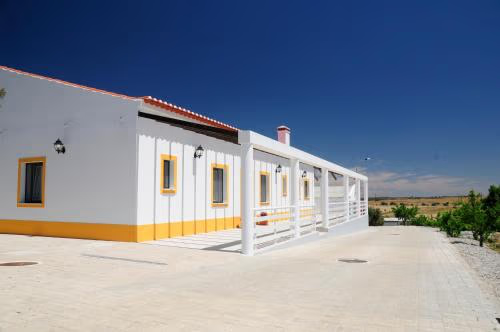 OpenReservations accepted
Corvos e Cadavais
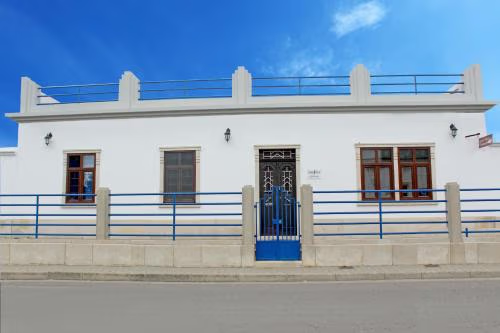 OpenReservations accepted
A CASA DA VILA
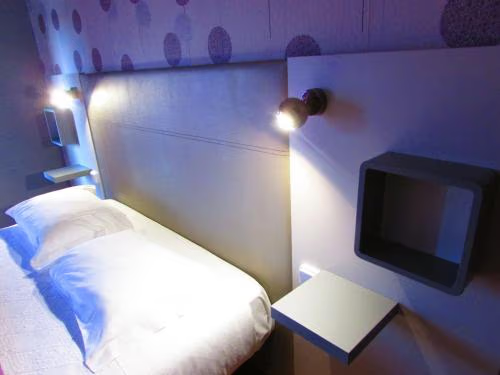 OpenReservations accepted
ATCamões




Town 7 of 24