

Town on the Camino
Castro Verde
Portugal
- places to stay
- 8
- Caminos
- 2
- Elevation
- 245 m
Castro Verde is where Portugal celebrates St James's Day: the Battle of Ourique on 25 July 1139 is seen as the birth of the kingdom, and in the Basílica Real azulejos tell the story of it and of the apostle's life. All around lies the Campo Branco, wide, shadeless and home to the great bustard.
How long to stay?
An afternoon is enough, just not on Mondays or Tuesdays. After 29.5 kilometres from Almodôvar you will be tired, but everything important is close together: the Basílica Real with its church treasury, the church of Chagas do Salvador right where you arrive, the lamp museum and the windmill. On Mondays and Tuesdays the Basílica is closed, and on Mondays the Museu da Lucerna too. If you arrive on those days and want to see the heart of the town, you will have to add a day or be out of luck. For the birds of the Campo Branco you would need a guide and a whole day; that is more a trip of its own.
Castro Verde in Ninja numbers
- 130.5 kilometres is what you have walked since Faro, according to Camino Ninja, with 322.3 still ahead of you to Benfica do Ribatejo. You have left the Algarve and the Serra behind, and now the way belongs to the Alentejo.
- 25 July 1139: On this day, the feast of St James, Afonso Henriques is said to have defeated five Moorish kings at Ourique. The legend places the birth of Portugal on St James's Day.
- Around 60,000 azulejos cover the nave of the Basílica Real, and above all they tell the story of a battle.
- About 80 per cent of Portugal's great bustards live in the Campo Branco, according to the municipality, and you are walking through it today and tomorrow.
- €1 is the price of the Basílica and the church treasury together, while the Basílica alone is free (as of November 2026).
Arriving: across the white field
The stage from Almodôvar follows the old road towards Ourique through open country with little shade, via A-dos-Neves and Rosário, past the old Ferragudo mines and under the railway line. Near Monte da Filipeja, shepherd dogs sometimes roam free; just keep walking calmly. This is the Campo Branco, the white field, which the municipality calls the most important cereal steppe in Portugal.
In town, the stage ends in front of the church of Chagas do Salvador, with the Posto de Turismo right next to it. So you arrive exactly where you can get information. The Basílica Real on the Praça do Município is only a few streets away.
Castro Verde lies on the Caminho Português Central do Sul. This is also where the Caminho Central Via Atlântico begins, branching off towards the sea and meeting your route again in Santiago do Cacém.
In brief: Shepherd land, Order land, copper land
Castro Verde began as a small settlement in the wide fields of Ourique. Its position made it a district seat and a commandery of the Order of Santiago, and in the 16th century the Order was the largest landowner in the town centre. The herds came here on their seasonal migrations.
In 1620 King Filipe II ordered a fair, the Feira de Castro. For two centuries its stall fees paid for rebuilding and maintaining the church of Remédios. The Feira became the biggest market in the south of Portugal and is still held on the third weekend of October.
Today the area also lives from mining. The Neves-Corvo mine is one of the most important in Europe, and every year on the first weekend of September Castro Verde celebrates its mining identity with the Festival Castro Mineiro.
Portugal was born on St James's Day, says the legend
For a pilgrim, Castro Verde is a special place, because this is where Portugal's founding story meets the apostle. According to tradition, the Battle of Ourique fell on 25 July 1139, the day of St James. Afonso Henriques is said to have beaten five Moorish kings with a much smaller army and to have been proclaimed king there for the first time. The evening before, so the legend goes, the crucified Christ appeared to him and promised him a new kingdom.
Castro Verde has built a whole landscape of memorials around this story. The Ermida de São Pedro das Cabeças, built on the orders of King Sebastião in the second half of the 16th century, marks the battlefield, and every year on 25 July there is a celebration there. The church of Chagas do Salvador shows the battle in paintings by Diogo Magina. A memorial monument from the late 18th century stands in the town. And the Basílica Real tells it on tens of thousands of tiles, while six panels in the chancel show the life of James. Whether the battle really took place here and whether the miracle happened is something historians have argued about for a long time. Even so, for you as a pilgrim it is a lovely twist that Portugal set its founding myth on St James's Day: you are walking to the apostle, and on the way you pass the place where Portugal placed its beginning on his feast day.
Following the trail of Ourique: what to see
The sights are close together in the centre, and you can see them all in an afternoon without your rucksack. Watch out for the closing days.
- Basílica Real de Nossa Senhora da Conceição: The town's main church goes back to the Order of Santiago and King Sebastião, and it took its present baroque form in the first half of the 18th century under King João V, who was also Master of the Order of Santiago. The nave is lined with around 60,000 azulejos from about 1730 that tell the story of the Battle of Ourique; in the chancel, six panels show scenes from the life of James. For you as a pilgrim, these six pictures are the real reason to go. Look up as well: the painted wooden ceiling shows the Miracle of Ourique and is considered the most elaborate in the diocese of Beja. It was restored from 2021, and since 2023 the church has been fully open again and is a national monument. It is open Wednesday to Sunday, from November to March 9:30–12:30 and 14:00–17:30, from April to October 10:00–12:30 and 14:00–18:00 (as of November 2026).
- Tesouro da Basílica Real: In one of the sacristies, the church treasury shows sacred art from the villages of the municipality. The most important piece is the silver head reliquary of St Fabian from the 13th century, rediscovered in 1986 in Casével, the village you walk through tomorrow. There is also a Flemish Santa Bárbara from the 15th century and an Indo-Portuguese crucifix from the 17th century. Together with the Basílica, admission is €1 (as of November 2026).
- Igreja das Chagas do Salvador / Nossa Senhora dos Remédios: Your stage ends here. The church was first dedicated to the Wounds of the Saviour and later gained Nossa Senhora dos Remédios as its main patron, after miracles were attributed to a picture of the Virgin. The paintings by Diogo Magina show the victory of Ourique. It was rebuilt with the money from the Feira de Castro. We have not found its opening hours.
- Museu da Lucerna: The museum shows Roman oil lamps from the 1st to 3rd century, found in 1994 in Santa Bárbara de Padrões. The municipality calls it the largest collection of Roman lamps in the world. On the lamps you can see household gods, animals, scenes of everyday life and mythical figures. Open Tuesday to Sunday 10:00–12:30 and 14:00–17:30, closed on Mondays and public holidays (as of November 2026, according to the municipality).
- Moinho de Vento at the Largo da Feira: The windmill stood idle after 1940; the municipality restored it in 2003 and set the grinding mechanism going again. There is a miller; you can visit by arrangement or when it happens to be running.
Food and drink
Castro Verde is lamb country. The municipality lists as specialities lamb from the Campo Branco, roasted lamb heads, migas with pork from the black pig or with asparagus, and the açordas, the bread soups of the Alentejo. For dessert there are queijada de requeijão, folhados de gila and popias. After a day on the steppe, an açorda is exactly what you need.
Honestly
- Monday and Tuesday are bad days to arrive. The Basílica Real is shut on both days, and the lamp museum and the Posto de Turismo on Monday. If you can plan your stages, arrive between Wednesday and Sunday.
- The Campo Branco has almost no shade. In July and August the average high in nearby Beja is a good 33 degrees. From June to September this section is an ordeal; set off early and carry two to three litres of water.
- There is no pilgrim hostel. You sleep in private accommodation or at the campsite, see below.
- You will not see the birds in passing. The great bustard cannot be ordered, and the environment centre is 7 kilometres outside town. With luck you may spot one from the path along the way.
- The dogs before the town. Near Monte da Filipeja, shepherd dogs sometimes roam free. Stay calm, keep your distance, keep walking.
Where pilgrims sleep
There is no pilgrim hostel in Castro Verde, neither municipal nor run by the parish. There is a private hostel with a dormitory, from €25 according to our data, and the municipal campsite on the Rua Timor Lorosae, from €13.50 (both as of November 2026). There are also guesthouses. Book ahead, and sort out your bed in Messejana now too: beds are scarce there, because workers from the Aljustrel mines need them as well.
Ninja tips
- Go to the Posto de Turismo first. It is right next to the end of the stage on the Rua D. Afonso I, Tuesday to Friday 9:00–17:00, at weekends 10:00–13:00 and 14:00–17:00, telephone 286 328 148 (as of November 2026). Ask there for a stamp for your pilgrim passport and about accommodation for Messejana.
- The six St James panels are in the chancel. Many visitors stop at the battle scenes in the nave. Go to the front.
- Look out for the Horta da Ordem on the way out of town. On the gate of this plot there is a big S, for Santiago. A quiet sign of who once owned the land here.
- Plan your lunch break in Casével. The village lies after 14.6 kilometres, pretty much halfway to Messejana, and it is where the head reliquary you saw in the church treasury comes from.
- Rest at the Fonte dos Milagres. The public fountain near Almeirim is on your way, and its water is said to have special powers. We have not checked whether it is drinking water; do not rely on it.
- Shop this evening for tomorrow. On this route there are supermarkets only in the towns, and on the last 10 kilometres before Messejana you walk between pasture fences.
When it rains
In November, nearby Beja gets 76 millimetres of rain on average, in December 80 (climate normals 1991–2020). Castro Verde then helps you with solid roofs:
- Basílica Real and Tesouro: Wednesday to Sunday, from November to March 9:30–12:30 and 14:00–17:30 (as of November 2026).
- Museu da Lucerna: Tuesday to Sunday 10:00–12:30 and 14:00–17:30 (as of November 2026, according to the municipality).
- Centro de Artes e da Viola Campaniça: The centre for the viola campaniça, the region's large wire-strung guitar, has been open since April 2021, Monday to Friday from 9:00 until late afternoon (the municipality gives 17:00 and 17:30).
Practical tips for pilgrims
- Supplies: Supermarket, post office and taxis are in town.
- Festivals: The Feira de Castro on the third weekend of October fills the town, as does the Festival Castro Mineiro on the first weekend of September. Book early then.
- Cante Alentejano: The polyphonic singing of the Alentejo has been on UNESCO's Intangible Cultural Heritage list since 2014, and Castro Verde has several choirs. Ask at the Posto de Turismo whether anyone is singing somewhere.
- Vale Gonçalinho environment centre: 7 kilometres outside town, Tuesday to Saturday 9:00–13:00 and 14:00–18:00, telephone 286 328 309 (as of November 2026). Only worthwhile with a car or a lift.
Onward: through the Campo Branco to Messejana
The next stage is 29.2 kilometres long. You leave Castro Verde towards Almeirim (8.3 kilometres) with the Fonte dos Milagres, pass through Gregórios (10.6) to Casével (14.6) and then go past the old Casével station on quiet country roads. The last 10 kilometres run along farm tracks between the fences of livestock farms, and at the end you cross the motorway on a viaduct and arrive in Messejana. If you want to head for the coast, take the Caminho Central Via Atlântico from here.
What awaits you tomorrow
Messejana, a white village on a hill that was once a district seat and a commandery of the Order of Santiago. Of its eleven churches four remain, and of the castle only ruins. Beds are scarce there, so call today.
Deep dive: The battle on St James's Day
A short read, in case you want to learn more about Castro Verde. About four minutes' reading.
Where you stand
When you stand on the Praça do Município in front of the Basílica Real, you are in a town that grew up around a single story. All around lies the Campo Branco, a plain of grain and pasture across which, on some days, only the wind and the great bustards pass. Since 2017 this landscape has been a UNESCO biosphere reserve, the only one south of the Tagus. But the story Castro Verde tells is older than any protected zone. It is the story of a summer's day in the year 1139.
A victory on the twenty-fifth of July
According to tradition, on 25 July 1139 the troops of the young Afonso Henriques met a far larger army at Ourique, led by five Moorish kings. The Christians won. And after the battle, so it is said, his men proclaimed Afonso Henriques king for the first time. 25 July is the day of St James the apostle, who in Spain and Portugal had become the patron saint of the Reconquista. That the birth of Portugal falls on this day is probably no coincidence of the storytellers.
In Castro Verde they show you the site of the battle at São Pedro das Cabeças, a few kilometres from town. King Sebastião had a chapel built there in the second half of the sixteenth century, and to this day there is a celebration there every 25 July.
The legend of the crucified Christ
A miracle belongs to the battle. On the eve, so the legend goes, the crucified Christ appeared to Afonso Henriques and promised him a new kingdom that would carry the faith out into the world. You can find this scene on the painted wooden ceiling of the Basílica Real, and the town's priest once put it this way: Portugal was born in Guimarães and consolidated on the fields of Ourique.
Is it true?
Here you have to distinguish honestly between memory and history. Where exactly the battle took place is disputed among historians, and several places lay claim to it. The miracle itself appears in the sources only much later. In the nineteenth century the historian Alexandre Herculano publicly doubted that it ever happened, setting off a fierce quarrel with the Church. What can be said with certainty is that Afonso Henriques called himself king in those years, and a little later Portugal was recognised as a kingdom. So Ourique is less a date than a founding image. Castro Verde has decided to guard this image, with chapels, paintings, a memorial monument and tens of thousands of tiles.
The Order and the king's church
In the Middle Ages the land around Castro Verde belonged to the Order of Santiago, the knights of the apostle. The Order was the commander and, in the sixteenth century, the largest landowner in the town centre. It founded the main church, and King Sebastião had it refurbished in memory of Ourique. It took its present form in the first half of the eighteenth century, under King João the Fifth, who was at the same time Master of the Order of Santiago. The design is attributed to the architect João Antunes.
Around 1730 the walls of the nave were lined with azulejos, some sixty thousand tiles that tell the battle scene by scene. They are attributed to a Lisbon master with the initials P. M. P. And in the chancel, where the altar stands, six pictures show the life of James. The apostle on whose feast day the battle was fought is thus right at the front.
The church fell into decay over the years. From 2019 the roof was cleaned and repaired, and from 2021 the painted ceiling was restored, with money from Europe and from the company that operates the Neves-Corvo mine. In 2023 the church fully reopened, and in the same year it was declared a national monument. When this text was written, in autumn 2026, the Ourique tiles themselves were still waiting for their restoration.
Wool, market and copper
Castro Verde was never just a place of memory. It was a place of shepherds. The herds crossed the Campo Branco on their migrations, and in 1620 King Filipe the Second ordered a fair. With the fees for the market stalls, the church of Remédios was rebuilt and maintained for two centuries, the church in front of which the pilgrim stage ends today. At the Feira, livestock, woollen blankets and socks were traded, many of them from Santa Bárbara de Padrões. It became the biggest market in the south of Portugal and is still held every October.
Beneath the fields lies the Iberian Pyrite Belt, and there was mining here as early as Roman times. The Roman oil lamps found in 1994, now in the Museu da Lucerna, also come from Santa Bárbara de Padrões. For decades the Neves-Corvo mine has produced copper and zinc, and it has changed the area: it brings work, and its operating company helped pay for the restoration of the Basílica.
What Castro Verde gives you
You come out of the steppe, sweaty, with dusty shoes, and find in a church six pictures of the life of the man you are walking to. Whether the Miracle of Ourique happened is not for you to decide. But you can remember that a whole country placed its beginning on the day of your apostle. Tomorrow you walk on through the white field, and perhaps somewhere a great bustard will take off. This day needs nothing more.
Where to stay in Castro Verde
Places to stay in Castro Verde.
 OpenReservations accepted
Parque de Campismo Municipal
13€- OpenReservations accepted
Hostel In My House
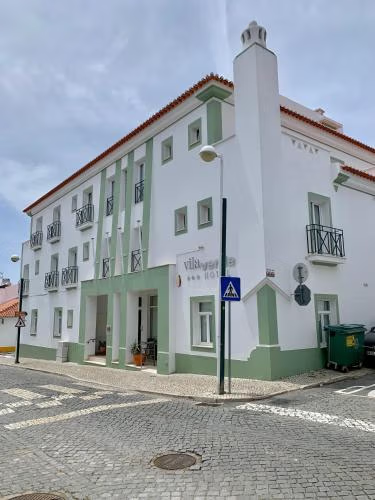 OpenReservations accepted
Hotel Vila Verde

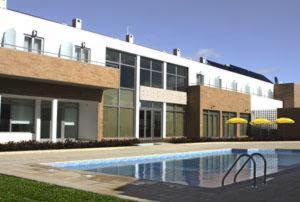
Town 8 of 24