

Town on the Camino
Arco de Baúlhe
Portugal
- places to stay
- 2
- Camino
- 1
- Elevation
- 223 m
Arco de Baúlhe is the stop just before Cabeceiras de Basto: a village at the end of a railway line whose old carriages now stand here in a museum, among them King Carlos I's saloon car. The Bohemian pilgrim party passed through as early as 1466. Good for a break; for the night, walk on 5.6 kilometres.
How long to stay?
A break is enough. Arco de Baúlhe is only 5.6 kilometres before Cabeceiras de Basto, the day's stage town, and there is no pilgrim bed here. If the railway museum is open, it is worth half an hour to an hour; otherwise a coffee and a look at the old station will do.
Arco de Baúlhe in Ninja numbers
- 201.9 kilometres lie behind you since the start on the Douro on the Caminho Leon de Rosmithal.
- 6.9 kilometres from the village of Cavez to here, with 105 metres of ascent and 176 metres of descent.
- 5.6 kilometres remain to Cabeceiras de Basto; the last stretch climbs gently.
- 1876 is the oldest build year among the carriages in the museum, a passenger coach; the steam locomotive MD 407 dates from 1908.
- 1,669 people lived in the former parish of Arco de Baúlhe in 2011.
Arriving: up from the Tâmega
From Cerva you come down into the Tâmega valley and cross the river at the medieval Ponte de Cavez. From there it is another 6.9 kilometres to Arco de Baúlhe. The Camino passes by the village; the centre with the old station lies a short way off, and the village point on the Camino Ninja map is a good half kilometre from the track.
In brief: a place name in the chronicle
In the summer of 1466 the embassy of the Bohemian knight Jaroslav Lev of Rožmitál, known in Portugal as "Leon de Rosmithal", passed through here on its way to Braga. His companion's chronicle calls the place "Barcodevonde" or "Barcos de Vondelde"; the historical study by the municipality of Póvoa de Lanhoso identifies it as Arco de Baúlhe. Much later the village became the terminus of the Tâmega line. Since 2013 Arco de Baúlhe and Vila Nune have formed a joint parish in the municipality of Cabeceiras de Basto.
At the end of the tracks: what to see
The two sights are close together in the village.
- Railway museum (Núcleo Museológico): In the old carriage sheds next to the station, the Fundação do Museu Nacional Ferroviário shows rolling stock from Portugal, Belgium, England, France and Germany, built between 1876 and 1948. The centrepiece is a historic train: the steam locomotive MD 407 of 1908 and two saloon cars, among them car 4001, in which King Carlos I travelled. For pilgrims it is a rare sight: you arrive on foot at a place where all journeys used to end. We did not find opening hours or admission prices; ask in the village or at the municipality of Cabeceiras de Basto.
- Santuário Nossa Senhora dos Remédios: The chapel was restored in 2000 and redesigned in 2013, and in September 2023 the Archbishop of Braga raised it to the status of a sanctuary. On the first weekend of September the village holds its festival here with a procession; a month earlier a flagpole several metres high is raised for it, accompanied by ox carts and concertina music.
Honestly
- Hardly a bed. Arco de Baúlhe has a country house and a campsite that, according to our data, is open from April to September, but no pilgrim bed. Most people carry on 5.6 kilometres to Cabeceiras de Basto.
- The museum is not a sure thing. We found no confirmed opening hours. Don't count on getting in.
- The village lies off the Camino. For the station and the museum you make a short detour from the track.
Ninja tips
- Take your lunch break here. From Cerva to Cabeceiras it is 24.3 kilometres; Arco de Baúlhe comes after 18.7 of them, just right for a rest before the last climb.
- Come at the start of September. If your walk falls on the first weekend of September, you will see the festival of Nossa Senhora dos Remédios with its procession.
Onward: to Cabeceiras de Basto
Beyond Arco de Baúlhe the Camino climbs gently, 5.6 kilometres with 147 metres of ascent and 83 metres of descent, to Cabeceiras de Basto. There the monastery of São Miguel de Refojos is one of the great Baroque buildings of the north, and there you will also find a bed for the night.
Deep dive: Barcodevonde
A short read, in case you want to learn more about Arco de Baúlhe. About two minutes' reading.
A name that went into hiding
When the Bohemian embassy passed through the Tâmega valley in the summer of 1466, its chronicler wrote down the names of the places as he heard them. His account survives only in a Latin translation printed more than a hundred years later, and along the way the sounds of a Portuguese village turned into words like "Barcodevonde". Only when specialists from the municipality of Póvoa de Lanhoso traced the journey place by place did they recognise Arco de Baúlhe in it.
Where the tracks ended
Centuries later the village became an end point. This is where the Tâmega line ended, a narrow-gauge railway coming up from the valley. In the sheds where carriages were once parked now stand vehicles from five countries, the oldest from 1876. The saloon car in which King Carlos I travelled recalls the time when kings, too, went by train.
What Arco de Baúlhe gives you
For the railway, this was the end; for you, the way goes on. When this text was written, in autumn 2026, the Camino was not yet waymarked everywhere (all municipalities are to follow by March/April 2027), and few pilgrims passed through. So you are walking a trail that is only just becoming visible again, through a place whose own name was invisible for a long time.
Where to stay in Arco de Baúlhe
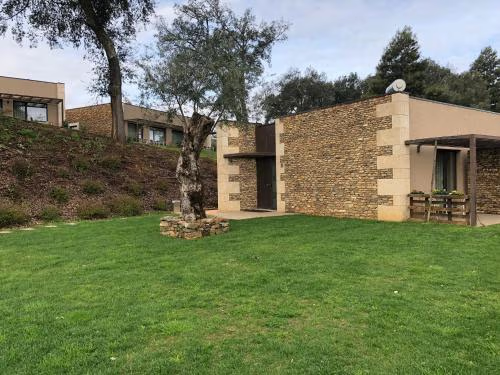
Places to stay in Arco de Baúlhe.
 Closed
Campismo Arco
 Open
Bosque da Harmonia
Town 11 of 16