

Town on the Camino
Cabeceiras de Basto
Portugal
- places to stay
- 2
- Camino
- 1
- Elevation
- 290 m
Cabeceiras de Basto is the stage town beneath the dome: in the middle of town stands the Benedictine monastery of São Miguel de Refojos, whose Baroque dome rises 36 metres above the crossing, crowned by the Archangel Michael. Today the town hall sits in the monastery. 207.5 kilometres lie behind you; three stages remain to Braga.
How long to stay?
An afternoon is enough. Cabeceiras de Basto is a small town, and everything you will want to see stands around the monastery. After the long stage from Cerva you still have enough time for the monastery church and a stroll across the square. If you need a rest day, this is a quiet place for it before the last 53.7 kilometres to Braga.
Cabeceiras de Basto in Ninja numbers
- 207.5 kilometres lie behind you since the start on the Douro on the Caminho Leon de Rosmithal.
- 24.3 kilometres is the stage from Cerva to here, with 566 metres of ascent and 587 metres of descent.
- 36 metres is the height of the Refojos dome above the crossing; of 29 Benedictine monasteries in Portugal, only this one has such a dome.
- 1122 is the year the monastery is first mentioned in a document.
- 45 seats make up the chestnut-wood choir stalls where the monks once sang.
Arriving: into the Terras de Basto
From Cerva you go down into the Tâmega valley, cross the river at the Ponte de Cavez and reach the town via Arco de Baúlhe. The last 5.6 kilometres from Arco de Baúlhe climb gently. At the end you stand in front of the monastery; its dome with the archangel is the town's landmark.
In brief: monks, kings, town hall
The monastery of São Miguel de Refojos is documented since 1122. Around 1131 Afonso Henriques, who would become Portugal's first king, placed the monastery's land under his special protection. The Benedictines stayed for more than seven centuries. In 1755 the new building began to plans by the Braga architect André Soares, making the monastery one of the great Baroque buildings of the north; in the 1760s Frei José de Santo António Vilaça worked here, and the chapel and high altar are his.
When the religious orders in Portugal were dissolved in 1834, the state sold the building. Today the municipal administration works in the monastery, and the sacristy is a museum. Church and sacristy have been listed since 1933, and in 2014 the town put the monastery forward as a candidate for World Heritage status.
Beneath the dome: what to see
Everything important is inside the monastery or right next to it.
- Monastery church of São Miguel de Refojos: entirely Baroque, with the 36-metre dome, on whose balustrade stand twelve busts of bishops and popes and on whose lantern stands the Archangel Michael. For pilgrims the archangel is more than decoration: he is the monastery's patron, the guide of souls to whom you entrust yourself at the end of a journey. Look out for the double organ, whose pipework was restored in 2009. We did not find opening hours; since September 2022 the monastery has had a visitor reception, the Espaço Ilídio dos Santos.
- Sacristy and museum: The sacristy has a slanted arch that is considered unique in Portugal, and today it serves as a museum.
- Choir stalls: 45 seats of chestnut wood, where the monks sang the Divine Office.
Honestly
- No pilgrim hostel. In Cabeceiras de Basto, too, you sleep in a hotel or a holiday apartment; the only pilgrim hostel between the Douro and Braga is in Parada de Aguiar. Book ahead.
- Opening hours unclear. We found no reliable times for the church and museum. Don't arrive too late in the day if you want to go in.
- The next stage climbs. On the way to Guilhofrei you go up to 572 metres, the day's high point, in the middle of a stage with only small villages.
Where pilgrims sleep
There is no pilgrim hostel in Cabeceiras de Basto. In town there are a hotel and holiday apartments, which you will find further down this page. Ask when booking whether you can leave early in the morning.
Ninja tips
- Look up before you go in. On the lantern of the dome stands the Archangel Michael, 36 metres above the crossing.
- Come at the end of September. On 29 September Cabeceiras de Basto celebrates its municipal holiday, the feast of the Archangel Michael.
- Stock up here. The next stage to Guilhofrei passes only small villages; take water and food from town.
Onward: over the heights to Guilhofrei
The next stage runs 20.6 kilometres via Cumieira and Bucos to Guilhofrei, with 470 metres of ascent and 390 metres of descent. The high point, at 572 metres, is at kilometre 219.5, between Bucos and Guilhofrei. After that, two stages remain via Póvoa de Lanhoso to Braga.
Deep dive: The saint of Basto
A short read, in case you want to learn more about Cabeceiras de Basto. About three minutes' reading.
A monastery for the archangel
Anyone who travelled through these valleys in the Middle Ages passed a monastery dedicated to the Archangel Michael. In Christian tradition Michael is the angel who guides and weighs souls. To this day the town celebrates his feast on 29 September.
Senhorinha
The best-known saint of this region is a woman. Senhorinha, a Benedictine nun from nearby Vieira do Minho, became abbess and moved her convent to Basto. She died on 22 April 982. Some 150 years later, in 1130, the Archbishop of Braga declared her a saint, at a time when bishops could still do so within their own dioceses. In the twelfth and thirteenth centuries her tomb in Basto became a pilgrimage destination for the region. Even King Sancho I came to pray for the healing of his son, the future King Afonso II. The son recovered. A nearby spring that bears her name is still said to have healing powers.
The church that holds her tomb stands in the village of Basto in the municipality of Cabeceiras de Basto, not on the Camino. The historical study of the Caminho Leon de Rosmithal lists it explicitly among the old pilgrimage destinations of this region.
What Cabeceiras de Basto gives you
You arrive as a pilgrim in a region that has known pilgrims since the Middle Ages. Senhorinha's tomb, the archangel's monastery, the road of the Bohemian embassy: here, paths lie on top of one another. When this text was written, in autumn 2026, the Caminho Leon de Rosmithal was still young. Perhaps you are one of the first to walk it through here to the end.
Where to stay in Cabeceiras de Basto
Places to stay in Cabeceiras de Basto.
 Open
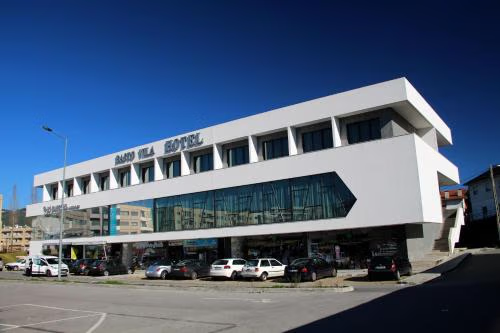
Basto Vila Hotel
 Open
Vistas da Villa
Town 12 of 16