

Town on the Camino
Arnsdorf
Germany
- places to stay
- 5
- Camino
- 1
- Elevation
- 263 m
Arnsdorf is the quiet evening before Dresden: a village between fields and forest, with a church from 1638 and a hospital with a heavy history. In 1940/41 at least 2,681 patients were taken from here to Pirna-Sonnenstein. The pilgrim bed waits 4.5 kilometres further on in Wallroda, and it is 26.8 kilometres to Dresden.
How long to stay?
An afternoon is enough, and really you'll want to walk a bit further. Arnsdorf has two churches, a reservoir nearby and a hospital history that is worth knowing, but no pilgrim hostel in the village itself. That one is 4.5 kilometres further on in Wallroda, right on the way. If you sleep there, you shorten the long day to Dresden. For Arnsdorf, a break with your eyes open is all you need.
Arnsdorf in Ninja numbers
- 41.9 kilometres lie behind you, according to Camino Ninja, since you set off in Bautzen, and 266.1 kilometres to Hof are still ahead. So you've done almost a seventh.
- 26.8 kilometres is the distance from here to Dresden. From the pilgrim hostel in Wallroda you save yourself 4.5 of them.
- 2,681 people were taken from the Arnsdorf state hospital to Pirna-Sonnenstein between July 1940 and August 1941, and most were murdered there. Among them were 182 children.
- 1410 is the year the older of the two bronze bells of Wallroda village church was cast. It hangs in the district where the pilgrim hostel stands.
Arriving: between fields and forest
From Bischofswerda you come through fields and forest via Großharthau and Seeligstadt to Arnsdorf, 16.1 kilometres in one go. Today the place belongs to the district of Bautzen, has just under 5,000 inhabitants (as of the end of 2025) and four districts, including Wallroda and Kleinwolmsdorf, through which the Saxon Way of St James continues. In the south of the village is the railway station on the Görlitz–Dresden line. That matters if you are breaking off here or already planning your rest day in Dresden.
In brief: a village before the city
The village church appears in records of the Diocese of Meissen in 1346. On 23 November 1631 the village burned, and the church, with its thatched roof, lost everything except the choir vault, the chancel arch and the walls. War and plague delayed the rebuilding, and it was not consecrated until 1 November 1638. From 1908 the Kingdom of Saxony built its last new psychiatric hospital here. It opened on 1 April 1912 and has shaped the village ever since.
A hospital with a church tower and a memory
The Arnsdorf state hospital was a small town in itself: almost 80 hectares, pavilion-style buildings, an administration building with a 35-metre clock tower and its own church, octagonal in plan and 35.5 metres high. In 1931 around 1,700 patients lived here. In the Nazi period Arnsdorf became a transit institution for Aktion T4. From July 1940 to August 1941 at least 2,681 patients went to Pirna-Sonnenstein, among them 1,379 women and 182 children. Since 1987 a memorial plaque in the administration building has remembered them. Today the site is the Sächsisches Krankenhaus Arnsdorf, a specialist psychiatric hospital. Walk past quietly: this is not a museum, but a place where people are being treated.
Two village churches and a reservoir: what to see
Arnsdorf itself is crossed quickly. The worthwhile sights are at the church in the village and, shortly after, on the way to Wallroda.
- Dorfkirche Arnsdorf (village church): The church, reconsecrated in 1638 after the great fire, has an octagonal roof turret and its own bell tower from 1918. Inside it is worth looking up: the painted panel ceiling of 1719/20 was restored between 2001 and 2011. The altar of 1632 comes from Borna, and the pulpit dates from around 1680 and shows the four evangelists. The pewter baptismal bowl is from 1637, so from the time when the church was still a burnt-out ruin. We haven't found any opening times.
- Hospital church and administration building: The church of 1912/13 and the administration building with the clock tower are listed buildings. A pneumatic organ of 1913 plays in the church. Whether and when it is open to visitors, we haven't found out. From outside you get an impression of how big this hospital was once meant to be.
- Dorfkirche Wallroda (village church): The church in the Wallroda district has stood in its present form since the 17th century, but a place of worship is mentioned here as early as the 14th century. Before the Reformation it is said to have been a destination for pilgrims itself. Two bronze bells date from 1410 and 1420, and the late Gothic winged altar from around 1520. The organ that Gottfried Silbermann built in 1732/33 is no longer here: it was sold and now stands in Bremen Cathedral. A memorial stone in the cemetery commemorates three Soviet prisoners of war who were murdered on a country road in April 1945.
- Talsperre Wallroda (Wallroda reservoir): The reservoir was created between 1986 and 1989 and covers 36 hectares. The path leads from Arnsdorf straight to the dam. There is a campsite and a pub there. Swimming is allowed, but without lifeguards and at your own risk.
Honestly
- There is no pilgrim bed in the village itself. The pilgrim hostel is in Wallroda, 4.5 kilometres further on. Plan your day so that you arrive there while you still have some energy.
- The best-known address is a hospital. The hospital grounds are not a sightseeing destination. You can't take it for granted that the hospital church is open.
- The next day is long. It is 26.8 kilometres to Dresden, part of it through the Dresdner Heide and at the end through the city. If you don't sleep in Wallroda, set off early.
Where pilgrims sleep
The pilgrim accommodation for this stretch is the Pfarrhof-Pächterhaus Wallroda at Friedensstraße 3 in the Wallroda district, 4.5 kilometres beyond Arnsdorf on the way. The parish runs it as a pilgrim hostel, and you'll find contact details and current conditions on its website, kirche-afw.de. Call ahead. In Arnsdorf village itself there are a few private rooms and holiday flats, which you can find in the app.
Ninja tips
- Walk on to Wallroda. The 4.5 kilometres in the afternoon won't be missing from your long walk to Dresden tomorrow, and you'll sleep in the village with the bells of 1410.
- Look at the altar in Wallroda. The winged altar of around 1520 is older than the Reformation in Saxony and older than the church where it stands today.
- The station is your emergency exit. From Arnsdorf, the RE 1 and S 8 run via Radeberg to Dresden Hauptbahnhof. Handy if your feet have had enough or you want to look at your rest-day lodgings in Dresden in advance.
Onward: through the Dresdner Heide into the city
Beyond Arnsdorf the path leads to the Wallroda reservoir, through Wallroda and Kleinwolmsdorf, and then towards the Dresdner Heide. You reach Dresden after 26.8 kilometres.
What awaits you tomorrow
Dresden doesn't arrive suddenly; you walk into the city as into a forest. First through the Dresdner Heide, for centuries the hunting ground of the Saxon court, then through the Prießnitz valley and past the old Saugärten, where captured wild boar once waited for the royal hunt. Only then does the Elbe valley open up, and you walk across the Augustusbrücke towards the Old Town.
Deep dive: Two churches, a hospital and an organ in Bremen
A short read, in case you want to learn more about Arnsdorf. About two minutes' reading.
A village that started twice
The village church of Arnsdorf is first mentioned in records of the Diocese of Meissen in 1346. How old it really is, nobody knows. What is certain is when it almost vanished: on 23 November 1631 the village burned down, and with it the church under its thatched roof. What remained were the vault over the choir, the chancel arch and the walls. Then came the Thirty Years' War and the plague, and only on 1 November 1638 could the congregation reconsecrate its church. The pewter bowl in the font dates from 1637.
The hospital
In 1906 the Kingdom of Saxony decided to build a new psychiatric hospital in Arnsdorf. It opened on 1 April 1912, on almost 80 hectares, with pavilions, a large manor farm and its own church. It was the last new foundation of its kind in Saxony. At the end of 1912, 353 patients lived here; by 1931 there were around 1,700. What came after is among the darkest chapters of the place. From 1934 patients were forcibly sterilised. From July 1940 to August 1941 Arnsdorf served as a transit station for the Aktion T4 murders of the sick. At least 2,681 people were taken from here to Pirna-Sonnenstein, among them 1,379 women and 182 children. Most of them were killed there. Further transports to other institutions followed later. A memorial plaque in the administration building has remembered the victims since 1987. Today the Sächsisches Krankenhaus Arnsdorf treats people with mental illness on the same site.
The organ that went to Bremen
In Wallroda, 4.5 kilometres further on, stands a church that is said to have attracted pilgrims even before the Reformation. Its two large bells were cast in 1410 and 1420, and the winged altar was carved around 1520. An organ by Gottfried Silbermann, built in 1732 and 1733, came here in 1865. Later it was sold and rebuilt, and today it stands in Bremen Cathedral. So whoever sleeps in Wallroda is in a village whose organ now sings in another city.
What Arnsdorf gives you to take with you
Arnsdorf is not a place where you stay long. But it asks for something pilgrims are good at: looking, and walking on without forgetting. On the eve of Dresden, which gets so much attention, that may be the right thought for the last quiet evening.
Where to stay in Arnsdorf
Places to stay in Arnsdorf.
 Open
Familie Schwarzmeier
Donativo- Open
Pfarrhof-Pächterhaus Wallroda
Donativo 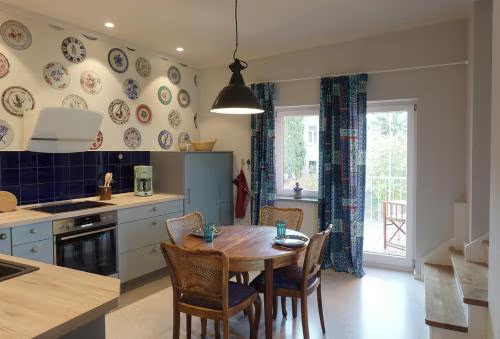 OpenReservations accepted
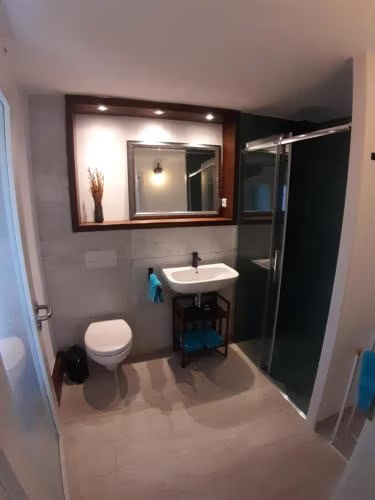
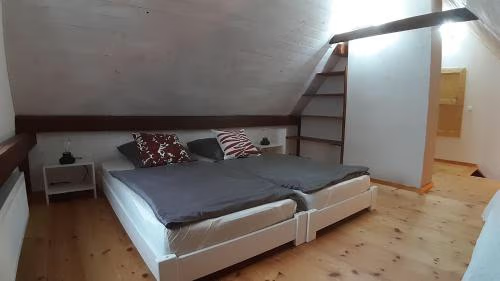
Alte Sattlerei- Wohnen mit besonderem Flair
KitchenCooktopsPlates & UtensilsAnd more
Town 3 of 15