

Town on the Camino
Dresden
Germany
- places to stay
- 105
- Camino
- 1
- Elevation
- 117 m
Dresden is the city of reconciliation on the Saxon Way of St James: the Frauenkirche (Church of Our Lady), which collapsed in 1945 and was reconsecrated in 2005, prays the Litany of Reconciliation from Coventry. As early as 1455 the city had a hostel for strangers with a St James altar, on the road to Freiberg. After 68.7 kilometres from Bautzen, the city is worth a rest day.
How long to stay?
Worth a rest day, at least. After three or four days through villages and forest, you arrive in a big city with three major churches within a few hundred metres: the Frauenkirche, the Kreuzkirche (Church of the Holy Cross) and the cathedral. Add to that evening devotions, a boys' choir with a long tradition, and museums for a whole day. The arrival after 26.8 kilometres from Arnsdorf is long. If all you can manage that evening is to find your bed, you haven't seen anything of Dresden. So plan a day without your rucksack.
Dresden in Ninja numbers
- 68.7 kilometres behind you since Bautzen, according to Camino Ninja, with 239.3 still ahead of you to Hof. A good fifth is done.
- 117 metres above sea level is where Dresden sits. Almost nowhere on the whole Saxon Way of St James are you lower; from here on it heads towards the Ore Mountains and the Vogtland.
- 1455 is when the Elendenherberge (hostel for strangers) at the St James hospital is first mentioned, a night shelter for poor travellers with a St James altar, right on the road to Freiberg. That is where you are heading too.
- 138 singers between 9 and 19 years old make up the Dresdner Kreuzchor (as of August 2026). If you are here on a Saturday, ask about its vespers.
Arriving: out of the forest and over the bridge
Dresden doesn't greet you with suburbs but with trees. The Saxon Way of St James leads through the Dresdner Heide, one of the largest urban forests in Germany, through the Prießnitz valley and past the old Saugärten, where the court once kept captured wild boar for hunting. Through the Radeberger Vorstadt you come down into the Elbe valley. Then you cross the Augustusbrücke, and the Old Town with its towers lies ahead. Over the Brühlsche Terrasse you carry on to the Altmarkt. You couldn't arrive in Dresden in a better way.
In brief: a royal seat on the Elbe
On 31 March 1206 "Dresdene" appears for the first time in a document; the name comes from Sorbian. The margraves and later the electors of Saxony made the place their seat. Under Augustus the Strong, who also became King of Poland in 1697, and his son, the Baroque Dresden arose that people now call "Florence on the Elbe". In February 1945 air raids destroyed the city centre; the city's historians' commission puts the death toll at 22,500 to 25,000. In the GDR many ruins were cleared away and the city was rebuilt in socialist modernist style. The great Baroque buildings returned only bit by bit. Today Dresden has around 563,000 inhabitants (as of the end of 2025).
An indulgence for a bridge pier
In the Middle Ages Dresden was itself a small pilgrimage destination. A particle of the Cross of Christ, a gift of Margravine Constantia, gave the Kreuzkirche its name, and many people from the surrounding area came for the Feasts of the Cross. In 1319 the clergy obtained an indulgence of forty days from the Pope. It went to anyone who visited the church on the Feasts of the Cross, or who donated to the building of the Elbe bridge. The bridge counted as a pious work, and its funds were tied to those of the Kreuzkirche. So when you walk across the Augustusbrücke, you are standing on an old place of devotion, even though the present arches only date from 1910. And at the other end of the Old Town, outside the Wilisches Tor on the road to Freiberg, an Elendenherberge at the Jakobshospital took in poor travellers for the night from 1455. "Elend" then meant: in a foreign land. That is the direction you will head out in tomorrow.
Reconciliation in sandstone: what to see
Everything important lies close together in the Old Town, and you can manage it in a day without your rucksack. Two sights are a little off to the side: the Diakonissenhauskirche in the Neustadt and the Wettiner Platz on the way out of the city.
- Augustusbrücke: A stone bridge has stood on this spot across the Elbe since 1220. Augustus the Strong had it rebuilt with twelve arches in 1727 to 1731; the present bridge with nine sandstone arches was built in 1907 to 1910 so that ships would have more room. For you it is the gateway to the Old Town. Stop for a moment in the middle and look back at the Elbe valley you have come through.
- Frauenkirche: George Bähr built it from 1726 to 1743, and its dome is called the "Steinerne Glocke" (stone bell). After the raid of 13 February 1945 it held out for about another day, then collapsed because the sandstone could not withstand the heat. After the fall of the Wall it was rebuilt and consecrated in 2005. For pilgrims it is more than a landmark: at the devotion "Friedenswort & Orgelklang" (word of peace and organ music), the congregation prays the Litany of Reconciliation from Coventry, with a short guided tour of the nave (at the beginning of November 2026 at 12 noon and 6 pm). Entry is free, a donation is welcome. Opening times change from day to day because of rehearsals and concerts, so check the church's calendar beforehand.
- Kreuzkirche: The Old Town parish church on the Altmarkt is named after the relic of the Cross and has been dedicated to the Holy Cross since 1388. In 1760 it was destroyed in the Seven Years' War and rebuilt by 1792; in 1945 only the tower and outer walls remained. In the rebuilding up to 1955 it was given a deliberately plain, rough plaster inside. This bare space feels honest after the splendour of the Frauenkirche. This is where the Kreuzchor sings, whose tradition goes back more than 800 years. The tower is 92 metres high and open daily from 10 am to 6 pm, on Sundays from 1 pm (as of November 2026).
- Cathedral (Katholische Hofkirche): Saxony was Protestant, but its rulers were Catholic. So Elector Augustus III had Gaetano Chiaveri build him a court church of his own, consecrated on 29 June 1751. Today it is the cathedral of the Diocese of Dresden-Meissen. The heart of Augustus the Strong lies in the Wettin crypt. The organ is the last work of Gottfried Silbermann, the same organ builder whose organ from Wallroda now stands in Bremen. We have not found reliable opening times.
- Diakonissenhauskirche: In the Neustadt on Bautzner Straße stands the church of the Diakonissenanstalt (deaconesses' institution), the oldest Cross of Nails centre in Dresden. Church and hospital were destroyed in 1945, and from 1965 young people from Coventry and Germany helped with the rebuilding. Since 9 September 1965 the church has carried the Cross of Nails of Coventry. Access is via the Holzhofgasse and the hospital's emergency entrance.
- Wettiner Platz and the doors of the Jakobikirche: From 1901 to 1953 the Jakobikirche stood here, a neo-Romanesque building with an 80-metre tower. Its congregation bore the name of the old Jakobshospital. In the air raid of 17 April 1945 it was badly hit, and in 1953 it was blown up. Since 2011 the layout of the square has traced the church's ground plan, and its bronze doors of 1902 stand as a memorial at the old site. A small greeting to St James on your way out of the city.
Honestly
- There is no pilgrim hostel in Dresden. For pilgrims on a small budget, what is left is mainly the youth hostel, plus a few private rooms. Call ahead.
- A lot of what looks old is new. The Frauenkirche was only reconsecrated in 2005, and around the Altmarkt there are buildings from the GDR era. That is not a flaw but Dresden's history. Still, if you expect an Old Town that grew naturally, you will be surprised.
- The Frauenkirche isn't yours alone. Rehearsals, concerts and services shorten the visiting hours, often to just a few hours a day. If you want to experience it quietly, come for the devotion rather than a sightseeing visit.
- We don't know of a fixed pilgrim stamp. We haven't found a reliable stamp location in Dresden. Ask in the churches or at your accommodation.
- The day of arrival is long. From Arnsdorf it is 26.8 kilometres, from the pilgrim hostel in Wallroda 22.3.
Where pilgrims sleep
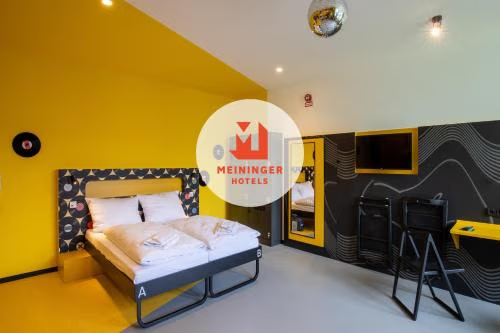
Dresden has no church-run pilgrim hostel. The obvious choice is the DJH Jugendherberge Dresden – Jugendgästehaus at Maternistraße 22, a few minutes' walk from the Old Town. It is big (478 beds in 203 rooms), and the breakfast buffet runs from 6 to 10 am (as of November 2026). The reception hours are given contradictorily on its website, so clarify your arrival time beforehand. In addition there are a few private pilgrim rooms, which you will find in the app. If you are just passing through Dresden, you will find pilgrim rooms in the old chapel 9.5 kilometres further on in Pesterwitz.
Ninja tips
- Keep 12 noon free. The midday devotion "Friedenswort & Orgelklang" in the Frauenkirche with the Litany from Coventry suits a pilgrim's day better than any guided tour. The dates are in the Frauenkirche's calendar.
- Climb the Kreuzkirche tower. From there you can see across the Old Town and the Elbe valley and get a sense of where you came from yesterday. On Sundays it only opens at 1 pm.
- Make a detour via the Wettiner Platz. On your way out through the Wilsdruffer Vorstadt, the detour to the bronze doors of the Jakobikirche is worth it. Not far from there, at the corner of Annenstraße and Am See, the Jakobshospital stood. There is nothing left to see of it, but you leave in the same direction as the strangers of 1455: towards Freiberg.
- Listen to the Kreuzchor if you are here on a Saturday. The Kreuzchor regularly sings vespers in the Kreuzkirche. Dates and times change, so ask at the church.
- Two Silbermann organs on one route. In the cathedral stands Gottfried Silbermann's last organ. His organ from Wallroda, which you passed yesterday, now stands in Bremen.
Practical tips for pilgrims
- Pilgrim credential: The credential for the Saxon Way of St James is issued by the Verein Sächsischer Jakobsweg (the Saxon Way of St James association) at Frankenstraße in return for a donation of €5. The association has its address in Dresden, Hospitalstraße 14, and can be reached on 0172 3608657 or at info@saechsischer-jakobsweg.de (as of November 2026).
- Sunday: The Frauenkirche holds a service on Sundays (at the beginning of November 2026 at 11 am and 6 pm); the Kreuzkirche only opens to visitors around midday.
- A day without your rucksack: The Frauenkirche, Kreuzkirche, cathedral and Augustusbrücke are a few minutes' walk apart. The Diakonissenhauskirche is in the Neustadt on the other side of the Elbe.
- Getting there and away: Dresden has long-distance trains at the Hauptbahnhof. Back to Arnsdorf, the RE 1 and S 8 run.
Onward: out along the Weißeritz
You leave the city through the Wilsdruffer Vorstadt as far as the Weißeritz, which sets your way out. Via Plauen you reach Pesterwitz after 9.5 kilometres, then via Kohlsdorf and Wurgwitz to Freital and on to Grumbach, 18.6 kilometres beyond Dresden. After that the Tharandter Wald begins.
What awaits you tomorrow
Grumbach is a meeting point: at Grumbach the variant from Königsbrück, which the association has waymarked over from the Via Regia, joins the main route. Anyone who walked past Dresden to the north walks with you from here. And beyond it waits the Tharandter Wald, the second big forest after the Dresdner Heide, this time for walking out.
Deep dive: Cross, bridge, hostel
A short read, in case you want to learn more about Dresden. About 5 minutes' reading.
On the bridge
When you step onto the Augustusbrücke from the Neustadt side, the picture Dresden is famous for lies before you: the dome of the Frauenkirche, the tower of the Hofkirche, the palace, the terrace above the river. Below you flows the Elbe. A stone bridge has stood on this spot since the thirteenth century. The present nine arches date from 1907 to 1910; its predecessor had been built by Augustus the Strong. For people in the Middle Ages, though, this bridge was more than a way across the river. It was a pious work. Its funds were administered together with those of the Kreuzkirche, in the so-called Brückenamt (bridge office).
A splinter of the Cross
The story begins with a relic. According to tradition, Margravine Constantia, a Babenberg from Austria, brought a particle of the Cross of Christ to Dresden. A Cross chapel was added to the Nikolaikirche for her, and the veneration drew, as an old chronicle says, a great stream of people from the surrounding area. One prince even assured visitors to the Feasts of the Cross that on those days they would not be prosecuted for earlier offences or debts. In 1319 the clergy obtained an indulgence of forty days from the Pope. It was granted to anyone who visited the church at the Feasts of the Cross and on St John's Day. And it was also granted to anyone who helped build the bridge. Prayer and building site, both counted as a way to salvation. In 1388 the whole church was dedicated to the Holy Cross. The Nikolaikirche became the Kreuzkirche.
The hostel for strangers
Dresden lay on trade routes, and anyone travelling on them needed a place for the night. Outside the Wilisches Tor, on the road to Freiberg, there was the Jakobshospital for that purpose, a so-called Elendenherberge. "Elend" then meant not misery but strangers. Here poor travellers found a bed for one night. The house is first mentioned in 1455, when Elector Frederick II granted it free gathering of wood from the Heide. A year later a priest named Johannes Terrembach donated a farmstead at what is now the corner of Annenstraße and Am See. The chapel with its St James altar was maintained by a shooting brotherhood. How many pilgrims of St James slept there, nobody knows. But the hostel bore the apostle's name, and it stood on the road to Freiberg, in the direction in which the Saxon Way of St James leaves the city today. In 1532 the hospital burned down. A few years later Duke George had it rebuilt larger, now as a home for a hundred poor and elderly people. It remained so until 1839.
What remained of the name
The name, however, lived on. When the city grew in the nineteenth century, the new congregation in the Wilsdruffer Vorstadt was given the name Jakobigemeinde, in memory of the old hospital. In 1901 it consecrated its Jakobikirche on what is now the Wettiner Platz, a mighty building in the Rhenish Romanesque style with an eighty-metre tower. It stood for less than fifty years. In the air raid of 17 April 1945 it was badly damaged, the congregation dissolved the following summer, and in 1953 the ruin was blown up. Not until 2011 did the square get a design that traces the church's ground plan. The bronze portal doors of 1902 stand there as a memorial. It is a quiet place where hardly anyone stops. For a pilgrim to Santiago it is a greeting.
A Catholic court in a Protestant land
With the Reformation, pilgrimage on the old Frankenstraße ended, for Saxony in the year 1539. Dresden became a Protestant city, and it remained one. All the stranger is the big church on the Elbe bank next to the palace. Augustus the Strong became Catholic in order to be able to become King of Poland, and his son, Augustus III, had a Catholic court church of his own built. Gaetano Chiaveri, a master builder from Rome, designed it, and it was consecrated in 1751. A passage connected it to the palace. Today it is the cathedral of the diocese, and in its crypt lies the heart of Augustus the Strong.
February 1945
In the night of 13 to 14 February 1945 and on the days after, British and American bombers destroyed the city centre. The historians' commission set up by the city gave a figure in 2010 of 22,500 to 25,000 dead. The Frauenkirche, George Bähr's great work from the years 1726 to 1743, stood for about another day after the raid. Then the sandstone gave way in the heat, and the dome collapsed. For decades a heap of rubble remained. The Kreuzkirche burned out, and only the tower and walls remained standing. It was rebuilt by 1955, deliberately plain inside, with rough plaster. Standing in it today, you can still see the wound.
Reconciliation
After the fall of the Wall, the rebuilding of the Frauenkirche began, and in 2005 it was consecrated. That people from England helped was no coincidence. As early as 1965 young people from Coventry had come to Dresden, from the city whose cathedral had been destroyed by German bombs in 1940. They helped rebuild the church of the Diakonissenanstalt in the Neustadt. Since 9 September 1965 it has been a Cross of Nails centre, the oldest in Dresden. And in the Frauenkirche the congregation still prays the Litany of Reconciliation from Coventry. Its refrain is just one sentence: Father, forgive.
What Dresden gives you
When this text was written, in autumn 2026, the Frauenkirche had been reconsecrated for twenty-one years. You come on foot, out of the forest, and after a day or two you go out again, on the same road on which strangers looked for a bed in 1455. In between you can sit in three churches: one that had collapsed, one that had burned out, and one built for the faith of the court and not of the people. Dresden shows you that you can rebuild what seemed lost. And that a city can take in strangers. You can take both with you.
Where to stay in Dresden
Places to stay in Dresden.
 Open
Frau Wenke
Donativo- Open
Familie Harpe/Humm
Donativo - Open
Familie Hohn
Donativo


Town 4 of 15