

Town on the Camino
Bischofswerda
Germany
- places to stay
- 6
- Camino
- 1
- Elevation
- 291 m
Bischofswerda is a town that was rebuilt after a single evening: on 12 May 1813 it burned down to all but three houses, and afterwards it rose again in neoclassical style on the old layout. Your first stage ends here, 25.5 kilometres beyond Bautzen. An afternoon is enough for the Altmarkt and the Christuskirche.
How long to stay?
An afternoon is enough. Bischofswerda is a small town of a good ten thousand inhabitants, and the core around the Altmarkt is small. What you see dates almost entirely from after 1813, built as one piece on the street network of the Middle Ages. After the first long day from Bautzen that is exactly the right measure: arrive, once round the square, a look into the Christuskirche, an early night.
Bischofswerda in Ninja numbers
- 25.5 kilometres lie behind you since Bautzen, according to Camino Ninja. The first stage is done.
- 282.2 kilometres are still ahead of you from here to Hof.
- 3 houses within the town wall survived the fire of 12 May 1813, along with part of the Fronfeste (the old town gaol). The rest is reconstruction.
- 8 town fires are recorded in the chronicle between 1429 and 1813. Bischofswerda has practice at starting again.
- 4 stars appear in the town's coat of arms beside two crossed bishop's crosiers. Nobody knows what they mean.
Arriving: in the town of the bishops
From Bautzen you come into the town via Göda and Demitz-Thumitz on the Saxon Way of St James. The destination is the Altmarkt, a square that has been a protected monument since 1978 as an example of a medieval town layout. Bischofswerda calls itself the "gateway to Upper Lusatia". For you as a pilgrim it is more the gateway out: from here the way leads into the Wesenitz valley and towards Dresden.
In brief: the bishops' island
The name says almost everything. "Werda" was the name of the hill between marshes and ponds where Sorbs settled around 600. The bishops of Meissen developed the place, according to the town chronicle above all Bishop Benno, who had a church built here in the 11th century. Bischofswerda is first mentioned in documents in 1227, and as a town for the first time in 1361. The bishops ruled until 1559, then rule passed to Elector Augustus of Saxony.
From 1286 there was a regular market. People brought their goods on Schieböcke, wheelbarrows without a box. That is why the town festival is still called the "Schiebocker Tage".
New on an old layout: the fire of 1813
In May 1813 Bischofswerda was occupied by Napoleonic troops, and fighting took place outside the gates. On the evening of 12 May a fire broke out, probably through the soldiers' carelessness. Within the town wall only three houses and part of the Fronfeste seem to have been left standing.
On the orders of King Frederick Augustus I of Saxony the town was rebuilt on its medieval layout. The town hall and the Christuskirche are by the architect Gottlob Friedrich Thormeyer. So you walk here through a medieval street network with almost no medieval house standing on it. The lanes date from the Middle Ages, the houses almost all from after 1813.
Neoclassicism on the Altmarkt: what to see
Everything worth seeing lies close together, around the Altmarkt.
- Altmarkt and town hall: Thormeyer's neoclassical town hall was finished in 1818. The square in front was redesigned in 2006/07, and beforehand archaeologists dug and found foundations of the first, Gothic town hall, which stood in the middle of the market in 1286 and was pulled down in 1763. The Paradiesbrunnen (Paradise Fountain) on the market dates from 1914.
- Christuskirche: The Protestant town church, also neoclassical and designed by Thormeyer. At the entrance is a mosaic by Josef Goller, and inside a painting by Osmar Schindler, who grew up in Bischofswerda. We haven't found any opening times.
- Church of St Benno: The Catholic church bears the name of the bishop who, according to tradition, developed the place into a town. Benno of Meissen, who died in 1106, is a Saxon saint, and for pilgrims at the start of a long road he is the fitting host here. In 2020 an ecumenical pilgrim group of the St James Society started its stage to Arnsdorf at this church.
- Memorial to the Battle of 1813: More of an information board than a memorial, and the obelisk stands a few metres further towards the town in a front garden. A short stop that explains why everything here looks so young.
Honestly
- No pilgrim hostel. We haven't found a church or municipal pilgrim accommodation in Bischofswerda. You sleep privately, in a guesthouse or in a hotel.
- Little old-town magic. If after Bautzen you expect towers and walls, here you find a quiet, uniform small town of the 19th century. That is its character, not a flaw, but it's not a rest day either.
- The 1813 memorial disappoints. A board and an obelisk in a front garden. The town plan tells the story better.
Where pilgrims sleep
There is no pilgrim hostel in Bischofswerda. The app lists private rooms that take in pilgrims, plus guesthouses and holiday flats in the town. The nearest real pilgrim accommodation is the Pfarrhof-Pächterhaus Wallroda, 20.6 kilometres further on, where pilgrims stay for a donation.
Ninja tips
- Split the stage by feel. It is 16.1 kilometres to Arnsdorf and 20.6 to the Pfarrhof in Wallroda. After the long first day, the shorter option is no sign of weakness.
- Train as an emergency exit. Bischofswerda station has direct connections to Dresden, Görlitz, Zittau and Liberec in the Czech Republic. If you need to tend blisters or only have a weekend, you can get away from here easily and come back.
- The town hall square tells the story. Stand on the Altmarkt and picture the Gothic town hall in the middle of the square. It stood there until 1763.
Onward: into the Wesenitz valley
Beyond Bischofswerda the path leads via Goldbach and Seeligstadt (kilometre 28.7 according to Camino Ninja) along the Wesenitz to the Schlosspark Großharthau (kilometre 32.9) and on to Arnsdorf, 16.1 kilometres from here.
What awaits you tomorrow
Arnsdorf and, four and a half kilometres beyond it, Wallroda with the Pfarrhof-Pächterhaus, where pilgrims sleep for a donation. After a night in the small town, that is the first hostel on the way that is expressly there for pilgrims. From Arnsdorf it is then another 26.8 kilometres to Dresden.
Deep dive: The town that was founded twice
A short read, in case you want to learn more about Bischofswerda. About two minutes' reading.
A hill in the marsh
Bischofswerda gets its name from two things that have long since vanished: the bishops and the water. Werda was the name given to the hill that rose out of marshes and ponds. Around the year 600 Sorbs settled here. Later came the bishops of Meissen, and with them the man after whom the Catholic church is named today. Bishop Benno is said to have built a church here in the eleventh century and made the place a town. In 1227 Bischofswerda appears in a document for the first time. The coat of arms still carries two crossed crosiers, plus four stars whose meaning nobody knows any more.
Fire, eight times
The town's chronicle is a chronicle of fires. In 1429, 1469, 1528, 1583, 1596, 1641, 1671 it burned. Each time it was rebuilt. Then came the year 1813. Napoleon's troops were in the town, fighting went on outside, and on the evening of 12 May a fire broke out, probably through carelessness. Afterwards only three houses were left standing within the wall.
The second founding
The king did not have the town built to a new plan, but on the old one. The streets and squares stayed where they had been since the Middle Ages. On this the architect Gottlob Friedrich Thormeyer placed a new town hall and a new church, plain and neoclassical. So Bischofswerda is a town with two birth dates: a medieval one in its ground plan and a nineteenth-century one in its elevation.
What Bischofswerda gives you to take with you
On the evening of your first pilgrim day you stand in a town that lost everything and still kept its way. Perhaps that is not a bad thought for the next three hundred kilometres. What you leave behind on the road matters less than the direction in which you walk on.
Where to stay in Bischofswerda
Places to stay in Bischofswerda.
 Open
Frau Venus — Privatzimmer
Donativo- Open
Familie Matthias Greth
25€ 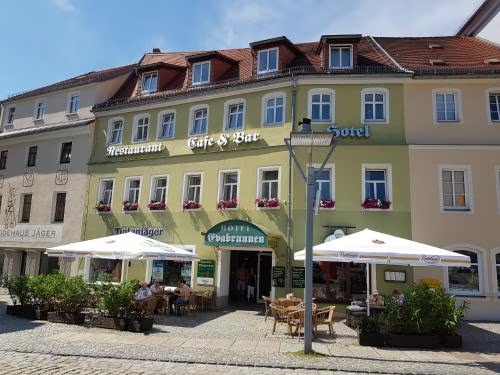 OpenReservations accepted
Hotel Evabrunnen
Town 2 of 15