

Vía de la Plata
The Vía de la Plata runs 701.2 kilometers from Seville along the line of a Roman highway through Extremadura and Castile and León to Astorga, where it joins the Camino Francés. Along the way you pass Itálica, Mérida with its Roman bridge and theater, the noble city of Cáceres, the lonely arch of Cáparra, Salamanca and Zamora. 30 stages with ↗ 7,857 meters of ascent, a high point of 1,147 meters at the Pico de la Dueña, long days without a village and a summer in which you simply shouldn't walk here. At Granja de Moreruela the Camino Sanabrés branches off straight to Galicia.
- 01At a Glance
- 02Overview
- 03Other Names
- 04Who It's Ideal For—and Who It's Not So Ideal For
- 05Route & Landscape
- 06Stages, Terrain, and Difficulty
- 07The Silver Way Without Silver – the Name Comes from the Paving
- 08Highlights Along the Way
- 09How Santiago Got Its Archbishop's Title via This Road
- 10How Pilgrims Find Their Way onto This Path
- 11Continue the pilgrimage?
- 12Preparation & Practical Information
- 13What the journey will cost you
- 14Getting Here
At a Glance
- Start / Finish: Seville / Astorga (km 700.8), where it joins the Camino Francés; on to Santiago via the Francés, or from Granja de Moreruela onward via the Camino Sanabrés
- Length: 701.2 km
- Duration: 30 stages; with rest days in Mérida, Cáceres and Salamanca, 32 to 36 days
- Elevation: ↗ 7,857 m / ↘ 6,994 m
- Highest point: 1,147 m at km 459.0 on the Pico de la Dueña, between Fuenterroble de Salvatierra and San Pedro de Rozados
- Landscape: the Guadalquivir plain, the Sierra Morena, Extremadura's holm-oak dehesa, reservoirs on the Tagus, the mountain threshold of Béjar, then the grain plateau of Castile
- Operator / Waymarking: the Vía de la Plata pilgrim associations and the regions; yellow arrows, in Extremadura also granite marker cubes, and Roman milestones again and again along the way
- Traces of St. James: Mérida, whose archiepiscopal dignity passed to Santiago in 1120; the Order of Santiago with houses in Mérida and Cáceres; pilgrim hospitals in Zafra, Benavente and La Bañeza; an albergue with a Cristo Peregrino in Fuenterroble
- Accommodation: albergues and guesthouses, but widely spaced; several donativo albergues, otherwise mostly 10 to 20 € in a dorm (as of October 2026)
- Connecting routes: Vía Augusta in Seville, Southern Route in Zafra, Camino Mozárabe in Mérida, Camino Torres from Salamanca, Camino del Levante in Zamora, Camino Sanabrés from Granja de Moreruela, Camino Francés in Astorga
- Best time: March to May and late September to October; from June to August Extremadura is too hot
Overview
The Vía de la Plata is the route on which you cross Spain from south to north. It starts in Seville and almost all the way follows the Roman road that linked Emerita Augusta, today's Mérida, with Asturica Augusta, today's Astorga. Along it lie cities whose old towns UNESCO has each declared World Heritage: Seville's cathedral in 1987, Cáceres in 1986, Salamanca in 1988 and Mérida in 1993.
It is also the loneliest of the great routes. Around 9,000 pilgrims arrived in Santiago via the Vía de la Plata in 2024, just 1.8 percent of all arrivals. And of those 9,000, half had only set out in Ourense, and only a little over a fifth in Seville. If you walk the whole way from the Giralda, you belong to a minority within a minority. Here, a pilgrim in the village is still an event.
Other Names
In Spanish the route is called Vía de la Plata or Ruta de la Plata, in German Silberstraße or Silberweg, in English the Silver Way or Silver Route. Historians call the Roman road itself the Iter ab Emerita Asturicam, after its entry in the Antonine Itinerary. The Pilgrim's Office in Santiago counts all arrivals via the Plata and the Camino Sanabrés under one name, which is why statistics often say "Vía de la Plata" even if someone only walked from Ourense. Pilgrims who come from Andalusia and continue via Ourense sometimes speak of the Mozárabe-Sanabrés.
Who It's Ideal For—and Who It's Not So Ideal For
Ideal if you've already walked a Camino and are looking for the opposite of the Francés: wide spaces, few pilgrims, long quiet days. Ideal if history appeals to you, because on no other Way of St. James do you walk so often on Roman paving, past milestones, bridges and baths. And ideal for sections from city to city.
Honestly, though, it's not for you if you want to walk in summer: between June and August, temperatures in Extremadura regularly climb above 40 degrees Celsius, and on the long stages there's neither shade nor fountain. Not for you if you expect a bar after 20 kilometers – between Carcaboso and Aldeanueva del Camino there are 37 kilometers without a village on the route. And not for you if you need company: in the evening you'll often sit alone in the albergue, and English is rare.
Route & Landscape
Seville to Mérida (km 0–209.5): From the Triana district the route runs flat through the Guadalquivir plain, passing the ruins of Itálica near Santiponce on the very first day. Beyond Castilblanco de los Arroyos (km 40.2) the Sierra Morena begins; via Almadén de la Plata (km 68.7) you reach Extremadura and, at Monesterio (km 102.6), over 700 meters. Then comes the Tierra de Barros, with wine and olives, via Zafra (km 146.7); Torremejía (km 192.6) lies 0.7 kilometers off the line. In Mérida (km 209.5) you arrive on the Guadiana over the Roman bridge.
Mérida to Salamanca (km 209.5–496.6): Past Mérida the route skirts the Roman reservoir of Proserpina and crosses the dehesa to Alcuéscar (km 245.5) and Cáceres (km 283.1). Then the quietest part: the Tagus reservoir at the Embalse de Alcántara, whose albergue lies 0.8 kilometers off the route, Galisteo (km 354.7) with its wall of river pebbles, and the arch of Cáparra; Oliva de Plasencia lies 5.5 kilometers away. From Aldeanueva del Camino (km 402.4) the line climbs on Roman paving via Baños de Montemayor to the Puerto de Béjar (km 414.9), the border with Castile and León, and over the Pico de la Dueña to Salamanca.
Salamanca to Astorga (km 496.6–701.2): Now the plateau takes over, grain all the way to the horizon. Via Zamora (km 564.0) on the Duero you reach the fork at Granja de Moreruela (km 605.7); the Plata goes straight on via Benavente (km 633.3) and La Bañeza (km 675.9) to Astorga (km 700.8).
Stages, Terrain, and Difficulty
We show the Vía de la Plata in 30 stages, with distances from the Camino Ninja map, calibrated exactly to 701.2 km. Most days fall between 17 and 30 kilometers; three are longer because there's simply no albergue in between. Where intermediate lodging exists, it's noted.
- Seville → Guillena (22.8 km) — flat across the plain, via Santiponce and Itálica.
- Guillena → Castilblanco de los Arroyos (17.4 km) — first hills, olive groves.
- Castilblanco de los Arroyos → Almadén de la Plata (28.5 km) — into the Sierra Norte Natural Park.
- Almadén de la Plata → Monesterio (33.9 km) — into Extremadura; can be split at El Real.
- Monesterio → Fuente de Cantos (20.3 km) — dehesa, gently downhill.
- Fuente de Cantos → Zafra (23.8 km) — open pastureland.
- Zafra → Villafranca de los Barros (20.1 km) — wine country via Los Santos de Maimona.
- Villafranca de los Barros → Torremejía (25.8 km) — dead-straight farm tracks without shade.
- Torremejía → Mérida (16.9 km) — short, to leave time for the theater and the bridge.
- Mérida → Aljucén (16.5 km) — via Proserpina and El Carrascalejo.
- Aljucén → Alcuéscar (19.5 km) — through Cornalvo Natural Park, no village en route.
- Alcuéscar → Valdesalor (26.0 km) — lots of Roman roadbed.
- Valdesalor → Cáceres (11.6 km) — a short stage for a day in the city.
- Cáceres → Embalse de Alcántara (33.5 km) — empty pastureland all the way to the reservoir.
- Embalse de Alcántara → Grimaldo (19.0 km) — across the Tagus reservoir and via Cañaveral.
- Grimaldo → Carcaboso (29.8 km) — via Galisteo on the Jerte.
- Carcaboso → Aldeanueva del Camino (37.0 km) — the queen stage: pastures, the arch of Cáparra, no village.
- Aldeanueva del Camino → La Calzada de Béjar (21.9 km) — over the Béjar pass.
- La Calzada de Béjar → Fuenterroble de Salvatierra (19.7 km) — highlands, milestones by the path.
- Fuenterroble de Salvatierra → San Pedro de Rozados (28.2 km) — over the Pico de la Dueña (1,147 m), no services.
- San Pedro de Rozados → Salamanca (24.4 km) — down into the city.
- Salamanca → Calzada de Valdunciel (15.0 km) — a short day out of the city.
- Calzada de Valdunciel → El Cubo del Vino (20.5 km) — plateau, with the highway within earshot.
- El Cubo del Vino → Zamora (31.9 km) — can be split at Villanueva de Campeán.
- Zamora → Montamarta (19.3 km) — via Roales del Pan.
- Montamarta → Granja de Moreruela (22.4 km) — along the Esla reservoir to the fork.
- Granja de Moreruela → Benavente (27.6 km) — across the Esla and via Barcial del Barco.
- Benavente → Alija del Infantado (21.6 km) — fields and irrigation channels.
- Alija del Infantado → La Bañeza (21.0 km) — through the Jamuz valley.
- La Bañeza → Astorga (25.3 km) — to the Francés.
Nothing is technically difficult: dirt tracks, drove roads, Roman roadbed. The two real climbs are the Sierra Morena before Monesterio and the Béjar threshold. The real difficulty is heat, wind and distances. On stages 4, 14, 17 and 20 you carry water for the whole day.
The Silver Way Without Silver – the Name Comes from the Paving
No significant amount of silver was ever carried along this road. The name dates from the Arab period: the Muslims called the paved Roman road al-Balat, "the paved way." Castilian ears heard plata, silver, in it, and a sober description of a road became a glittering proper name. Strictly speaking, then, the Silver Way is a mishearing.
In writing, the name turns up surprisingly late. Christopher Columbus mentions the road on November 28, 1504, in a letter to his son Diego, simply as "la Plata." In 1507 the humanist Antonio de Nebrija writes in his work on measures and distances: "Argentea vulgo dicitur. Quod Licinius pontifex primum stravit, deinde Traianus Caesar refecit" – the people call it the Silver one; Licinius first had it paved, then Emperor Trajan restored it. There's a lovely twist to that: Trajan was born in Itálica, that is, on the first walking day of this route. The emperor who had the road repaired came from its starting point.
The road itself is much older than its name. A 1995 study catalogued 189 Roman milestones along it, and the mile count ran in two sections: from Mérida, and from Salamanca to Astorga. In practice that means: between Alcuéscar and Cáceres and around Fuenterroble, keep an eye out for round granite columns by the wayside – some still stand where the Romans set them up.
Highlights Along the Way
- Seville (km 0) — cathedral with the Giralda, World Heritage since 1987.
- Itálica (near Santiponce, km 9.1) — founded by Scipio in 206 BC, birthplace of the emperors Trajan and Hadrian.
- Zafra (km 146.7) — Renaissance town with two arcaded squares and a former Hospital de Santiago.
- Mérida (km 209.5) — founded in 25 BC as Emerita Augusta for veterans, capital of Lusitania; theater, the Los Milagros aqueduct and the Roman bridge, 792 meters with 60 arches, pedestrian-only since 1991.
- Proserpina reservoir (km 215.5) — Roman dam from the 1st or 2nd century, 427.8 meters long and still in use today.
- Cáceres (km 283.1) — old town of noble palaces and fortified towers, World Heritage since 1986; in 1170 the Fratres de Cáceres were founded here, the nucleus of the Order of Santiago.
- Arch of Cáparra (between Carcaboso and Aldeanueva) — four-way gateway from the late 1st century, donated by Marcus Fidius Macer according to his parents' wishes; the town became a municipium in 74. The route runs right through it.
- Baños de Montemayor (km 411.8) — thermal baths with a Roman tradition, followed by Roman paving uphill.
- Fuenterroble de Salvatierra (km 444.0) — parish albergue of Don Blas Rodríguez, 2.5-meter-tall Cristo Peregrino.
- Salamanca (km 496.6) — university since 1218, Plaza Mayor and the frog on the façade; World Heritage since 1988.
- Zamora (km 564.0) — the "capital of the Romanesque," with the highest density of Romanesque churches in Europe.
- Granja de Moreruela (km 605.7) — the great fork, with a Cistercian ruin nearby.
- Astorga (km 700.8) — Roman Asturica Augusta, cathedral and the Bishop's Palace that Antoni Gaudí designed from 1889 on.
How Santiago Got Its Archbishop's Title via This Road
The Vía de la Plata wasn't built as a Way of St. James, but Santiago owes it more than you'd think. Under the Visigoths, Mérida was the seat of an archbishop. After the Moorish conquest the title lay dormant until Pope Callixtus II transferred it to Compostela in 1120, at the urging of the ambitious Bishop Diego Gelmírez. Ever since, Santiago has been an archdiocese, carrying the dignity of a city you walk through on day nine. When Alfonso IX of León reconquered Mérida around 1230, he placed the city under Santiago's jurisdiction, and the Order of Santiago set up a house in the Alcazaba, which the Moors had built in 835 to protect the bridge.
The first travelers heading north were high-ranking, too. In 1063 Ferdinand I of León had the remains of St. Isidore carried from Seville to León along this road. Around 1600 the Jesuit Juan de Mariana wrote in his history of Spain about the beginnings of the pilgrimage: "de todas las partes del mundo acudían a visitarlo, siendo el mayor número los que venían de tierras de moros" – people came to the tomb from every part of the world, but most of all from the lands of the Moors. Around 1612 the canon Bernardo de Aldrete walked to Santiago with clergy from Andalusia. In 1737 the Salamanca professor Diego de Torres Villarroel didn't want to take the Plata and made the detour through Portugal – which became the Camino Torres.
Then things went quiet. Its rediscovery as a pilgrim route began in 1990 and 1991, when the Amigos del Camino de Santiago of Navarre, under Andrés Muñoz Garde, led the first international pilgrimage on the Plata. In Fuenterroble, the parish priest Don Blas Rodríguez made his church the meeting point of the movement; in 2009 his association even traveled with pilgrim carts from Assisi to Rome.
How Pilgrims Find Their Way onto This Path
Most start in Seville, arriving by plane or high-speed train. Others arrive already on foot, via routes that flow into the Plata:
- Vía Augusta — from the Atlantic coast to Seville
- Southern Route — from Huelva over the Sierra de Aracena to Zafra
- Camino Mozárabe — from Almería via Granada and Córdoba to Mérida
- Camino del Levante — from Valencia right across Castile to Zamora
Starting partway, in Mérida, Cáceres, Salamanca or Zamora, is easy; all have train and bus connections. For the Compostela, the last 100 kilometers to Santiago are what count.
Continue the pilgrimage?
Yes, because the Plata doesn't end in Santiago. The Camino Ninja map, like the signs, takes it as far as Astorga; from there the Camino Francés leads over the Cruz de Ferro, Ponferrada and O Cebreiro to Santiago. Most Plata pilgrims turn off earlier, though: at Granja de Moreruela the Camino Sanabrés begins, 370 kilometers via the Sanabria, the passes into Galicia and Ourense to Santiago. The Camino Ninja planner combines both variants automatically.
A third option starts in Salamanca: the Camino Torres runs through northern Portugal via Lamego and Braga and joins the Central Portuguese Way at Ponte de Lima.
Preparation & Practical Information
Pilgrim passport and app. As on all Spanish routes, you need a pilgrim passport (credencial) to stay in the albergues and to receive the Compostela at the end. It's best to order it online in advance so it reaches you in time for the start of your trip; you get your first stamp in Seville Cathedral. Because the spacing of the albergues decides your days here, the easiest way to plan is directly in the Camino Ninja App, where you put your stages together and plan suitable accommodation right along with them; you'll have the map and track with you offline there.
Season. The best time to go is March, April and May, when the dehesa is in bloom, or from late September. In June it can already get dangerously hot; July and August are not months for pilgrims. In winter the plateau is cold and some private albergues close.
Water and supplies. On several stages there's no shop, bar or fountain for over 20 kilometers. Count on two to three liters of water a day, more when it's warm, and shop the evening before, because village shops close at midday and on Sundays. Start early, and call private albergues a day ahead.
What the journey will cost you
The Plata is cheap. The Molino de Pancaliente pilgrim albergue in Mérida costs 10 €, in Astorga the Siervas de María 8 € and the Franciscans 10 €, in La Bañeza the Monte Urba albergue 10 €, in San Pedro de Rozados Mari Carmen 12 € (as of October 2026). The municipal albergue in Guillena charges 15 € with breakfast, El Carrascalejo 15 €, private albergues such as Los Miliarios in Carcaboso or Torre de Sabre in El Cubo del Vino 20 € (as of October 2026). In Alcuéscar, Aldeanueva del Camino and Fuenterroble there are donativo albergues – give what you would give in a paid albergue.
Budget 30 to 45 € a day with albergue, bar breakfast, supermarket and pilgrim menu. Cities are pricier: hostal rooms in Mérida run 30 to 50 €, hostel beds in Seville 16 to 25 € (as of October 2026). Plan city days for the four World Heritage cities.
Getting Here
To the start. Seville has an airport with connections from across Europe, including Germany, Austria and Switzerland, and lies about two and a half hours from Madrid by AVE high-speed train.
Joining midway and getting home. Mérida, Cáceres, Salamanca and Zamora are linked to Madrid and Seville by train and bus. If you stop in Astorga, take the bus or train to León and on to Madrid; if you walk all the way to Santiago, you can fly straight home from there.

Get your pilgrim credential and shell
Everything you need for the Vía de la Plata, shipped to your door.
Visit Camino Shop
Other Caminos
 Appenzeller Weg
Appenzeller Weg
52.6 km from Rankweil across the Rhine to St. Peterzell: St. James Chapel (1464), 163 Years of the Wedding Trail, connection to the Via Jacobi. Stages, costs, how to get there.
Read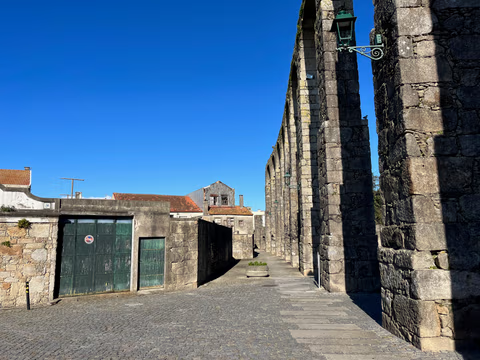
Aqueduct Trail – A path running along the Vila do Conde Aqueduct
From the Coastal Trail to the Camino Central: 12.9 km along the aqueduct from Vila do Conde to São Pedro de Rates. Route, stage, hostels, costs—explained honestly.
Read
Augsburg Way of St. James
The Augsburg Way of St. James runs 231.7 km in 11 stages from Oettingen in the Ries via Donauwörth, Augsburg, Bad Wörishofen and Ottobeuren to Ermengerst in the Allgäu — the Fuggerei, the Jakobervorstadt, a pilgrim of 1446 and Mozart's organ duel. Stages, hostels, costs.
Read

