

Town on the Camino
Balugães
Distrito de Braga, Região do Norte, Portugal
- places to stay
- 4
- Caminos
- 2
- Elevation
- 93 m
Balugães is the halfway point between Barcelos and Ponte de Lima: 15.3 kilometres are behind you, 17.7 still ahead. Just before the village you cross the old Ponte das Tábuas down to the Rio Neiva, then climb to the church of São Martinho, with its rest area and fountain. A break is enough, then it's on into the Lima valley.
How long to stay?
A break is enough, half an hour to an hour. Balugães is not a stage town but the middle of a long day: according to Camino Ninja it is 33 kilometres from Barcelos to Ponte de Lima, and here you have done almost half. That is time enough for the bridge over the Neiva, the rest area at the church and a look up to the Aparecida sanctuary. If you want to split the long stage, you will find private rooms here, but most pilgrims only sleep 6 kilometres further on in Vitorino dos Piães.
Balugães in Ninja numbers
- 15.3 kilometres is the distance from Barcelos to here according to Camino Ninja, past Portela de Tamel and Aborim.
- 17.7 kilometres still lie ahead of you to Ponte de Lima. According to Camino Ninja it is 173.5 kilometres to Santiago.
- Around 55 metres above sea level is the lowest point at the Neiva, according to Camino Ninja, a good kilometre before the village. After that the path climbs again.
- 841 people lived in the parish of Balugães in 2011, on less than three square kilometres.
Arriving: over the Neiva
From Portela de Tamel the path leads down a long way via Aborim until you stand at the Rio Neiva. Here you cross the river on the Ponte das Tábuas, an old bridge that is considered medieval. On the bank there is a small recreation spot with a pond and a waterfall. Then the path climbs into the village, you carefully cross the main road and take an old track into the centre of the parish. Balugães still belongs to the municipality of Barcelos and the district of Braga.
In brief: an apparition on the mountain
Above Balugães, on the Monte da Carmona, the sanctuary of Nossa Senhora da Aparecida dominates the landscape. Tradition dates the Marian apparition it goes back to to 1702, and in the village it is called the first Marian apparition in Portugal. Who is said to have met her there, exactly how the story goes and when the present church was built, we have not found in reliable sources.
Since 2002 the parish coat of arms has shown a green bridge with two arches over blue and white waves, with a red mitre above it. The mitre probably stands for Saint Martin, the patron saint of the place. A bishop, then, who can no longer give you his cloak, but can at least offer you a rest area.
Between river and hill: what to see
Balugães has two places that matter to pilgrims: the river below and the church on the way. The sanctuary up on the mountain you will mostly see from afar.
- Ponte das Tábuas: The bridge over the Rio Neiva is your way into the village, not a detour. It is considered medieval; we have not found an official dating. On the bank next to the bridge is a small recreation spot with a pond and a waterfall. This is the lowest point before the Lima valley, good for a rest with your feet in the shade before it goes uphill again.
- Igreja de São Martinho: The parish church is on the way. The path climbs to the left of it, past a fountain, and next to the church a well-kept rest area awaits. It is described as a small Romanesque church; we have not found an official dating, nor any opening or Mass times.
- Santuário de Nossa Senhora da Aparecida: The sanctuary on the Monte da Carmona shapes the image of Balugães, and it belongs to the Archdiocese of Braga. It is the reason the place has a name that reaches beyond the village. How far it lies from the track and when it is open, we have not been able to establish reliably. Ask in the village before you take a detour uphill with a rucksack.
Honestly
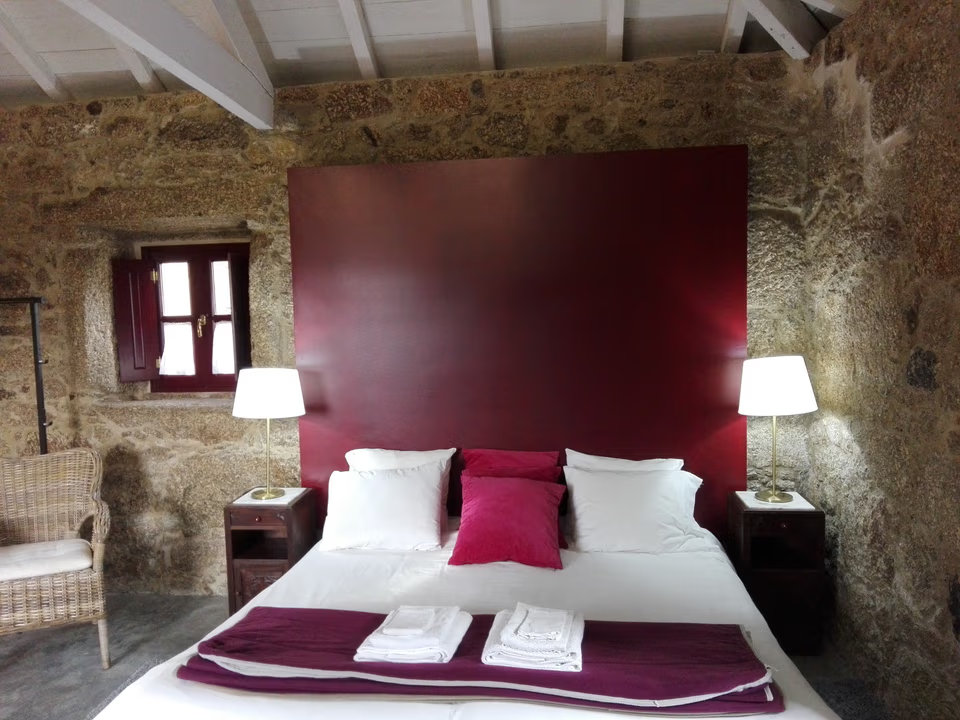
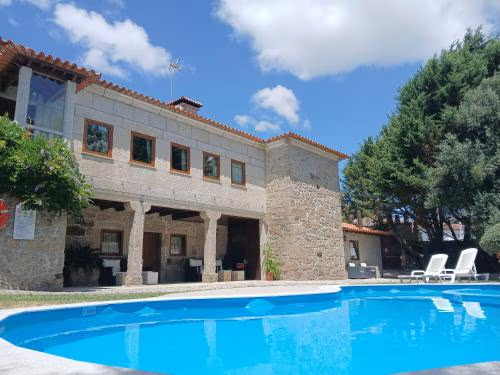
- There is no pilgrim hostel here. Anyone who sleeps in Balugães sleeps privately: in country houses and in a small house with a few beds in a dormitory. According to our data the nearest hostels for pilgrims are 6 kilometres further on in Vitorino dos Piães.
- The main road is the least pleasant moment. On the climb into the village the path crosses the main road. Look twice before you cross.
- The sanctuary is not a sure thing. It is the best-known building in the parish, but we could not establish either its position relative to the path or its opening hours. Don't plan a detour you haven't asked about first.
- There isn't much more. Balugães is a village on the way, not a place for an afternoon. That is fine, as long as you know it.
Ninja tips
- Fill your bottle at the fountain by the church. On the climb to São Martinho there is a fountain and a rest area right on the path.
- Take your long break down at the Neiva. After that it goes uphill, with a short dip, until beyond Vitorino dos Piães, to around 175 metres.
- Split the 33 kilometres if they are too much for you. Most people don't do it here but in Vitorino dos Piães, where two houses cater specially for pilgrims.
Onward: to Vitorino dos Piães and into the Lima valley
Beyond Balugães it goes down once more to a good 70 metres, then the path climbs to Vitorino dos Piães, 6 kilometres according to Camino Ninja. On the way you pass from the municipality of Barcelos into the municipality of Ponte de Lima, and from the district of Braga into the district of Viana do Castelo. A good kilometre beyond Vitorino you reach the highest point of the day at around 175 metres, then it goes down via Facha and Seara into the plain of the Lima. It is 17.7 kilometres from here to Ponte de Lima on the Camino Portugués Central. The Fátima: Caminho do Norte also runs through Balugães, only in the opposite direction.
Deep dive: The river, the church, the mountain
A short read, in case you want to learn more about Balugães. About two minutes' reading.
Down at the Neiva
If you come from Barcelos, you left the town of the rooster behind you this morning and walked via Portela de Tamel and Aborim. Then the path drops, and down by the river stands an old bridge, the Ponte das Tábuas, the bridge of planks. How old it is, no document we have found says. People call it medieval, and anyone who walks across it is happy to believe it.
A village with a bridge on its coat of arms
Balugães is small, barely three hundred hectares, and in 2011 841 people lived here. When the parish received its coat of arms in 2002, it put in a bridge with two arches over waves, and above it a mitre that probably stands for Saint Martin, the patron saint. His church is on the way, with a fountain and a bench beside it. For a pilgrim that is perhaps the nicest way of meeting a saint: as the host of a rest.
The mountain of the apparition
Above the village, on the Monte da Carmona, stands the sanctuary of Our Lady of the Aparecida. According to tradition it goes back to a Marian apparition in 1702, and in Balugães they say it was the first in Portugal. We have found nothing more than this tradition, and so we don't tell more. Fátima, which everyone knows today, came more than two hundred years later.
What Balugães gives you
Balugães is the middle of a long day. Half lies behind you, half ahead of you, and the path has just led you down to the river. From here it is only uphill, to Vitorino, and then down to the Lima. Drink at the fountain of São Martinho, look up once at the mountain, and then walk on.
Where to stay in Balugães
Places to stay in Balugães.
 Open
Casa Altamira - Alojamento Local
 OpenReservations accepted
Rancho de la Luna
 OpenReservations accepted
Casas da Quinta da Cancela
Services in Balugães
What you can find in town before the next stage.
- Café
- Shop
- Fountain
- Train station
- Restaurant
Source: © OpenStreetMap contributors · updated January 2026
Town 27 of 43