

Stage town on the Camino
Ponte de Lima
Distrito de Viana do Castelo, Região do Norte, Portugal
- places to stay
- 48
- Caminos
- 4
- Elevation
- 22 m
Ponte de Lima is the place where you are not supposed to forget: at this bridge over the Lima, which the Romans took for the river of forgetting, a general is said to have called his soldiers by name. The town received its charter in 1125. The pilgrim hostel costs €5, and tomorrow the climb over the Labruja awaits.
Right now in Ponte de Lima (as of October 2026)
- Rubiães in winter: According to Gronze, the public hostel in the next stage town, Rubiães, closes for building work from 15 November 2026 to 31 January 2027. The municipality of Paredes de Coura announced around €400,000 for the renovation in May 2026. During that period, plan on private accommodation.
- Early closing: From November to March the pilgrim hostel in Ponte de Lima closes its doors at 21:00, otherwise at 22:00.
- 200 years of Feiras Novas: The big September festival celebrated its bicentenary in 2026 (9 to 14 September 2026). If you are walking in September: the dates fall around the second weekend of the month every year.
How long to stay?
An afternoon is enough. The old town is small, and the best things lie close together: the bridge, the Gothic chapel on the far bank, the towers of the old town wall and the path under the plane trees by the river. On top of that, you usually arrive after a long stage from Barcelos, and tomorrow brings the most important climb on the whole Camino Portugués. Save your legs. If you do take a rest day, don't make it a Monday: all the museums are closed.
Ponte de Lima in Ninja numbers
- 1125 is when Queen Teresa gave Ponte de Lima its town charter. That makes it the oldest vila in Portugal, even if a town on the Douro disputes it (see the deep dive).
- Around 156 kilometres separate you from Santiago, according to Camino Ninja.
- €5 is the price of a bed in the public pilgrim hostel (as of October 2026).
- 315 metres of ascent over 4.2 kilometres is what tomorrow's climb to the Labruja pass holds for you.
- 200 years old is what the Feiras Novas turned in 2026.
Arriving: at the river of forgetting
From Barcelos it is a good 33 kilometres according to Camino Ninja, with the steep climb to Portela de Tamel along the way. If you split the stage, you sleep in Vitorino dos Piães and then have just under 12 kilometres left. You reach the old town on the left bank of the Lima. The bridge starts at Largo de Camões, where an information panel explains its history. The pilgrim hostel is on the other side: you cross the bridge to Arcozelo, and there, on Largo da Alegria, stands the Casa do Arnado, about 400 metres from the heart of the old town, right on the Camino.
In brief: a town that grew around a bridge
Ponte de Lima owes its name to the bridge. This is where the Roman road from Braga to Astorga, the Via XIX, crossed the river, and on it lay a station called Limia. On 4 March 1125 Teresa, the mother of the first Portuguese king, gave the place a town charter. In the fourteenth century King Pedro the First had a new, longer bridge built and the town walled, with nine towers and six gates. The work was finished around 1370.
Later the walls were no longer needed, and in the eighteenth and nineteenth centuries most of them were taken down. Ponte de Lima remained a market town, surrounded by vineyards and Baroque manor houses. Today it calls itself the capital of Vinho Verde, and every other Monday one of the oldest markets in the country takes place here.
The river that eats memory
The Greek geographer Strabo wrote that the Lima was also called the Lethe. In ancient myth that was the river of the underworld whose water wipes out all memory. When the Roman general Decimus Junius Brutus reached the river with his legions around 137 BC, his soldiers refused to cross. They were afraid of losing their memory. Brutus took the standard, crossed alone and, from the far bank, called each soldier by his name. He had forgotten nothing. So they followed him.
Statues by the riverside recall the scene today: the general on horseback and his legionaries. When you cross the bridge, you walk the way they were afraid of. And the nice part: on the other bank, what awaits you is not oblivion but your bed.
Along the Lima: what to see
Ponte de Lima is a place for a slow evening stroll. Everything important is within walking distance between the hostel and Largo de Camões.
- The bridge: It is really two bridges. The shorter part on the north bank, on the hostel side, is Roman, probably from the time of Emperor Augustus, and partly stands on dry ground. The long Gothic part dates from the fourteenth century. In 1504 King Manuel the First had it repaved and decorated with battlements. There were defensive towers at both ends, demolished in 1857 and 1858 to make way for traffic. Today the bridge is for pedestrians only, and it has been a national monument since 1910. Medieval pilgrims to Santiago already walked across it.
- Capela do Anjo da Guarda: The small chapel on the north bank, just a few steps from the hostel, dates from the last quarter of the thirteenth century and is Romanesque-Gothic. It shows the Archangel Michael and was a place of devotion and refuge for travellers. Floods on the Lima have damaged it several times, and it has been rebuilt again and again.
- Igreja de Santo António da Torre Velha: The church right next to the chapel bears the name of the old defensive tower that once stood at the end of the bridge on its axis. You can still see the tower's foundations down by the bridge. Together with the chapel beside it, it is one of the most photographed sights in town.
- Igreja Matriz: The main church in the old town goes back at least to the early fifteenth century and took its present form from 1567 onwards. The high altar of 1729 is dedicated to Our Lady of Sorrows, Nossa Senhora das Dores. She is also the focus of the big September festival, the Feiras Novas, which opens here with Mass and Vespers.
- Museu dos Terceiros: In two churches of the old Franciscan friary at the southern end of Avenida dos Plátanos, the museum displays sacred art. The walk there under the plane trees by the river is reason enough to go. Open Tuesday to Sunday 10:00 to 12:30 and 14:00 to 18:00, admission €2.50 (as of May 2026), closed on Mondays.
- The towers of the town wall: Of the original nine towers, two still stand. The Torre da Cadeia Velha, the old prison tower, now houses the tourist office. The Torre de São Paulo bears a Gothic inscription showing how high the river once rose: „Aqui chegou o rio pelo risco“, the river came up to this line.
Food and drink
The dish of Ponte de Lima is Arroz de sarrabulho, a dark rice with pork and blood, seasoned with nutmeg and pepper. It comes with rojões, fried chunks of pork, and often tripas enfarinhadas, fried tripe. After 33 kilometres, it is exactly right. With it you drink Vinho Verde, here also as a red, and at the Centro de Interpretação do Vinho Verde you can taste it for €3 (as of 2026).
Honestly
- You earn your arrival. From Barcelos it is a good 33 kilometres with a steep climb. If you don't need to walk that far, split the stage in Vitorino dos Piães.
- The public hostel is beautifully located but basic. In Camino Ninja reviews, pilgrims complain about closely packed beds, communal showers whose temperature you can't adjust, and a sparse kitchen. For €5 and this spot by the river, many take it in their stride.
- It gets cold in winter. There are no blankets, so you can't do without a sleeping bag.
- Mondays are a cultural break. All museums are closed, but there is a market instead, though only every other Monday.
Where pilgrims sleep
- Albergue de peregrinos de Ponte de Lima: the municipal hostel in the Casa do Arnado on Largo da Alegria, just across the bridge in Arcozelo. It opened in 2009 and is run by a local association of friends of the Camino. 60 beds in three dormitories, €5, check-in from 15:00, no reservations, open all year, pilgrims only. A sleeping bag is compulsory, there is a kitchen, and you can get your credencial here for €1.50.
- Pousada de Juventude de Ponte de Lima: the youth hostel at the edge of town, about a kilometre from the centre, with dorm beds from around €18 to €24 including breakfast.
There are also private hostels with dorm beds from about €22, one of them a good kilometre outside the old town. In Arcozelo, already on the way to Labruja, there are further private hostels.
Ninja tips
- Bring breakfast forward: At the youth hostel you can ask at check-in whether you may have breakfast before the regular time. For the climb to Labruja, an early start is worth its weight in gold.
- A stamp made of wax: At the Old Village Hostel you get a stamp in coloured sealing wax, one of the most unusual on the whole Camino. It is, however, about a quarter of an hour from the centre.
- The Romans in your house: The Casa do Arnado, the hostel building, also houses a small centre on Roman times, the Estação do Tempo Romano (open Tuesday to Sunday as of 2022). So you can learn more about the road you are walking on right next door.
- Water for tomorrow: Between Codeçal and Rubiães there are more than nine kilometres without a bar or shop, exactly on the stretch over the pass. Do your shopping today.
- Across the bridge in the evening: Look for the statues of the Romans by the riverside. You are the one who dared.
When it rains
Ponte de Lima is wet: on average around 1,360 millimetres of rain fall here each year. These places are open Tuesday to Sunday, and all are closed on Mondays:
- Museu dos Terceiros: sacred art in two friary churches, 10:00 to 12:30 and 14:00 to 18:00, €2.50 (as of May 2026).
- Estação do Tempo Romano: in the Casa do Arnado next to the hostel, 10:00 to 12:30 and 14:00 to 18:00 (as of 2022).
- Centro de Interpretação do Vinho Verde: Fonte da Vila 28, 10:00 to 12:00 and 14:00 to 17:00 (as of 2022), wine tasting €3.
- Museu do Brinquedo Português: Portuguese toys from many generations, 10:00 to 12:00 and 14:00 to 17:00 (as of 2022).
- Centro de Interpretação da História Militar: in the Paço do Marquês, 10:00 to 12:00 and 14:00 to 17:00 (as of 2022).
Practical tips for pilgrims
- Credencial and stamp: You can get the credencial at the pilgrim hostel for €1.50, and the stamp there too.
- Tourist office: in the Torre da Cadeia Velha in the old town.
- Shopping: Buy supplies for tomorrow this evening, because after Codeçal there is nothing until Rubiães.
- Feiras Novas: If you arrive in mid-September, you'll experience one of the biggest folk festivals in the north of Portugal. In 2025 around 30,000 people crowded the lanes.
Onward: over the Labruja
Tomorrow you leave Ponte de Lima across the bridge and follow the Labruja river through vineyards and woods, via Arcozelo and Codeçal to Labruja, a good 10 kilometres according to Camino Ninja. Then the climb to the Portela Grande de Labruja begins, past the Cruz dos Franceses, with 315 metres of ascent over 4.2 kilometres. It is the most important climb on the whole route, easy enough to walk, but medieval pilgrims feared it. From Codeçal, at a gentle pace, you need about an hour and a half to the top. To Rubiães it is just under 18 kilometres in total, to Valença around 35. You are on the Camino Portugués Central, and it is still around 156 kilometres to Santiago.
What awaits you tomorrow
A day in the woods and on the mountain, and at the end a village with a Romanesque church from the thirteenth century. In Rubiães there are six Roman milestones of the Via XIX, two of which support the porch of a chapel. It is the same road on which you crossed the bridge of Ponte de Lima today.
Deep dive: The river of forgetting
A long read, in case you want to learn more about Ponte de Lima. About thirteen minutes' reading.
On the bridge
When you stand on the bridge of Ponte de Lima in the evening, you have two banks and two ages beneath your feet. On one side lies the old town with its towers and squares. On the other side, in Arcozelo, stand a small Gothic chapel and a church named after a tower that no longer exists. Between them flows the Lima. And beneath you is a bridge that is really two bridges: a short stretch from Roman times and a long one from the fourteenth century.
This place does not take its name from a saint, a prince or a mountain. It is simply called the bridge on the Lima. Everything that happened here happened because people wanted to cross this river. Roman soldiers, merchants, kings, pilgrims. You are one of them.
And this river has a story that suits a pilgrim route better than almost any other. People believed it was the river of forgetting.
Lethe
In the underworld of the Greeks there was a river called Lethe. Whoever drank its water forgot everything they had been in life. The souls of the dead drank from it before they went on to a new life. Lethe is the Greek word for forgetting.
The Greek geographer Strabo, writing around the beginning of the Common Era, reports that the Lima was also called the Lethe, the river of forgetting. He tells a story to go with it: Celts and Turduli had come this far together on a military campaign. After a quarrel they lost their leader, scattered and stayed where they were. As if they had forgotten where they came from and where they were going. People believed the river's water robbed you of your memory.
Whether the Romans took that literally, we don't know. But the story still told here today assumes that ordinary soldiers believed it.
The general who called the names
Decimus Junius Brutus was consul in Rome in 138 BC. After that he was sent to the Iberian Peninsula, where bands from Lusitania were raiding Roman territory. He marched north, crossed the Douro and entered the land of the Callaeci, as the Romans called the people of today's Galicia and northern Portugal. The Greek historian Appian writes that Brutus was the first Roman who thought of crossing the Lethe.
And here begins the scene that Ponte de Lima still tells today. The Roman historian Livy reports, in the summary of his work, that the soldiers refused out of superstition to cross the river until Brutus himself went ahead. Local tradition has turned this into an image you don't forget. Brutus takes the standard, the legion's emblem, and walks alone through the river. On the far bank he turns round and calls his soldiers by name, one after the other. He has forgotten nothing. He still knows who they are. And so they follow him.
The sources disagree about the year. Some say 138 BC, others 137, and in Ponte de Lima you often read 135. Rome granted Brutus a triumph for his campaign and the surname Callaicus, conqueror of the Callaeci. For the Callaeci the campaign meant destruction; excavations at the Cividade de Terroso show traces of burning from this period. For the storytellers of Ponte de Lima it is the founding legend of their river.
Further upstream too, in Xinzo de Limia in Galicia, people know the story. There, every summer, they celebrate a festival of forgetting and re-enact the crossing. The river has two countries and one legend.
What the story tells you
You can read this legend as an anecdote about a clever general. But you can also hear it differently, especially with a rucksack on your back. People stand on one bank, afraid of losing themselves on the other side. One goes ahead, and from over there he calls their names.
Perhaps you know this fear in another form. You wonder whether, after weeks on the Way, you are still the same person, whether you are leaving something behind that you won't find again. The legend of Ponte de Lima offers a quiet answer. Whoever arrives on the other side is called by name. You don't lose yourself in the river. You arrive.
A road older than the Way
The Romans came to stay, and they built a road. The Via XIX ran from Bracara Augusta, today's Braga, via Tude, today's Tui, to Asturica Augusta, today's Astorga. On the Lima there was a station called Limia, and here stood the only bridge far and wide, the only one between the river mouth and the interior. Anyone heading north had to cross here.
The Roman bridge is dated to the time of Emperor Augustus. Some of its arches survive on the north bank, on the side where the pilgrim hostel stands today. The road itself can still be found in many places. In Arcozelo there is a milestone at the Quinta de Faldejães. Near Labruja a small Roman bridge with a single arch spans the river of the same name. And in Rubiães, where you arrive tomorrow, there are six milestones, two of which support the porch of a chapel.
When pilgrims later set out for Santiago, they followed this road. The route through Ponte de Lima was shorter than the others, but it led over the rugged mountains of the Labruja. So you are walking on a road that was there long before the Apostle. The waymarks are new. The road is not.
A queen makes a place a vila
On 4 March 1125 Teresa issued a charter for the place called Ponte. Teresa was the daughter of King Alfonso the Sixth of León and, after the death of her husband, Henry of Burgundy, governed the County of Portugal. The Pope already called her queen. Her son was Afonso Henriques, who later became the first king of Portugal after defeating his own mother at the Battle of São Mamede in 1128 and sending her into exile.
With this charter, a foral, Teresa made Ponte a vila, a place with rights of its own. A foral regulated administration, taxes and freedoms and freed people to some extent from the rule of a feudal lord. The foral of Ponte also mentions a market. Afonso the Second confirmed it in 1217, and Manuel the First renewed it in 1511.
Today there is a statue of the queen in Ponte de Lima by the sculptor Luís Valadares, unveiled on 4 March 2002, exactly 877 years after the charter. On the pedestal are words that sum up the event: „E fez vila o lugar de Ponte“. And she made the place Ponte a vila.
The oldest vila in Portugal?
Ponte de Lima likes to call itself the oldest vila in Portugal, and you will read this on many signs. It is not quite that simple, and it is worth saying so honestly.
For one thing, there is competition. São João da Pesqueira on the Douro received its first foral as early as between 1055 and 1065 from King Ferdinand the Great of León, long before Portugal existed as a kingdom. Whether that counts depends on what you mean by Portugal.
For another, historians argue about what actually happened in 1125. The historian António de Almeida Fernandes argued in 1960 that before the charter there were only scattered farms here, and that Teresa founded the vila on the south bank in the first place. The historian Avelino de Jesus da Costa disagreed. A church of Santa Maria by the river is documented as early as 986, he said, and in the eleventh century there was already a market and trade here. The charter contains the sentence „faciam villam supra nominato loco Ponte“, I make a vila at the said place Ponte. For Costa this was not a foundation out of nothing, but a privilege for a settlement that already existed, to attract more people. Documents of this period, he argued, like to exaggerate how empty things were before.
On one point they both agreed: they considered the old identification of Ponte de Lima with a Roman Forum Limicorum to be fantasy. What remains is a place that is very old, received its rights very early and is rightly proud of it, even if the superlative wobbles.
Walls, towers and a new bridge
By the fourteenth century the old Roman bridge was no longer enough. Under King Pedro the First a new, much longer bridge was built in the Gothic style. Some believe that King Dinis had already begun the work. At the same time the town got a wall. An inscription on the Torre Velha gave the start of construction: 8 March 1359. On 19 May 1370 King Fernando confirmed that the work was complete. The wall was a good kilometre long and had nine towers and six gates. Two towers guarded the bridge, one of them the Torre Velha on the north bank.
In 1504 King Manuel the First had the bridge repaved and decorated with battlements. In 1511, under him, the Porta Nova was completed together with the tower that long served as a prison and now houses the tourist office. On the Torre de São Paulo you can read a Gothic inscription marking how high the floodwater once rose. The river that was supposed to steal memory has itself left a memory here in stone.
In the eighteenth and nineteenth centuries nobody needed walls any more, and they were taken down. The stones went into new houses. In 1857 and 1858 the two bridge towers were demolished so that carts could pass. Of the old Torre Velha you can see only the foundations. During excavations at Largo de Camões in the year 2000, two Gothic arches of the bridge were found buried under the square. So the bridge is even longer than what you see.
A king on the way to Santiago
Where people have to cross a bridge, they need somewhere to stay. A royal inquiry from around 1412 mentions an albergaria on the Rua da Ponte, the street that inevitably led to the bridge. An albergaria was a simple house where travellers and the poor found a roof over their heads. Anyone who wanted to cross the bridge came through this street.
One of these travellers was a king. Manuel the First of Portugal made a pilgrimage to Santiago de Compostela in 1502. Local tradition says that on the way he spent the night in Ponte de Lima, in the Casa do Patim, a house that already stood in the fifteenth century. Whether he really slept here cannot be proved. What is certain is that the same king had the bridge he had crossed repaved two years later.
On the north bank a place still stands where medieval travellers stopped. The Capela do Anjo da Guarda, the Chapel of the Guardian Angel, dates from the last quarter of the thirteenth century. It is small, Romanesque and Gothic at once, and it shows the Archangel Michael. For travellers it was a place of devotion and refuge. Those moving on, over the mountains to the north, could entrust themselves here to the angel who, in Christian tradition, weighs souls on the scales. The Lima has flooded the chapel several times, and each time it was rebuilt.
It lies just a few steps from today's pilgrim hostel. It was already standing when medieval pilgrims feared the Labruja pass.
The main church and Our Lady of Sorrows
In the old town stands the Igreja Matriz, the main church. Its roots go back at least to the early fifteenth century, to the time of King João the First, and it probably stands on the site of an older church. In 1567 a major rebuilding began that gave it its present form. Most of the woodcarving inside dates from the eighteenth century. The rose window on the façade was added only in 1932, modelled on the Franciscan church in Porto.
Its high altar of 1729 is dedicated to Nossa Senhora das Dores, the Mother of God of Sorrows. She is the woman to whom the town's biggest festival is devoted. Every September the Feiras Novas begin here with a solemn Mass and Vespers, and on the last day her procession moves through the old town.
Two hundred years of Feiras Novas
On 5 May 1826 King Pedro the Fourth authorised by decree three days of fairs in Ponte de Lima in honour of Our Lady of Sorrows. These became the Feiras Novas, the new fairs, and they are still one of the biggest folk festivals in the north of Portugal. They take place around the second weekend of September, with a livestock fair, drummers, bagpipers, hundreds of accordion players, fireworks, a big parade and the procession.
A Brazilian journalist who has walked the Caminho Português twice himself described around thirty thousand people in the lanes in 2025. The floats rode on small lorries and tractors and showed country life: the grape harvest, threshing the maize, work in the mills. He called the mood orderly and devoted. In 2023 an application was made to recognise the Feiras Novas as intangible cultural heritage.
In 2026 the festival turned two hundred. On 5 May 2026, exactly two centuries after the decree, the town presented an anniversary book, an exhibition and a documentary, and finished with fireworks for the next century. The Feiras Novas themselves ran from 9 to 14 September 2026.
Wine, rice and manor houses
Around Ponte de Lima there are more Baroque manor houses than anywhere else in Portugal, houses of the country nobility with names such as Aurora, Bertiandos and Calheiros. Farming remained the main livelihood here well into the twentieth century. In the fields grows the wine for Vinho Verde, and Ponte de Lima calls itself its capital. Here they drink it red as well.
On the table comes Arroz de sarrabulho, a rice cooked with pig's blood and seasoned with nutmeg and pepper, with fried pork on the side. It is not refined food. It is food for people who have worked outside all day. Or walked.
Ponte de Lima has produced people who are well known in Portugal. Francisco de São Luís became a cardinal and Patriarch of Lisbon. José Norton de Matos was a general and a politician of the Republic. And Fernando Pimenta, born in 1989, won Olympic medals in canoeing for Portugal, a silver in 2012 and a bronze at the Tokyo Games.
A house for pilgrims on the riverbank
In 2009 the town opened a pilgrim hostel in the Casa do Arnado on Largo da Alegria, on the north bank, just across the bridge. The building belongs to the municipality, and a local association of friends of the Camino looks after the pilgrims. Sixty beds, five euros. In the same building a small centre tells of Roman times.
And so a circle closes. The hostel stands on the bank that, according to the legend, the legionaries did not want to set foot on, a few steps from the Roman bridge and the Chapel of the Guardian Angel. Today's pilgrims sleep on the side from which Brutus called his soldiers by name.
What Ponte de Lima gives you
Ponte de Lima is a place about remembering. It remembers a queen, a Roman general, a flood, two hundred years of festival. It took down its walls and kept its bridge. And it tells a story in which someone goes ahead and calls the others by name.
Perhaps that is a good thought for the evening before the mountain. Tomorrow you cross the Labruja, the climb that the pilgrims of the Middle Ages feared. You are not walking alone. Many have gone before you, on the same road, over the same bridge. If you like, say the names of the people you have brought with you this evening, quietly to yourself or out loud by the river. The Lima takes none of them from you.
Then walk back across the bridge, past the chapel, and go to sleep. Tomorrow morning you call yourself.
Where to stay in Ponte de Lima
The places pilgrims rate highest in Ponte de Lima come first.
- Top #1
 OpenReservations accepted
Old Village Hostel
- Top #2
 OpenReservations accepted
Pousada de Juventude de Ponte de Lima
- Top #3
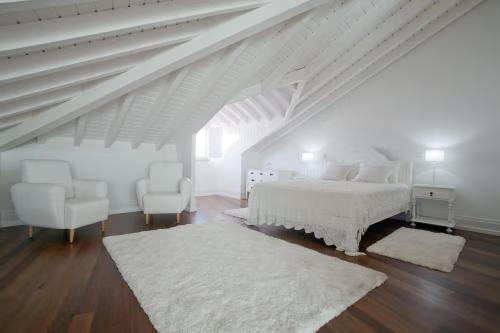 OpenReservations accepted
Mercearia da Vila



Services in Ponte de Lima
What you can find in town before the next stage.
- ATM
- Café
- Shop
- Medical clinic
- Pharmacy
- Fountain
- Post office
- Train station
- Bus station
- Restaurant
Source: © OpenStreetMap contributors · updated January 2026