

Stage town on the Camino
Belorado
Burgos, Castilla y León, Spain
- places to stay
- 13
- Camino
- 1
- Elevation
- 771 m
Belorado is the first small Castilian town beyond La Rioja, 233.7 kilometres from Saint-Jean: a market town with a fuero from 1116, hermits' caves in the rock beneath the castle, and bronze plaques with handprints as a sign of welcome. The parish albergue beside Santa María takes you in on a donation basis. An afternoon is enough.
Right now in Belorado (as of October 2026)
- Church opening: Santa María is part of the region's "Apertura de Monumentos" programme, which ran from 14 June to 18 October in 2026. Outside that period the church is usually open only for Mass.
- Parish albergue: open from 1 April to 31 October. In winter you are left with the municipal albergue and the private ones that stay open all year.
How long to stay?
An afternoon is enough. The square, Santa María, the view of the caves beneath the castle and a stretch of the way over the bronze plaques: you can manage all of that in two hours after arriving. Belorado is a working small town, not a museum piece. If you arrive on a Monday, you will see the weekly market, which the town has held for almost 900 years.
Belorado in Ninja numbers
- 233.7 kilometres lie behind you since Saint-Jean-Pied-de-Port, and you have 542.4 still to go to Santiago on the Camino Francés.
- 22.2 kilometres is the distance from Santo Domingo de la Calzada to here, with 348 metres of ascent. Beyond Grañón you left La Rioja and entered Castile.
- 1116 is the year King Alfonso I of Aragon gave Belorado its town charter with a market. Monday is still market day.
- 1,158 metres is the height you reach tomorrow in the Montes de Oca, 15 kilometres beyond Belorado. Tonight you sleep at 771 metres.
Arriving: beneath the castle
From Villamayor del Río you come into town on an almost flat last hour. The way leads through the centre to the Plaza de Armas, with its arcades and pavilion, where there is a digital pilgrim information point. Above the town you see the rock with the castle remains, beneath it caves in the stone, and in front the church of Santa María. The parish albergue stands right next to this church, in the El Corro quarter.
In brief: border, market and fuero
Belorado lay on the old border between Navarre and Castile, and the castle on the rock guarded the pass. The place is first mentioned in 945. In 1116 Alfonso I of Aragon, known as el Batallador, gave it a town charter with a market; the town sees in this the oldest documented fair in Spain. In the Middle Ages Belorado had eight churches and two pilgrim hospices. Of one of them the Ermita de Nuestra Señora de Belén remains. After the 14th century it went downhill, and the expulsion of the Jews hit the town hard. In 2024 Belorado then made national headlines: the Poor Clares of the Santa Clara convent broke away from the Church. In March 2026 the last seven former nuns left the convent after an eviction ruling, and in June 2026 the Supreme Court confirmed the ruling for good.
A Welcome in Bronze: what to see
Everything lies on the way or a few minutes from it.
- Iglesia de Santa María: It was originally the castle chapel and took on its present look in a rebuilding in the 16th century, in Renaissance style, with three naves and a star-ribbed vault. Of the first building only the Romanesque figure of Santa María on the high altar remains. Important for you: several paintings show the apostle, as a pilgrim and as a Moor-slayer. The church stands right next to the parish albergue. In 2026 it was open from 14 June to 18 October within the region's programme; we could not reliably find the exact hours, and the parish volunteers do the locking up.
- The caves beneath the castle: In the rock faces beneath the castle remains lie early Christian hermit caves. According to tradition San Caprasio, Santa Pía and San Valentín lived here. Of the castle itself mostly foundations remain.
- Paseo del Ánimo: Along the way through town lie bronze plaques with hand and foot prints, according to the town a symbol of welcome. You will find names such as Miguel Induráin, Alberto Contador and Martin Sheen, the lead actor of the pilgrim film "The Way".
- Iglesia de San Pedro: The church on the square has an 18th-century altar and, in the Capilla de la Adoración, relics of the martyrs of Cardeña.
- Ermita de Nuestra Señora de Belén: On the edge of town, the only remnant of an old pilgrim hospital. Inside are an altar from 1620 and a late Romanesque crucifix from around 1200. We did not find opening hours.
Food and drink
Belorado has bars, restaurants, a supermarket, a bakery and a butcher's. Several private albergues cook in the evening for their guests; pilgrims quoted around €14 for a three-course meal in 2023 and 2024 (as of 2024). Buy today what you need tomorrow: beyond Belorado the villages get small.
Honestly
- No beauty at first sight. Belorado is a working small town with a through road. The charm lies in the square and beneath the castle, not in the approach.
- Little is left of the castle. Foundations, wall remains, caves. If you expect a fortress, you will be disappointed.
- Santa María is usually closed outside summer. In 2026 the opening programme ran only from mid-June to mid-October.
- The albergues are big. The largest private one has almost 100 beds. If you want quiet, go to the small parish albergue while it is open.
Where pilgrims sleep
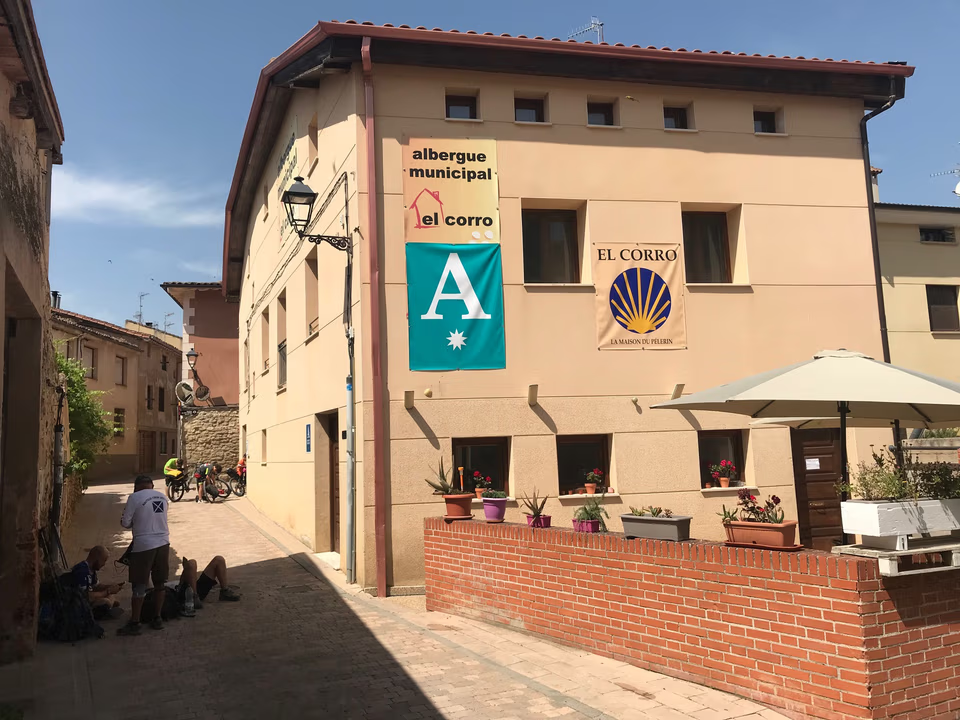
The Albergue Parroquial de Peregrinos next to Santa María belongs to the parish of Santa María y San Pedro. Volunteers from the Swiss Association of the Friends of the Camino run it. It has 20 places in three rooms, a donation with a recommendation of at least €10, breakfast included, a kitchen, no reservations, credencial only, check-in from 13:00, open from 1 April to 31 October (as of 2026). Open all year is the municipal Albergue municipal El Corro in the same quarter; the town was looking for a new operator in 2025, and we could not reliably find the current price. In addition there are several private albergues at €10 to €22 for a dorm bed, from small to very large, most of them open only from spring to October.
Ninja tips
- Withdraw cash here. Pilgrims warn that the next cash machine comes only in Burgos. In Atapuerca there is none.
- Monday is market day. The weekly market goes back to the town charter of 1116.
- Plan your first coffee. In November pilgrims found no open bar for a long time beyond Belorado; in summer Tosantos has a bar.
- Snacks at the petrol station. At the edge of town there is a Repsol petrol station with takeaway coffee, snacks and toilets, but no fresh food.
- Post before noon. Correos is open Monday to Friday from 10:00 to 13:30, not on Saturdays.
Practical tips for pilgrims
- Stamp: in the albergues.
- Shopping: supermarket, bakery, butcher's, pharmacy and bank in town.
- Post: Correos Monday to Friday 10:00–13:30.
- Festivals: San Vitores on 26 August, the Fiestas de Gracias in early September, Virgen de Belén on 25 January.
Onward: into the Montes de Oca
Beyond Belorado you walk through Tosantos (km 238.6) and Villambistia to Villafranca Montes de Oca (km 245.6). It is 11.9 kilometres to there, gently rising. Then the climb into the Montes de Oca begins: 3.1 kilometres beyond Villafranca you reach the highest point of the stage at 1,158 metres, and after that it goes long and lonely through forest to San Juan de Ortega (km 257.5). From Belorado that is 23.8 kilometres with 482 metres of ascent. If you walk on, you reach Atapuerca after 30.0 kilometres.
What awaits you tomorrow
The Montes de Oca, feared in the Middle Ages for wolves and robbers, and at the end of the forest the monastery of San Juan de Ortega, founded by a disciple of Santo Domingo who devoted his life to building roads and bridges for pilgrims.
Deep dive: The Town on the Rock
A short read, in case you want to learn more about Belorado. About three minutes' reading.
A Pass Between Two Slopes
Belorado lies at a natural bottleneck between two slopes, where the way leads up from the valley of the Ebro onto the high plateau of Castile. Even before the Romans people lived here, on a hill called La Muela, at least since the fourth century before Christ. In the Middle Ages a castle stood on the rock above today's town, guarding the pass between Pamplona and Castile. Belorado was border country, and border country was valuable.
The King's Market
In 1116 Alfonso the First of Aragon, whom people called the Battler, gave the place a town charter. It allowed a market and a fair and gave the citizens the right to govern themselves. The town sees in this the oldest documented fair in all of Spain. The weekly market on Monday goes back to this time, and it still takes place today. Belorado grew, had eight churches, two hospices for pilgrims and a Jewish quarter.
Hermits in the Rock
Beneath the castle lie caves in the stone. Tradition says that early Christian hermits lived there, among them San Caprasio, Santa Pía and San Valentín. Whether each of these names belongs to a particular cave, nobody knows for sure. But the thought that people sought seclusion here, in a place where merchants and pilgrims passed by, belongs to Belorado as much as the market does.
Decline and Present
After the fourteenth century the town lost importance. After the death of Peter the First the new ruling family punished the town, and the expulsion of the Jews under the Catholic Monarchs took away part of its merchants. Later it belonged to the Constables of Castile. Today around two thousand people live here. When this text was written, in autumn 2026, Belorado had just come through one of the strangest church conflicts in Spain: the Poor Clares of the Santa Clara convent had broken away from Rome in 2024, were sentenced by a court to leave, and left the convent in March 2026.
What Belorado Gives You
On your way through town you walk over bronze plaques with hands. The town laid them there as a sign that someone is being received here. In the small albergue next to Santa María you are received by volunteers from Switzerland who once arrived here themselves. Belorado is not a place you remember because it is beautiful. You remember it because you were taken in here.
Where to stay in Belorado
The places pilgrims rate highest in Belorado come first.
- Top #1
 OpenReservations accepted
Hostel.B
- Top #2
 OpenReservations accepted
Albergue municipal El Corro
- Top #3
 ClosedReservations accepted
Albergue Cuatro Cantones


Services in Belorado
What you can find in town before the next stage.
- ATM
- Café
- Shop
- Tobacco
- Medical clinic
- Pharmacy
- Fountain
- Post office
- Train station
- Bus station
- Restaurant
Source: © OpenStreetMap contributors · updated November 2025
Town 15 of 49